


Suske en Wiske - 'De Sprietatoom' (cover).
Willy Vandersteen is the most famous, influential and productive Flemish comic artist of all time. Appearing since 1945, his signature work, 'Suske en Wiske' ('Spike and Suzy' in English, 'Willy and Wanda' in American English), is the longest-running Flemish comic series still in production. The folksy adventures of the kids Suske and Wiske, their aunt Sidonia, comic relief Lambik and strongman Jerom have entertained generations of readers, and the series has become the best-selling Dutch-language comic in Belgium and the Netherlands. Vandersteen is widely praised as an unsurpassed and versatile storyteller, equally gifted in both comedy and drama. His stories are filled with weird gags, colorful characters, playful language, nail-biting cliffhangers and moving morals. Vandersteen's genre-busting work brought his characters to many different locations and time periods. Besides his main series, the legendary cartoonist created many other original series, including 'De Familie Snoek' (1945-1954, 1965-1972), 'De Vrolijke Bengels' (1946-1952), 't Prinske' (1953-1959), 'Jerom' (1960-1991) and 'De Geuzen' (1985-1990). Together with his many co-workers, he took pre-existing characters from literature, folklore and local history for comic book series like 'Tijl Uilenspiegel' (1951-1953), 'De Rode Ridder' ("The Red Knight", 1959- ), 'Karl May' (1962-1977), 'Biggles' (1965-1970), 'Robert en Bertrand' (1972-1992) and 'De Geuzen' (1985-1990). In some cases, he created copyright-free substitutes, like the western series 'Bessy' (1952-1992), which was a knock-off of 'Lassie'. To maintain his impressive production and fully exploit the commercial possibilities of his comic creations, he founded his own studio, Studio Vandersteen, which became one of the most lucrative comic production houses in the Benelux. Some of Vandersteen's series have been translated all across the globe, with 'Suske en Wiske', 'De Rode Ridder', 'Bessy' and 'Jerom' being his most popular (the latter two especially in Germany). No Belgian comic artist other than Hergé has been the subject of such a fanatic following, with fanclubs, fanzines and special events organized for his creations to this day. Even though 'Suske en Wiske' and 'De Rode Ridder' are the only ongoing Vandersteen series in the 21st century, original artwork by Vandersteen and mint copies of first printing albums remain collector's items.
Early years
Willebrord Jan Frans Maria Vandersteen was born in 1913 in one of the poorer areas of Antwerp, the Seefhoek. His father was a sculptor and ornament maker. From a young age, Vandersteen was blessed with an inexhaustible imagination and a gift for drawing and storytelling. He was captivated by the jokes, tall tales and folk legends that were told in bars. Everything in his city of birth made him dream away, from the medieval buildings to the zoo and the harbor. As a youngster, he watched plays, read adventure novels and scribbled stories on the sidewalk with crayon. Yet teachers told him he would "never make a living with writing and drawing alone." Instead, Vandersteen was predestined to follow in his father's footsteps, attending evening courses in ornament making at the Antwerp Academy of Fine Arts. However, it was a dying profession. Through his uncle, he got a job as a window designer at the Innovation department store in Antwerp, where his career took a different direction.
One day, Vandersteen was paging through a U.S. fashion magazine, and noticed a fascinating article with the title 'Comics In Your Life', dealing with the cultural impact of newspaper comics. Vandersteen had read comics as a child, particularly in the magazine De Kindervriend, where one of his favorite characters was 'Blutske', from a translated comic by an unknown foreign author. As a teen, he had read Hergé's 'Totor' (1926-1929) in the scouts' magazine Le Boy Scout Belge, which inspired him to create gag cartoons and comics in his own scouting magazine, but he had never done anything with it since. The 'Comics In Your Life' article introduced him to many U.S. comics he wasn't familiar with. Vandersteen was especially intrigued that certain cartoonists were so popular and well-paid, and decided to become one himself. A bold move, since in the early 1930s, Belgian comics were still in their infancy, with only Hergé having some success. Only a couple of local comic artists existed and most made illustrated stories for children's magazines. For his training, Vandersteen learned from studying other artists. Besides Hergé, he considered Walt Disney, Floyd Gottfredson, Eugeen Hermans (Pink), George Herriman, Otto Soglow, Bud Fisher, E.C. Segar, Milton Caniff, Alex Raymond and Hal Foster as important graphic influences. In the field of high art, he looked up to the Flemish masters Pieter Bruegel and Peter Paul Rubens, as well as the Dutch painter Hieronymus Bosch. Later in his career, he also expressed admiration for H.G. Kresse, Bob de Moor, Marc Sleen, Anton Pieck and - to the surprise of many - the cartoonist Kamagurka.

Early wartime strip of 'Kitty Inno'. Kitty dislikes how she looks with a gas mask, until she uses it as a hat.
Early comics
Vandersteen's earliest comic, 'Pinneken en Dik' (1939), never saw publication, so he was off to a bad start. World War II changed his opportunities. As the Nazi oppressor banned all import of U.S. and British comics in occupied Belgium, there was suddenly a higher demand for locally produced material. Willy Vandersteen made his professional debut with the comic feature 'Kitty Inno' (1940-1942) in Entre Nous, the monthly staff magazine of the Innovation stores. This gag comic about a young woman mostly told jokes related to the store and war-time reality of buying products with food stamps. When Vandersteen left his job at Innovation in 1942, 'Kitty Inno' was continued by other, anonymous, artists until 1945. On 19 March 1941, his first newspaper comic appeared in De Dag, 'Tor, De Holbewoner' (1941-1942). It also ran in French as 'Herculin' in the Brussels weekly Mon Copain. Between 11 June and 3 September 1941, these pantomime gags about a bearded caveman were temporarily moved to De Dag's children's supplement Wonderland, before being interrupted for a month. De Dag then brought back the series on 8 October until the final episode appeared on 28 January 1942. When asked to replace Wonderland's run of the American comic 'Cicero's Cat' by Bud Fisher (under the title 'Barabas', Vandersteen created 'De Lollige Avonturen van Pudifar' (26 March-21 May 1941). A couple of weeks later, Vandersteen also created a spin-off about Pudifar's son, 'Barabitje'. During this period he signed all his comics with "Wil".

'Pudifar'. Translation: "Go away, pussy. You interrupt my singing lesson." - "Hello! Police! A cruel animal executioner tortures a cat!"
When in 1942 Vandersteen had left L'Innovation, he found a job at another store, De Corporatie, doing paper work about meat distribution and creating illustrations for the butcher's magazine Het Slagersblad. He also made posters and leaflets for Winterhulp, an organization providing food for the needy. A year later, the publishing company of the newspaper Ons Volk asked Vandersteen to create a children's comic book. The only condition was that he had only one week to finish it. His day job boss gave him a week off and Vandersteen managed to complete his first full humorous adventure comic book, 'De Avonturen van Piwo, Het Houten Paard' (1943) before the deadline. The story about a wooden horse that comes to life received two sequels: 'Piwo en De Paardendieven' (1944) and 'Piwo Bij De Zoeloes' (1946).
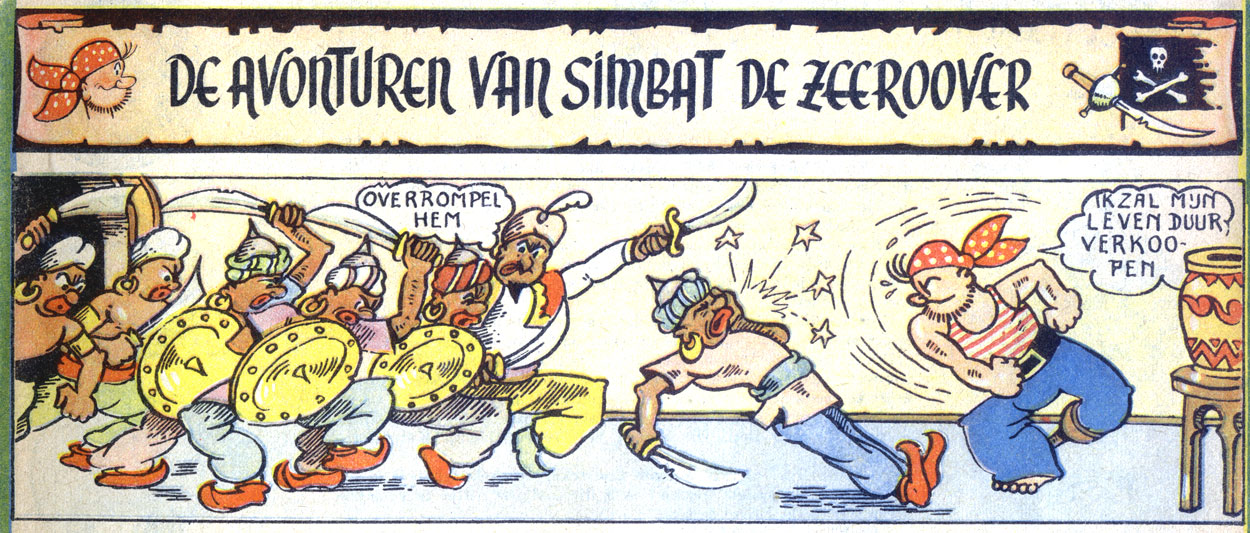
'De Avonturen van Simbat de Zeerover'.
Bravo! magazine
In May 1943, Vandersteen joined the bilingual comic magazine Bravo!, where his fellow artists E.P. Jacobs and Jean Dratz gave him a lot of professional advice. For this magazine, he created 'Tori De Holbewoner' (1943-1944), basically a younger version of his earlier caveman creation Tor. A month later, Bravo! ran his humorous pirate comic, 'Simbat de Zeerover' (1943-1944), of which the protagonist can be seen as a prototypical version of his future comic hero Lambik. Vandersteen's final comic strip for Bravo!, 'Lancelot' (November 1945 - 26 September 1946), was a gag comic about a knight and his dachshund Sando.
Collaborations with Bert Peleman
On 3 February 1944, Vandersteen turned up in the first issue of the children's magazine De Rakker. He illustrated a couple of covers and columns, including those by the poet Bert Peleman. Peleman then scripted Vandersteen's text comic 'Bert, De Lustige Trekker' (1944), about a joyful boy scout, whose adventures ran until the magazine's final issue on 28 August of that same year. Vandersteen and Peleman collaborated again in De Illustratie, a weekly sister magazine of the Nazi publication Volk en Staat, for which they created the text comic 'Peerke Sorgloos' (18 February 1944). The droll jokes of this befuddled old gentleman were signed by Vandersteen as "Wil" or "Pim", while Peleman wrote the rhyming sentences that appeared underneath each image. The series continued until September 1944, when Belgium was liberated by the Allied Forces.
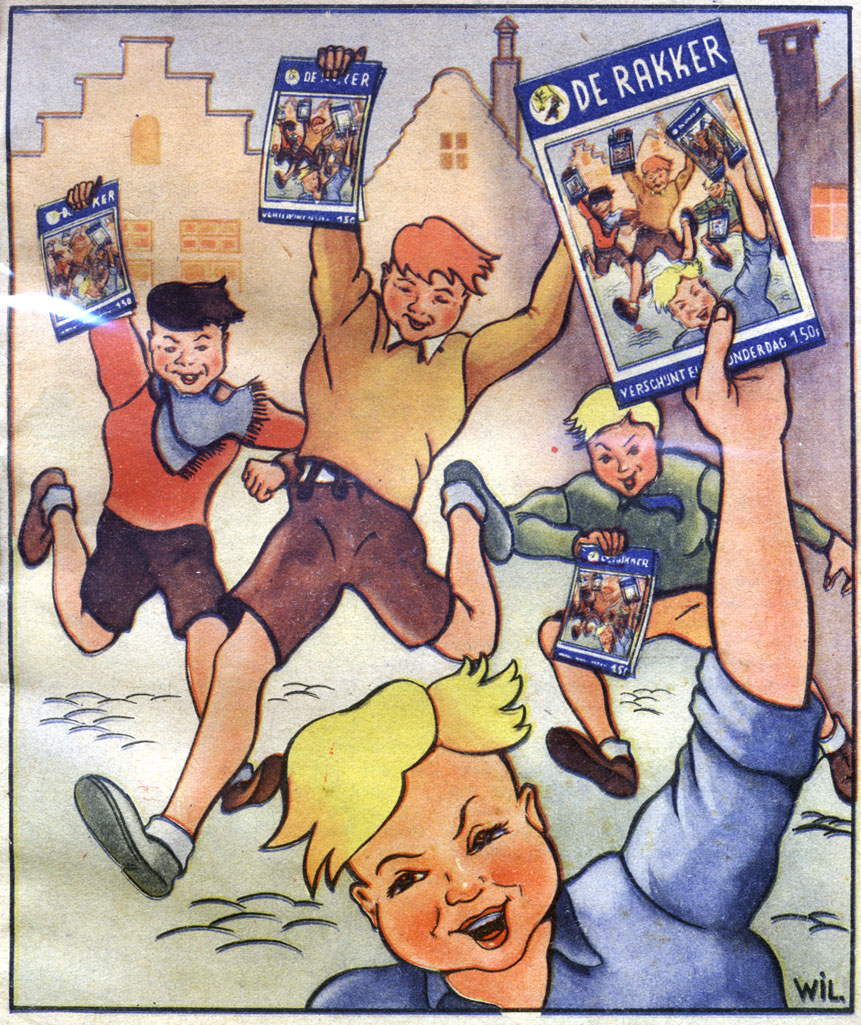
Cover illustration for De Rakker (3 February 1944).
Nazi collaboration
In 1942, Willy Vandersteen secretly drew some antisemitic and pro-Nazi cartoons for a booklet written by Bert Peleman, 'Zóó Zag Brussel De Dietsche Militanten' ("How Brussels Saw The Dietsch Militants", 1942). In the Nazi magazine Volk en Staat, Vandersteen also created cartoons under the title 'Bart de Brigademan'. Both men used pseudonyms for these works. Peleman wrote under "Ulenspiegel", while Vandersteen called himself "Kaproen" (though, judging differences in artwork, he may have alternated with the magazine's house cartoonist Edgard Vanmechelen, who usually signed with "Gard"). Other cartoonists who have worked for Volk en Staat have been Buth, C. Dick, Paul Jamin and Armand Panis. After the war, Peleman was arrested and convicted for Nazi collaboration, but Vandersteen managed to keep his old shame a lifelong secret. Nevertheless, some journalists had a hunch that Vandersteen might have been Kaproen. Biographer Peter van Hoeydonck once asked Vanderteen directly, but the artist denied it. Rumors kept dogging the estate even after Vandersteen's 1990 death. In 2010, the Vandersteen family let archivists from the GeheugenCollectief agency research the matter. A document was found which confirmed the rumors. The news made headlines, but was nevertheless only a minor controversy, since Vandersteen had also created some anti-Nazi stories during World War II, such as the illustrated story about 'Dappere Jan' (1943) for a special issue of Bravo! magazine, although this was not made available for the general public, but released specifically as a birthday gift for publisher Jan Meuwisen. Still, he openly signed it under his more revealing pseudonym "Wil".
It remains a mystery why Vandersteen made pro-Nazi cartoons. His children said it went against everything their father had taught them. Vandersteen's successor Paul Geerts suspected that he was probably in desperate need of income. He recalled that Vandersteen once told him about the war years and especially how "horrible it was to hear your children cry from hunger." The secret was probably a heavy burden on Vandersteen's conscience. Some post-war 'Suske en Wiske' stories frequently mention forgiveness in the context of war collaborators. Many of his comics in general have a running theme of people who did something wrong seeking forgiveness. Pacifism is also a recurring subject, with some albums describing war as "a conflict where both parties lose." Nobody ever suspected anything dubious about these themes, as they all fit well within Vandersteen's idealistic convictions and the Catholic idea of redemption and forgiveness. But in hindsight they may be interpreted as a personal cry for help. Last but not least: many Vandersteen stories revolve around people with hidden identities. For people interested in the mystery about Vandersteen's war past, Aline Sax and Veronique Van Humskerke's report, 'Onderzoeksrapport: De Oorlogsjaren van Willy Vandersteen' (2013-2014) in collaboration with Geheugen Collectief vzw, Berchem, is a thorough and insightful examination of the matter.

'Bert, De Lustige Trekker'.
French-language comics
After the Liberation of Belgium, many magazines and newspapers were terminated or temporarily put on hold. Only Bravo! kept appearing. Most of Vandersteen's comics now appeared in French-language magazines. For the children's magazine Franc Jeu he drew 'Floche et Flache Tiennent Le Maquis' (23 Oct. 1944 - 3 March 1945) and 'Bill et Sam Aux Philippines' (17 March - 4 August 1945), using the pseudonym "Mik". Both were humorous war stories in which two Allied soldiers fight against, respectively, German soldiers in Europe and Japanese soldiers in the Philippines. The magazine also featured a text comic adaptation by Frank Saxter of Edgar Allan Poe's 'The Narrative of Arthur Gordon Pym of Nantucket' ('Les Aventures d'Arthur Gordon Pym', 1944-1945). The first 15 episodes were illustrated by Léon Noël and the final five by Vandersteen. Between 31 March and 4 August 1945, Franc Jeu featured Vandersteen's humorous detective series 'Une Enquête de l'Inspecteur Briket' (1945) and between 5 May and 4 August 1945 another detective feature, 'Le Secret du Meurtrier' (1945), signed with Valentin. Although Valentin's style is very reminiscent of Vandersteen, Rolf De Ryck argues in his book 'Van Kitty Inno tot De Geuzen' (1994) that this comic was certainly not created by Vandersteen.
Appearing under the pseudonym Bobs, Vandersteen's humorous western comic 'Les Aventures de Bill Bing et Panzo' (1944-1945) ran in the first four issues of the architectural magazine Perce Neige, before being abruptly discontinued. The pantomime comic 'Les Péripéties de Peggy le Petit Scotch' (1944-1945) lasted longer. The Scotch terrier Peggy kept toddling from December 1944 until June 1945. For Le Petit Monde, Vandersteen drew the one-shot pantomime comics 'Un Mot Qui Fait Balle' (1946), 'Après La Kermesse' (1946), 'Le Fantôme du Chateau' (1946), 'Le Temps' (1946), 'Un Mot Qui Fait Balle' (1946), 'Par Ici La Sortie' (1946), 'Coeur Tendre' (1946), 'Un Ami Devoué' (1946), 'En L'An 500' (1946), 'Le Bon Plaisir du Roy' (1946), 'Incrédule' (1946), 'Drôle de Cabane' (1946), 'Le Truc' (1946), 'La Nuit de Noël de Bill Fink' (1946) and 'La Nuit de Nouvel An' (1946). Among the regular columns he illustrated were 'Images Sans Dessins' (14 March - 30 May 1946) and 'La Lanterne Magique' (1946), the latter scripted by Maurice Carême. Vandersteen also created the first long story of the humorous adventure comic about the young couple 'Poppy et Maggy' (3 October 1946 -11 March 1947), two further episodes were made by other creators.

Introduction of 'Lancelot', with cameo appearance of the artist (Bravo! #21, 1945).
Suske en Wiske
On 30 March 1945, Vandersteen launched his breakthrough newspaper comic 'Suske en Wiske' in De Nieuwe Standaard. After daily serialization in the newspaper, the stories were printed in popular book collections by Standaard Uitgeverij. The first story introduced three main characters of the future series: the little egg-headed girl Wiske, her rag doll Schalulleke and aunt Sidonie. In Vandersteen's draft, Wiske already had a boy companion named Suske (named after Vandersteen's father Sus), but in this original story, he was her older brother. Without consulting Vandersteen, the editor had changed his name into "Rikki". As such, the first story is titled 'Rikki en Wiske in Chocowakije'. The author got his way on 15 December, when the next story 'Op Het Eiland Amoras' took off. In the first panel, he wrote Rikki out the series, because the character looked too much like Hergé's Tintin anyway. Wiske and Sidonie travel to the island of Amoras, where Wiske meets a local boy of her age, named Suske. They instantly become inseparable friends. Readers unfamiliar with this backstory often assume the duo are siblings, which makes scenes in which Wiske is jealous whenever Suske gets female attention rather awkward to the uninitiated. Suske is a flat character with no real flaws. Wiske, on the other hand, is vain, stubborn, jealous, short-tempered and too curious for her own good. In earlier stories, Suske and Wiske were much younger, walking on toddler legs. But as the series progressed, they became young teenagers, making Wiske's love for her doll Schalulleke a bit strange. Nevertheless, despite her flaws, Wiske has a good heart, making her far more relatable to readers than Suske. As the series' first breakout character, she received the honor of closing off every story with a wink to the readers.
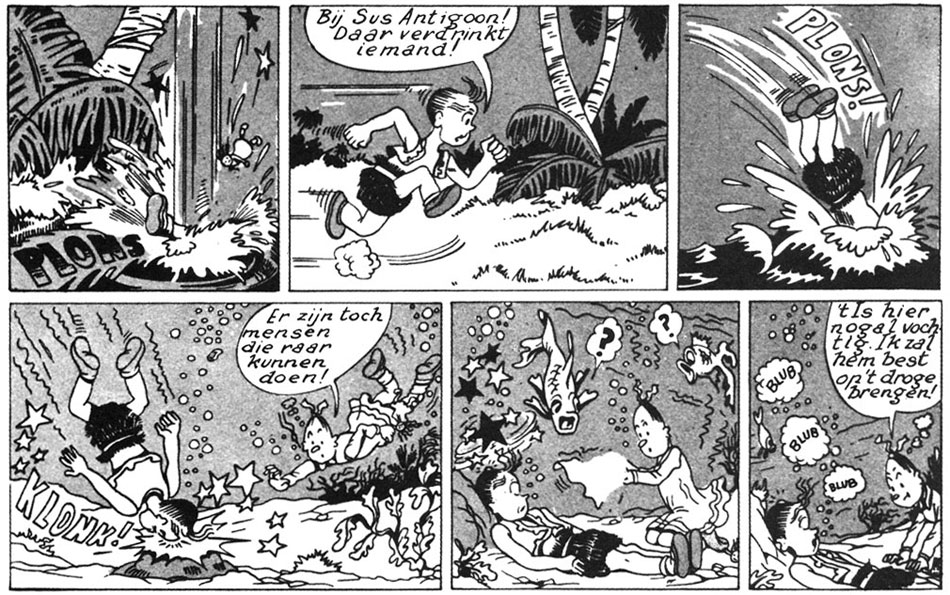
First encounter between Suske and Wiske in 'Op het Eiland Amoras' (1945-1946).
Tante Sidonie/Sidonia
Tante Sidonie is Suske and Wiske's adoptive aunt. At the time, there was an unwritten rule that comic characters could not have children of their own, as this would imply sexual intercourse. But Vandersteen merely felt that real parents would never allow their offspring to go on dangerous adventures, so an aunt made "more sense". The 'Suske en Wiske' series is unique for a children's comic, as the kids are never seen at school. Their school life is not even hinted at. Although a surrogate parent, Sidonie cares a lot about Suske and Wiske, providing the series with a strong family dynamic. In an additional rule for early comics, adult female comic characters weren't allowed to be attractive. So Sidonie is presented as an ugly flat-chested spinster, with a big nose, chin and feet. Her thin, flexible body was inspired by E.C. Segar's Olive Oyl. Many gags poke fun at the odd ways she can bend her body, her nervous breakdowns, her constant search for a man and temper tantrums. But much like Wiske, she is, considering the times, a remarkably strong, inventive and intelligent female character.
Professor Barabas
In addition to Suske, the episode 'Op Het Eiland Amoras' also introduced the absent-minded professor Barabas. He was originally an obese stutterer, but he soon lost those traits. Barabas' inventions often set the plot in motion. In 'Op Het Eiland Amoras', his supersonic helicopter, the Gyronef, is introduced, while in 'De Sprietatoom' (1946), he constructs an anthropomorphic car named Vitamitje. His most famous invention, a time machine, was introduced in 'De Tuf-Tuf Club' (1952), allowing many adventures set in historical eras. These three Barabas inventions returned in many subsequent stories.

'Suske en Wiske' - 'Prinses Zagemeel' (colored reprint version, 1947), featuring the origin of the logo used by Amsterdam comics store Lambiek.
Lambik
The 'Suske & Wiske' story 'De Sprietatoom' (1946) also marked the debut of Lambik, who instantly became the series' most popular character. Named after Vandersteen's favorite beer brand Gueuze Lambic, he provides most of the comic relief. Lambik is a clumsy, vain and short-tempered fool. The so-called "plumber-detective" constantly overestimates his own abilities. Many of his blunders have become classic, such as pinning a note to excuse his absence "because I'm not here", or giving villains his weapon, so he can strip search them for guns. Overall, Lambik is the archetype of the Belgian soul: a simple-minded bon vivant who enjoys a nice, cool beer. Precisely for this reason, many readers identify with him.
Lambik became so popular that he inspired two spin-offs. Between 1948 and 1951, a series of irregularly appearing gags named 'De Lotgevallen van Mijnheer Lambik' were published in the magazines Kuifje, Ons Volk and Ons Volkske. Officially titled 'De Avonturen van Suske, Wiske en Lambik', it is nowadays more commonly known as 'De Grappen van Lambik', the title under which it appeared in book format. The feature also ran in French as 'Les Farces de Monsieur Lambique'. Between 24 January 1954 and 1963, it was a regular series, published in the weekly De Bond. In this gag comic, Lambik had the stupid bespectacled assistant Sezar as a sidekick. In later years, Vandersteen passed on the entire gag series to his assistant Karel Boumans. Between 2005 and 2006, new episodes of 'De Grappen van Lambik' were created by, successively, Marc Verhaegen and Luc Morjaeu.

Jerom, running faster than sound, in 'De Tamtamkloppers' (1953).
Jerom
In the Suske en Wiske episode 'De Dolle Musketiers' (1952), the super strong but monosyllabic caveman Jerom made his debut. At the suggestion of Vandersteen's co-worker Karel Verschuere, his appearance was modeled after the title character in V.T. Hamlin's comic 'Alley Oop'. In the original story, Jerom was a brute, short-sized villain who walked around bare-chested. Some newspaper readers felt repulsed, with one even writing that "my breakfast loses all taste when I see him." Halfway through the plot, Jerom converts to "the good side" and moves in with Lambik to become another main cast member. Over the course of the series, Jerom slowly but surely civilized. He changed his bearskin for a modern suit, but always kept talking in a dry, witty telegram style. Jerom's most proverbial character trait is his phenomenal strength. He is capable of running faster than sound, can generate electricity, jump to extraordinary heights and punch people out with some delay, so that they only collapse a few seconds later. Vandersteen and his assistants had a lot of fun introducing new physically impossible superpowers in each album, if only as a set-up for funny gags. Just like Superman, Jerom eventually became a deus ex machina. Some fans mark his capability of solving every possible problem as the first decline in the series' quality. To keep the stories a bit more interesting, Jerom is sometimes sent on holiday or temporarily put to sleep.
Jerom became so popular that on 18 August 1960, he received his own spin-off series in the magazine Ons Volkske. Originally, 'Jerom' was a humorous adventure series in the same tradition as the parent series. These episodes had Tante Sidonia and Professor Barabas as secondary characters, but did not feature Suske, Wiske or Lambik. In 1967, the 'Jerom' comic was moved to Pats, the juvenile supplement of newspaper De Standaard. A year later, it appeared in Het Belang van Limburg too. Rebooted as 'Jerom, De Gouden Stuntman', Jerom became a superhero in yellow costume with cape. Much like Batman, he received a boy sidekick named Odilon. Many stories were written by Marck Meul and Jacques Bakker, while Eduard De Rop drew most of the episodes, often aided by Diane Asselberg (inking), Eugeen Goossens, Paul Geerts, Peter Koeken and Merho.
The 'Jerom' comic was extraordinarily popular in Germany, where it first ran under the name 'Wastl' (1965-1968) in the magazine Felix by Bastei Verlag. Starting in 1968, new stories were published directly in a Wastl comic book, first appearing every two weeks and eventually on a weekly basis. Between February 1972 and June 1973, an additional 'Wastl' series appeared in the magazine Klasse. The heavy production schedule was so demanding that the quality of the stories and artwork eventually began to decline. For that reason, several of the German 'Jerom' stories have never appeared in Dutch, and the deal with Bastei was eventually terminated in 1973. 'Jerom' was also translated into French ('Jérôme'), Greek and English ('Big Billy Bigg', which ran in Sparky). The Dutch version of 'Jerom' kept running for another decade. In 1982, it was retitled 'De Wonderbare Reizen van Jerom', but one paper after another canceled the series. The final album was published by Standaard Uitgeverij in 1991.
Other 'Suske en Wiske' characters
In the 'Suske en Wiske' story 'Het Rijmende Paard' (1962-1963), the cast received a nemesis, Krimson, an evil doctor running a large criminal network. His only weakness is that he suffers nervous breakdowns and needs to be fed pills by his butler Achiel to calm down. Some minor recurring characters are worth mentioning too, such as Sus Antigoon (1945) - the ghost of Suske's alcoholic forefather - and Lambik's jungle-based brother Arthur (1946), who has the ability to fly because he ate too much bird seed. Later episodes introduced the rich castle owner Anne-Marie van Zwollem and her mad father (1957), the annoying vacuum cleaner salesman Theofiel Boemerang (1957) with his catchphrase "Kleine percentjes maken rijke ventjes" ("Little percents make rich people") and Tobias the street dog (1961), who is adored by Wiske but hated by Lambik.

Clever wordplay in this episode of 'De Geverniste Zeerovers' (1957-1958): all words begin with the letter V!
Style
To build up an audience, Vandersteen modeled his comics after the U.S. newspaper format, where every episode was part of a daily serialized story. Each 'Suske en Wiske' episode - generally two strips a day - typically features one or two gags, to provide readers with their daily laugh. Vandersteen used many cartoony and silly situations, which set him apart from other Belgian comics that were more grounded in reality. Other comedy can be found in wordplay, such as pun-based names, funny accents, pseudo ancient Dutch, telegram- or rhyme talk. Long before Jef Nys, Vandersteen was the first Flemish comic artist to let Spaniards add the word "-os" at the end of each sentence. Later in his career, Vandersteen gave almost every 'Suske en Wiske' story an alliterative title, something that eventually became a joke in itself and a cult phenomenon among fans, as the gimmick was copied in the names of fanclubs, podcasts and events.
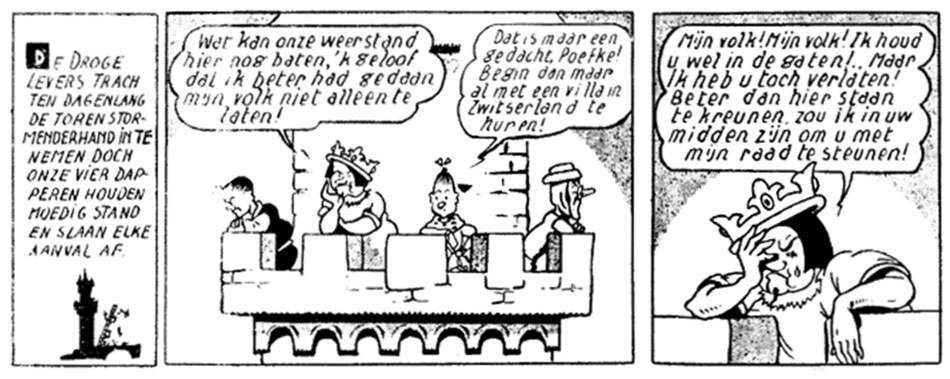
Political satire in the original publication of 'De Koning Drinkt' (1948), referring to the Royal Question. The king has fled and feels guilty for leaving his people behind. Wiske advises him to "hire a villa in Switzerland", in reference to Belgian King Leopold III who, after World War II, also lived in exile in Switzerland for a few years.
The 'Suske en Wiske' series also thrived on recognizability. The backgrounds, characters, dialect-driven dialogues and ironic sense of comedy are all unmistakably Flemish. Many characters are based on local folklore, such as Lange Wapper and Kludde in 'De Zwarte Madam' (1948) and the Buckrider demons in 'De Bokkenrijders' (1949). Other stories are set in national history, with the main cast meeting people like Gaul chieftain Ambiorix, the 16th-century rebels 'De Geuzen' and painter Pieter Bruegel. During the first seven years of the franchise, stories made references to current events and politics, like the bombing of the Yser Tower (1946) and the Royal Question (1945-1990) whether Belgian King Leopold III was allowed to return to the throne after the war. Since many of these jokes were quickly dated and sometimes controversial, Vandersteen eventually dropped them in favor of more timeless comedy. In general, readers responded enthusiastically to this regional atmosphere, especially since no comics before had found so much inspiration in Flemish culture. In fact, Vandersteen can be credited with familiarizing many historical and folkloric characters in both Flanders and the Netherlands. Setting many storylines in real-life cities, towns and countryside only added to the recognizability.

Professor Barabas' "Tele-time Machine" offers endless plot possibilities (From: 'De Dolle Musketiers').
One of Vandersteen's greatest strengths was his ability to tell captivating stories. He deliberately ended every episode on a strong cliffhanger. Recurring elements are secret doors, mysterious manuscripts and masked people refusing to reveal their identity. He often stretched readers' patience weeks on end, to hilarious degrees. In 'De Bokkenrijders' (1948), for instance, Sidonie reads a manuscript but the final page drops on the floor, so the revelation has to wait until the next episode. In other stories, the cliffhanger just turns out to be the set-up for a joke, like in 'De Mottenvanger', when Lambik hears about the end of the world and his wall crumbles. In the next episode, it turns out somebody merely drove his car into his house. Vandersteen tingled audience curiosity so often that people started reading their newspapers backwards, just so they could check the funnies first.
Contrary to most other comics, that are often restricted by their setting, 'Suske en Wiske' has tremendous versatility in plot. Vandersteen's imagination was constantly sparked by novels ('De Dolle Musketiers', 1952, 'De Straatridder', 1955), fairy tales ('Prinses Zagemeel', 1947, 'De Schone Slaper', 1965), myths, legends ('De Zwarte Madam', 1947, 'De Ringelingschat', 1951), paintings ('De Koning Drinkt', 1947, 'Het Rijmende Paard', 1962, 'De Dulle Griet', 1966), films ('De Speelgoedzaaier', 1954, 'Jeromba de Griek', 1965), TV series ('De Texasrakkers', 1959, 'Wattman', 1966) and travels ('De Gouden Cirkel', 1960, 'De Sissende Sampan', 1962). Thanks to professor Barabas' Gyronef and his time machine, Vandersteen had an easy device to send his characters to whatever country, fantasy world or historical era he wanted. It gave Vandersteen and his successors creative freedom and made the franchise more unpredictable, appealing to many different readers' tastes. Belgian comic creator André Franquin put it best by saying: "When you read Vandersteen, you're afraid of doing anything else afterwards. He has already invented and done everything."
Amidst all the fun and adventure, the author never lost sight of a tightly built plot with a dramatic story arc. As someone who grew up in a folksy neighborhood, Vandersteen knew what the average person enjoyed. His Catholic and boy scout backgrounds gave him a strong sense of virtues and values. Having experienced poverty and war misery firsthand, many stories show a tremendous compassion for the underprivileged and promote pacifism and forgiveness. His main cast members may have their flaws, but they always stick up for each other and do the right thing in the end. All these aspects built a strong emotional bond between 'Suske en Wiske' and its readers, making it the timeless classic it remains today. Vandersteen's son Bob once stated: "All the stories my father drew were adventures he wished he could experience himself."
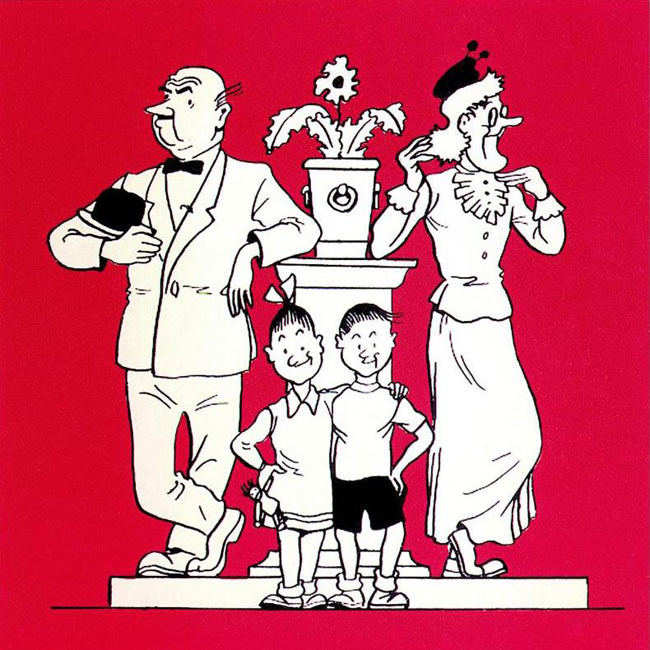
Back cover illustration from the early 'Suske en Wiske' albums.
Success and impact
A hit from the beginning, every magazine and newspaper wanted to publish 'Suske en Wiske'. The newspaper De Nieuwe Standaard ran 'Suske en Wiske' from 30 March 1945 until its name changed into De Nieuwe Gids in April 1947. A few months later, on 1 July 1947, the series moved to another paper, De Standaard and its sister paper Het Nieuwsblad. It became instantly clear that Vandersteen had absolutely made it, since 25,000 readers all took subscriptions to the new home papers of 'Suske en Wiske'. The success didn't stop there. Between 1948 and 1953, two comic serials starring Lambik ran in the Catholic magazines Kerkelijk Leven (nowadays Kerk en Leven) and De Bond, but were in fact 'Suske en Wiske' stories, later retitled as 'De Gekalibreerde Kwibus' and 'Het Vliegende Hart'. Between 1948 and 1959, an exclusive version of 'Suske en Wiske' also ran in the weekly Kuifje/Tintin. Between 1950 and 1951, six educational gag comics about personal hygiene starring Suske, Wiske and Lambik appeared in De Volksmacht, a weekly by the Christian Union ACW. Another propaganda comic was 'Wiske, Jong Kajotster' (1958-1959), which appeared in the monthly magazine Belofte by De Jong VKAJ, a juvenile Christian organization. Between 27 February and 15 June 1959, Vandersteen created a weekly comic strip for De Standaard starring the 'Suske en Wiske' characters as part of a contest to test readers' linguistic knowledge.
The "Vandersteen model", became the standard for Flemish comics for decades to come: serialized newspaper comics appearing on a basis of two strips a day. If a story is concluded, the next one kicks off a day later. Because of this publication schedule, four new book collections can be released every year. In Vandersteen's wake, every Flemish newspaper wanted to have its own serialized comic series with its own popular characters. Vandersteen paved the way for many of his colleagues, of which Marc Sleen ('Nero'), Pom ('Piet Pienter en Bert Bibber') and Jef Nys ('Jommeke') became the most successful. Starting in January 1947, concluded 'Suske en Wiske' serials became collectable as comic book albums with iconic red frames and the title printed in white. Between 1949 and 1959, the back cover showed the main cast posing around a potted flower. Afterwards, the image changed to just Suske and Wiske showing off the available titles, until in 1966 the familiar iconic image of Jerom lifting a tower of the rest of the cast was introduced. Around the same time, with book #67, the series began appearing in full color, a process that also included the colorization of the older episodes. But instead of reprinting these episodes with their original volume number (#1 through #66), they were implemented in the ongoing series amidst the new episodes, regardless of chronological order, all in all making the 'Suske en Wiske' series a confusing mess for collectors. Between 1981 and 1984 and again from 1993 to 1999, Standaard Uitgeverij, reprinted the original 1940s and 1950s version of the 'Suske en Wiske' stories in the series 'Suske en Wiske Klassiek'. A treasured memory for many generations were the annual seasonal book specials, generally released around Christmas and the summer holidays. They featured exclusive 'Suske en Wiske' stories that were not part of the regular album series. The books were filled with games, activity pages, reprints of older Vandersteen series and other comic series owned by Standaard Uitgeverij. The specials, first launched in 1973, tended to have different titles, but from 1986 until 2002 they were known as the 'Suske en Wiske Familiestripboek' series.
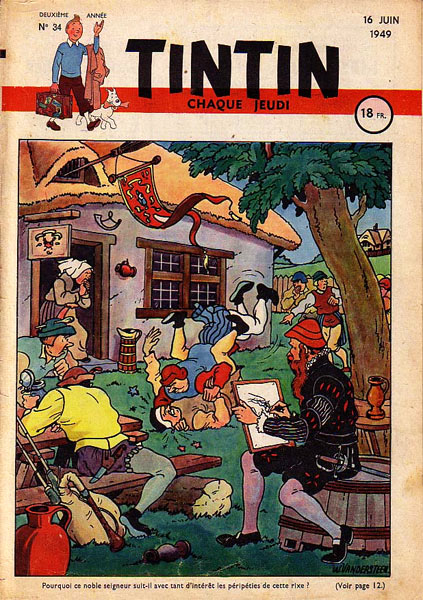
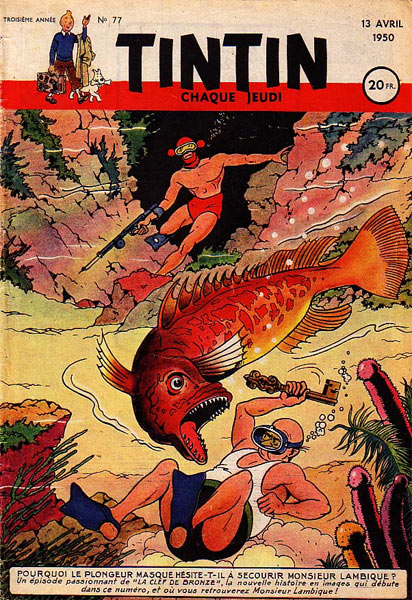
Covers for Tintin/Kuifje. The first cover (16 June 1949) depicts a scene from 'Het Spaanse Spook'. The other (13 April 1950) from 'De Bronzen Sleutel'.
Suske & Wiske in Tintin
At the start of his career, Vandersteen drew his comics spontaneously, without a consistent style or any realism. For instance, Wiske's hair is tied together in an odd way and all shoes have pointed noses, which would hurt horribly in real life. In 1948, Vandersteen's work underwent a notable graphic evolution when editor Karel Van Milleghem asked him to create exclusive 'Suske en Wiske' stories for him to boost up the sales of Kuifje, the Dutch-language edition of Tintin magazine, to boost up sales with Dutch and Flemish readers. Besides Kuifje, these new Vandersteen stories also appeared in the French-language Tintin too, as well as Ons Volkske, a children's magazine produced by the same publisher. 'Tintin' creator Hergé, also the art director of the magazine, only insisted that both the artwork and narratives had to be more realistic, in line with the style and reputation of his magazine. Kicking off in the 9 September 1948 issue with the classic 'Het Spaanse Spook', Vandersteen changed his artwork drastically. His pages were drawn with more attention to anatomy and technical detail. Suske, Wiske and Lambik are the only cast members of the original series to appear in these weekly episodes, and were all redesigned, most notably Wiske, who received blond curls. The cartoony gags were toned down and over-the-top fantasy elements disappeared. To allow storylines set in a historical era, the characters were often put under collective hypnosis, instead of traveling by time machine. Other stories just start off in a historical past without any explanation how the characters got there. Bob De Moor, Hergé's right hand man and Vandersteen's good friend, often helped Vandersteen out, since he was more skilled in realistic drawing.
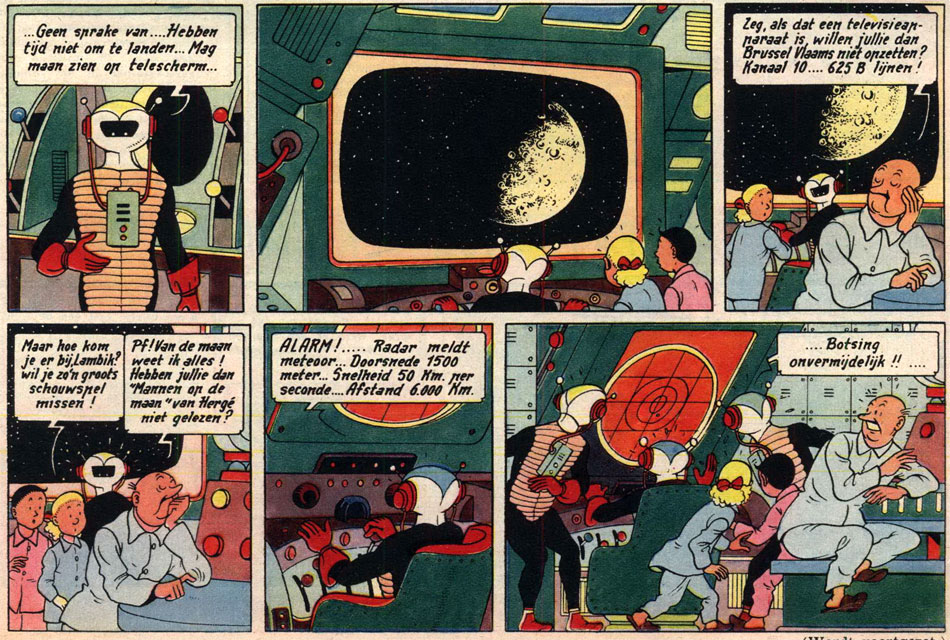
"Deleted scene" from 'De Gezanten van Mars', in which Lambik is uninterested in landing on the moon, because he read Hergé's 'Tintin' story 'Explorers on the Moon' (Kuifje #39, 29 September 1955).
All eight 'Suske en Wiske' stories produced for Tintin rank as highlights in the series. 'De Schat van Beersel' (1952-1953) is widely regarded as Vandersteen's magnum opus. A treasure hunt story set in the real-life castle of Beersel, it brings Suske, Wiske and Lambik to the Middle Ages. Like all other Tintin comics, the 'Suske en Wiske' stories were released by publisher Lombard in hard-cover book format. Because of their blue color, they are generally referred to as "De Blauwe Reeks" ("The Blue Series") to distinguish them from Standaard's red cover albums, which contained the newspaper comics publications. Decades later, the Blue Series stories were reprinted in the Red Series too, although often clumsily shortened to meet the limited amount of pages.
By doing more research and enriching his illustrations for the Tintin magazine stories, the newspaper episodes of 'Suske en Wiske' also improved. Vandersteen's narratives looked better than ever. In fact: in reader's polls held by Tintin magazine in the 1950s, 'Suske en Wiske' often ended in first place, way above 'Tintin' itself. Both Hergé and Edgar P. Jacobs are known to have felt threatened by this success, although Hergé did congratulate Vandersteen with his improved graphics and even nicknamed him "the Bruegel of comics". Nevertheless, Vandersteen left Tintin magazine in 1959, shortly after the departure of his editor Van Milleghem. An unfinished story, 'De Sonometer', only existed in six sketched out pages. In 2020, writer François Corteggiani and artist Dirk Stallaert completed the story.
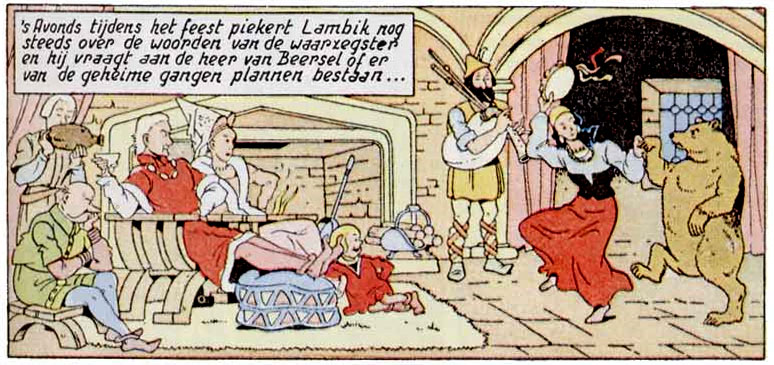
'De Schat van Beersel'.
Suske en Wiske: international
'Suske en Wiske' became extraordinarily popular in the Netherlands, basically the only Flemish comic strip to become a huge bestseller there. At first, the albums for Dutch readers ran as a separate series, which changed all Flemish expressions into standard Dutch and removed many of the Flemish cultural references. The characters Lambik, Sidonie, Jerom and Schalulleke were renamed to Lambiek, Sidonia, Jeroen and Schanulleke. In 1963, the Flemish and Dutch series were merged into the current standard Dutch version. At this occasion, Sidonia and Schanulleke became the official names of these characters. In 1946, the first Dutch magazine to publish 'Suske en Wiske' was De Stem, which circulated in Breda. The series then conquered a spot in many regional papers: Het Binnenhof, Utrechts Nieuwsblad, De Leidsche Courant, Rotterdamsch Nieuwsblad, Noordhollands Dagblad, De Gelderlander and De Goudsche Courant. Between 1955 and 1960, the comic ran in the Dutch weekly Revue and from 2005 until 2012, the TV guide TrosKompas also published new, original stories. In 1974, the story 'Het Spaanse Spook' was serialized in the comic magazine Sjors, while between 1986 and 1990, new stories were printed in Eppo/Wordt Vervolgd and its successor Sjors & Sjimmie Stripblad. In later years, 'Suske en Wiske' continued to run in the regional newspaper De Limburger and the national paper De Telegraaf.
'Suske en Wiske' was destined for translation. In Wallonia, it ran in French as 'Bob et Bobette' (not to be confused with Loÿs Pétillot's 'Bob et Bobette') in Le Petit Monde, Tintin and the Brussels newspaper La Cité. Some other languages also use variations of the the character names Bob and Bobette too, such as Italian ('Bob & Bobetta'), Greek ('Bobi & Lou'), Spanish (originally 'Tin & Titina', later 'Bob y Bobette') and Portuguese ('Bibi & Baba' in Portuguese, 'Zé and Maria' in Brazilian). In Norway, Denmark and Sweden, the series was translated as 'Finn & Fiffi', in Finland as 'Antti & Anu' and in Iceland as 'Siggi & Vigga'. Between 1958 and 1960, the series ran in the German magazine Felix as 'Ulla und Peter'. In English, the characters have been called 'Willy and Wanda' (USA), 'Spike and Suzy' (UK) and 'Luke and Lucy' (in a 2009 film and video game). 'Suske en Wiske' were also translated into Persian, Swahili, Chinese, Japanese, Tibetan, Tamil and Indonesian ('Bobby & Wanda').
Suske en Wiske: post-Vandersteen
Until 1972, 'Suske en Wiske' was personally scripted and penciled by Vandersteen, after which he passed the series to his main co-worker Paul Geerts, who continued the majority of the albums until 2001. After his retirement, Vandersteen only drew two extra stories, 'De Ruige Regen' (1985) and 'De Wervelende Waterzak' (1988), while also scripting 'De Vinnige Viking' (1976), 'Het Verborgen Volk' (1976), 'Het Bretoense Broertje' (1982) and 'De Eenzame Eenhoorn' (1988). Between 1990 and 2001, Geerts alternated on stories with Marc Verhaegen, who eventually became the comic's main artist. Since 2005, the series has been continued by scriptwriter Peter Van Gucht and main artist Luc Morjaeu, the latter succeeded in 2023 by Wout Schoonis. Schoonis is assisted by Christian Verhaeghe (backgrounds), Thijs Wessels (inking), colorist Sabine De Meyer and graphic designer Tom Wilequet.
The main colorist between 1971 and 2006 was Rita Bernaers. Since Willy Vandersteen's death, the holdings of the Vandersteen family (Erven Vandersteen GCV and Amoras II CVA) are managed by Willy Vandersteen's eldest daughter, Helena Vandersteen (1938-2025). From 2002 until her death in 2025 at age 86, she was also the business manager of Studio Vandersteen. Her son Tom Wilequet (b. 1959) is the studio's office manager and digital editor.
From 31 March 1972 until the magazine's demise on 3 December 2001, exclusive 'Suske en Wiske' stories were published in the Flemish TV guide TV Ekspres. One ran in Story in 2002. Between 1993 and 2003, the franchise also had its own comic magazine, Suske en Wiske Weekblad. On 17 December 2022, both De Standaard and its sister paper Het Nieuwsblad ran the final installment of the 'Suske en Wiske' newspaper serial, ending the comic's 77-year legacy as newspaper feature. Since then, new stories have been released directly in book format.
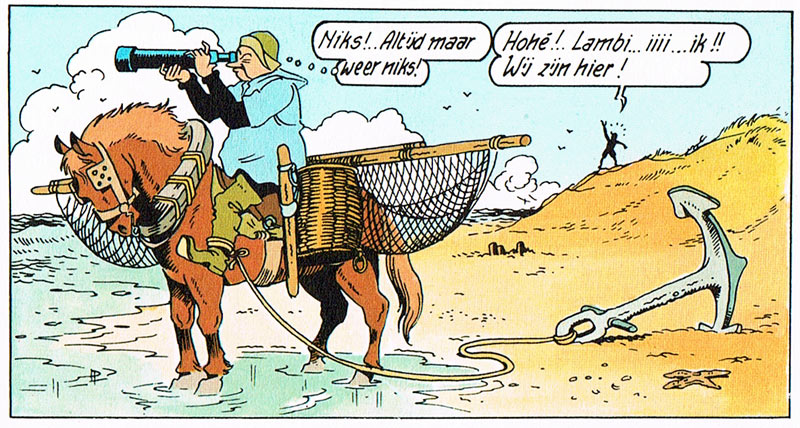
The daily episodes of 'Suske en Wiske' also underwent some Clear Line influences in the Tintin years ('Het Bevroren Vuur', 1951)
Studio Vandersteen
Vandersteen once said he could never outdo Hergé in international sales, unless he simply produced more albums and series for a national audience. With his commercial mindset, he worked for as many publications as possible. Luckily, he was in high demand, but to keep all his series running he needed help. In the early days, his wife Paula inked most of his stories. Wim Goderis, assistant-director of Standaard Boekhandel, often brainstormed with Vandersteen for his humorous gag series. For his realistically-drawn comics of the late 1940s, Vandersteen was assisted by Maurice Tillieuxas ghost artist, while Bob De Moor helped out with some of the 'Tijl Uilenspiegel' work in Kuifje. In 1949, Vandersteen hired his first official assistant, François-Joseph Herman, who inked many of his stories until 1952. The same year, Karel Boumans became inker, letterer, colorist and background designer until 1959. Jo-El Azara assisted on the 'Suske en Wiske' story 'De Lachende Wolf' (1953). For his series with realistic artwork, Vandersteen received important assistance from Karel Verschuere. Over the decades, many other loyal artists joined the Kalmthout-based studio, most notably Paul Geerts, Karel Biddeloo (Bik), Jeff Broeckx, Eugeen Goossens, Robert Merhottein, Eduard De Rop, Eric De Rop, Peter Koeken and Ron Van Riet.
Even taking into consideration that he didn't draw everything on his own, Vandersteen's production remained staggering throughout his lifetime. He sometimes worked on several series at the same time, and was always approachable whenever his artists got stuck with writer's block or overdue pages. Many times he came up with fresh ideas from the top of his head, even drawing them out for his assistants. Yet the workaholic was also a party animal. On his nights off, he loved to go drinking, even if he had a deadline to complete. However, when he returned home at dawn, he dutifully finished his pages first, regardless how tired or hungover he was. Vandersteen had a holy respect for deadlines. As long as a series remained profitable, he wanted to keep it running. It not only provided his employees with skilled practice, but also a decent living. Vandersteen never forgot how difficult his early years had been, and for this reason, he rarely fired people.

'De Familie Snoek'.
De Familie Snoek
Vandersteen's first major creation after the launch of 'Suske en Wiske' was the witty gag comic 'De Familie Snoek' (1945-1954, 1965-1972), which ran in De Nieuwe Standaard (later retitled to De Standaard). Contrary to 'Suske en Wiske', this comic featured a real family. Vandersteen's friend Wim Goderis was a major contributor to the gags, which he often based on his own family life. The main characters are Leonard Snoek, his wife Marie, teenage daughter Gaby and young son Sloeber. Most gags feature the gullible and naïve couple in all kinds of zany events. Later gags added Albert, Leonard's millionaire brother from the USA, and the impolite neighbor Krab, who talks in a telegram style, much like Jerom. At a certain point, Gaby married her comic artist neighbor Stan Steur, in many ways a self-portrait of the author. This marked the first instance of two main cast members in a Belgian comic strip getting married and having children of their own, the twins Pietje and Mietje. Unintentionally, 'De Familie Snoek' is nowadays a nostalgic time capsule of post-World War II life in Flanders.
The original series ran from 22 December 1945 until 9 January 1954, but on 16 April 1965, 'De Familie Snoek' made a comeback in a rebooted version in Pats, the junior supplement of De Standaard. The characters were redesigned by Vandersteen's co-workers Eduard De Rop and Eugeen Goossens. On 5 June 1969, the feature was discontinued in Pats and moved to TV Ekspres, where it ran from 14 June 1969 until 4 March 1972, with co-production by Eric De Rop. 'De Familie Snoek' appeared in French as 'La Famille Guignon' and in the 1960s also ran in the British magazine Sparky, first as 'The Pike Family', then as 'The Snooks'. More than one observer has noticed the conceptual similarities between Vandersteen's 'De Familie Snoek' and Merho's later series 'De Kiekeboes'.
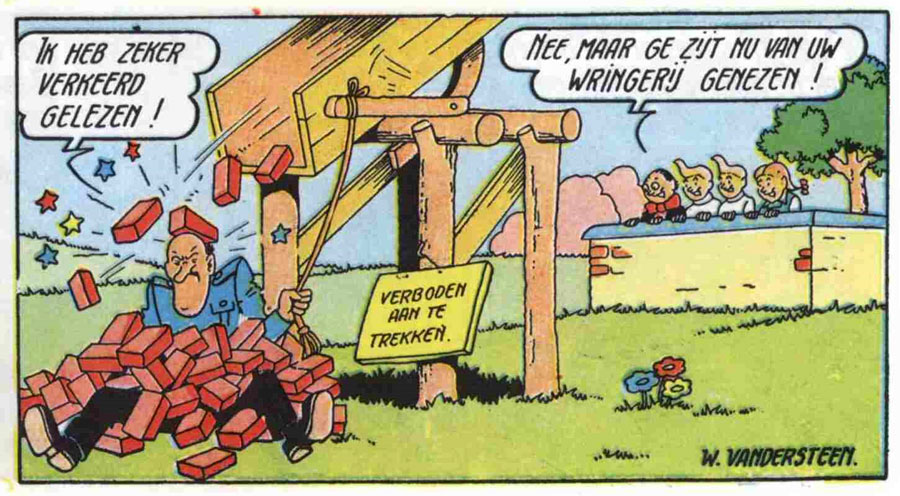
'De Vrolijke Bengels'.
De Vrolijke Bengels
For Ons Volkske, the children's supplement of Ons Volk, Vandersteen created the classic gag comic 'De Vrolijke Bengels' ("The Cheerful Rascals", 1946-1954), which debuted on 1 August 1946. Gag comics about naughty children have always been popular in Belgium, with Rudolph Dirks' 'Katzenjammer Kids', Hergé's 'Quick & Flupke' and Pink's 'Filipke en de Rakkers' as important predecessors. The jolly rascals in Vandersteen's comic are the boy genius Poliet, who talks in rhyme, the girl Vlooike and the stone deaf twins Pontius and Pilatus. Originally, there was also a chubby kid named Patatje, but he was dropped shortly afterwards. The kids often combat Tieter, a bossy and stupid police officer, but have a common enemy in the mean prankster Job. Another recurring character is Mie Pladijs, an elderly woman whose cakes are frequently robbed by Job.

'De Vrolijke Bengels', now starring Suske and Wiske.
Between 3 April and 6 November 1947, 'De Vrolijke Bengels' moved to 't Kapoentje, the youth supplement of Overal, after which Vandersteen took the series to another magazine titled Ons Volkske, this time the new children's supplement of Het Nieuwsblad, where it ran until the 35th issue in September 1954. Between 9 March 1950 and 30 April 1953, 'De Vrolijke Bengels' had a change of concept, when the child characters were replaced by Suske and Wiske, while Lambik became officer Tieter's deputy. In 1955, some 'Vrolijke Bengels' gags also ran in Revue. At the time, the series was so popular that rival magazine 't Kapoentje felt the need to create a similar comic when Vandersteen left them, resulting in 'De Lustige Kapoentjes' (1947-1989). It was first drawn by Bob De Moor (1947-1949), then Marc Sleen (1950-1965) and afterwards continued by other artists until 1989. Because of its far longer run, 'De Lustige Kapoentjes' has essentially overshadowed 'De Vrolijke Bengels' as the most typical Flemish children's gag comic from that era.

'Het Plezante Circus' (Ons Volkske). French-language version.
Het Plezante Circus/De Lustige Zwervers
When 'De Vrolijke Bengels' had run its course, Vandersteen created a new gag comic for Ons Volkske titled 'Het Plezante Circus' ("The Joyful Circus"), which ran between 9 September 1954 and 10 April 1958. The feature also appeared in French as 'Le Cirque Zim-Boum'. Set in a circus, the comic stars two children, Jefke the acrobat and Mieke the dancer, as well as Gust the clown and Karlo the magician. The misanthropic worker Bros serves as the antagonist. In turn replacing 'Het Plezante Circus', Vandersteen created 'De Lustige Zwervers', which ran in Ons Volkske from 17 April 1958 until 11 August 1960. Karel Boumans and Eduard De Rop were regular assistants on this feature. The gags center around two tramps, Job and Bob, who are shadowed by a secret agent, Agent 17, who wants to arrest them for vagrancy. Though short-lived, much of the concept was an embryonic version of Vandersteen's future series 'Robert en Bertrand' (1972-1992).
One-shot serials
Between the mid-1940s and late 1950s, Vandersteen expanded his workload by making several short-lived comic series. For Ons Volkske, he created the chivalry comic 'Ridder Gloriant' (27 December 1945 - 14 March 1946), a feature obviously inspired by Hal Foster's 'Prince Valiant'. A second story ran in the newspaper Ons Volk between 3 December 1950 and 28 June 1951. In addition, Vandersteen created several realistically drawn one-shot comics, often based on historical events. 'Het Roode Masker' ("The Red Mask", 21 March-1 August 1946) is set during the Spanish occupation of the Netherlands in the 16th century. 'De Heldentocht der Bataven' ("The Hero's Journey of the Batavians", 8 August - 19 December 1946) takes inspiration from the Batavian Uprising against the Romans, while 'De Zwarte Luipaard' ("The Black Leopard", 26 December 1946) is set during the Boer Wars. Vandersteen went to the Stone Age with 'Tussen Water en Vuur' ("Between Water and Fire", 6 November 1947 -13 May 1948) and the 18th-century Boerenkrijg peasant uprisings with 'De Jonge Brigand' ("The Young Brigand", 20 May 1948 - 13 January 1949). Between 26 June and 20 November 1947, readers of 't Kapoentje could enjoy his pirate adventure comic 'De Blauwe Kreeft' ("The Blue Lobster").
Meanwhile, the newspaper Ons Volk ran various realistic one-shot comics by Vandersteen. 'Marscommando's op Aarde' ("Martian Commandos on Earth", 14 July 1946 - 12 January 1947) was a science fiction story about alien invasions from Mars. The atmospheric ghost story 'Het Veenspook' ("The Peat Ghost", 19 January - 29 June 1947) ran in Ons Volk and its follow-up Overal. The underwater treasure hunt story 'Het Verzonken Rijk' ("The Sunken Empire") could be read between 6 July and 9 November 1947. A couple of years before Hergé, Vandersteen already made a moon travel comic with 'De Eerste Maanraket' ("The First Moon Rocket", 16 November 1947 - 31 May 1948). The exotic thriller 'De Staalblauwe Boeddha' ("The Steel Blue Buddha", 6 June 1948 - 16 January 1949) was set in China and mostly drawn by Vandersteen's assistant Maurice Tillieux. Vandersteen returned to horror with the werewolf story 'De Weerwolf' (26 June 1949 - 15 January 1950), while 'Het Gouden Masker' ("The Golden Mask", 11 June - 26 November 1950) took place in darkest Africa. A rare humorous story for Ons Volk was 'Tanjar de Viking' (22 January - 4 June 1950), about a bluestone Viking statue that came to life, like the Golem. Vandersteen's final contribution was an adaptation of 'Willem Tell' ('William Tell', 19 July - 20 September 1951). Vandersteen created the one-shot comic 'De Pantoscaaf' ('The Pantoscave', March 1949 - July 1950) in De Knape, a magazine for Catholic students, which also published it in book format.

'Het Veenspook', 1947.
Short-lived features
Vandersteen's pantomime comic 'Bert Trekkers' (1947) ran in the travel magazine De Toerist. For the monthly printers' publication Graphica, he drew the gag comic 'Pietje Bovenkast' (1947-1948). To compete with Marc Sleen's annual Tour de France comics in Het Volk, Vandersteen created 'Draaien, Altijd Maar Draaien' (1948-1949) for De Standaard. While Sleen invented his own gags and continued for many years, Vandersteen mostly illustrated Marius Sepacu's sports columns and quit after only two editions. For the Centra supermarkets, Vandersteen and his assistant Karel Boumans made the advertising comic 'De Familie Vergaren' (1958-1959), which also ran in French as 'La Famille Tirelire'. Its storylines featured a family trying to save money by shopping at Centra.
In 1960, Vandersteen created 'Geschipper naast Mathilde', a celebrity comic based on the popular Flemish TV sitcom 'Schipper Naast Mathilde' (1955-1963), which appeared in De Zondagmorgen. As he already grew tired of it after one episode, Vandersteen passed on the feature to Eugeen Decamps and Eduard De Rop, who continued it until 1962. Coincidentally, that same year, the 'Schipper Naast Mathilde' TV series inspired yet another comic feature: Johan Anthierens and Eddy Ryssack's 'Kapitein Matthias' (1960) in Humo magazine. The most unusual comic strip in Vandersteen's career was 'De Geschiedenis van Sleenovia' (1965), made when Marc Sleen had left Het Volk to join the competing newspaper De Standaard, but contractual obligations prevented him from using his creation 'Nero' in this paper for about three months. To bridge this period, the journalist Gaston Durnez scripted a 'Nero' story of his own, cut-and-pasted from old 'Nero' stories, while Vandersteen's assistants Eduard De Rop and Karel Verschuere provided most of the additional artwork.

'Tijl Uilenspiegel'.
Tijl Uilenspiegel
For the comic magazines Tintin and Ons Volkske, Vandersteen created the historical adventure comic 'Tijl Uilenspiegel', loosely based on Charles De Coster's 1861 novel (of which Félicien Rops was one of the original illustrators). Set in the 16th century, the original novel depicts Tijl as a trickster who frequently fools people, including priests. When he uses his wits to fight the Spanish oppressors, he eventually becomes "the spirit of Flanders". In his adaptation Vandersteen left out the scenes that were too adult or anti-religious and focused primarily on Uilenspiegel's resistance fighting. He condensed many chapters, added his own imagination and took many cues from paintings by Pieter Bruegel. 'Tijl Uilenspiegel' remains a highlight in Vandersteen's oeuvre. The first story, 'Opstand der Geuzen', was serialized in Tintin/Kuifje between 26 September 1951 and 24 December 1952. The second and final story, 'Fort Oranje', ran between 7 January and 9 December 1953 and brought Tijl and his friends to New Amsterdam in pre-colonial America. This album was almost completely drawn by his main co-worker, Karel Verschuere. Other artists who have lended a helping hand on 'Tijl Uilenspiegel' artwork have been Bob De Moor and Tibet.
Judi/Rudi
Between 23 October 1952 and 11 March 1954, the comic serial 'Judi' (1952-1956), ran in Ons Volkske magazine. It told events from the Old Testament from the viewpoint of a 14-year old Jewish boy named Judi. The stories were published in book format by the Catholic publishing house Sheed & Ward, with approval from Leo Suenens, then auxiliary bishop of Mechelen and later cardinal of Belgium (1961-1979). However, most young readers didn't enjoy the dry and preachy tone, while Catholic teachers and preachers criticized the work for its liberal and often sensational approach of the Bible. A total of five stories were made. The first three installments were mostly penciled by Vandersteen and inked by Karel Verschuere, who did all of the artwork for the fourth album, 'De Zwervers' (1956). When the stories were reprinted in the Ohee series in the 1960s, Verschuere drew one final story with the character, who was by then renamed to "Rudi".

''t Prinske' (Kuifje, 26 May 1954).
't Prinske
Vandersteen's final creation for the Lombard team was the gag comic ''t Prinske', appearing between 23 December 1953 and 14 October 1959 in both Tintin magazine and Ons Volkske. The series revolves around a young prince from the fictional kingdom of Marmeladië. In the original version, the prince remained nameless, but in the French translation 'Son Altesse Riri' (later 'Le Prince Riri'), he was given the name Riri. Many gags feature him interacting with a solemn court marshall and another prince around his age, Foerak. Eduard de Rop was one of Vandersteen's inkers for this comic.

'Bessy' #1 - 'Het Geheim Van Rainy Lake' (1954).
Bessy
Inspired by the popularity of the 'Lassie' TV series, Willy Vandersteen and his co-worker Karel Verschuere created a more successful blend of adventure and didactics: 'Bessy'. Vandersteen asked MGM for permission to create a comic strip around Lassie and even bought a collie dog for inspiration. However, the studio insisted on exact adaptations, so in the end, Vandersteen decided to come up with his own series. Just like Lassie, Bessy is a female collie, but all action is set in the Far West. Bessy and her owner Andy travel through the prairie with occasional educational intermezzos. Whenever the duo encounters an animal or a plant, captions give readers a small biology lesson. 'Bessy' took off on 24 December 1952 in La Libre Belgique, before making its Dutch-language debut in the weekly Ons Volk (17 December 1953). Starting in 1959, the adventures also ran in the newspapers Het Belang van Limburg and De Gazet van Antwerpen. One story, 'De Gevangene van de Witchinoks', also appeared in De Standaard. In the Netherlands, 'Bessy' ran in the Catholic weekly Katholieke Illustratie (1955-1966), while newspaper De Telegraaf published two stories, 'De Strijdbijl' en 'De Verdwaalden' in 1960 and 1961.
However, the series had its biggest success in Germany, where between October 1958 and August 1960, Bastei Verlag published the stories in the youth magazine Pony. After that, the 'Bessy' feature ran in Bastei's Felix magazine. Starting on 15 February 1965, full new stories were churned out by Vandersteen's team every month and from the 58th issue every week(!). In the end, about 992 'Bessy' titles were created exclusively for the German market. Some stories were never even translated into Dutch or French. Twenty titles were instantly released as books without prepublication.
To maintain this heavy workload, Vandersteen had to hire new assistants and establish a separate unit of his studio, based in Antwerp. He gave Verschuere co-credit, albeit not under his full name, but as part of the collective pseudonym Wirel ("Wi" for Willy, "Rel" for Karel). His assistant also received 20 percent payment of the royalties. No other Studio Vandersteen employee had ever received such benefits. Over the decades, many artists industriously worked on the immense 'Bessy' production: Frans Anthonis, Jeff Broeckx, Chris Callebaut, Eduard De Rop, Eric De Rop, Guy Derrie, Edgard Gastmans, Eugeen Goossens, Peter Koeken, Walter Laureysens, Michel Mahy, Jan Moens, Jacky Pals, Jean Bosco Safari, Frank Sels, Marcel Steurbaut, Christian Vandendriessche, Ann Van De Velde, Patrick van Lierde, Ron van Riet, Jos Vanspauwen, Jean Veyt, Jos Verreycken, Robert Wuyts, as did the scriptwriters Jacques Bakker, Daniël Jansens and Hugo Renaerts. While the production schedule of 'Bessy' was high, some of these hundreds of German stories were reprints. Others were rehashings of other western comics by Vandersteen, especially from the 'Karl May' series. The studio often recycled these stories panel by panel, replacing the hero's face with Andy's and drawing Bessy in the backgrounds. As the production increased, everything became so rushed-out that the drawings became sloppier. On 12 January 1984, 'Bessy' was discontinued in La Libre Belgique. Bastei Verlag terminated its contract a year later, feeling they didn't get their money's worth. Not all the complaints were about the graphic quality, though. In some cases, they asked to tone down the violence.
Scriptwriter Marck Meul and artist Jeff Broeckx tried to reboot the series as 'Bessy, Natuurkommando' (1985-1992), in collaboration with the World Wildlife Fund. The setting was changed to the present, with Andy and Bessy being wildlife preservers, flanked by a young woman named Aneka, and a little boy called Kid. Some stories appeared in De Stipkrant, the children's supplement of the newspaper De Standaard. Bastei Verlag ran the series as 'Bessy - Rettung für die bredrohten Tiere'. Even though 'Bessy Natuurkommando' managed to lengthen the series until after Vandersteen's death, it was eventually discontinued in 1992.
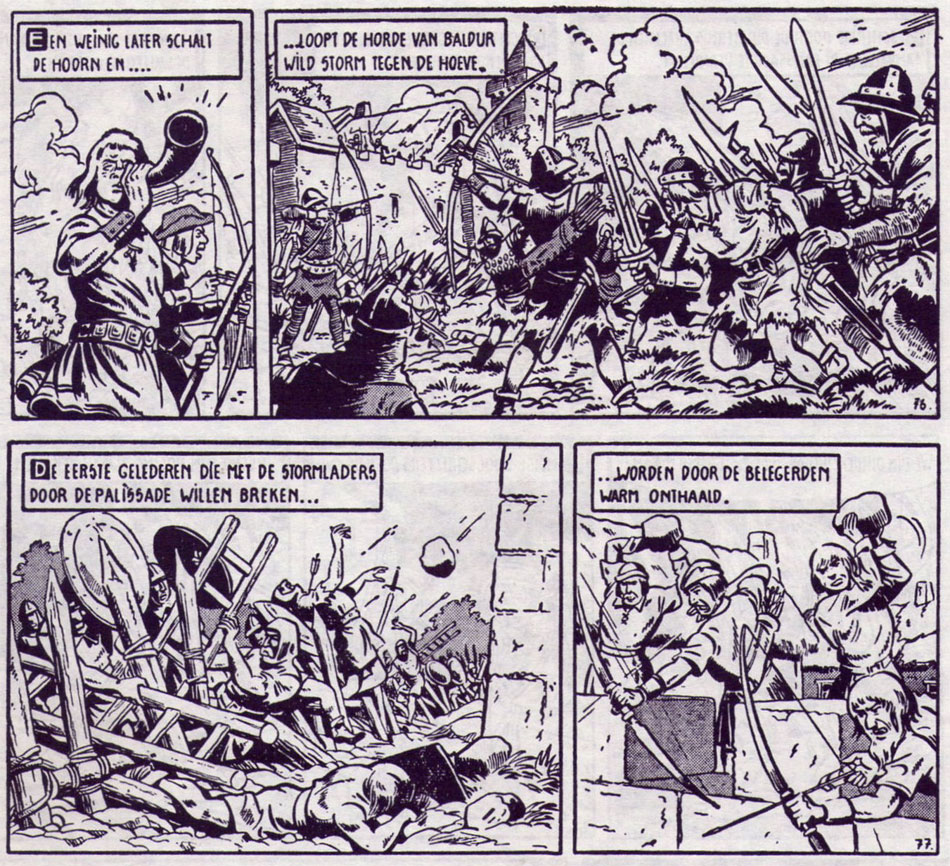
De Rode Ridder #2 - 'De Gouden Sporen'.
De Rode Ridder
On 5 November 1959, Willy Vandersteen launched a comic book adaptation of Leopold Vermeiren's popular youth novel series about the noble knight Johan, AKA 'De Rode Ridder' ("The Red Knight"). Created in 1946, Vermeiren's original stories had been serialized in De Kleine Zondagsvriend, a Sunday juvenile supplement in the newspaper De Gazet van Antwerpen. These original stories were illustrated by a pseudonymous artist named "Jan de Simpele", later followed by Gustaaf De Bruyne, Paul Ausloos and then Karel Verschuere. Vandersteen always had a soft spot for historical adventure stories and since Verschuere was working for his studio, it seemed to be an easy deal. However, publisher De Zuidnederlandse Uitgeverij owned the rights to the series. Antoon Sap, publisher at NV Standaard Boekhandel, solved the problem by simply signing Vermeiren under their contract. The novelist greenlighted the comic adaptation, but preferred to have his name removed from the comic book credits because he also worked as a school inspector. For the same reason, Vermeiren's occasional scriptwriting work for Jef Nys 'Jommeke' was also done anonymously. Vermeiren only gave Vandersteen permission to use Johan, none of his other characters. As a result, the novels and comic strip take place in a different universe. The only similarity, other than the name and title hero, was that Vermeiren changed his protagonist's black hair color into blond on the book covers so he would resemble Johan from the comics.
The first 'De Rode Ridder' comic story was serialized in the newspaper De Standaard. The early stories clearly reveal the influence of Hal Foster's 'Prince Valiant'. Johan is a lonely knight roaming through woods and fields, fighting for justice. Later, he becomes a Knight of the Round Table and serves under King Arthur and Queen Guinevere. The 1964 story 'Koning Arthur' introduced Merlin the wizard, who remained a regular cast member afterwards. As Vandersteen embarked upon a long trip to South East Asia, the first story, 'Het Gebroken Zwaard' (1959), was mostly written and drawn by studio employees, based on a short story outline by Vandersteen. Willy Vandersteen wrote and drew the second story, 'De Gouden Sporen' (1960), himself. Afterwards, he took a seat back and concentrated on album cover design and scriptwriting, while his co-workers did most of the artwork.
For the first three 'Rode Ridder' stories, Vandersteen's son Bob provided background art. Throughout most of the 1960s, Karel Verschuere, Eduard De Rop and Frank Sels each illustrated several albums. This constant shift in creators explains why there was no real focus in the character's universe. Some stories take place in different era of the Middle Ages, often centuries apart from one another. Sometimes the stories are serious in tone, while in other episodes Johan meets dragons, witches, fairies, gnomes and wizards. The knight travels through Continental Europe, but his horse also brings him as far as Scandinavia, Iraq, Cambodia, Korea, China or Japan. Since the studio employees had to work on other series too and often rush to meet their deadlines, occasional sloppy work was unavoidable. Off-model drawings, spelling mistakes and errors in continuity, proportion or perspective were rampant. The infamous album 'De Zwarte Roos' (1968) has often been cited as the worst executed 'Rode Ridder' story.
But through it all, Vandersteen's talent for storytelling shines through. The adventures are captivating, suspenseful and overall epic, helping 'De Rode Ridder' comics become bestsellers. As a result, Vermeiren's original novels sold better too, even though the comic version completely overshadowed them. Between 1969 and 2004, Karel Biddeloo was in charge of the 'De Rode Ridder' series and transformed it into pure sword & sorcery, with sly hints at eroticism. Vandersteen only scripted one story since, 'Het Dodenschip' (1974). After Biddeloos's death, Dutch comic artist Martin Lodewijk, of 'Agent 327' fame, became the series' new writer, with Claus Scholz providing the artwork. Peter Van Gucht was briefly scriptwriter, until he was succeeded in 2012 by Marc Legendre. Since 2016, the Italian artist Fabio Bono has been the series' main illustrator. He took the opportunity to give the always clean-shaven Johan a stubble.
Pats/Tits
On 5 September 1962, all publications of De Standaard carried a new weekly supplement named Pats, starring a gag comic of the same name created solely by Eduard De Rop. The character was based on the popular puppet show 'Pats Poppenspel' by Karel Weyler (who had also made puppets out of the 'Suske en Wiske' characters). The series ran until 8 February 1967, after which Vandersteen's 'Jerom' comic took its place. On 28 February 1974, the Pats supplement was retitled to De Patskrant and its title character redesigned. The new Pats received a baby sister, Trezebees, and a strange extraterrestrial pet called Flappy, best described as a big-eared, flying squirrel. Vandersteen took care of the first stories himself, but eventually handed the production to Merho. Pats Poppenspel threatened to sue, since they weren't financially compensated for the use of their brand name. After a court case, both the newspaper and the comic changed names. On 23 August 1977, De Patskrant became Stipkrant and the Pats character was redesigned and renamed into 'Tits', named after the boy's bowler hat, which is called "a tits" in Flemish slang. The rest of the cast stayed the same and the comic continued until 3 June 1986, by then drawn by Peter Koeken.
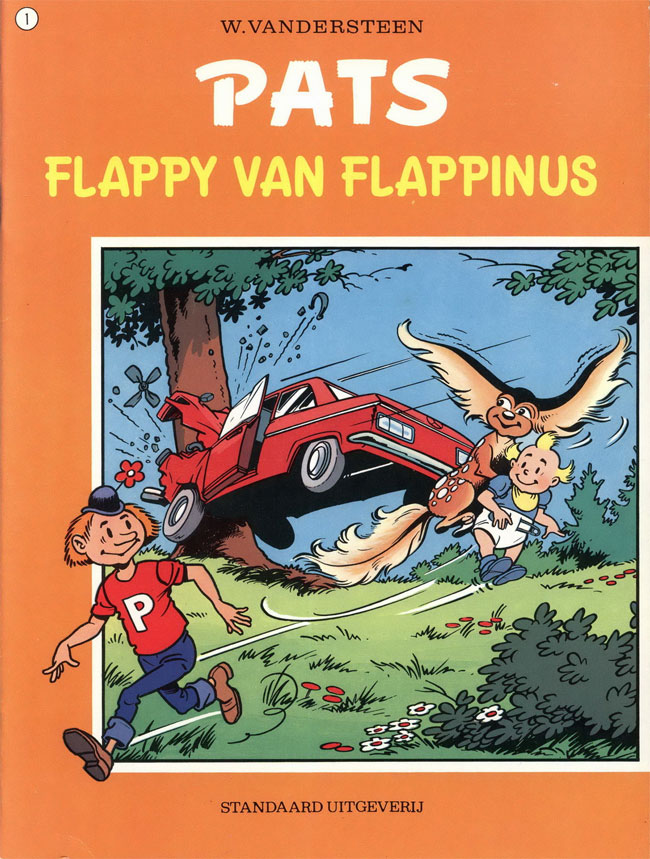
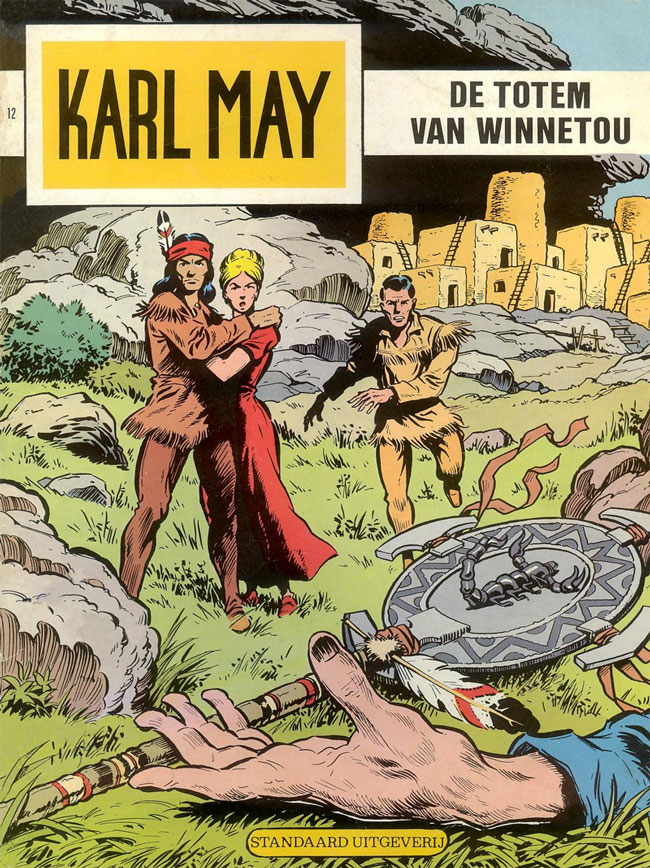
'Pats' and 'Karl May'.
Karl May
In 1962, Vandersteen rediscovered Karl May's old cowboy novels about Old Shatterhand and Winnetou, which he had enjoyed so much as a boy. With help from Karel Verschuere, Frank Sels, Eduard De Rop, Eugeen Goossens and Karel Biddeloo, he adapted them into a comic series. The first story was published directly in book format, but the second one appeared in De Standaard from 10 December 1962 on. After 13 stories, 'Karl May' was moved to the children's supplement Pats, where new stories ran between 16 April 1965 and 6 December 1977. Some of the later 'Karl May' stories were drawn/inked by Merho.
Biggles
On 12 April 1965, Vandersteen also launched 'Biggles', a comic book series based on W.E. Johns' popular aviation novels. These novels had been adapted into comic strips before by foreign artists like Pim van Boxsel, Albert De Vine, Rob Embleton, Ola Ericson, Gote Goransson, Guicha, Roger Melliès, Maurice Rondepierre, Alfred Sindall and Mike Western, but as always Vandersteen managed to put his own spin on it. The series was mostly drawn by Verschuere and Karel Biddeloo. Biddeloo eventually continued the series on his own until 19 January 1970.
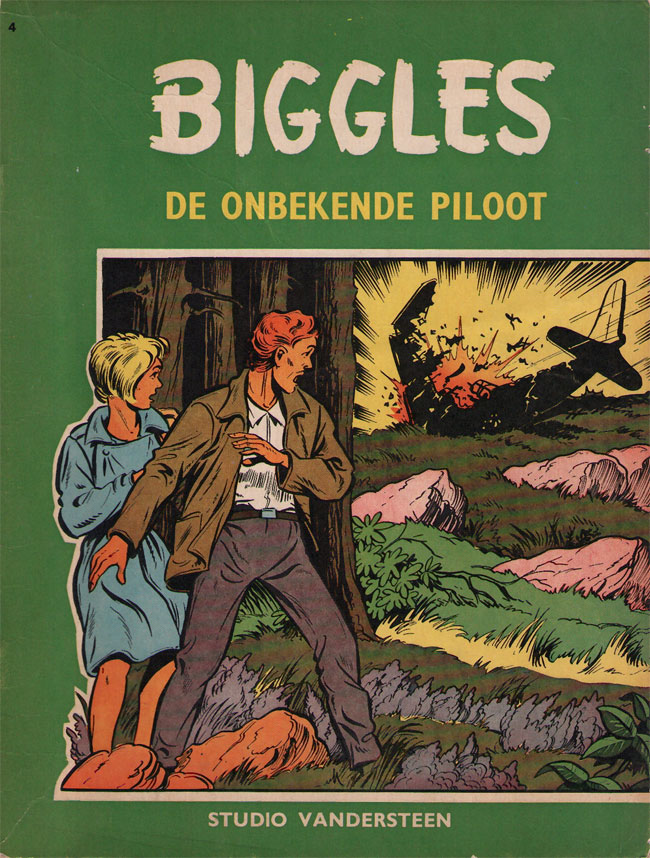
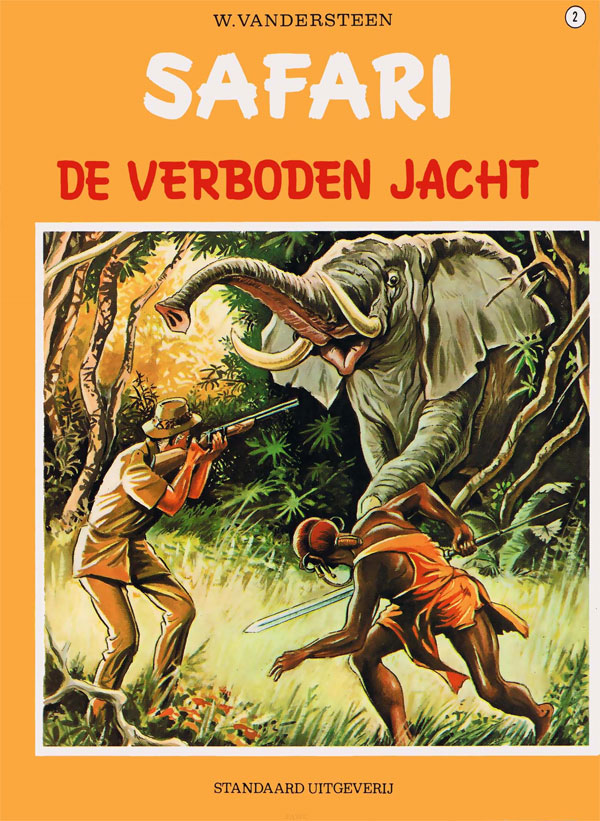
'Biggles' and 'Safari'.
Safari
In the late 1960s, the TV series 'Daktari' (1966-1969) - about a vet in East Africa - was quite popular. It inspired Vandersteen to create the comic series 'Safari' (6 May 1969 - 29 January 1974), which ran in Pats and was mostly illustrated by Karel Biddeloo and Merho. Contrary to 'Daktari', 'Safari' is set in Central Africa and stars a white hunter, Sam Burton. Sam is assisted by biologist Ellen Moore, her son Tim and a Maasaï hunter named Mgono. Much like 'Bessy', the stories had regular intermezzos to educate readers about African culture, flora and fauna. Quite unusual for Vandersteen was that the series followed an ongoing storyline throughout all albums. Much of its concept was modeled after the British comic series 'Fraser of Africa' (1960-1961) by George Beardmore and Frank Bellamy, which also featured a white hunter and a Maasaï. 'Safari' was eventually terminated due to lack of success, which Vandersteen attributed to the demystification of Africa through TV.

Robert en Bertrand #1 - 'Mysterie Op Rozendael'.
Robert en Bertrand
When Vandersteen retired from the 'Suske en Wiske' comic in 1972, he had more time for a new ambitious project. Since childhood, he was a huge fan of Raf Verhulst's 'Robert en Bertrand', about two happy-go-lucky tramps. In the late 19th and early 20th century, their adventures were the subject of many theatrical plays and youth novels. Vandersteen cherished a lifelong dream to make a comic about them, set in the 19th century. In his version, the blond-haired Robert and black-haired Bertrand are scoundrels too, but fight injustice wherever they go. Their motto is "Slechts in 't gevaar, geweld in 't gebaar." ("Only when in danger, violence is allowed."). During their journeys, they adopt the young Moldavian prince Joeki (modeled after Vandersteen himself as a child). The trio is constantly stalked by secret agent Nr. 17, who wants to jail them for vagrancy. The 'Robert en Bertrand' comic ran in De Standaard from 30 November 1972 until 6 July 1992. While some regard it as one of Vandersteen's finest achievements, the series was never a huge hit with the general audiences. Starting in 1985, the scripts were written by Marck Meul, with Ron Van Riet providing the artwork. Other Studio Vandersteen workers who contributed were Eugeen Goossens, Jeff Broeckx (inking), Ann Van De Velde (inking), Marie-Claire De Cock (coloring), Eduard De Rop and his son Eric.

De Geuzen - 'De Wildeman van Gaasbeek'.
De Geuzen
Also in 1972, Willy Vandersteen developed a comic series set in the 16th century, during the Spanish occupation of Flanders. The main characters are slightly based on 'Tijl Uilenspiegel', namely a young hero (Hannes), his sweetheart (Veerle) and an chubby comedic sidekick (Tamme), all expies for Tijl, Nele and Lamme Goedzak. The original comic went as far as 11 pages, before Vandersteen abandoned the project. Thirteen years later, he returned to his original idea and redesigned the characters. The end result was 'De Geuzen' (1985-1990), which started out as a humorous series. From the fifth album on, both the artwork and the general tone became more serious. Vandersteen felt very attached to 'De Geuzen' and spent a lot of time on historical research. As a personal tribute, each book publication reproduced an engraving by Pieter Bruegel. The love scenes between Hannes and Veerle were also far more sensual - though still chaste - in comparison with his other series. Vandersteen put his soul into this passion project and didn't seek serialization with editorial interference. Instead, all stories appeared instantly in book form. Vandersteen also insisted on having no assistance and didn't allow anyone to continue the series after his death. However, as his health deteriorated, some of his artists occasionally filled in for him, most notably inker Eugeen Goossens.
Schanulleke
While it is often claimed that 'De Geuzen' was the last of Vandersteen's new series, his actual swan song was 'Schanulleke' (1988), a spin-off built around a living version of Wiske's rag doll. Originally, the concept started as two illustrated children's adventure books created by Willy Vandersteen himself, 'Schanulleke in de Dierentuin' (1986) and 'Eiko de Wijze Boom' (1986). For this spin-off, the veteran comic artist gave Schanulleke a male sidekick, the clown doll Duddul. On 27 December 1988, 'Schanulleke' became a one-page gag-comic for young readers, scripted by Dutch comic writer Patty Klein, and drawn by Eric De Rop. Anita Schauwvlieghe assisted on the backgrounds and inking. The 'Schanulleke' gags were published in De Stipkrant, the children's supplement of newspaper De Standaard, as well as the Dutch toddlers' magazine Okki. Later on, the series was also reprinted in Suske en Wiske Weekblad and in Minitoe, the children's supplement of the Dutch newspaper Nieuws van de Dag.
Media adaptations
A real-life rag doll based on Schanulleke was made available by the Antwerp firm Morema as early as 1947. The same year, Karel Weyler of Pats Poppenspel created a series of popular puppet plays based on the 'Suske en Wiske' characters, with which he toured throughout Flanders. By 1958, these hand puppets became commercially available as toys, along with a 1960 hook-and-ring game named "Op-Jerommeke". In 1948, the cartoonist Pil designed a ceramic statuette of Wiske. Between 9 October 1955 and October 1957, Belvision produced some very low-budget animated TV cartoons based on the 'Suske en Wiske' stories published in Tintin magazine, broadcast on the Flemish public TV channel N.I.R. (nowadays V.R.T.). The most popular media adaptation was Wies Andersen's puppet show 'Suske en Wiske', broadcast on Dutch TV by the TROS from 6 October 1975 until 15 December 1976. Aided by a catchy theme song, the program increased the franchise's popularity in the Netherlands to such a degree that Vandersteen didn't have to worry about financial issues for the rest of his life. The series had six original stories, later adapted into comic stories. Between 1989 and 1991, several 'Suske en Wiske' stories were adapted into an animated TV series by Atelier 5, broadcast on VTM. The animation was so limited that many episodes relied on constant stock footage. One of the Studio Vandersteen people working on these productions was Eugeen Goossens.
In 1994, 'Suske en Wiske' was adapted into a successful theatrical musical, 'De Stralende Sterren', which also traveled the Netherlands with equal success. Two additional musicals followed, 'De Spokenjagers' (2002) and 'De Circusbaron' (2008). In 2004, the story 'De Duistere Diamant' (2004) was adapted into film, while five years later a CGI-animated film followed, 'Luke and Lucy: The Texas Rangers' (2009). Over the decades, the 'Suske en Wiske' franchise has inspired books, audio plays, video games, figurines, jam jars, crockery and tons of other merchandising.

'De Sissende Sampan' (1963). In 1959-1960 Vandersteen had traveled to South-East Asia and was deeply shocked by the poverty in Shanghai, which inspired not only this album, but also this scene.
Controversy
As popular as Vandersteen is, he has also been the subject of several controversies. Early in his career, he didn't shy away from plagiarism. The original newspaper print of 'Rikki en Wiske in Chocowakije' (1945) stole a scene from Hergé's 'Tintin in America' in which gangsters shoot the reporter from an open window, which then turns out to be a dummy. However, this sequence was removed in the album version. In 1982, Rob Møhlmann's book 'Prins Valiants Zwartboek Over Plagiaat' (1982) caused an uproar for exposing how Vandersteen copied imagery from Pieter Bruegel, Gustave Doré, Hal Foster and Alex Raymond for many scenes in 'Judi', 'Ridder Gloriant', 'De Rode Ridder' and 'Suske en Wiske'. Vandersteen admitted borrowing poses, but defended himself by stating that there were no reference guides available at the time. Indeed, Vandersteen wasn't the only comic artist at the time who copied other cartoonists. And while he often looked for inspiration in other media, he usually wrote original storylines inspired by the imagery, settings and characters.
In the late 1940s and early 1950s, many 'Suske en Wiske' stories expressed Flemish-nationalist viewpoints, including sympathy for repressed collaborators. These were so controversial at times that some readers wrote letters and certain stories couldn't appear in book format, nor French translation, before the references were removed. Many people who knew Vandersteen personally called him apolitical, so perhaps these controversial remarks were a result of following his paper's ideology and public opinion rather than any true conviction. Indeed, once Vandersteen's sales rose, he eliminated all such commentary in favor of more general jabs at "incompetent politicians, policemen, tax inspectors and civil servants." The only real controversy he caused since was the story 'De Toornige Tjiftjaf' (1970), in which Vandersteen criticized bird hunters, at the time a polarizing debate. Despite the angry letters he received, the practice was eventually banned in Belgium.
Vandersteen was also frequently accused of commercialism. He often submitted to the demands of his publishers and advertisers. Some fans dislike the way he redesigned 'Suske en Wiske' for the stories in Tintin magazine, because his drawing style became too streamlined. Aiming at the much bigger market in the Netherlands, many 'Suske en Wiske' stories were set there, with the cast flying with Dutch airline company KLM in blatant product placement. Many old-school fans feel this "Hollandisation" destroyed the charm of the original Flemish series. Some Dutch fans agree too, deliberately purchasing the dialect versions of old albums, rather than the standard Dutch versions.
Another bow to commercial pressure was Vandersteen's increasing preachiness. Vandersteen clearly tried to appeal to moral guardians and give his comics a wholesome reputation. Especially in the Netherlands, comics had a bad public image, so "educational comics" had a bigger chance to see publication. Many stories became allegories and metaphors for real-life issues, building up to a predictable moral explanation.
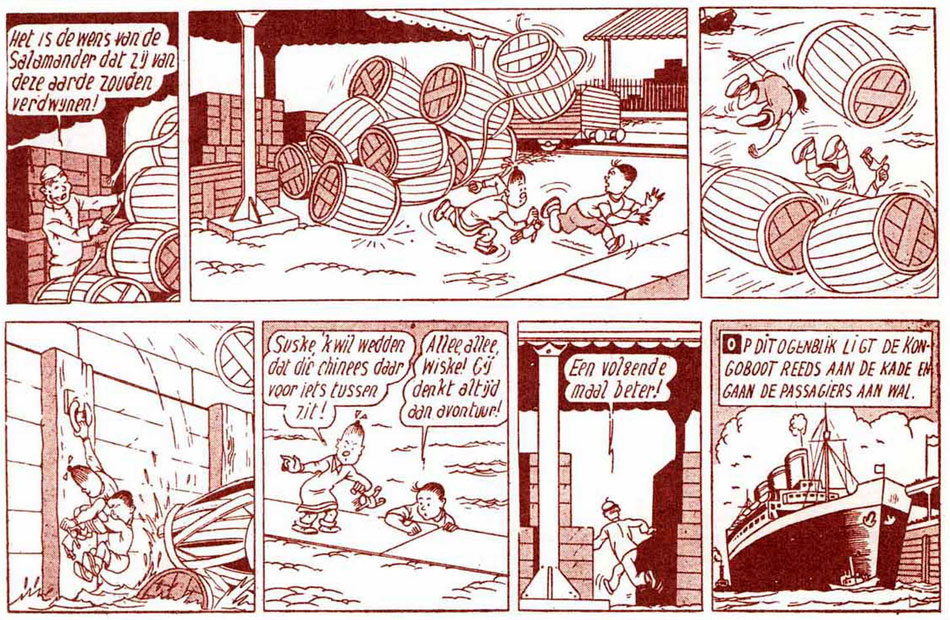
Sequence from the original version of 'De Witte Uil' (1948).
Vandersteen's studio has often been accused of putting quantity over quality. Vandersteen typically launched a comic because he was interested in a certain setting or theme. After a couple of stories, he usually grew tired of it. Sometimes, he just discontinued the series, but more popular ones were simply passed on to his co-workers. Without Vandersteen's guidance, most inevitably turned into factory products. Certain 'Suske en Wiske' stories were purely made as exclusive advertising comics (and collectables afterwards, since they weren't part of a regular series). Others cashed in on local tourism, popular TV shows or annual thematic events. Classic 'Suske en Wiske' stories were crudely redrawn and colorized by assistants to look more like the newer episodes. Fan backlash was so huge, that the remaining old stories were reprinted in their original look.

Less inspired redrawn version of 'De Witte Uil' (1972).
Many former employees have described Vandersteen as a wonderful boss. He didn't mind whether they clowned around, because he considered a fun atmosphere essential to create entertaining stories. But he was also lenient about them muddling along, arriving late, or delivering subpar work. As long as the deadlines were reached and the clients paid, everything was fine. As a result, readers and publishers noticed that certain series really went downhill. By 1984, Standaard Uitgeverij was forced to intervene, because many papers and magazines had discontinued their contracts. Series way past their popularity, like 'Karl May', 'Tits' and 'Jerom', were canceled, while 'Bessy' was retooled. In the end, Vandersteen didn't regard himself as an artist anyway. He once called his profession "merely a craft one should try to do as good as possible."
Graphic contributions
Throughout his career, Vandersteen also illustrated a couple of books by Flemish or Dutch novelists. In 1945, he illustrated four children's books in the 'Zoo ik een... was' series, featuring the life of an Inuit, Native American, pirate and knight through the imagination of a child. They were published by Standaard Boekhandel and popular enough to be translated into French by Casterman. Vandersteen created calendars for the Flemish Catholic Boy Scout movement (1953-1954) and a 1959 brochure to prevent juvenile crime. Vandersteen illustrated the cover of a Christmas single by Jo Leemans, 'Aba Heidschi Bumbeidschi/Maria's Kind' (1968). In 1970, Vandersteen made the propaganda comic 'Met Kil en Fil op het Kiliaanpad' for the Antwerp delegation of the Christian-Democratic party CVP. In 1980, he was one of many Belgian comic artists to make a graphic contribution to 'Er Waren Eens Belgen.../Il Était Une Fois... Les Belges', published on the occasion of the 150th anniversary of Belgium as a nation.

'De Wervelende Waterzak' (1988) was the final 'Suske en Wiske' album drawn by Willy Vandersteen. It was a tribute to the Scouts movement.
Recognition
In 1959, Willy Vandersteen was made an honorary citizen of Duffel. During his lifetime, Vandersteen won one comic award for "Best Comic Script" (1977) at the Festival of Angoulême, France, for the 'Robert en Bertrand' episode 'De Stakingbreker'. In 1989, he was also honored as one of the few comic pioneers included in the permanent exhibition at the Brussels Comic Strip Center.
Parody & plagiarism
Willy Vandersteen is arguably the most imitated and spoofed Dutch-language comic artist. In 1949, his assistant François-Joseph Herman created 'Le Secret de la Mer' (1949-1950) for the magazine Feu Sacré, an adventure story bearing a strong resemblance to the 'Suske en Wiske' story 'Lambiorix'. Halfway through the plot, the comic abruptly was ended, possibly through interference of Vandersteen. In the Netherlands, Ben Jansen made the pornographic 'Suske en Wiske' parody 'De Glunderende Gluurder' (1982), while Johnn Bakker drew a more political satire, 'De Keizerkraker' (1982), about the Amsterdam squatters' movement. Both became infamous because Standaard Uitgeverij fought them in court over copyright infringement, although Vandersteen himself bought a copy of 'De Glunderende Gluurder' and could see the humor in it. Zak named a satirical comic book about the Pope 'De Vliegende Paap' (1982), after the 'Suske en Wiske' story 'De Vliegende Aap', while Erik Meynen gave the first story of his celebrity comic 'Van Rossem' the title 'De Poenpakker', referring to the 'Suske en Wiske' story 'De Poenschepper'. For the newspaper De Morgen, Kamagurka ridiculed the S&W story 'De Rosse Reus' (1981), while it was running in the rival paper De Standaard. 'Suske en Wiske' was spoofed as a sex parody by Roger Brunel in 'Pastiches 3' (1984). Between 2004 and 2006, Windig & De Jong made the Dutch gag comic 'Sliske', featuring a toothless version of Vandersteen's Wiske ("slissen" is Dutch for "to lisp"). Marc Scherbateyev created an erotic parody of Wiske, titled 'Nudiske'.
In his series 'Lolo et Sucette', Marc Hardy once depicted Lambik and Jerom as two gays who are into leather. During the early 1990s, Tom Bouden imagined a grown-up version of Suske and Wiske titled 'Suster en Wiebke', followed by a full comic book parody, 'Suster en Wiebke: Het Dertigersdipje' (2019). De Rode Ridder has been spoofed by the TV show 'Buiten de Zone' as 'De Roze Ridder', and also by the cartoonists Jeroom (as 'Ridder Bauknecht'), Tom Bouden & Kim Duchateau ('Herman de Lichtroze Ridder'), Pascal Agotha ('Nahoj, de Groene Ridder') and Geinz and Jean Deras ('De Rode Ruiter'). In 1971, Ever Meulen spoofed 'De Vrolijke Bengels' in Humo as a bunch of stoners, trying to run from the law. For the same magazine, Fritz Van den Heuvel made the one-shot comic 'Tipy Gaat Kamperen' (1991), in which Vandersteen's 'Bessy' is spoofed.
Final years and death
In 1990, Vandersteen passed away from cancer. Even on his deathbed in the hospital, he had continued to draw. In his testament, he left specific instructions behind about his series. Yet without his genius most were doomed to die out. 'Bessy' disappeared into the sunset in 1992, while 'Robert en Bertrand' was canceled in 1993. Vandersteen also left behind some projects that were never finished, including a mid-1970s reboot of Pat Sullivan and Otto Messmer's 'Felix the Cat'. In the 21st century, only 'Suske en Wiske' and 'De Rode Ridder' have remained in production, although they have been retooled and remodeled often to appeal to modern readers.
Some posthumous spin-offs of 'Suske en Wiske' have come about as well, such as the junior version 'Klein Suske en Wiske' (2002-2015), first by Jeff Broeckx and then by others. More adult and stylistically different spin-off series have been 'The Red Knight' (1990) by Ronald Grossey and Marvano, 'Amoras' (2013- ) by Marc Legendre and Charel Cambré, 'J. ROM - Force of Gold' (2014-2016) by Bruno De Roover and Romano Molenaar and 'Red Rider' (2017) by Lectrr and Stedho, while one-shot 'Suske en Wiske' stories have been produced by varying creators, including Yann, Gerben Valkema, Conz and Steven Dupré.

Kees Kousemaker and his wife Evelien, alongside special guest Willy Vandersteen, at Lambiek's opening day on 8 November 1968.
Legacy and influence
The huge amount of titles Willy Vandersteen and his team produced explain why he is the most collected comic artist of the Low Countries. Certain fans are willing to buy everything he ever signed his name to, even work by an assistant or a posthumous publication. The demand is so high, that old and rare stories have been reprinted frequently. Numerous Dutch and Belgian bookstores have earned a living thanks to Vandersteen collectors. Vandersteen also had a considerable cultural impact. In Flemish dialect, a strongman (or someone who thinks he is) is often called a "Jerommeke", while dumb twits are sometimes compared with Lambik. Many bars in Flanders have been named after Lambik as well. On 8 November 1968, Kees Kousemaker opened the first European comic store in Amsterdam and named it Lambiek. Willy Vandersteen was present at the opening party. Between 2000 and 2004, a Dutch club for vandalizing speed cameras named themselves after the 'Suske en Wiske' story De Tuf-Tuf-Club, which also involves speeding cars. They were eventually disbanded for breaking the law and sued by Vandersteen's heirs for copyright infringement. Theme park Walibi in the Belgian city of Waver also has a bumper car ride named Tuf Tuf Club. Since 1987, fans of 'Suske en Wiske' are gathered in De Fameuze Fanclub with about 1,800 members in Belgium and The Netherlands. The club organizes events, hosts an informative website and publishes the quarterly news magazine Versus.
Several monuments have been erected to honor Vandersteen and his work. On 8 June 1965, Suske and Wiske received a statue in Zuiddorpe, The Netherlands, and another one on 19 May 1979 in the Antwerp Zoo, sculpted by René Rosseel. On 17 September 1995, a statue was erected by Gilbert Uitdenhouwen at the Heidestatiestraat in Antwerp. On 13 February 1988, Vandersteen received a statue of his own in Hasselt, sculpted by Gerald Moonen. His birth house in the Seefhoek in Antwerp has a commemorative plaque since 1991, while the town where he spent most of his life and career - Kalmthout - has several other memorials, including a path (1986) and a bust, designed by Valeir Peirsman and unveiled on 15 September 2007, after which the local square was also named after Vandersteen. On 29 November 1997, Vandersteen's old villa in Kalmthout became an interactive children's museum. In June 1995, a comic book wall dedicated to 'Suske en Wiske' was inaugurated at the Rue de Laeken/Laekensestraat 116 by G. Oreopoulos and D. Vandegeerde, as part of the Brussels Comics Route. Four other comics murals were created in the Korte Ridderstraat 8 in Antwerp (13 May 2006), near the station of Kalmthout (26 April 2009), the Handelsstraat in Antwerp (16 October 2015) and in the IJzerlaan in Middelkerke (24 September 2018). In 2002, Monique Mol created another statue dedicated to Suske and Wiske in Middelkerke. In the comic neighborhood of the Dutch city Almere streets have been named after Wiske, Sidonia, Lambik and Jerom. The 2017 indoor theme park Comics Station in Antwerp was modeled after six Belgian comic series, among them 'Suske en Wiske'.
Willy Vandersteen has influenced practically the entire post-World War II comic scene in Flanders. Indebted to him are Bob De Moor, Marc Sleen, Piet Tibos, Ever Meulen, Jean-Pol, Hec Leemans, Kamagurka, Paul Geerts, Marc Verhaegen, Ann Van De Velde, Jan Bosschaert, Merho, Willy Linthout, Urbanus, Erik Meynen, Stedho, Pierre Boschmans, Philippe Delzenne, Steven Dupré, Steve Michiels, Luc Morjaeu, Nix, Luc Cromheecke, Kim Duchateau, Wout Schoonis, Bavo, Thijs De Cloedt, Zookie, Kristof Berte and Conz. In Wallonia, he influenced François Walthéry, Marc Hardy and Jean Van Hamme. Art curator Jan Hoet was also a fan.
In the Netherlands, influences can be spotted in the work of Martin Lodewijk, Theo van den Boogaard, Peter van Dongen, Joost Swarte, Dick Matena, Gerrit de Jager, Co Loerakker, Hanco Kolk, Gleever, Hein de Kort, Maaike Hartjes, Norbert Mirani, Jos Beekman, Aloys Oosterwijk, Wilfred Ottenheijm, Marcel Ozymantra, Willem Ritstier. Marnix Rueb, Wilbert van der Steen, Robin Vinck, Berend Vonk, Hendrik J. Vos, Johan Westerhoff, Ben Westervoorde and Windig & De Jong. An obscure Dutch duo named Schietvereniging Okido created a 1988 comic, 'Zef Bef', in which both Lambik and Marc Sleen's Nero have cameos.
Willy Vandersteen Prize
Since 2010, an semi-annual Willy Vandersteen Prize is awarded to the best Dutch-language comic book during one of the Flemish or Dutch comic festivals. The jury consists of professionals from the creative industry and a member of the Vandersteen family selects, and the award comes with a prize money of 5,000 euros. Prize winners have been Brecht Evens (2010), Michiel van de Pol (2011), Typex (2013), Simon Spruyt (2014), Charel Cambré & Marc Legendre (2015), Gerben Valkema & Eric Hercules (2016), Wilbert van der Steen (2017), Wauter Mannaert (2019), Judith Vanistendael & Zidrou (2021), Joris Mertens (2022), Veerle Hildebrandt (2023), Jan Vriends (2024) and Aimée de Jongh (2025).
Books about Willy Vandersteen
Peter van Hoeydonck's 'Willy Vandersteen: De Bruegel van het Beeldverhaal' (Standaard Uitgeverij, 1994) and Rolf van Ryck's 'Willy Vandersteen: Van Kitty Inno tot de Geuzen' (Standaard Uitgeverij, 1994) remain the standard works about Vandersteen's life and career. Van Hoeydonck's '50 Jaar Suske en Wiske' (Standaard Uitgeverij, 1995) is a fascinating work about everything that makes the franchise great. Luk Guilaume's 'Willy Vandersteen, De Interviews - De Foto's' (Standaard Uitgeverij, 2005) collects all interviews the legendary creator ever gave. Ronald Grossey in turn wrote an interesting study about Vandersteen's studio, 'Studio Vandersteen, Kroniek van een Legende (1947-1990)' (Standaard Uitgeverij, 2007, with an updated edition in 2025). Since 2019, the Dutch radio producer Koen Maas hosts De Perfecte Podcast, a podcast series in which past, present and future of Vandersteen's legacy is discussed with experts, associates and family members.
Comics shop Lambiek will always be grateful to Willy Vandersteen for illustrating the letter "L" in our encylopedia book 'Wordt Vervolgd - Stripleksikon der Lage Landen', published in 1979.

Final panel from 'De Tamtamkloppers', featuring a classic wink from Wiske.
Luke and Lucy on the WWW
(in English, French and Dutch)