


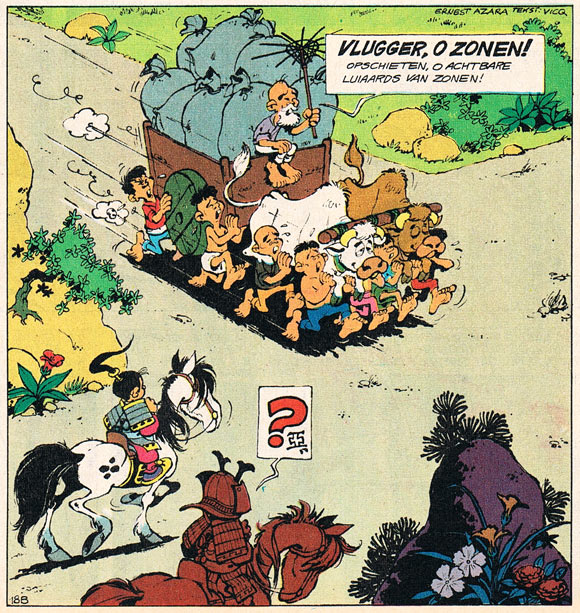
'Taka Takata' - 'Haddada Surmamoto'. Dutch-language version.
Joseph F. Loeckx, best known as Jo-El Azara, was born in Drogenbos. He studied art at the Institute Saint-Luc in Brussels. Azara met Willy Vandersteen during a holiday, and the famous Flemish comic artist asked him to work at the Vandersteen Studios, where he collaborated on the 'Suske en Wiske' episode 'De Lachende Wolf' in 1953. Azara recalled one time, while inking a page, he accidentally pushed over his Chinese ink pot, damaging the page. Vandersteen gave him a tube of white paint and a paint brush to remove all ink stains manually, even between the dialogues, instead of fixing it by cutting and pasting the speech balloons. The plus side of this time-consuming menial task was that he never forgot to properly close his ink bowl lid ever again.
In 1954, he drew a short story about 'Hamlet' for Junior/Ons Volkske.

'Taka Takata'.
Between 1954 and 1961, El-Zara was employed by Studio Hergé, where he assisted on two albums starring 'Tintin et Milou'. By 1958, he was drawing for a variety of magazines under pseudonyms like Jo-El, Ernest and eventually Jo-El Azara. Besides publications in Caravane and Spirou, he collaborated with Will on the Peyo series 'Jacky et Célestin' for Le Soir Illustré in 1961-62.
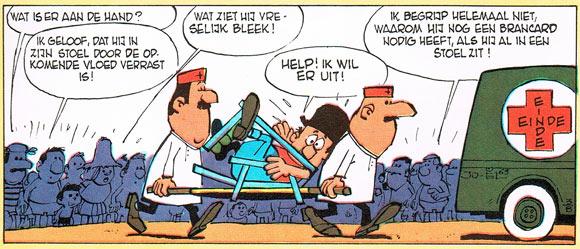
'Évariste Confus'.
Jo-El Azara eventually became one of the most popular artists of humorous comics for magazine Tintin, where he created his own series for the first time. After short stories with Yves Duval in 1962 and the gag series 'Évariste Confus' in from 1963 to 1965, he came up with his most famous creation in cooperation with scriptwriter Vicq, the Japanese soldier 'Taka Takata'. 'Taka Takata' was notable for being the first Belgian comic strip starring an Asian character, even though he still has a very stereotypical look. The only other major Belgian series since with an Asian hero since has been Roger Leloup's 'Yoko Tsuno' (1970). 'Taka Takata' remained a popular feature from 1965 throughout the rest of the 1960s and the 1970s. Azara also drew one story starring the British detective 'Clifton', a series created by Raymond Macherot, in 1969.

'Taka Takata'.
Azara was also expanding his activities by appearing in other magazines besides Tintin. He drew 'Bonnedague' in Record (1962-66), 'Pauvre Icare' in Chouchou (1965), as well as 'Mayflower' (1963-65), 'La Campagne de Grèce' (1965) and 'Monsieur Chapomou' (1965-66) in Pilote in cooperation with scriptwriters like Jacques Acar, Jacques Lob, Maurice Rosy and Crespin. Together with Vicq, he created yet another Japanese hero, the samurai 'Haddada Surmamoto', for Tintin's competing magazine Spirou in 1967-68. He returned to Spirou once again in the early 1980s with 'Zagazik'.

'Taka Takata'.
In addition, Azara was active in the advertising and communication field, drawing books like 'L'Histoire Mondiale du Transport et de la Logistique' (1989) and 'L'Heure de l'Euro' (1999). He was asked by Pierre Tchernia and Albert Uderzo to participate in the development of the medieval street in Parc Astérix in France. Settled in the South West of France, Azara began his own Azeko label in 1994, through which he reprinted his 'Taka Takata' albums.
Azara was one of the artists making a graphic contribution for 'Pepperland' (1980), a collective comic book celebrating the 10th anniversary of the Pepperland comic book store.

'Yaba-Dap'.