


'De Familie Doorzon' (1998). Translation: "People, it's 12 o' clock! We start with our very final happy hour!".
Gerrit de Jager is one of the most recognizable and versatile comic artists of The Netherlands, with a decades-long career spawning many creations. Outspoken and original in his humor, and with a practical and commercial mindset, his comics and cartoons have appeared in a great many mainstream magazines and newspapers, as well as specialized publications. Initially working in a steady partnership with his childhood friend Wim Stevenhagen under the name "Prutswerk", De Jager's solo career took off in the 1980s. After dividing their joint creations, De Jager gained great success with the family comic 'De Familie Doorzon' in Nieuwe Revu (1980-2010). A hilarious satire of Dutch society and the issues that polarize its citizens, the series often caused controversy, but also inspired merchandising and some spin-off comics. Among a younger audience, De Jager became known with his more family-friendly gag strip 'Roel en Zijn Beestenboel' (1978-1996), about a young man who runs a vegetarian restaurant with his animal friends. Initially created for Jippo magazine, it later ran in the Belgian comic weekly Robbedoes and, under the title 'Aristote et ses Potes', also its French-language edition. As a result, De Jager became one of the few Dutch comic creators with success in the French-speaking countries, resulting in the collaborative creation 'Eva en Adam' (1995-2001) with the Belgian artist Philippe Bercovici. Over his decades-long career, De Jager proved his capability to make humorous comics for all kinds of audiences, often taking inspiration from his own life, the news of the day or his absurd imagination. In addition to his dysfunctional Doorzon family, he also made more gentle comics on families and relationships, such as 'Liefde en Geluk' in Het Parool and other publications (1983-2005) and 'Zusje' in Trouw and Margriet (1999-2026). Other creations had less durability, but appealed to several different readerships, including teenage girls ('Puck' in Club, 1980-1984), music fans ('Toon Ladder' in Muziek Express, 1982-1991) and football fans ('Krijter' in Hard Gras, 1994- ). While spending a large part of the 1990s on television projects and commercial assignments - notably the 'Bob de Beer' franchise for the department store De Bijenkorf - De Jager focused on more topical cartoon series, like 'Broodje Beurs' for Het Financiële Dagblad (2007-2012), about the ups and downs of the stock exchange, and his daily 'John' cartoon in AD (2005- ). Later in his career, he also took the time to look back, for instance in the critically acclaimed graphic novel 'Door Zonder Familie' (2013), about the early years of his comics career and his first marriage, and 'Songlife' (2021), a personal reflection on rock music as the soundtrack of his life.
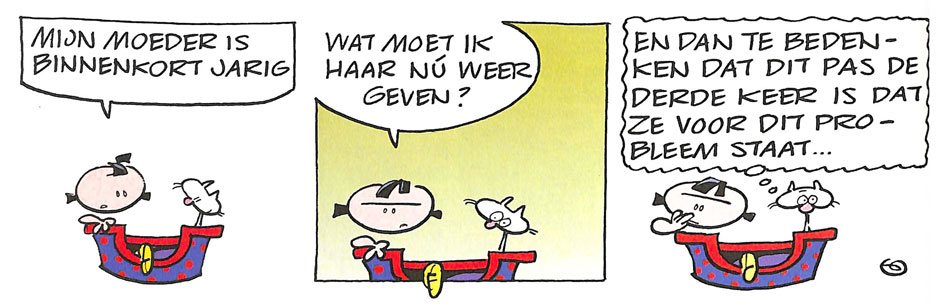
'Zusje'.Translation: "My mother celebrates her birthday soon. What should I give her now?" - "And to think that this is only the third time that she faces this problem..."
Early life and career
Gerrit de Jager was born in 1954 in Amsterdam. As his father worked for the Royal Dutch Airlines KLM, one of the first comic series he adored was the aviation comic 'Buck Danny' by Jean-Michel Charlier and Victor Hubinon. In a 2025 interview with Nieuwe Revu, De Jager said he had an insecure childhood, largely due to the unpredictable behavior of his father. One moment he could be the jovial dad who introduced his son to the humor of Monty Python, on other moments he was harsh and aggressive. De Jager quickly discovered that he had the gift of turning the unpleasant things in his life into humor, a trade that would prove very beneficial in his future career. As a child, he also enjoyed the Dutch comic magazines Pep and Sjors, where he became particularly fond of Jan van Haasteren's 'Baron van Tast', Peter De Smet's 'De Generaal' and René Goscinny & Albert Uderzo's 'Astérix'. In the newspaper, he read the 'Peanuts' strip by Charles Schulz, which became an influence on his own gagwriting. During boring lessons, De Jager scribbled away in his notebooks, keeping his drawings as small as possible. In order to maintain readability, he showed an early interest in typography and design. In his professional years, De Jager would benefit from these skills, when he used the small format for his newspaper comics and graphic novels. Among his other early influences were the Clear Line of Hergé and gag comic creators like Dik Browne, Michel Greg (particularly 'Achille Talon') and André Franquin. Also the offbeat and edgy humor of Robert Crumb, George Herriman, Don Martin and Guillermo Mordillo tickled his imagination. Later in life, De Jager expressed admiration for Bill Watterson and his colleagues Maaike Hartjes and Jean-Marc van Tol.

Comic work by Gerrit de Jager from the early 1970s, based on Frank Zappa's song 'Billy the Mountain'.
While still a teen, De Jager contributed early work to the comic paper of NSU (1971-1972) and to Bullebak, a magazine for a bulldog kennel (1972), signing with "Gart". In 1973, he also made his first appearance in the weekly men's magazine Nieuwe Revu. A partner in crime for De Jager was the neighborhood kid Wim Stevenhagen, who went to the same school and shared an interest in comics and drawing. Their friendship started at the age of three, and resulted in a creative partnership that started with several gags for their high school newspaper, and then in several neighborhood magazines. Between 1972 and 1978, the duo studied Audiovisual Media at the Rietveld Academy in Amsterdam, where they later attended the "experimental animation" section. Among their fellow students were the future comic creators Lex van de Oudeweetering and Paul Schindeler. While still students, De Jager and Stevenhagen were asked to make animated segments to visualize a question in the TV quiz 'Twee Voor Twaalf'. Between 1975 and 1979, they produced four one-minute animations per month, an experience that laid the groundwork for De Jager's quick and efficient graphic style. Later on, the duo also made animated segments for the educational 'Schooltelevisie' broadcasts. Still during their student years, De Jager and Stevenhagen had their first comics published. At the Academy, De Jager used all of these professional jobs for his final exams and graduated effortlessly. Stevenhagen, on the other hand, was by then already kicked out of the Academy.
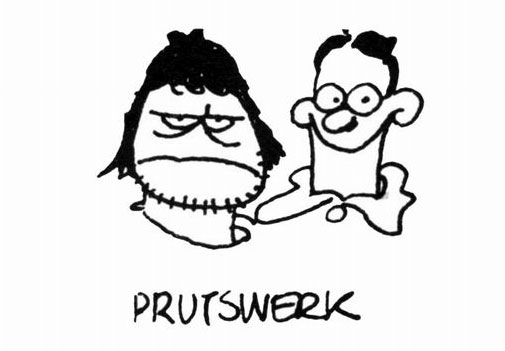
The Prutswerk duo: Wim Stevenhagen and Gerrit de Jager.
Prutswerk
During the first years of their professional careers, De Jager and Wim Stevenhagen remained an inseparable duo, working under the collective name "Prutswerk" (Dutch for "shoddy work") as a sort of Lennon-McCartney of comics. Their ironic pseudonym referred to their working methods. Since they had to churn out so much artwork on deadline, they divided the workload. Officially, Stevenhagen sketched out the pages, since he was better at doing lay-outs, while De Jager did the finished art with pencil and ink. However, this wasn't an ironclad law: if one of them was unavailable, the other filled in. Their artwork was barely distinguishable, except for a few specialties. Stevenhagen, for instance, enjoyed drawing cars more. At first, the duo was concerned that they didn't slave away on their pages, compared with professional cartoonists. Feeling obliged to fill up their panels, they started adding more background details, like thumbnails on the floor. These latter objects turned into a running gag. Initially, De Jager and Stevenhagen considered organizing a Prutswerk studio to raise the production value, bringing in as extra contributors fellow Rietveld students like Paul Schindeler, Marianne Hoogstraten and Fay Luyendijk (who later became known as a musician under the name Fay Lovsky). However, they quickly realized they were better off as a two-man team, since they instinctively understood each other and their time-saving graphic methods were quick, efficient and had more character.
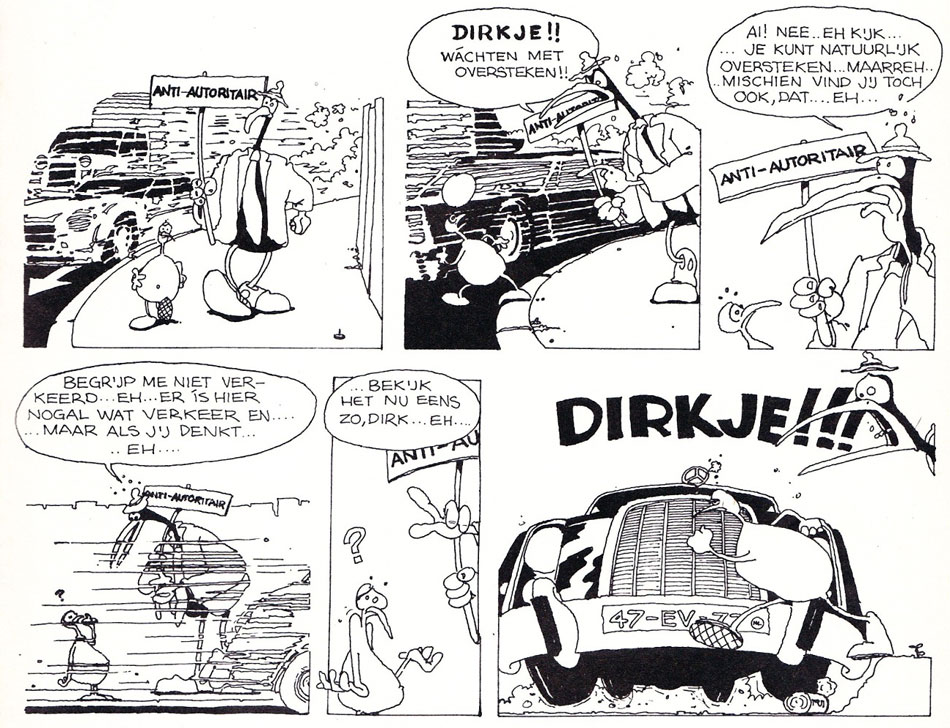
'Anti Autoritair', first story drawn by Gerrit de Jager for De Vrije Balloen (#8, March-April 1977).
De Vrije Balloen
Around 1977, De Jager and Stevenhagen noticed an ad at the Rietveld Academy in which young comic creators were invited to join the alternative comic magazine De Vrije Balloen. Founded in 1975, the magazine was run by a group of professional comic artists, who used it as an outlet for their more adult and experimental comics. Among the original contributors were Patty Klein, Jan van Haasteren, Jan Steeman and Thé Tjong-Khing. Along with another newcomer, Eric Schreurs, the Prutswerk duo was part of a new generation that debuted in its pages. In issue #8 of 1977, De Jager's first page was printed, 'Anti Autoritair', a gag written by Patty Klein. Over the next five years, De Jager and Stevenhagen's Prutswerk team-up remained a regular fixture in the magazine, crafting a funny animal cast of characters, spearheaded by the bird sleuth 'Prut Pruts Private Kreye'. Between 1982 and 1984, De Vrije Balloen was rebooted at Espee under the title De Balloen, and De Jager and Stevenhagen were on the editorial board, along with Aad Labadie and Bert Tier.
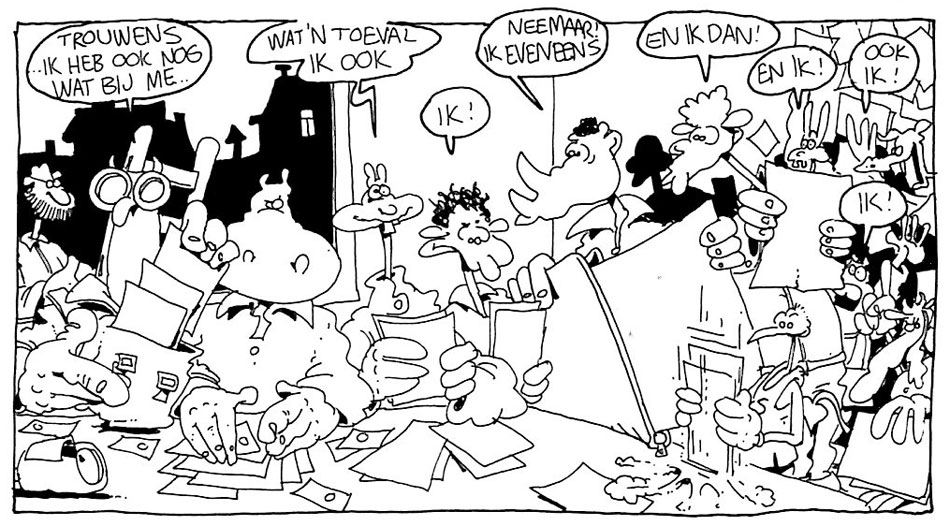
Editorial meeting at the offices of "De Blije Kalkoen" (De Vrije Balloen #28).
Prut Pruts Private Kreye
Prutswerk's first recurring comic character originated from one of their 'Twee Voor Twaalf' animations. For a segment about the Tower of London, they created an anthropomorphic raven, who later developed into their investigator 'Prut Pruts Private Kreye' (1976-1983). In the comic, Prut Pruts is a cross between a raven and a crow, and the feature's pun-based name referred to the word "private eye" and "kraai", the Dutch word for "crow". During its first year, the comic ran in the Amsterdam neighborhood newspaper Buurtkrant Hugo de Groot, but it quickly moved to De Vrije Balloen. There, the duo expanded their strip with a full-fledged funny animal cast, with Prut Pruts working in all kinds of professions, but often returning to sleuthing. When in the early 1980s the magazine's editors were scammed by a malicious publisher, De Jager took inspiration from this setback to make a 'Prut Pruts' serial with a similar storyline, involving the magazine "De Blije Kalkoen". Several of De Vrije Balloen's contributors appeared as funny animal versions, for instance writer/founder Patty Klein as Betsy Zwijn. In a way, this was an early venture for De Jager into semi-autobiographical storytelling, something he would revisit more often in his later career. The 'Prut Pruts' strip appeared in De Vrije Balloen until its 47th and final issue in 1982. The character then reappeared in the magazine's short-lived follow-up De Balloen, published by Prutswerk's publisher and agent Ger van Wulften.
Malmberg magazines: Taptoe
Through their work for De Vrije Balloen, the Prutswerk team was also introduced to more mainstream magazines. Starting in 1978, their comics appeared in the Malmberg children's magazines, which were distributed at schools. In Taptoe, they co-created the Sherlock Holmes spoof 'Sulle Hooms' (1978-1982), scripted by Patty Klein. In each episode, the brilliant detective presents the reader with a puzzle or whodunit tale, of which the solution could be found in the same issue, a few pages later. The series was quite a challenge, since the team had to come up with a weekly puzzle, present it in a narrative and top it off with a funny punchline. Taptoe's 1983-1984 volume introduced a new Prutswerk creation, starring the unlucky garbage man 'Bert J. Prulleman' (1983-1984). This was however largely a Wim Stevenhagen solo production, as the Prutswerk partnership had broken up by then. In the late 1970s, the Prutwerk team also provided artwork to Malmberg’s pre-school magazine Primo.
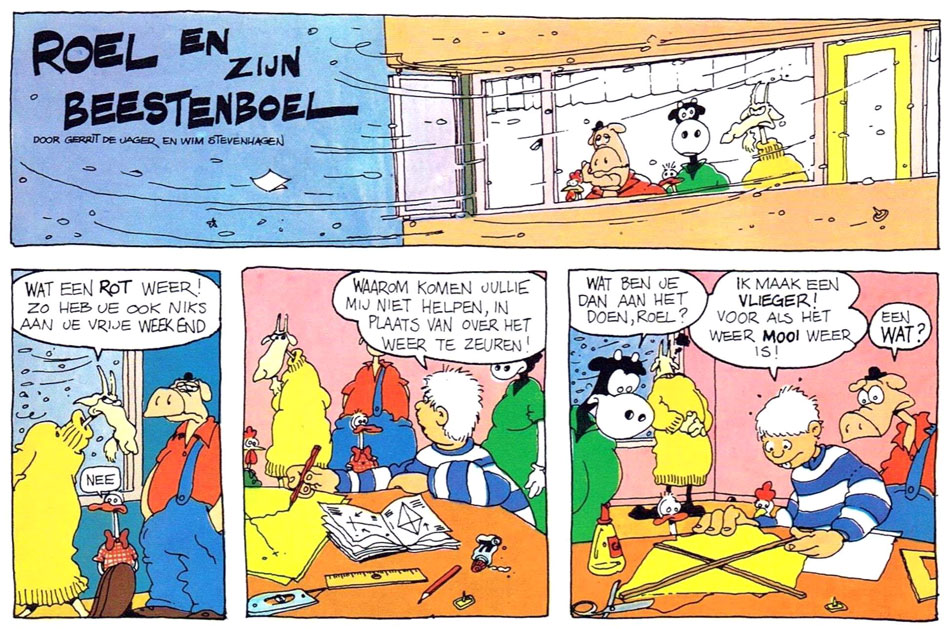
Early 'Roel en zijn Beestenboel' episode from Jippo.
Roel en zijn Beestenboel in Jippo
In Malmberg's Jippo magazine, Prutswerk launched 'Roel en zijn Beestenboel' (1978-1999), a popular comic that would remain a staple in De Jager's solo career. In Jippo, the feature debuted in the first issue of the school year 1978-1979 (16 September 1978). In the early one-page episodes - the first four were written in collaboration with Wim Schaasberg - young Roel moves with his parents from their countryside farm to an apartment building in the city. Sad to leave the farm animals behind, Roel dresses them in human clothing and takes them with him to his new home. In the first years, the animals - a cow, a pig, a goat, a duck and a hen - join Roel as he plays with neighborhood kids (including the quiet Jan-Willem), goes to school and joins the scouts. As the series progressed, the stand-out character became the goat Bokkie, whose antics and entrepreneurial skills cause most of the mayhem. This often leads to thematic gag series, like the early 1980s storyline in which Bokkie's outside swimming pool comes loose and drifts the entire animal crew into the open sea. During the final Jippo years, the 'Roel' gags had a companion strip called 'Jan-Willem Weet Raad!' (1982-1984) in which Bokkie replaces the absent Jan-Willem in helping the magazine's readers with their mailed-in problems. 'Roel en zijn Beestenboel' remained a popular feature in Jippo until the final issue of 16 June 1984. Between 1981 and 1984, the Jippo years of the feature were collected in four comic albums, published by Het Spectrum and Espee. In 1984, the 'Roel' comic found a new homebase in Robbedoes magazine, but by then the Prutswerk team had disbanded.
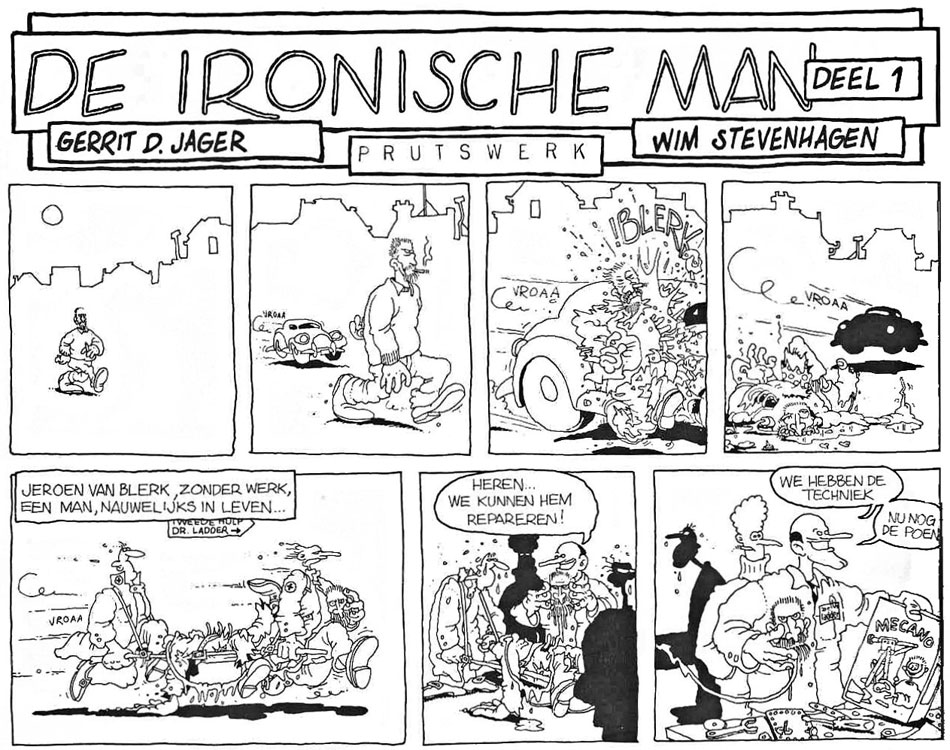
Han Gewetensim - 'De Ironische Man' (1978), a spoof of the intro to the TV show 'The Six Million Dollar Man'.
Gummi: Han Gewetensvim
In the meantime, Prutswerk's alternative and satirical humor had also found its way to the adult-oriented comic magazine Gummi. Starting their contributions in issue #11 of 1978, the duo made a great many short stories throughout Gummi's run. Their main recurring character was 'Han Gewetensvim', a journalist with the A t/m Z Gazet. Its publisher is the shady businessman Toon Ladder, a precursor to De Jager's later character of the same name. Leaning heavily on political references and the news of the day, Prutswerk's Gummi comics also had prominent roles for the politicians Dries van Agt and Hans Wiegel. After an unemployed man called Jeroen van Blerk is run over by a car, Toon Ladder convinces Van Agt to have him transformed into "The Ironic Man", a Frankenstein-like creature able to take down his enemies by making ironic remarks. The name 'De Ironische Man' was a nod to the "bionic man" cyborg from the TV show 'The Six Million Dollar Man'. In the story, the Ironic Man is sent to the World Championship Football in Argentina as a stand-in for the Dutch national team's star player Johan Cruyff. In real life, Cruyff indeed refused to join his fellow players, to protest the military junta of dictator Jorge Rafaele Videla.
In 1979, the 'Han Gewetensvim' stories were collected by Espee in Prutswerk's first comic book. De Jager always regarded the 'Han Gewetensvim' feature more Stevenhagen's story than his own (the name Han Gewetensvim was even an anagram of Wim Stevenhagen). Despite being very self-referential, instantly dated and uncompromisingly Dutch, two four-story episodes were translated into French by Yvan Delporte and printed in (À Suivre) magazine in 1978-1979.
Espee
At Gummi magazine, De Jager and Stevenhagen were at the vanguard of a new generation of subversive comic creators, all gathered around the Amsterdam offices of the publishing house Espee, which also released their first book collections. Within a short time, the Espee crew expanded with Windig & De Jong, Eric Schreurs, Hein de Kort, Paul Bodoni and Willem Vleeschouwer, among other people. During their association with the publisher, De Jager and Stevenhagen participated in several group projects. Together, they wrote the script for 'Rammérix, Le Condôme', a porn parody of René Goscinny and Albert Uderzo's 'Astérix'. Published anonymously by Espee in 1982, the book was part of the 1980s wave of sex parodies with famous comic heroes. Most of the artwork was provided by Willem Vleeschouwer and Wim Stevenhagen.
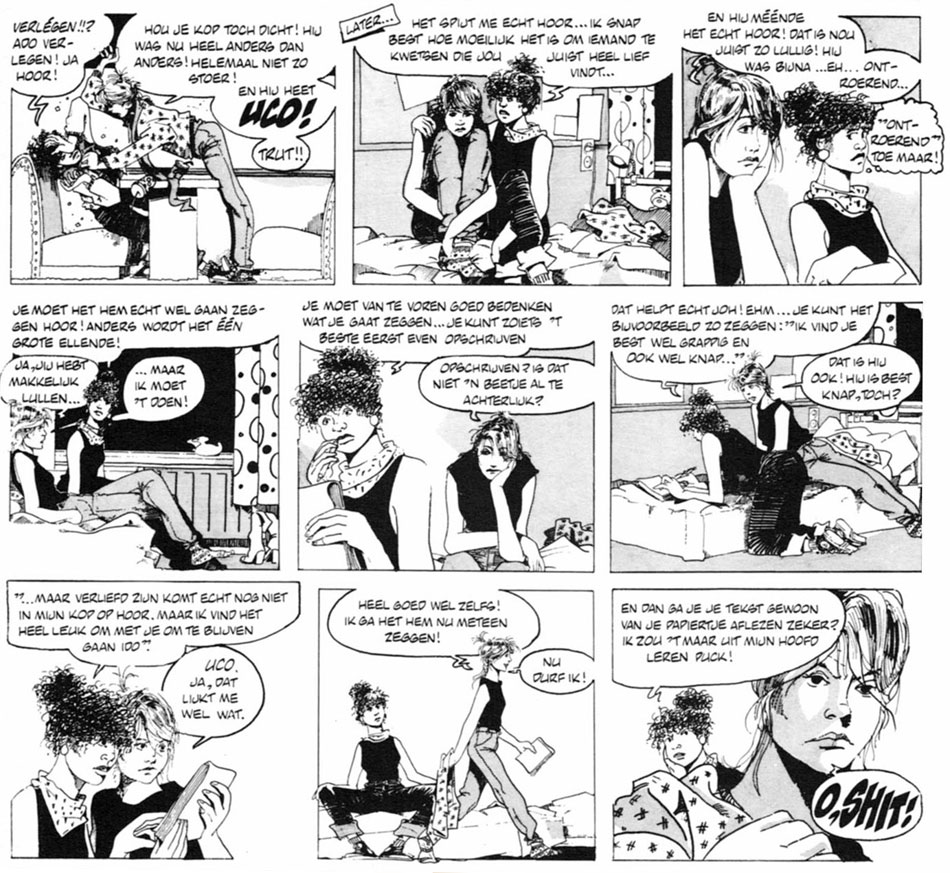
'Puck', rare realistic artwork by Gerrit de Jager.
Through Espee, De Jager also had his first solo excursion in the girls' monthly Club, drawing the 'Puck' comic about the life of a teenager (1980-1984). Initially drawn by Willem Vleeschouwer, De Jager took over from episode seven, using the pen name Gep de Mooy. Compared with his other work, 'Puck' is notable for its realistic drawing style. In addition, De Jager also made illustrations for Club's editorial pages. As he quickly grew tired of the job, this task was later taken over by another Espee artist, Aad Labadie.
The central figure at Espee was publisher Ger van Wulften, who offered his contributors considerable creative freedom and was a clever salesman. He was even able to get some of the "sleazier" artists of his publishing company printed in mainstream magazines and making art for well-established corporations. As "Fer Gevelfut", he often appeared in the editorial comics made by his team. When in 1980-1981, Van Wulften took care of the production of the Dutch edition of Casterman's comic magazine (À Suivre), De Jager and Stevenhagen made him the star in their editorial strip as an unnamed publisher. Also operating as their agent, Van Wulften arranged Prutswerk's biggest success, the publication of their 'Familie Doorzon' comic in Nieuwe Revu magazine.
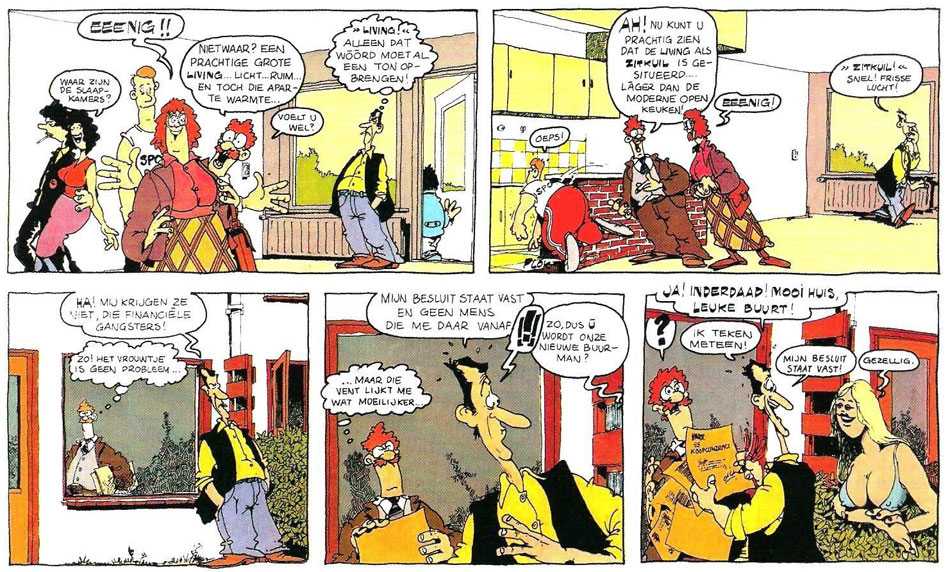
Debut episode of 'De Familie Doorzon' (1980). Father Doorzon doesn't like his new house, until he spots his sexy neighbor.
Launch of De Familie Doorzon
During the 1970s, Ger van Wulften distributed the French comic 'Les Frustrés' by Claire Brétécher to the men's magazine Nieuwe Revu. By 1979, it was time for a local replacement, and he introduced his artists De Jager and Wim Stevenhagen to the editors. The magazine wanted a raw humor comic with sex and social satire about a working-class family. Not one the reader could identify with, but one that would make them think: "I have neighbors like that." Working on this concept, Prutswerk came up with 'De Familie Doorzon' (1979-2010): its title a pun on the Dutch 1950s radio sitcom 'De Familie Doorsnee' about an "ordinary family", but also the term "doorzonwoning" to describe a typically Dutch home with windows on two sides, allowing the sun to shine all the way through. As can be expected, the Doorzon family lives in such a home, more specifically in the Labrador Street (a nod to Tintin's address) in the fictional town of Zulthoven.
For De Jager, the comic was right up his alley. Coming from the big city, he had married young and was now living in a boring residential area in Lelystad. However, it gave him enough material to spoof. Debuting in Nieuwe Revu in February 1980, the comic remained a fixture in its pages for thirty years. The book collections were instant bestsellers and gave De Jager and Stevenhagen their first commercial success. However, it also initiated a series of ruptures: first between the two creative partners, then with their publisher Van Wulften.
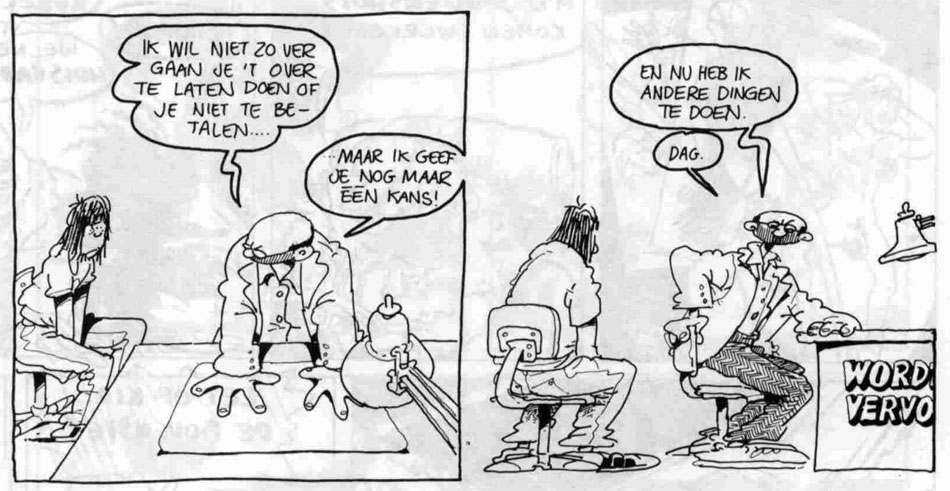
Editorial strip by Prutswerk with Espee's Ger van Wulften (Wordt Vervolgd #6, 1981).
Going solo
The creative partnership between De Jager and Wim Stevenhagen persisted until the early 1980s. During this period, they had established a great many comic creations together. However, both men had their preferences and specialties, and along the way, they had been dividing most of the workload for their series. As their collective comics turned into a business, De Jager was more determined to deal with all the legal and financial paperwork than Stevenhagen. Since both had their individual series, it left them with less time to collaborate on their few remaining collective comics. Also creatively, they drifted apart, particularly exemplified in their vision on 'De Familie Doorzon'. The duo enjoyed political-social satire, but Stevenhagen wanted to use their new comic as a soapbox for his own, strong-minded convictions. De Jager, on the other hand, was more interested in a hilarious punchline, and even used the character of Ma Doorzon to spoof Stevenhagen's viewpoints. In November 1982, the Prutswerk team officially parted ways. Although some journalists described the break-up as a dramatic moment, in reality it was more a departure on good terms. Both had already divided their preferred series. Stevenhagen continued 'Han Gewetensvim' and 'Bert J. Prulleman', while De Jager inherited 'Roel en Zijn Beestenboel' and 'De Familie Doorzon'.
However, the duo occasionally worked together afterwards, for instance on their weekly three-page comic section 'De Nieuwste Revu' (1985) in Nieuwe Revu. For the newspaper De Volkskrant, they made a new installment in the collective series 'Hollands Drama' (1991). Stevenhagen was also the colorist for Dee Jager and Philippe Bercovici's 1990s gag comic 'Eva en Adam'. Their final collaboration was a 1997 three-page comic for De Nieuwe Revu made in the light of Princess Diana's recent death: 'Diana & the Royal Dwarfs'.
With the growing success of 'De Familie Doorzon', De Jager and Stevenhagen had more issues with their publisher Ger van Wulften, as they didn't always agree with his commercial decisions. At their demand, a black comedy-themed book, 'De Zelfdodingsgids' ("Suicide Guide") was retracted from stores since it featured 'Familie Doorzon' reprints and had participation from the provocative film director Theo van Gogh, with whom they didn't want to be associated. Most of the time, their complaints fell into deaf ears, since Van Wulften owned the rights to the comic and therefore had the last say. On top of that, they felt that Van Wulften had withheld revenues from their commercially successful 'Doorzon' comic, something that the publisher always denied. Still, they also respected Van Wulften for giving them their big break, and it took until 1984 before De Jager and Stevenhagen decided to sue him. After a long trial, they eventually won the rights and profits to their creations.

'De Familie Doorzon' (1982).
De Familie Doorzon: characters
With 'De Familie Doorzon', De Jager had the perfect outlet for his daily annoyances, social observations and daring gagwriting. This was largely thanks to the comic's colorful cast. Father John Doorzon, nicknamed "Pa", is a conservative, racist and homophobic Catholic, and his wife Mieke Zonnevank, nicknamed "Ma", a progressive feminist and vegetarian. She often holds sessions with her best friend and fellow feminist Godelief. The lesbian Godelief is far more militant than Mieke and often drags her along in loony anti-male and new age activities. John and his wife often clash in their viewpoints, and their sex life had faded out ages ago. He vents his frustrations by reading girlie magazines, dialing sex phone numbers and visiting prostitutes. Mieke commits adultery, for instance with her house doctor, Dr. Wensverband. John also tries to pick up women, but is less successful. As a running gag, he goes through obsessive lengths to seduce his hot female neighbor. Whenever he spots her in the garden, he rushes outside, leaning over the hedge until it's completely out of shape. Throughout the series, several attractive women have lived next to the Doorzons, only to eventually move out or die in laughable accidents. The longest-lasting was Frau Hannelore Oberbührfrau, an East-German political refugee, who mixes loan words from her home country into her speech. Hannelore is married to Herman, a suicidal former sailor whose attempts to end his life always fail.
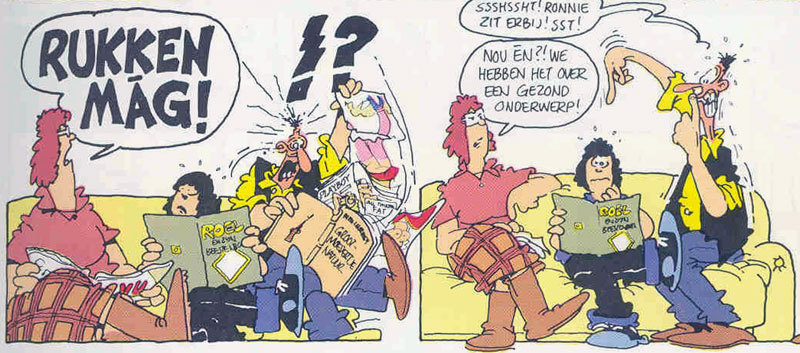
'De Familie Doorzon'. Mother Doorzon assures her son that "JERKING OFF IS O.K.!".
John and Mieke have three children living at home. Their daughter Doortje is in a relationship with a black Surinamese, Arie Bleekjes, with whom she has a mischievous baby son, Dozo. Neither Doortje or Arie have a job: they benefit from welfare and their parents' income. The couple has an active but troubled sex life, since Arie is often too drunk or tired. Doortje, on the other hand, is into kinky stuff and wants to try out all kinds of "exciting" role play, which fails to bring her husband in the mood. Much like her mother, Doortje has dozens of affairs. John and Mieke's first-born, son Tonnie, is gay. He has a relationship with Arie's twin brother, Kees. The youngest son Ronnie is a juvenile delinquent. The teenager grew from a mere hoodlum into a shady gangster, involved with pimping, drug dealing, robberies and even murder. To fit his new image, he started wearing sunglasses, tuxedos and smoking cigarettes and weed. Ronnie often hires Tonnie and Kees as his personal bodyguards and cronies. Another accomplice in Ronnie's antics is the Doorzon's pet Frisian ring snake, Sneek. Finally, Grandpa Doorzon is a closeted gay man, while Uncle Rien (based on Dutch illustrator Rien Poortvliet) is a cold-blooded game hunter.
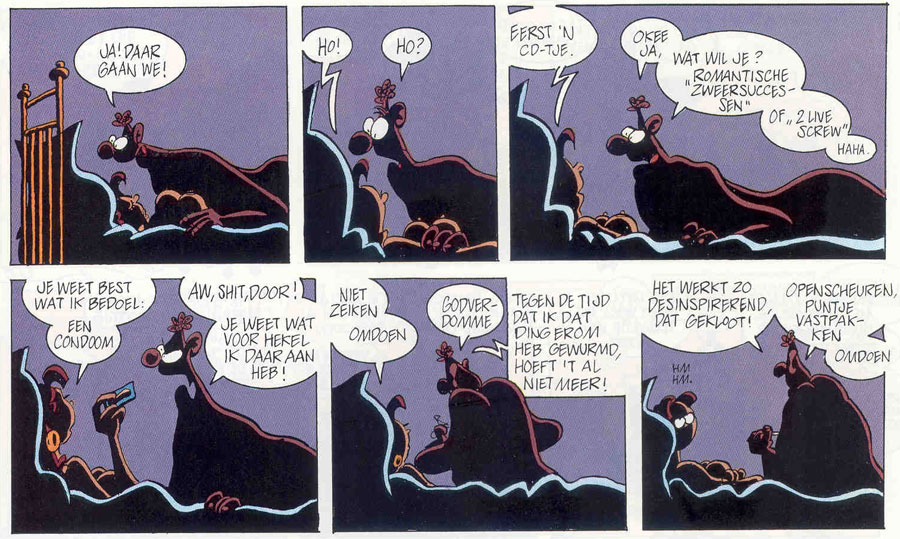
'De Familie Doorzon'.
The conservative John is horrified by the self-described "weirdoes" and "deviants" within his family. But he's far from a model citizen either. Apart from his intolerant attitudes, adultery and pornography addictions, he is a chain smoker and bar hopper. His light bulb store doesn't attract any customers, which he blames on everybody but himself. Whenever he goes on vacation, he sees no qualms in tying Henk, the family dog, to a tree. And John only goes to church when it suits him. Unfortunately, his local priest, Godenthal, is morally corrupt and doesn't respect his vow of celibacy. John receives more suitable support and advice from his favorite bartender, Tinus Vandernafoklarven, owner of "The Peg Bar". Yet even Tinus can get fed up with John's pathetic attempts to pick up his female clients or tendency to wallow in his misery. As much as John complains about the abnormal people who surround him, Tinus is also not your average café boss: he is a cross-dresser. The bearded bartender always walks around in a skirt, with a bra, stockings and high heels.
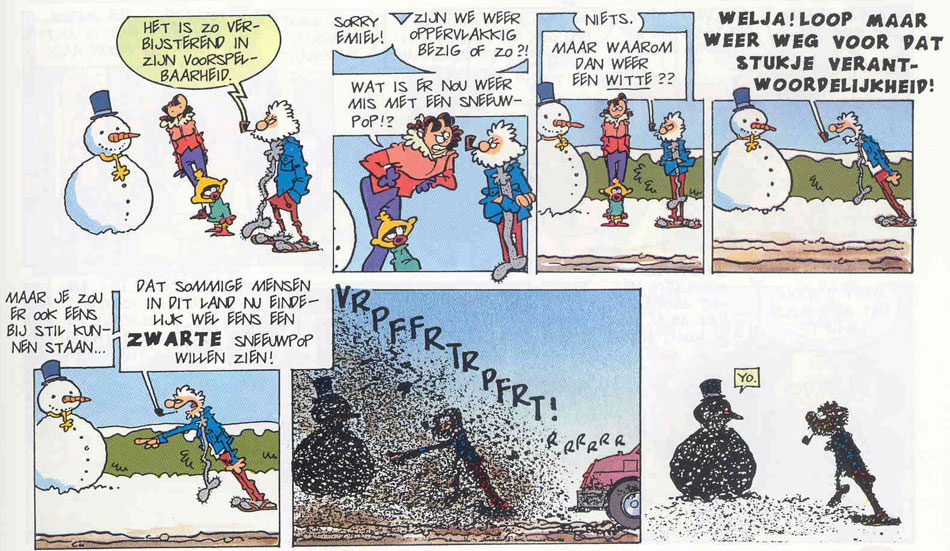
'De Familie Doorzon'. Emiel Rutjes feels offended that Doortje and Dozo refer to their snow creation as a "snow man" instead of a "snow person" and feels it might be time for a "black" snowman instead of always a white one.
John's relatives have their own regular advisor: Emiel Rutjes, a part-time social worker, marriage counselor, child rearing expert and self-help guru. He has a hippie-like tendency to "change" the world through idealistic, politically correct projects. In Dutch culture, such people are often dismissed as "geitenwollensokkendragers" ("people with goat wool socks") and naturally Emiel also wears a pair. He even uses a sock as a tie. Emiel often thinks up compromises for issues that divide conservatives and progressives. Although Emiel is well-meaning, he is an opportunist, living on welfare and using his fancy talk to get gullible women in his bed, including Doortje and Mieke. This explains why John is the only one who remains cynical about Emiel's therapies.
In the meantime, the Doorzon house is subjected to a constant stream of destructive renovations by the Biereco construction firm. Run by two handymen, Theo and René, "De Biereco's" often laze about and guzzle beer. Whenever they finish a construction, it tends to tip on its side. The duo was directly based on two real-life handymen, "De Bureco's", who spent ages refurnishing De Jager's house before he could sell it. According to him, everything they built did indeed collapse afterwards.
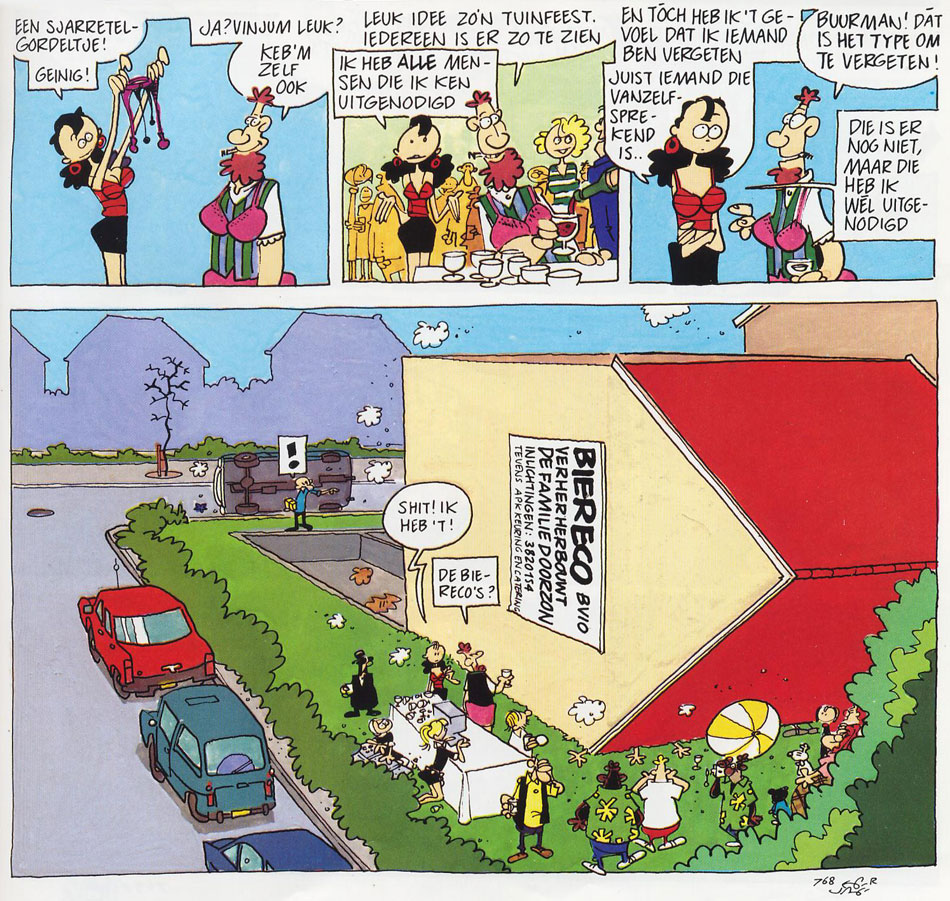
De Familie Doorzon #19 - 'Zwarte Handel'. Doortje suddenly realizes who they forgot to invite to the party: their incompetent builders the Biereco's.
De Familie Doorzon: style
Many elements in 'De Familie Doorzon' are autobiographical. De Jager originally based Pa Doorzon on his own father, Doortje on his big sister and Tonnie on his big brother. De Jager identified most with Ronnie, since he too was a little brat. Originally, Ronnie was a minor 12-year old character, but he eventually fleshed him out. In one storyline, the teenager gets the nextdoor neighbor - the subject of his father's desires - pregnant and bore quintuplets. In real life, De Jager also got his girlfriend pregnant, though she was 18 and he 22. As the author grew older, he related more to John, a pitiful middle-aged man who fails to understand the changing world around him. While living in a residential area himself, he saw people chit chatting behind hedges, while cheating on their partners. He also took a lot of inspiration from paging through the readers' section of the feminist magazine Opzij.
De Jager once described 'De Familie Doorzon' as an edgy counterpart to 'Jan, Jans en de Kinderen', a popular family comic by Jan Kruis for the women's weekly Libelle, about a nice, wholesome Dutch family. While Kruis did address topical issues like homosexuality, single motherhood and multicultural society, he did so in a positive, open-minded manner. In 'De Familie Doorzon', modern-day controversies were played for laughs rather than a social statement. Since the comic aimed at the adult readership of a men's magazine, the comedy is pitch black, vulgar and offensive. Later, De Jager emphasized that 'Doorzon' certainly wasn't a statement against 'Jan, Jans en de Kinderen', a comic he actually liked. During the bland 1980s, the time was ripe for comedies built around dysfunctional families. On television there was the British sitcom 'Only Fools & Horses'. Later that decade the Dick Maas film franchise 'Flodder' and Matt Groening's TV series 'The Simpsons' followed, while in the Dutch comics world, Ruud Straatman and Peter de Wit's 'De Familie Fortuin' (1985-1998) appeared in print.
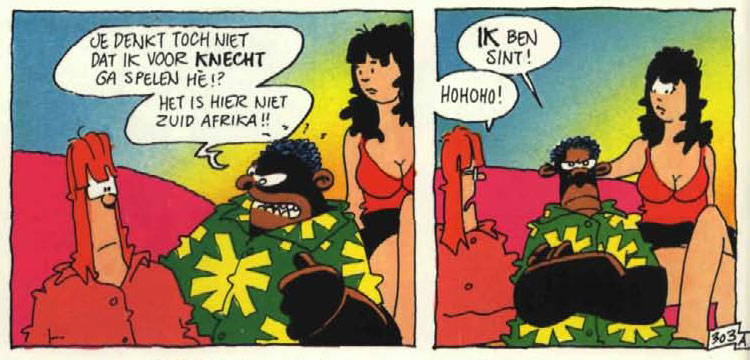
Already in the 1980s, the discussion about the character of Zwarte Piet in the annual Sinterklaas festivities was tackled in the 'Doorzon' comic.
'De Familie Doorzon' is a witty satire of Dutch society, particularly its reputation as a "tolerant welfare state". Many minority groups in the comic defend the right to be who they are but are often more driven by ego games. Well-intended initiatives to combat discrimination simply got absurd. The sexual revolution led to liberation, but also to a sleazy porn industry. Free access to prostitution and drugs made organized crime thrive. And welfare money simply gave many characters an excuse to lie around on their ass. On the other hand, the conservatives in the comic who try to keep everything "normal" are narrow-minded censor knights. Even more hypocritically, they often benefit the most from the things they want to ban. Readers often tried to pigeonhole De Jager's political ideology. Interviewed by Mario Stabel for Stripspeciaalzaak.be in 2021, the author revealed that "my opinion is merely whatever offers the best joke. Sometimes the punchline is very right-wing, other times very left-wing. I've always tried to expose the idiocy and bullshit, both within the right and left." Indeed, 'De Familie Doorzon' has managed to outrage and amuse both conventional and politically correct people.
De Jager enjoyed emphasizing the oddness of all the stereotypical representatives of the modern-day Netherlands. However, these cast members aren't one-note running gags, but fully fleshed out personalities. For instance, De Jager deliberately made Tonnie and Kees not effeminate gays, but a loving couple with exhibitionist tendencies. The black Surinamese Arie is so well integrated in Dutch society that John actually gets along with him, sharing a love for watching football and porn together. De Jager also subverted stereotypical clichés. Arie isn't a well-endowed black nymphomaniac, but sometimes suffers from impotence like any other middle-aged man. As eccentric and quarrelsome the Doorzons are, they do enjoy each other's company at times and even have heartwarming feelings towards each other. Thanks to his versatile cast, De Jager could use them in many different situations, inspired by new societal trends. Throughout the series, he has satirized camping, insurance companies, mail-order companies, pretentious poets, television, Internet and religion.
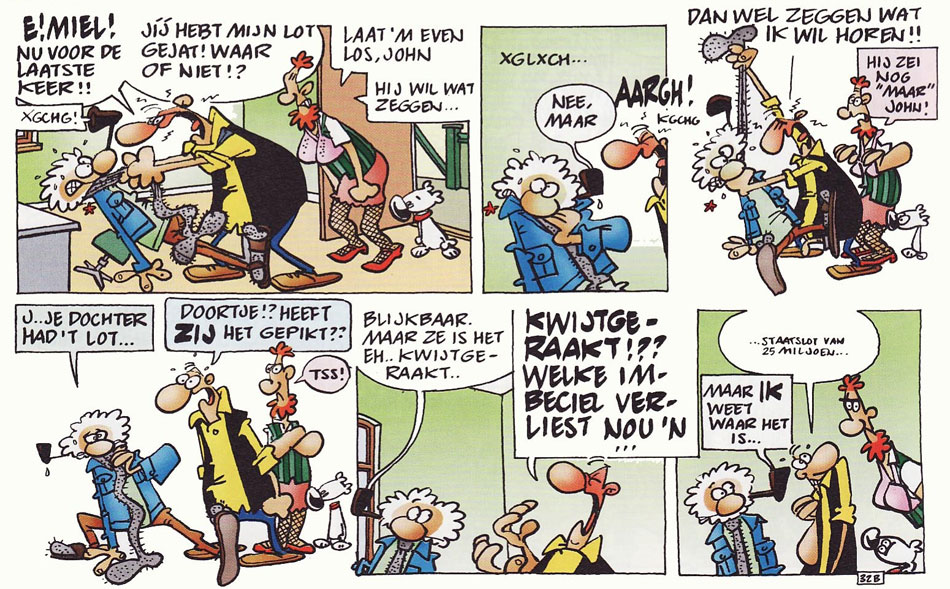
'Doorzon Is Binnen' (2000).
In the mid-1990s, De Jager was confronted with writer's block. He seriously considered discontinuing 'De Familie Doorzon', but eventually took a different approach by making full-length adventure stories instead of one-page gags. He'd already experimented with this idea in 'Emiel's Relatieboot' (1983), a parody of the TV show 'The Love Boat', where Emiel offers relation therapy on a ship. It featured the cast in an unusual setting and proved they were strong enough to carry a longer narrative. In 'Zwarte Handel' (1995), he experimented with a continuing plot for a few pages, in which the Doorzons strike oil in their garden. With 'Doorzon Is Binnen' (2000), 'Doorzon Te Koop' (2002) and 'Doorzon Verkocht' (2003), De Jager made three full-length story-driven albums. The first one was also serialized in the newspaper Het Parool, also the story De Jager was most proud of. 'Doorzon Is Binnen' was inspired by a real-life incident where a lottery winner in The Hague had accidentally been paid 25 guilders instead of the 7.9 million he was entitled to. The National Lottery had been unable to trace him for a week. In De Jager's story, John wins the lottery and tries to keep it a secret. Through a series of funny misunderstandings, the other side characters want to steal, retrieve or cash the precious ticket in. In the album 'Doorzon Ligt Dubbel: De Familie Kantoorzon' (2001), the Doorzons run their own office.
In March 2010, Nieuwe Revu #9 ran the final episode of 'De Familie Doorzon'. By then, Doortje and Arie had moved to Suriname, with the rest of the family joining them. Staying behind in The Netherlands, John finally enjoys the peace and tranquility he so craved. While De Jager acknowledged the end of 'De Familie Doorzon', John's daily opinions continued in the spin-off cartoon series that ran in Algemeen Dagblad since 2005. It wasn't until March 2026, before the 'Familie Doorzon' comic with the entire family was relaunched in the pages of Eppo magazine.
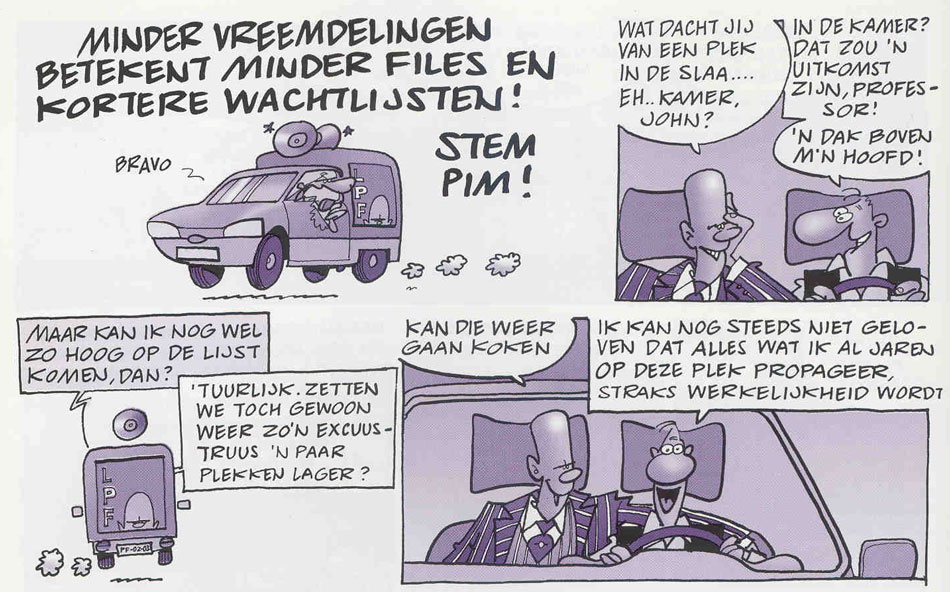
On occasion, Gerrit de Jager referenced real-life politicians and events in 'De Familie Doorzon'. In this episode, John meets homosexual far-right politician Pim Fortuyn and praises him for his anti-immigration policies. However, once Doorzon suggests putting "gay people back in their place", Fortuyn quickly runs off in anger.
De Familie Doorzon: success
In the Netherlands, 'De Familie Doorzon' can be credited with bringing the subversive attitude of underground comix into the mainstream. In a way, it followed in the footsteps of Peter van Straaten's topical gag comic in Het Parool, 'Vader en Zoon' (1968-1985), about the eternal arguments between a right-wing conservative father and his left-wing progressive teenage son. But 'De Familie Doorzon' went further in its subject matter. It introduced cast members not usually seen in Dutch comics, except as one-shot side characters, like homosexuals, crossdressers and Surinamese people. The comic also addressed daring topics, like same sex marriage, regulation of soft drugs and adoption by LGBTQ couples. Some are still hotly debated today, like abortion, gender fluidity and political correctness. But De Jager always managed to find comedy in these heavy-handed situations, making readers from different ends of the political spectrum laugh.
At the height of its success, the series sold more than 100,000 copies, published by various companies over the decades: Espee, Oberon, Big Balloon, Standaard and De Harmonie. Various merchandising items were launched, like annual agendas, tear-off calendars and, from 1992 on, five holiday-themed books. These holiday books also featured reprints of other comics by De Jager and Stevenhagen, as well as contributions by fellow creators such as Herman Brood, Luc Cromheecke, Hein de Kort, Ramon Lopez, Dick Matena, Marlen Nolta, Jan Rot, Eric Schreurs, Jan Vervoort, Windig & De Jong and translations of Bill Watterson's 'Calvin & Hobbes'. On commission, the Doorzon family appeared in exclusive educational comics, like the burglary prevention guide 'Familie Doorzon: Inbraakpreventie' (1988) and a comic promoting environment-friendly trash cans in 'Smerigste Biobakken' (1993). The characters were also used to advertise the health fund in 'Doorzon in het Ziekenfonds' (1982) and American Express' Travelers Cheques in 'De Familie Doorzon Op Vakantie' (1996). At a certain point, De Jager even hired a personal secretary to keep track of his business deals. In 1984, an animated TV adaptation was considered, for which De Jager and Stevenhagen designed character sheets and storyboards, but otherwise had no involvement. While some footage was finished, the entire project fell through once De Jager and Stevenhagen broke with their publisher Ger van Wulften.

'Sneek' strip from Sjors & Sjimmie Stripblad #11, 1993. Sneek feels a biologically responsible garbage can is "as hot as the tropics."
'De Familie Doorzon' also spawned spin-off comics. The family pet snake Sneek crawled off to star in its own gag comic 'Sneek' (1988-1999), published in the comics weekly Sjors & Sjimmie Stripblad (and its successors SjoSji and Striparazzi) and the TV magazine TV-Krant. Starting out as a strip with corny puns, the reptile later teamed up with Ronnie Doorzon for criminal activities. In 1997, Big Balloon published one 'Sneek' album. Since 2005, John Doorzon has been commenting on the news of the day in his daily one-panel 'John' cartoon in Algemeen Dagblad. During its final two years in Nieuwe Revu, 'De Familie Doorzon' was downsized to a half-page comic under the title 'John & Youssef', in which John Doorzon, by now abandoned by his family, chats from over the hedge with his Moroccan neighbor.
'De Familie Doorzon' is deeply rooted in Dutch culture. Nevertheless, in 1985 some albums were translated into German under the title 'Dekker'. The German weekly Stern once asked De Jager whether he could make an equivalent comic series for them, revolving around a stereotypical German family. De Jager liked the idea, but stated that he would have to move to Germany to get a good feel of their society, so he eventually declined the offer.

'Toon Ladder'. Toon Ladder doesn't want a DJ to spoil a concert he planned for his band. Yet the crowd loves "the great sound" of their fight.
Toon Ladder
As if 30 years of weekly 'Familie Doorzon' episodes isn't impressive enough, De Jager has created a great many other comics and cartoon features on the side. In 1982, the final Prutswerk co-creation saw the light, although this became largely a De Jager solo production. As the title character, the artists chose the shady publisher from their 'Han Gewetensvim' comic and gave him a new career as the music manager of Walgfun Records: 'Toon Ladder' (1982-1991). This gag comic was originally published in music magazine Muziek Express (1982-1988), and later continued in the monthly Music Maker (1986-1991). As manager, he invests in two young artists, Gé and Bertje, but his plans constantly backfire. In later episodes, the skeptical duo is replaced with other, more gullible wannabe pop stars. As a lifelong rock fan, 'Toon Ladder' was a project near and dear to De Jager's heart. He satirizes the record industry, where photo shoots, hairstyles, clothing and music videos are deemed more important than the actual songs. The comic is also an unintentional time capsule of the 1980s, when playback, benefit singles and MTV rose and hair metal, hip hop and house ruled. Behind the surface, 'Toon Ladder' also expressed De Jager and Stevenhagen's increasing frustrations about their publisher, Ger van Wulften. Toon was deliberately remodelled after him, while Gé and Bertje were alter egos for themselves. In 1992, two 'Toon Ladder' albums were published.

'Roel En Zijn Beestenboel'.
Roel en zijn Beestenboel in Robbedoes
Two years after the Prutswerk team broke up and split up their creations, 'Roel en zijn Beestenboel' made the transition from the defunct Jippo title to the Belgian Robbedoes magazine. While Robbedoes was originally a translated edition of the French-language parent magazine Spirou, in 1984 the Flemish editors had secured several pages which they could fill with work by Dutch and Flemish comic creators. This led to the introduction of Flemish creators like Luc Cromheecke and Hec Leemans in the magazine's pages, but also to the appearance of Dutch humorists like Toon van Driel, Peter de Smet and De Jager. Rebooting 'Roel en zijn Beestenboel' in the 12 July 1984 issue of Robbedoes, De Jager had Roel and his fully clothed animal friends move into a new apartment, where they have to continuously foil their landlord, who doesn't allow pets in his building. Becoming the star of the Dutch section, De Jager's feature was picked up by the French-language Spirou as well, where it ran between 1985 and 1994 under the title 'Aristote et ses Potes'. By 1986, the separate Dutch section in Robbedoes was already terminated, and most of the local productions disappeared. As they were also printed in Spirou, only De Jager's 'Roel en zijn Beestenboel' and Luc Cromheecke and Laurent Letzer's 'Tom Carbon' remained regular features, marking the international breakthrough of these creators. In 1986, Spirou's publishing house Dupuis launched a new book collection series of 'Roel en zijn Beestenboel', both in Dutch and in French.
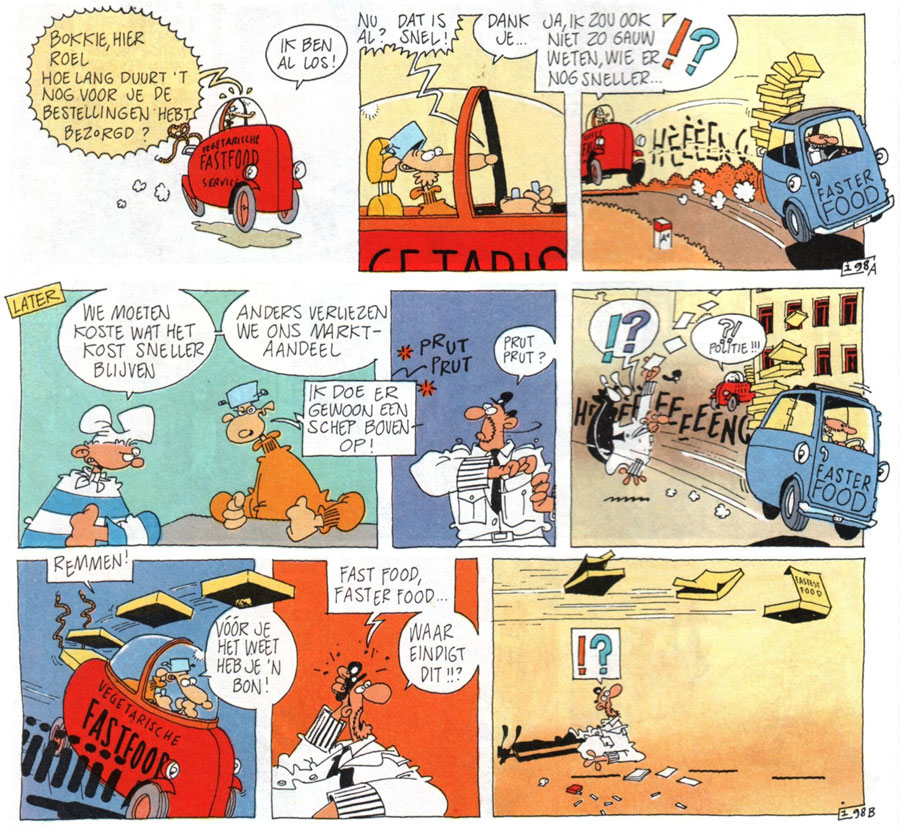
'Roel en zijn Beestenboel' #3: 'Fast Food'. Bokkie tries to be faster than their rival fast food service. The police officer wonders how much faster this fast food will get.
With 'Roel en zijn Beestenboel', De Jager developed himself into a humorist for a broad readership, with a knack for running gags, absurdism and slapstick humor. In the 1985 episodes, he had Roel - a bit older than in his original Jippo appearances - and his animals rent a new building to start a vegetarian restaurant. Roel is the cook, Ben the pig and Emmy the cow are the restaurant's waiters, while Ronald the duck and Hennie the hen do the dishes. Again, the driving force behind most of the humor is the enterprising goat Bokkie. For each new album, Bokkie's initiatives form the theme of the new series of gags. At the start of the restaurant business, Bokkie overenthusiastically runs the restaurant's cloakroom, leaving most guests largely undressed and completely baffled before reaching their table. Bokkie's main victim is the new landlord, who constantly fails to hand Roel his eviction order, because he can't make it past the cloakroom. Further series of gags have Bokkie start a fast food delivery service, run a train station next to the new TGV railway and try to secure a gastronomic "Mushroom" label from the visiting inspector (who is actually a walking mushroom). New characters in later episodes are Emmy's Spanish cousin Julio - hiding from bullfighters and oversensitive to the color red - and Bokkie's seven mischievous nephews, who at one point free the animals from the city zoo and hide them in Roel's restaurant.
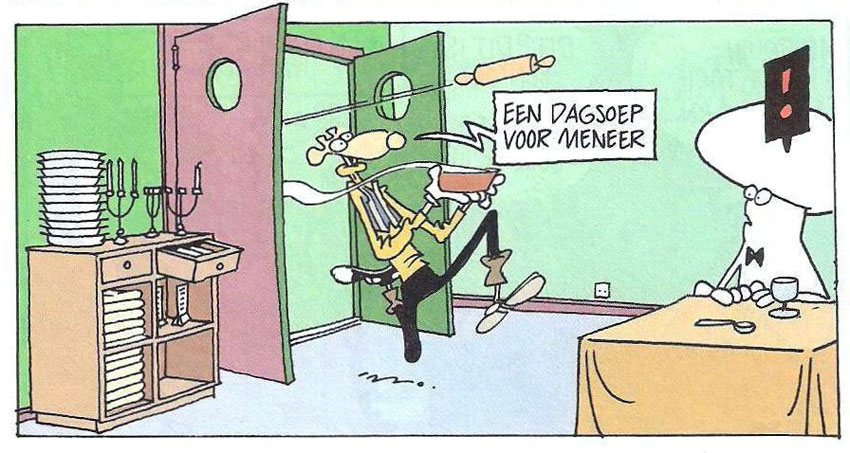
'Roel en zijn Beestenboel'.
In the annual "fog pages", De Jager explored the use of meta-humor. Around page 20 of each album, the cartoonist had his characters walk around in thick fog, showing only their speech balloons, in which they criticize their artist for being late for his deadlines, fooling his editors and trying to find the easy way out. In the spin-off gag strips 'Uit de Verhalentrommel van Oom Bokkie' (1986) and 'Oom Bokkies Kookstrook' (1987-1989), De Jager also cultivated his fictionally stressed relationship with the Robbedoes editors. Appearing on the magazine's editorial pages, Bokkie tries to tell the readers a story or teach them a recipe, but never reaches the end because the editors only gave him one strip of panels. Between 1988 and 1989, the 'Kookstrook' strips also appeared in Spirou as 'Mets et Gourmets'.
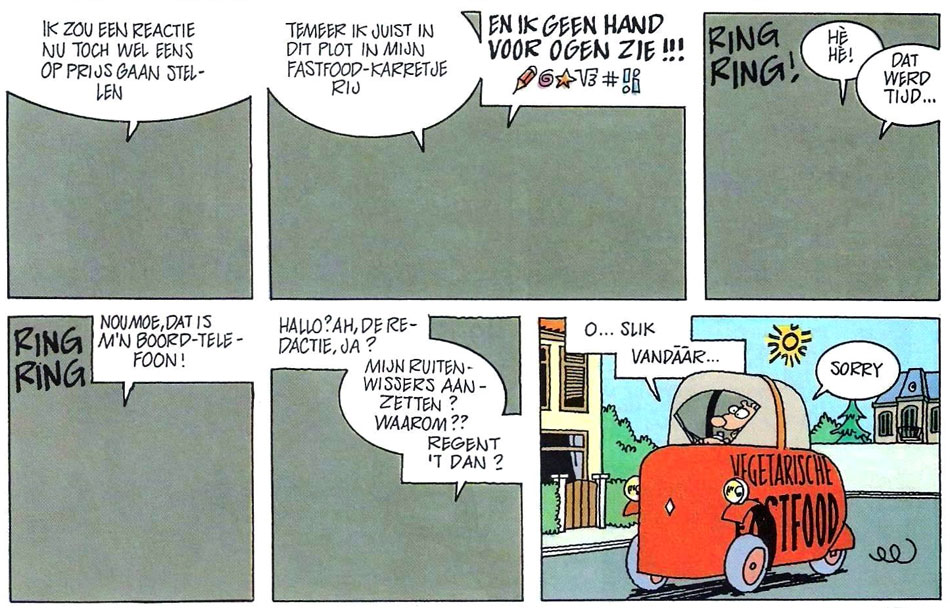
"Fog page" from the 'Roel en zijn Beestenboel' album '7 Bokkies'. Bokkie has forgotten to activate his windshield wipers.
Roel en zijn Beestenboel in other magazines
Between 1990 and 1997, 'Roel en zijn Beestenboel' also ran in the Dutch comic magazine Sjors en Sjimmie Stripblad and its successor SjoSji. When in 1994 the Robbedoes/Spirou Robbedoes publications came to an end, De Jager made his new gags directly for SjoSji, which were collected in the final album published by Big Balloon in 1996. For the KRO TV guides TV Studio and Mikro Gids, De Jager made the final incarnation of the series, the spin-off comic 'Bokkies voor Bokkies' (1999), in which Bokkie and his friends start their own commercial TV station. In 2006, the 'Roel en zijn Beestenboel' series made a short comeback in the relaunched Jippo magazine.
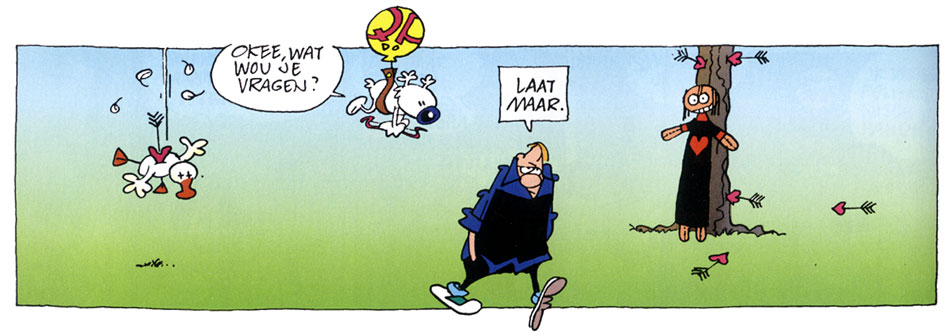
'Liefde en Geluk'.
Liefde en Geluk
Where his unhappy first marriage formed an important inspiration for 'De Familie Doorzon', De Jager got the idea for his first newspaper comic after falling in love again. His feature 'Liefde en Geluk' ("Love and Luck", 1983-2005), sometimes spelled as 'Liefdengeluk', debuted on the Goochem page of the Amsterdam newspaper Het Parool on 21 April 1983. Replacing Charles M. Schulz's 'Peanuts', the four-panel feature was introduced as "the tiniest strip of the Netherlands", as it was printed next to the Goochem header at the top of the page. The main character Jaap is madly in love with Greet, only his efforts to win her heart - serenades, flowers, love letters - don't seem to work. His friends strongly advise him to leave her alone, but he is too smitten with her to give up. Yet, when he does shift his attention to other women, Greet gets jealous and wants his attention. In later gags, they start dating, but never quite become a couple.
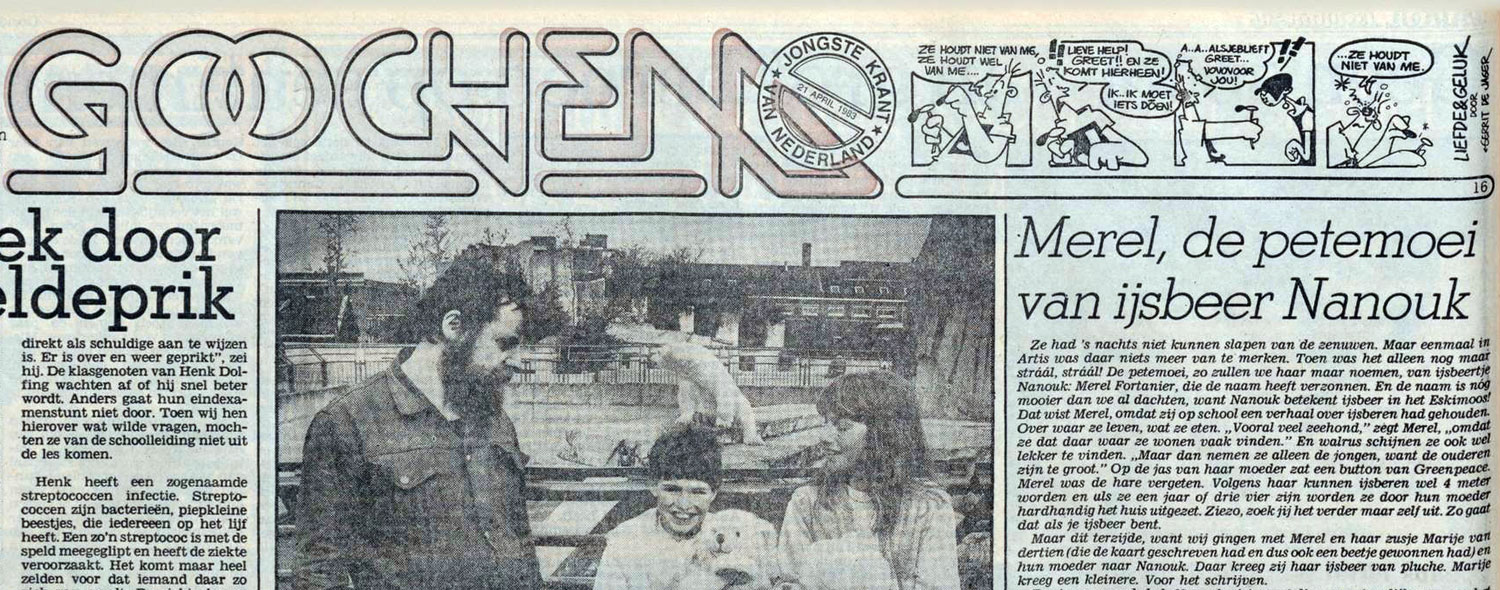
First appearance of 'Liefde en Geluk' on the Goochem page of Het Parool on 21 April 1983.
Despite the title, 'Liefde en Geluk' is more than a romance comic. Jaap often pours out his heart to bartender Bar-Jan, whose disobedient but highly intelligent fox terrier quickly became a stand-out character in the series. Throughout the series, he is only referred to as "Hond" ("Dog"). Many gags deal with Bar-Jan's frustrating and humiliating attempts to train the animal. Refusing to fetch a bone or a stick in the traditional way, the dog often starts arguing about performing such menial tasks. He considers urinating against a tree, sleeping in a basket or simply obeying his master beneath him. The only time he follows his animal instincts is when he attacks the mailman, who coincidentally also fancies Greet. While De Hond is a jerk, he can be very loyal and helpful when Jaap faces particular problems, for instance getting Greet's attention. In later episodes, they often team up, until Jaap basically becomes his new owner.
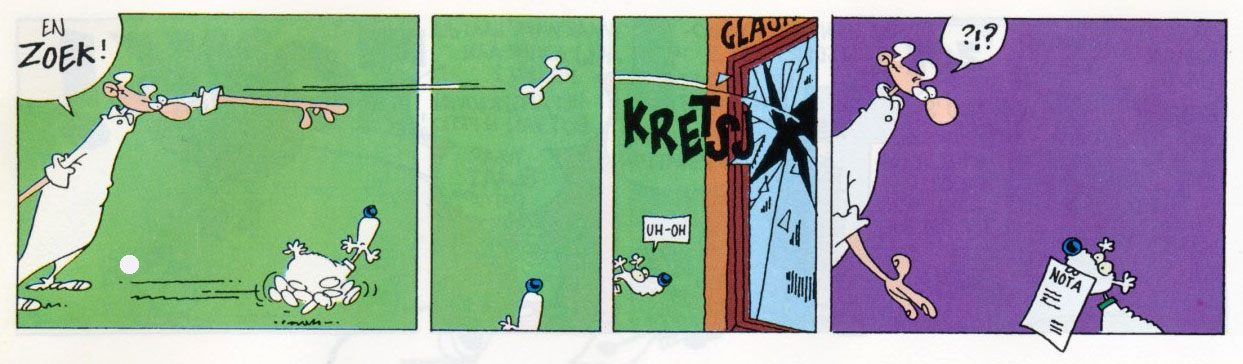
'Liefde en Geluk'.
'Liefde en Geluk' caught on and was eventually bought away by another newspaper, Algemeen Dagblad (AD), after which in January 1987 the 'Goochem' page in Het Parool introduced Windig & De Jong's 'Heinz'. 'Liefde en Geluk' also ran in the TV magazines Televizier, TV Guide and TV7, as well as the comic magazines Titanic and Sjors & Sjimmie Stripblad. Between 1994 and 1997, full-page gags and longer stories with the characters ran in SjoSji magazine. While several gags in 'Liefde en Geluk' feature timeless comedy, certain episodes took direct inspiration from current events by having Jaap, Greet and Hond comment on them. At this occasion, Greet acted as a fortune teller, giving Dutch and international politicians cosmic advice. Book collections of the series were published by Espee and Big Balloon. In 2005, several regional papers were absorbed by the national newspaper AD, and cartoonists were required to sign an exclusivity contract, which several refused. As a result, 'Liefde en Geluk' was canceled, although De Jager continued his association with the newspaper by launching his daily 'John' cartoon.

'Zusje' newspaper strip, initially with the faces of all the other characters obscured.
Zusje
In 1999, De Jager added a second daily strip to his production, this time for page 2 of the newspaper Trouw: 'Zusje' (1999-2008). Again inspiration came from his personal life. The cartoonist's sister-in-law just had a baby, and De Jager thought it would be funny to make a strip around an offscreen baby in a pram pondering life questions. He quickly discovered that the baby needed a conversation partner, so he gave her a bigger sister, who became the title character Zusje (although her real name is Pip). Too wise for her age, Zusje often teams up with the family cat, whom she joins in his basket to discuss life's problems and the news of the day. While mostly nameless, over the years the cat has been called Spierbal, Poesie and Kater.

'Mik'.
Interesting about De Jager's concept was that besides Zusje and the cat, all the other characters remained off-screen. Shortly after the launch of the daily strip, the editors of the women's magazine Margriet asked De Jager to create a weekly comic page about the characters around Zusje, most notably her parents. In 2000, a spin-off of the 'Zusje' comic debuted on Margriet's back cover under the title 'Mik', although this was eventually changed back to 'Zusje'. The Margriet version (2000-2026) revolved around working mother Mik van Galen and her husband Huib, and was initially focused on social themes such as the division of care. In a way, the strip was a prequel to the newspaper strip, as the baby wasn't born until the end of the first year of 'Mik'. Many gags revolve around the couple's attempts to combine their jobs with running their household. Mik works at a broker's office, where her nameless boss is focused on labor progress. Additional side characters are Mik's best friend Isabel and Huib's mother, Oma ("Grandma"), who is very independent, trendy and good with tools. Originally, 'Mik' was intended to address recognizable everyday events from a female perspective. But since De Jager was a man, the tone shifted more to how bumbling dad Huib reacts to situations.
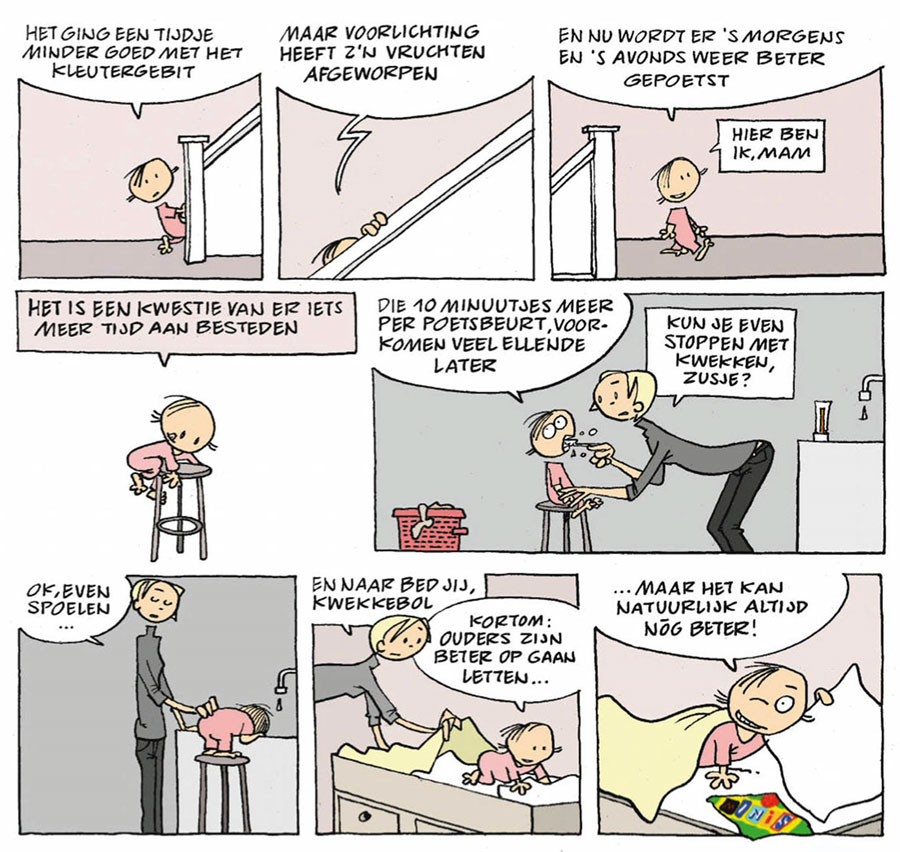
'Zusje' (2019). Zusje decides to eat more sweets, to make sure that her parents keep an eye on her developing teeth.
However, Zusje and her cat quickly became prominent characters in the weekly Margriet comic as well. Many gags revolve around Zusje's adorable but naïve interpretations of the world around her. The little girl is very demanding and wants to watch television and stay up late. If she can find a reason to not go to the daycare center, she is excited. A running gag is that Zusje sometimes pretends to be the Prime Minister ("Premier Zusje"). Wearing glasses on her nose, she observes problems on a children's level, but uses adult terms to describe them. Another running gag features Zusje as a fortune teller, predicting the future.
Over the years, 'Zusje' spawned several merchandising items, like calendars, agendas, some book compilations and two drawing guides for young readers: 'Striptekenen met Zusje' (2009) and 'Teken Je Eigen Stripavontuur met Zusje' (2010). The comic was also translated in French as 'Jupette' (2002-2005) for the Belgian comic magazine Spirou. For several years, the 'Zusje' strip ran simultaneously in both Trouw and Margriet, until the newspaper version came to an end in August 2008. In 2019, the thousandth 'Zusje' gag appeared in Margriet, and in 2025 the weekly comic's 25th anniversary was celebrated with a special book compilation, 'De Allerliefste Zusjes' (Uitgeverij L, 2025). In early 2026, the 'Zusje' comic was canceled in Margriet, and replaced by a gag comic with Walt Disney's 'Daisy Duck'. With this regular assignment dropped, De Jager picked up 'De Familie Doorzon' again, of which new gags began appearing in Eppo magazine.
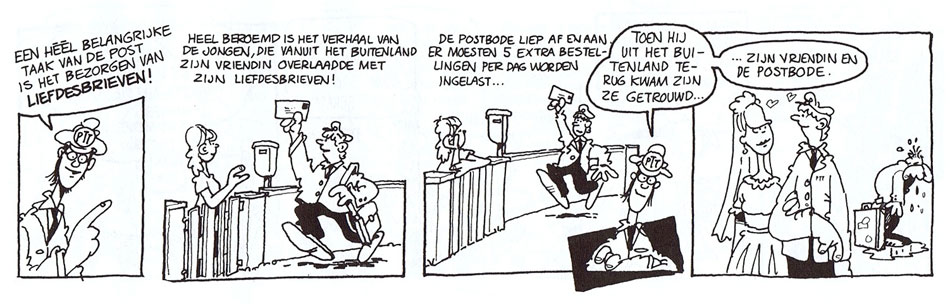
'De Postbode', comic strip series for the postal services, published in Club (1981). The mailman tells an anecdote about how a man used to send love letters to his girlfriend every day... until she married the mailman.
Commercial artist
With popular comic series in mainstream magazines and newspapers, publications abroad and commercially successful book series, De Jager became one of the most sought-after cartoonists of the Netherlands. His quick and efficient drawing style was instantly recognizable to many, making it interesting for commercial parties to require his services. Already during his early career, there were a variety of assignments, from designing stationery for the Dutch girl group Dolly Dots to drawing ads for the record company W.E.A. Later, more specialized magazines hired him for a comic feature. In 1985 and 1986, he made the 'Fan & Fanneke' strip for the Wordt Vervolgd and Nationale Toptien pages of the TV guide AVRObode/Televizier. As a supporter and member of the football club Ajax, De Jager made the comic feature 'Krijter' (1994- ) for the soccer magazine Hard Gras, starring a man who has to make the chalk lines on the playing field. Each episode featured commentary on recent sports events. In 2014, Oog & Blik/De Bezige Bij released the compilation book 'De Grap Is Rond', featuring soccer-related one-panel cartoons from Hard Gras by both De Jager and Peter de Wit.
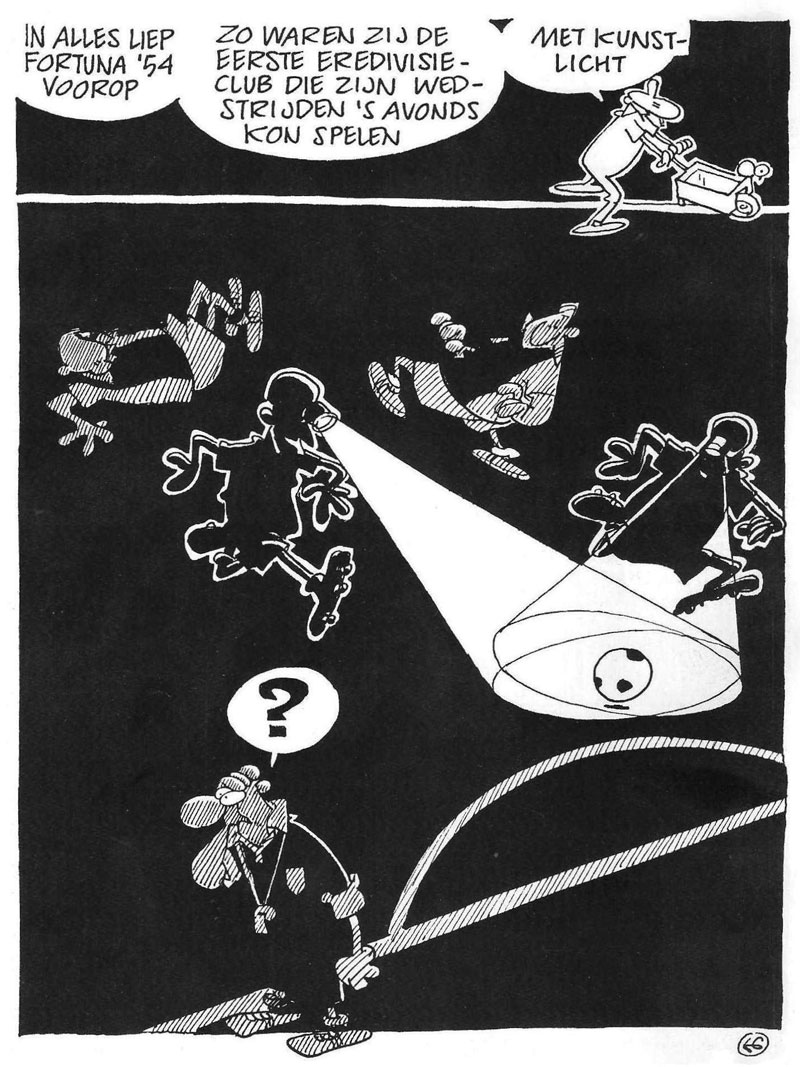
'Krijter' for Hard Gras magazine.
One of De Jager's most lucrative assignments was designing the concept and the artwork for the 'Bob de Beer' picture books and merchandise, commissioned by the department store De Bijenkorf. Between 1988 and 1995, seven picture books were made, the first written by De Jager himself, the later installments by Inez van Eijk and Gerrit Mollema. Robertus Bastiaan van Bolgeboren is a highly intelligent teddy bear, whose nickname BOB also stands for "Bijzonder Ontwikkelde Bear" ("Amazingly Developed Bear"). In the debut story, he puts an ad in the newspaper for adoption and ends up being bought by the married couple Jacques and Marije. He quickly becomes the boss in their household, taking advantage of their lesser intelligence. Bob has several cousins from foreign countries, like his African relative Balthasar and the Russian Gorbi, named after Mikhail Gorbachev. Apart from De Bijenkorf, Bob the bear was also syndicated to storehouses in France (Galeries Lafayette), Germany (Kaufhof) and Scandinavian countries.
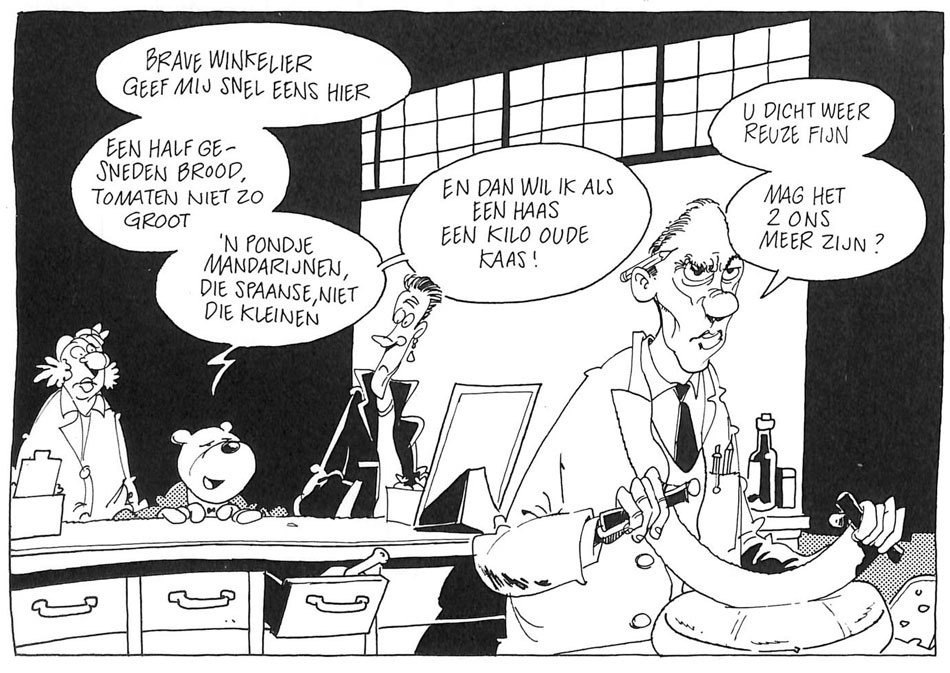
'Brieven van Bob' (1989).
In addition, De Jager has been a regular presence in several staff magazines and specialized titles, often using existing characters from his several series. Important clients have been the Dutch postal services PTT (later TPG and TNT), for which he has drawn promotional strips with his recurring mailman character in Club magazine (1981, later collected in the 1987 comic booklet 'Postbode!'), and additional features in the staff magazines Post-Vervoerkrant ('Aan Getekend!, 1992-2002), Post Magazine ('Bus Buzz', 2002-2003) and Mail! ('Aantekenen!', 2003-2006?).
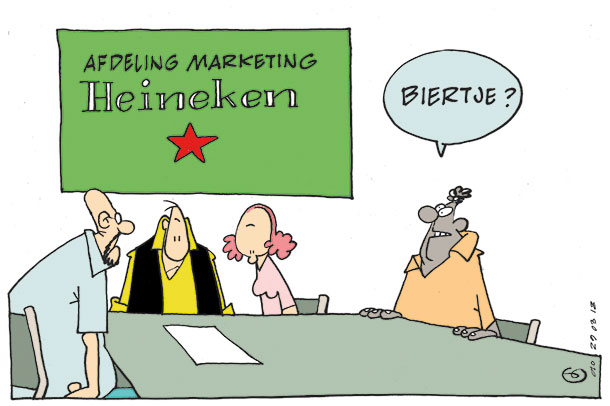
Cartoon for Heineken's Bierblad (March 2018).
De Jager's 'Doorzon' characters appeared in Bierblad, the staff magazine of beer brewer Heineken, and his advertising strips for the Amsterdam regional transportation services GVB appeared in De Volkskrant (2002). A long-running monthly strip has been 'De Firma Evenweg' for Technische Unie, a wholesaler for installation and industrial applications. In late 2011, he also began his comic 'Firma Biereco & Moes' (AKA 'Theo en Moes') in Metaaljournaal, a magazine for workers in the metal industry. Further commercial clients have been KLM, FBTO, the craft beer company Bier&Co, and the Florence care institution, for which he created the bimonthly comic strip 'Floortje'.

'Firma Biereco & Moes'.
In addition, De Jager has created several "safe sex" comic books in collaboration with the SOA Stichting in Utrecht: 'Stop Aids: Vrij Veilig' (1992), 'Denk Na: Vrij Veilig' (1993) and 'Ja, Ik Wil… Veilig Vrijen' (1997). Although these comics were intended as serious educational devices, De Jager didn't lose sight of putting in a little comedy. He used several of his familiar characters and let every page end in a punchline. The comics were also translated into many languages, making them his most widely distributed work.
Together with Maaike Hartjes, he has been for hire as a live cartoonist through the Comic House agency.
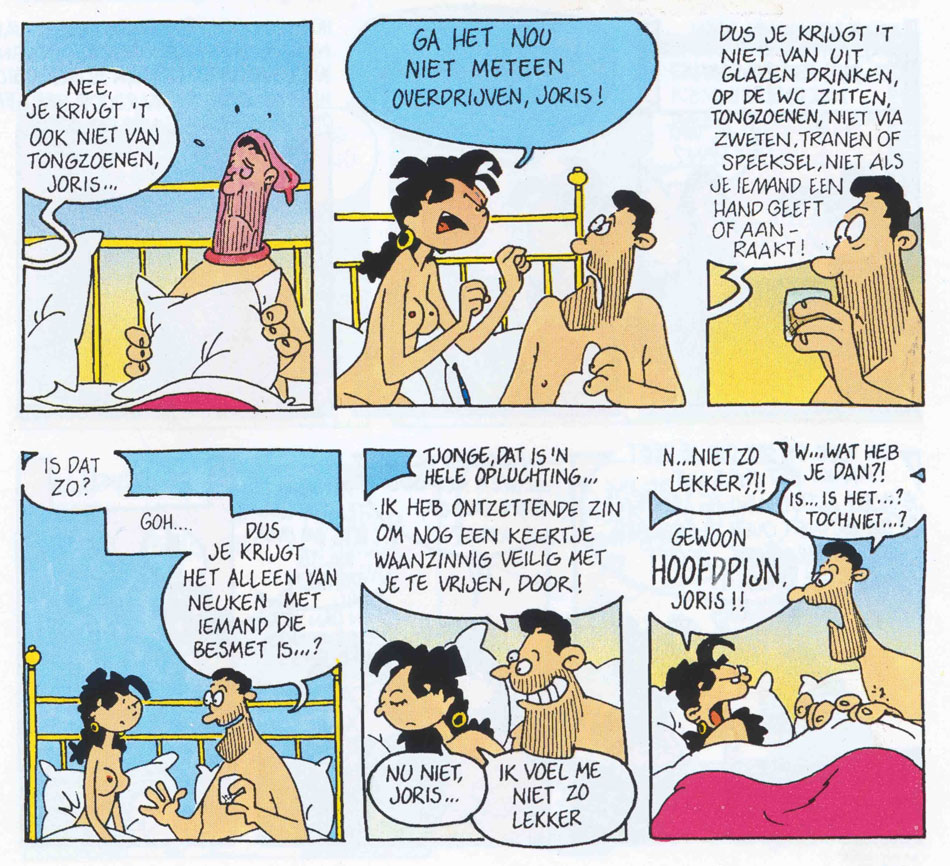
'Stop Aids: Vrij Veilig' (1992). Doortje informs Doortje how you can not get AIDS, which makes her "feel ill". When Joris panics, she assures him that she just has "a headache!".
Comics scriptwriting
Besides drawing himself, De Jager has also written scripts for other artists. In collaboration with his assistant Erik Varekamp, he created the newspaper gag comic 'S.O.S. Zeezicht' (1993-1994) for the newspaper Algemeen Dagblad, which were subsequently collected in two book compilations. The gags revolve around a couple who are stuck on a small deserted isle and try to get rescued.
In 1995, De Jager started a collaboration with his Belgian Spirou colleague Philippe Bercovici, best-known as the artist of the medical gag comic 'Les Femmes en Blanc'. Together, they made the gag comic 'Eva & Adam' (1995-2001). Scripted by De Jager, drawn by Bercovici and digitally colorized by Wim Stevenhagen, the series revolves around the marital troubles and squabbles between the first man and woman. Adam and Eve are drawn half naked, with only their genitals covered with leaves. In many episodes they talk about sex, with condom use being a frequent point of discussion. The snake is depicted as a sneaky, sunglasses-wearing dealer, who often commits adultery with Eve, wrapped in a condom. In French, the blasphemous dirty sex comic ran as 'Adam et Ève, le Retour' in L'Écho des Savanes and in Dutch in the Flemish TV guide Panorama (later P-Magazine). Publishing company Big Balloon brought out six albums. Since De Jager's French was rusty, all communication with Bercovici was done in English. The editors of P-Magazine were originally unaware that the comic was partially Dutch and retranslated the French speech balloons. Much to De De Jager's delight, this sometimes led to unintentionally funnier punchlines. While 'Eva en Adam' was successful enough to get a foot on the French market - Albin Michel released the album 'Et Dieu créa Eve' (1997) -, De Jager quickly grew tired of the format and eventually axed the series.
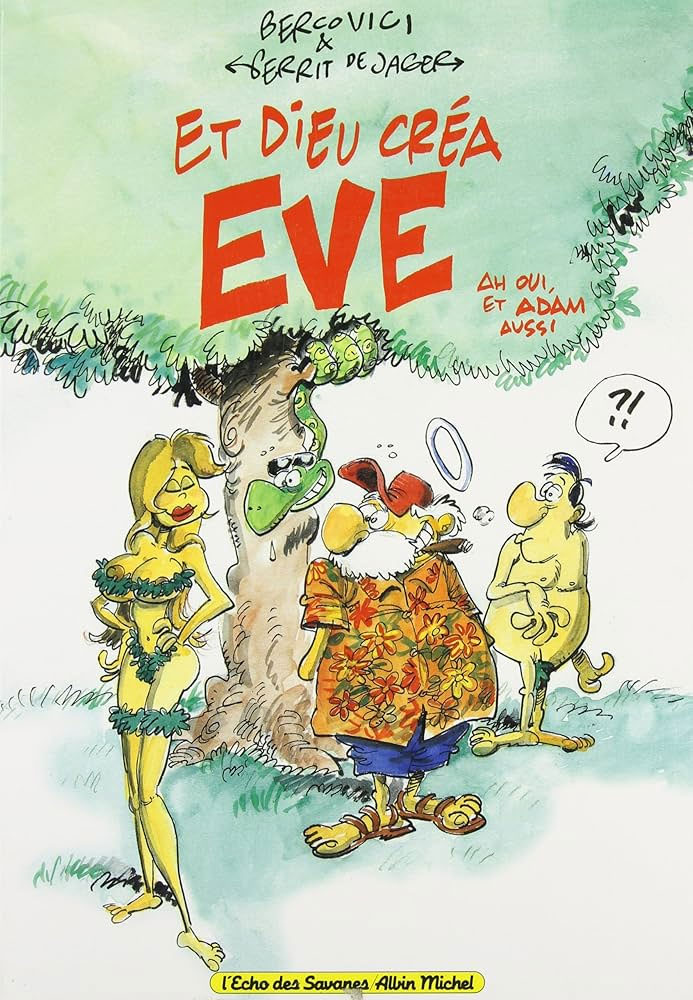
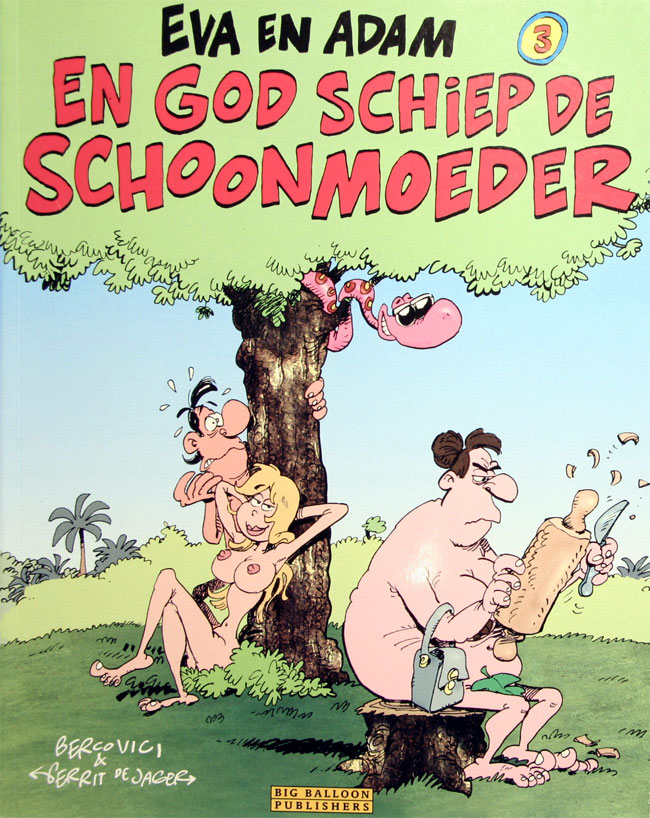
French and Dutch editions of the 'Eva & Adam' series, cover artwork by Philippe Bercovici.
Television work
In the second half of the 1980s, De Jager also ventured into television work. In 1987, he provided the animation for the music video of the novelty song 'Koud Hè?' by the Dutch comedians Henk Spaan en Harry Vermeegen, best known for their satirical TV series 'Pisa'. He later wrote scripts and made animated shorts for their comedy shows 'Verona' (1986-1989) and 'Die 2: Nieuwe Koeien' (1993-1996). The building firm in 'Verona' are a couple of farmers named the "Boereco's", a nod to 'De Biereco's' from 'De Familie Doorzon'. Coincidentally, De Jager later joined Henk Spaan in the new soccer magazine Hard Gras, for which he became a house cartoonist.
Together with writer Gerrit Mollema, with whom De Jager had worked before at Nieuwe Revu, he developed the concept and the scripts of the TV sitcom 'De Vereenigde Algemeene' (1992), about a banking firm, starring Karin Bloemen, Titus Tiel Groenestege, Akkemay and Janke Dekker. However, the series had little success, and was canceled after ten episodes.
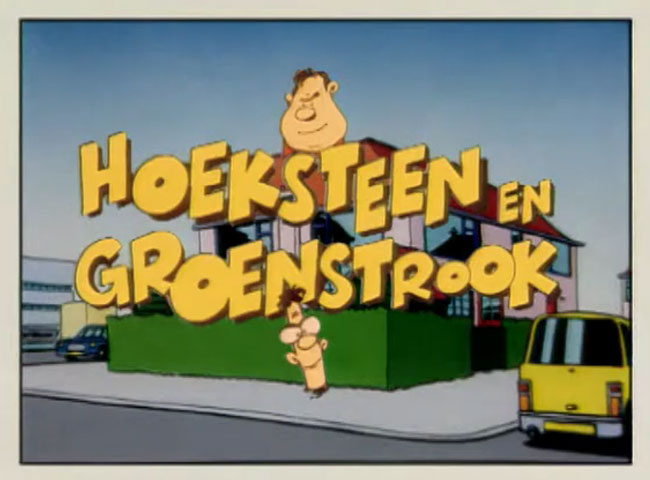
De Jager artwork from the leader of the 'Hoeksteen & Groenstrook' TV series (1993).
In 1993, De Jager, Hans Claessen and Theo Uittenboogaard developed the sitcom 'Hoeksteen & Groenstrook', broadcast on the educational broadcaster Teleac. The show was intended to educate viewers on environmentally friendly housekeeping in a playful manner. De Jager not only worked on the script but also designed the sets. 'Hoeksteen & Groenstrook' came with a special book, with extra comics and cartoons by De Jager. The lead actors in the series were comedian Michiel Romeyn (best-known for the comedy show 'Jiskefet') and the debuting John Buijsman. However, much to De Jager's frustration, Teleac falsely promoted the show as a "course", titled 'Consument & Milieu' ("Consumer and Environment") and broadcast it around midnight, alienating viewers. A couple of years later, actor John Buijsman was cast in a similar role for advertising spots by hardware store Gamma.
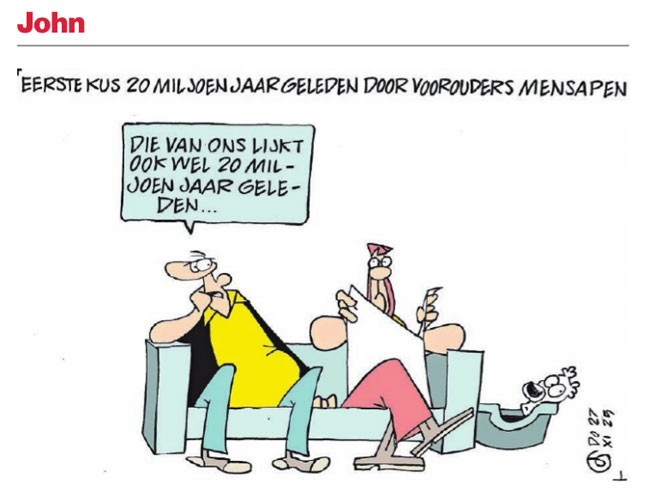
'John' cartoon for AD (27 November 2025). Translation: "The ancestors of apes first started kissing 20 million years ago." - John: "Our last kiss also seems to be 20 million years ago..."
Running a business
During the 1990s, De Jager was at the top of his game with his regular comic features, commercial assignments and TV scriptwriting. As a commercially-minded entrepreneur, he cashed in on his several comic series with annual tear-off calendars and school notebooks, cartoons and comic strips with his popular characters for third parties and special comic books marketed at specific demographics (like a "Liefde en Geluk' volume aimed at dog owners). While he was one of the few comic creators who actually became rich from his work, this also had a downside. At one point, he was mostly running a business from his Amsterdam home, with four people working in his staff, including a personal secretary. Much of his time went to acquisition, administration and other business, while much of the artwork was outsourced to assistants like Erik Varekamp and Peter van Dongen. In interviews, De Jager explained that working on all this secondary business made him a very grumpy man for many years. At the turn of the century, he decided to shift gears. During this period, many of his ongoing book series came to an end and he returned to doing what he liked the best: working on his daily and weekly comics and cartoon features.
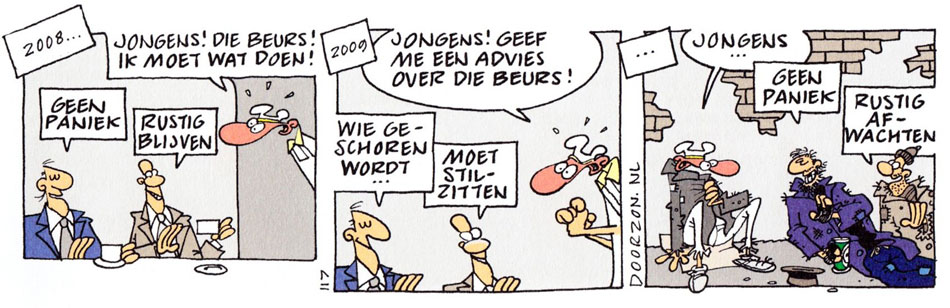
'Broodje Beurs'. Bar-Jan is panicking about the stock exchange, but the others keep telling him to just wait and be patient...
Topical gag comics and cartoons
For the financial newspaper Het Financiële Dagblad, De Jager drew the gag comic 'Broodje Beurs' (September 2007-2012). The name alludes to the sandwich store around the corner of the Amsterdam Stock Exchange, where business people traditionally meet during lunch breaks. In each gag, two anonymous business people discuss real-life recent economic events in their office flat or the sandwich bar, run by Bar-Jan from De Jager's other 'Liefde en Geluk' comic. The first episodes happened to coincide with the international credit crisis of 2007-2008. As a consultant for the topical stock exchange comedy, De Jager took advice and inspiration from his wife Marijke, a certified public accountant. The series spawned one album, 'Broodje Crisis', as well as a thematic tear-off calendar.
Since 1995, John Doorzon has been giving his daily opinion on the news in the newspaper Algemeen Dagblad. Between 2010 and 22 April 2015, De Jager also made two weekly cartoons for the news site Nu.nl, often starring the Biereco handymen from the 'Doorzon' series. After five years, he quit, as increased use of smartphones had the unfortunate side effect that each cartoon ended up on the bottom page and were therefore less visible to readers.
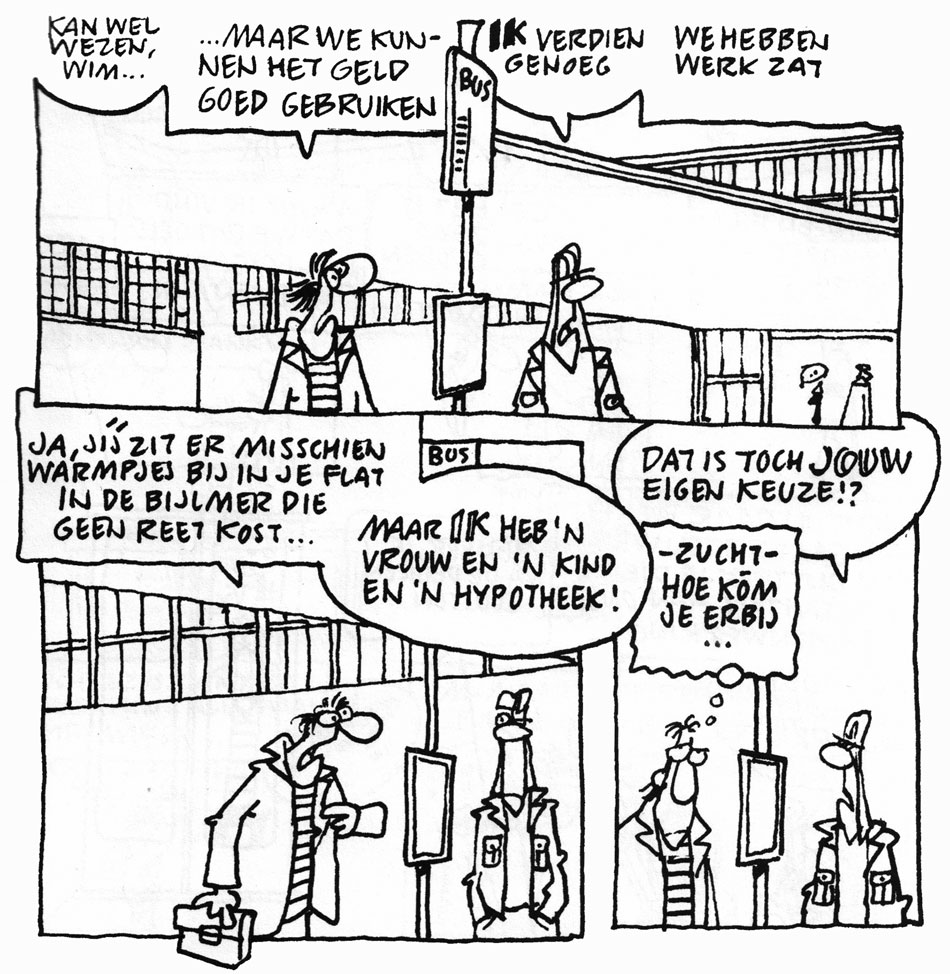
'Door Zonder Familie' (2013), depicting De Jager and Stevenhagen arguing about financial problems.
Door Zonder Familie
In the early 2010s, the publishing company Oog & Blik/De Bezige Bij planned a reprint of the first four 'Familie Doorzon' albums. For a prologue, De Jager developed an autobiographical short comic about the origins of his successful series. His publisher liked the idea and asked him to develop it into a separate, full-length autobiographical graphic novel. De Jager's wife and friends also encouraged him to adapt the many colorful anecdotes from his life into a book, which became 'Door Zonder Familie' (Oog & Blik/De Bezige Bij, 2013). The book focuses on De Jager's 1970s and 1980s career, dealing with how 'De Familie Doorzon' turned into a lucrative enterprise, but also the creative differences with co-creator Wim Stevenhagen and their legal struggle with former publisher Ger van Wulften. Drawn in a crude, sketchy manner in a small format, De Jager shows the darker side of his success story, not sparing himself in the process. For one, his comic career took a toll on his family life. He starts taking cocaine to "work faster" and gets addicted. Sometimes he makes unwise business decisions. Still, De Jager is able to see the funnier side of all these depressing events and 'Door Zonder Familie' also offers room for more frivolous anecdotes.
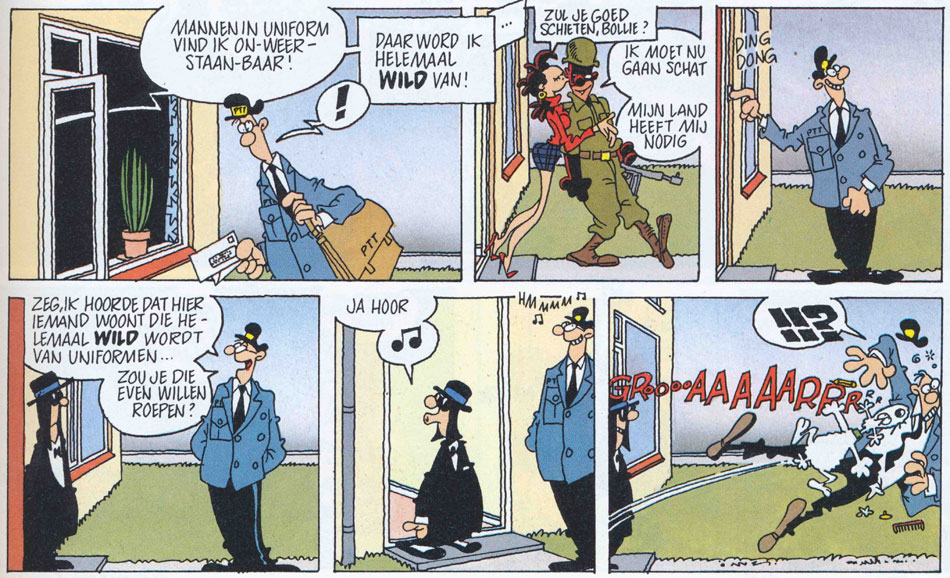
In whatever comic he turns up: De Jager's mailman is always attacked by a dog. Here, he overhears that Doortje "goes wild about men in uniform." When he asks Ronnie whether "somebody lives here who gets wild about uniforms", he calls their dog.
Style and shared universe
From the late 1970s until the late 1980s, De Jager drew in a detailed, expressive style. However, he originally found it difficult to remember how to draw his main cast members, so he used to take out every previous episode to remind himself of their look and design. By always copying the latest copy, the characters started to evolve. As De Jager's production increased, he settled on a more minimalist, linear approach, with limited background art. Especially in daily strips like 'Liefde en Geluk' and 'Zusje', everything is drawn with such speed that heads don't always have a neck and objects are reduced to their basic outlines. De Jager has used this "economic" approach to his advantage and sometimes even as part of the punchline, for instance in the previously mentioned pages set in the fog or at nighttime in his 'Roel en Zijn Beestenboel' comic. The characters typically point out that "their artist is late with his deadlines again" and "looking for an easy way to quickly finish the page." Like his cartoonist inspirations Peter de Smet and Don Martin, De Jager is also original in his use of onomatopoeia: sounds like BLERK! and KLONT! appear regularly in his pages.
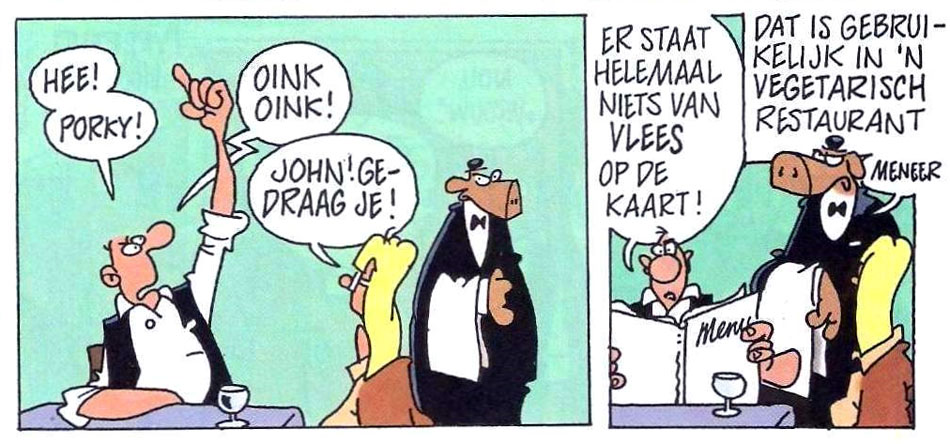
John and Mieke dine regularly in the vegetarian restaurant in 'Roel en zijn Beestenboel'.
A unique aspect from De Jager's many comic series is their "shared universe". His characters make regular crossover appearances. John Doorzon, for instance, dines frequently in Roel's vegetarian restaurant, always complaining about the lack of meat on the menu. Barkeeper Bar-Jan from 'Liefde en Geluk' also serves the businesspeople in 'Broodje Beurs'. Publisher and record executive Toon Ladder has appeared in 'Han Gewetensvim', 'Toon Ladder' and 'De Familie Doorzon', while in 'Puck' the main character's father has the same looks. Also crossing many series is De Jager's mailman with PTT bag, who appears in 'Liefde en Geluk', 'De Familie Doorzon' and the commissioned postal service strips. Whenever criminals lurk about, they are the father and son burglars from 'De Familie Doorzon'. Household jobs are generally done by De Biereco's and all dogs are fox terriers. De Jager also recycles certain names as a running gag. Newspapers are mostly titled A t/m Z Gazet, while every ship carries the name M.S. Fabiola. De Jager increased his characters' mythos through special publications, like a family album ('Doorzon Family Album', 1999), flashback-driven books, interviews with his cast members and an alphabetical encyclopedia ('Doorzon Hoogtepunten', Big Balloon, 1999).
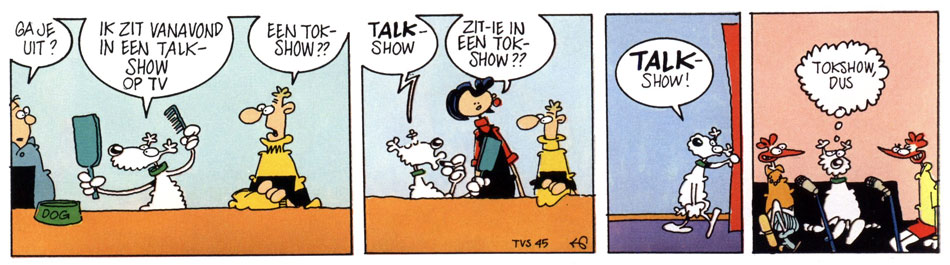
Guest appearance from Ronald and Hennie from 'Roel en zijn Beestenboel' in the 'Liefde en Geluk' strip. The Dog is invited to a talk show, which others mishear as a "tok show". The dog finds out that, surrounded by chickens, it is indeed a "tok show" (a pun on the sound "tok tok", made by chickens).
Controversy
As he isn't afraid to tackle daring subject matter, De Jager has also been the subject of criticism. In the early 1980s, the Catholic union for working youth, KWJ, asked De Jager and Wim Stevenhagen to make a special comic for them. A book deal was signed, but only then some feminist KWJ members discovered some of their earlier work, namely 'De Ironische Man'. Outraged over the amount of female nudity, some members even threatened to leave the organization if the KWJ would continue collaborating with these cartoonists. As a result, the deal was scrapped. Interviewed by Hans van den Boom and Jac Drewes in Stripschrift issue #156 (February 1982), De Jager stated that the KWJ kept harassing them afterwards. When the editors of the feminist magazine Opzij asked the duo to create a comic for them, KWJ members wrote letters of protest, claiming they were "sexists". At first, De Jager and Stevenhagen wanted to ask for a right to reply, but refrained once they noticed another columnist within the same issue actually praised 'De Familie Doorzon' as being very women-friendly.
By certain segments of the Dutch population, and despite its high sales, 'De Familie Doorzon', was deemed sleazy and offensive. It frequently depicted sex scenes with full frontal nudity. Societal taboos like teen pregnancy, suicide, blasphemy, impotence and abortion are played for laughs. Some people objected to the appearance of certain minority groups in the comic, like black people, gays, transvestites or Muslims, while others were more bothered by the fact that these groups were used as walking punchlines. Still, the only disturbing criticism happened when De Jager made a joke about André Brilleman, a sportsman with mafia connections who was later murdered. A few days later, an anonymous writer sent a letter of threat, referring to this joke, which he apparently didn't consider funny. But much to De Jager's amusement, the mysterious author claimed: "Mr. De Jager, we know where you live", even though the letter wasn't addressed to his house, but the offices of Nieuwe Revu.
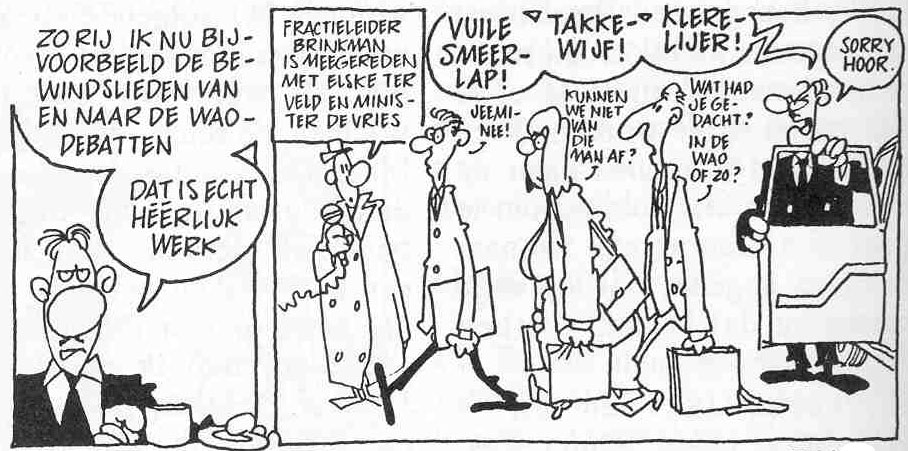
1991 'Familie Doorzon' episode about Tourette's syndrome.
In 1991, De Jager made a special 'Doorzon' comic for a WAO union paper, in which an uncle of John Doorzon is diagnosed with Tourette's syndrome. John takes him to a doctor, who is a caricature of Prime Minister Ruud Lubbers. Dr. Lubbers advises the uncle to become a taxi driver for the Minister of Social Affairs, so he can freely insult the politicians for their bad policies. The unions CNV and MHP printed the comic with a disclaimer that they "distanced themselves from its content." Indeed, it didn't take long before many people wrote letters to object against the insulting depiction of Tourette's patients. Only one union, the FNV, came to De Jager's defense. The comic artist managed to soothe the situation by collaborating with the official Tourette's awareness organization to make an official 'Roel en Zijn Beestenboel' comic book about the condition, intended for young patients. The comic was later translated into German and included in an official medical guide about Tourette's syndrome.
Comics-related projects
In addition to being a creator, De Jager has participated in a variety of comic-related projects. In 1992, he was co-founder of the Stichting Beeldverhaal Nederland ("Dutch Comic Strip Foundation") and, together with Joost Swarte and André Testa, part of the foundational board of the comic festival Stripdagen Haarlem.
In the 1990s, De Jager was also responsible for importing and translating Bill Watterson's 'Calvin & Hobbes' in The Netherlands. After reading the original English-language comics, he was so enthusiastic that he bought the Dutch translation rights, and arranged for them to appear under the title 'Casper en Hobbes' in the newspaper Trouw. The translated books were distributed through De Jager's own imprint, Spiff Press Publications, in collaboration with Big Balloon. He personally lettered and translated most of the gags. Problems with the American copyright holder eventually prompted De Jager to drop the project. After some time, the Dutch rights were sold to Eelco Koper, owner of Koper Comics.
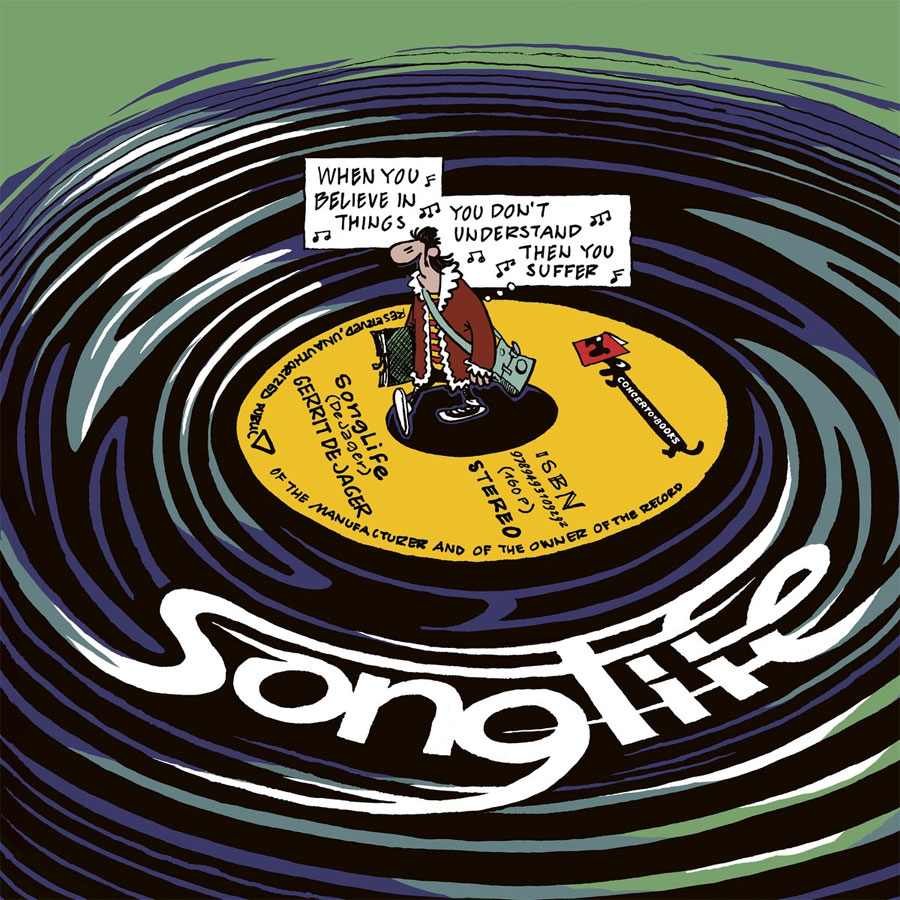
'Songlife' (2021), referencing Stevie Wonder's song 'Superstition'.
Love for music
Another lifelong passion for De Jager has been 1960s pop culture, from underground comix underground comix, pop art (Andy Warhol, Roy Lichtenstein) to rock music, like The Beatles and Frank Zappa. In the late 1970s, and early 1980s, he often hung around with Dutch musicians like Bram Vermeulen and the band De Toekomst, joining them at concerts, describing himself as "almost a roadie". De Jager also sang and played guitar in a few bands, for instance De Heino's. Together with Jean-Marc van Tol, he was responsible for the collective comics project 'Strips in Stereo' (De Harmonie, 2006), for which Dutch comic artists adapted Dutch-language songs into comics. His own contribution was a visualization of Peter Koelewijn's 'Kom Van Dat Dak Af'. De Jager also wrote and drew an autobiographical graphic novel about his love for music: 'Songlife' (Concerto Books, 2021). Describing the book as a "comic strip soundtrack to key moments in my life", it focused mostly on his teenage and early twen years, when pop, rock and soul gave him tremendous energy, solace and creativity.
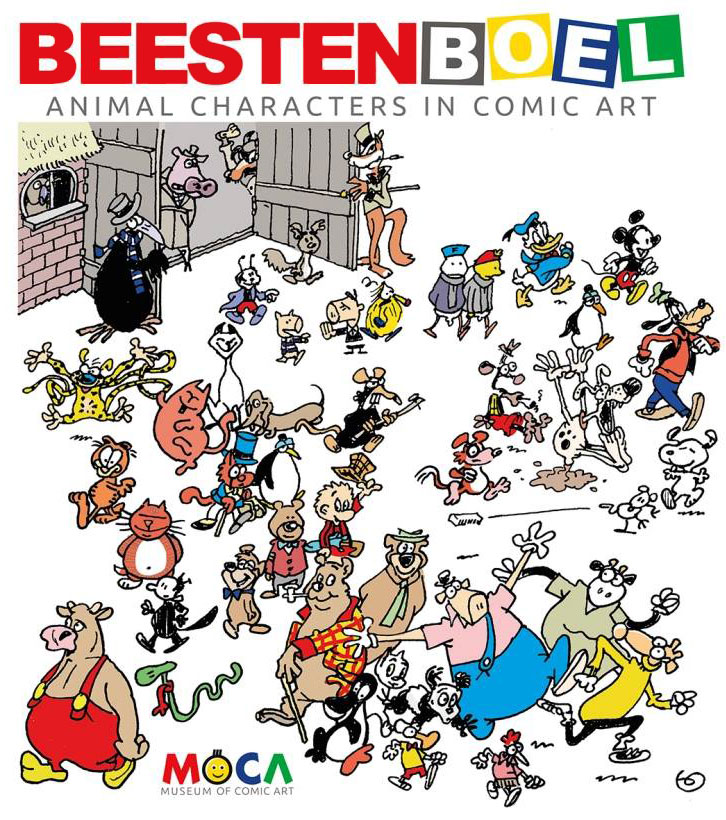
Gerrit de Jager's cover drawing for the catalogue of the 2023 'Beestenboel' exhibition at MoCA in Noordwijk. In the picture Oehoeboeroe the owl peers behind the window (from Jean Dulieu's 'Paulus de Boskabouter') and Johan De Moor's La Vache and the wolf from Edmond-François Calvo's 'La Bête est Mort' stand in the gate, while Dulieu's Salomo the raven and Marten Toonder's Joris Goedbloed open the doors. Outside the barn André Franquin's Marsupilami, the Red cat, Loedertje and Lotje from Jan Kruis' 'Jan, Jans en de Kinderen', Walt Disney's Bucky Bug, Rob-Vel's Spip the squirrel, Taco Zip and Kapitein Piep from Luc Cromheecke's 'Taco Zip', Kierewiet the canary and two bored penguins from Toon van Driel's 'De Stamgasten', Jean-Marc van Tol's Fokke and Sukke, Walt Disney's Donald Duck, Mickey Mouse and Goofy, a monkey from Hein de Kort's comics, Raymond Macherot's Chlorophylle, Harrie the dog from Eric Schreurs' 'Joop Klepzeiker, Charles M. Schulz' Snoopy, George Herriman's Ignatz the Mouse hurling a brick at Krazy Kat, Jim Davis' Garfield, Raymond Macherot's Chaminot the cat and Anthracite the rat, Windig & De Jong's Heinz, Hanna-Barbera's Boo Boo Bear and Yogi, De Jager's own Bob de Beer and Sneek the snake, Wil Raymakers' Boes, Walt Kelly's Pogo, Marten Toonder's Olivier B. Bommel, Tom Poes and Panda, Alain Saint-Ogan's Alfred the penguin and, again, De Jager's animals from his own comic 'Roel en Zijn Beestenboel'.
Graphic contributions
As an illustrator, De Jager has worked with Nieuwe Revu editor Gerrit Mollema on the picture book 'Stom!' (Leopold, 1995). In 2021, he made the illustrations for 'Het Nieuwbouw Handboek' by his niece Marije Duijn, an interior designer. In 2023, De Jager provided the cover illustration for the 'Beestenboel' exhibition in the Dutch Museum of Comic Art in Noordwijk.
In 1999, De Jager created the mini-comic 'Love Is In The Air' for the "Pincet" series of mini comics by De Plaatjesmaker, the imprint of Dutch comic creators Hanco Kolk and Peter de Wit. In 1995, De Jager paid tribute to Nikita Mandryka in the collective comic book 'Tronches de Concombre', published by Dupuis. He also made a graphic contribution to 'Suske en Wiske 60 Jaar!' (2005), which paid homage to Willy Vandersteen's 'Suske en Wiske', and was a contributor to 'Mooi is dat' (2010), an anthology with comic interpretations of Dutch literary works. In 2012, De Jager, along with several other Dutch artists, contributed to 'Bommel en de Bovenbazen', a collectively redrawn version of Marten Toonder's classic 'Tom Poes' story, serialized in NRC Handelsblad between 2 May through 21 September 2012. In addition, he was one of the artists participating in Gerrie Hondius's 'Teken Mijn Verhaal' ("Draw My Story") initiative, a foundation drawing out the (comic) stories created by handicapped children.
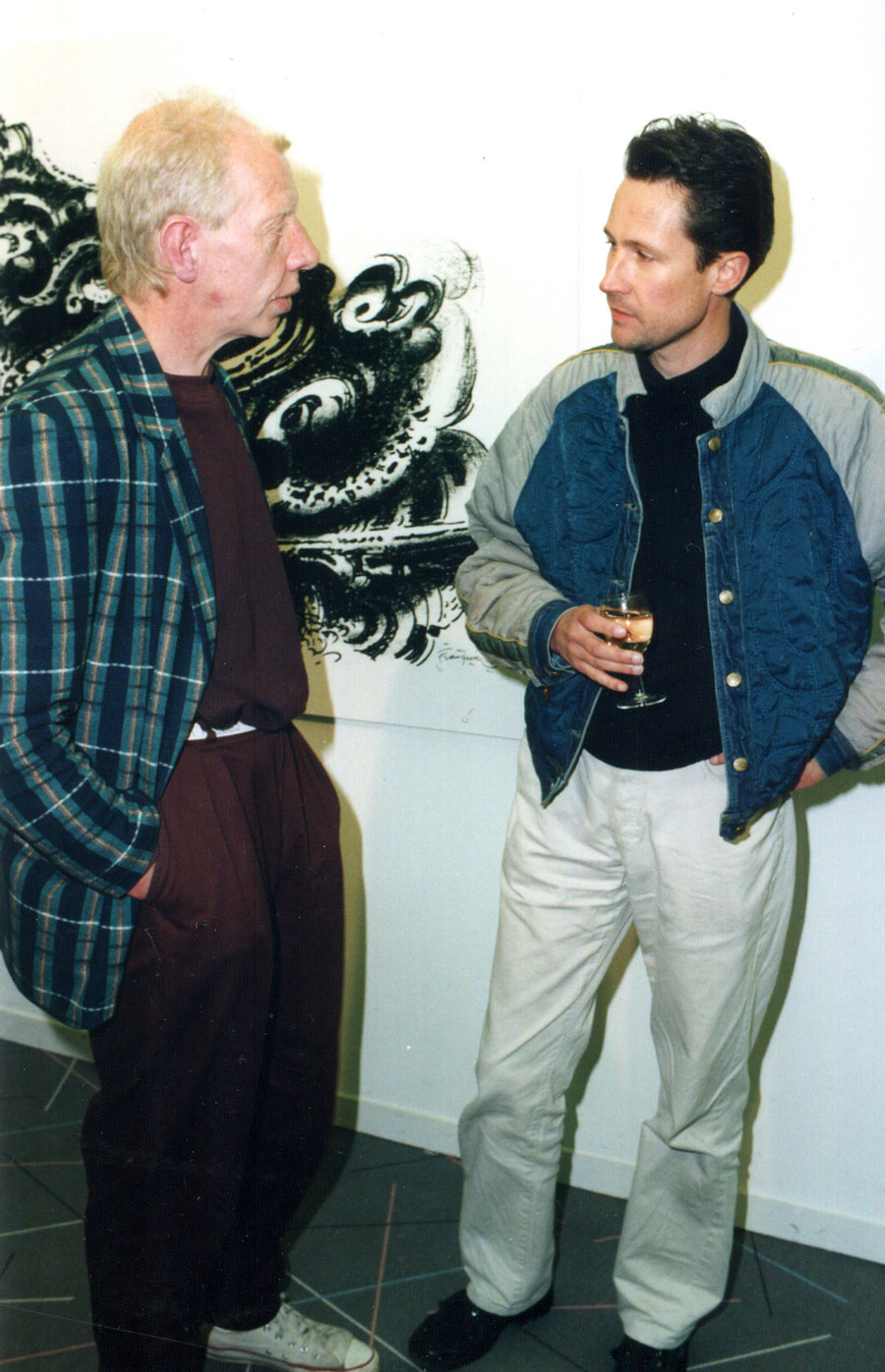
Gerrit de Jager (on the right) talking with Fred Julsing at the André Franquin expo at Gallery Lambiek in 1991.
Recognition
In 1980, the first 'Doorzon' album won De Jager and Stevenhagen a Stripschapspenning. In November 1987, during the Stripdriedaagse in The Hague, De Jager was awarded the Stripschap Prize by Dutch appreciation society Het Stripschap. In 1989, the 'Roel en zijn Beestenboel' album 'Fast Food' won the French award Prix RTL for "Best Youth Album". In 2004, De Jager had the honor of being the first Dutch comic artist to have an entire exhibition in the Stripmuseum of Groningen, devoted to his own work. During the Stripdagen in Houten, on 2 October 2006, De Jager and Jean-Marc van Tol won the P. Hans Frankfurther Prize for special merits for their 'Strips in Stereo' project. In 2016, he donated his personal archives to the "Bijzondere Collecties" ("Exceptional Collections") division of the University of Amsterdam. Apart from artwork, these archives also contain merchandising, like the teddy bears he designed for the De Bijenkorf store. In 2022, an exhibition devoted to the 40th anniversary of 'De Familie Doorzon' was held in the Allard Pierson museum in Amsterdam.
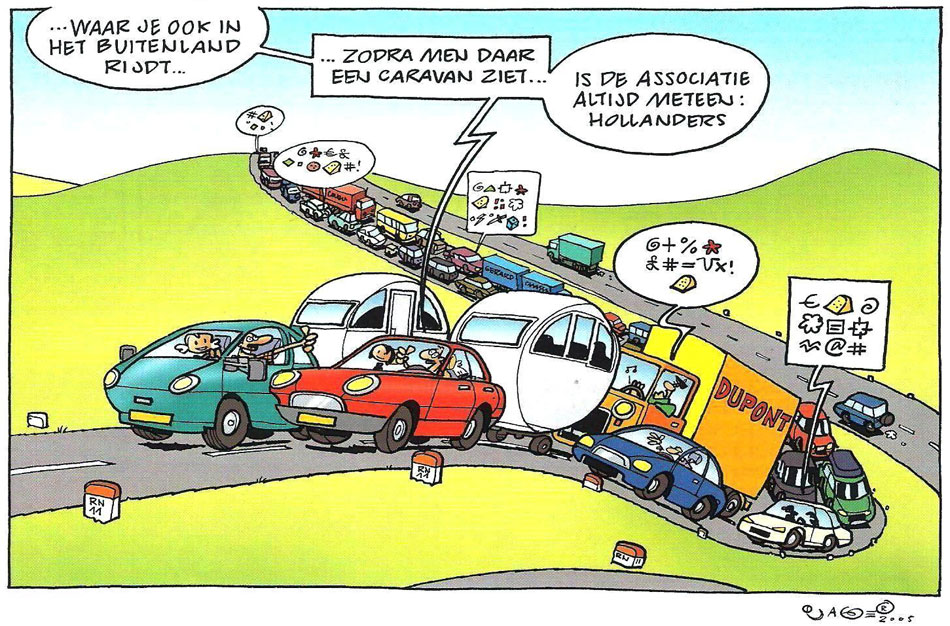
A typicall Dutch camper joke in 'Liefde en Geluk' (2005). Translation: "Wherever you drive abroad, once they spot your caravan they always associate it with Dutch people."
Legacy and influence
At the start of his productive career, De Jager wasn't always recognized as an artist. Most of his best-selling comics either ran in children's magazines or low-brow publications like Nieuwe Revu. Once his work started running in nationally syndicated papers, critics took him more seriously. In hindsight, many feel that 'De Familie Doorzon' in particular was just as much of its time, as ahead of it. The series is a time capsule of The Netherlands during the late 20th and early 21st century. Many of the latest trends and social-cultural developments were reflected in the series. Characters try to work their VCR's, install cable TV and Internet and struggle with their cell phones. The series also addressed many political issues that only became more pervasive in the decades that followed, among them critical questions about immigration, gender fluidity and whether the seasonal character Black Pete is racially offensive or not.
In The Netherlands, De Jager has been an influence on Margreet de Heer, Mark Retera, Willem Ritstier, Eric Schreurs, Bert Tier, Jean-Marc van Tol and Alex Turk (who as a teenager once sent an idea for 'Doorzon' gag to De Jager and was thrilled to actually see it published). In Flanders, Tom Bouden and Nix are among his admirers. In recent years, De Jager's youngest daughter India has been coloring his comics.
In the Dutch city of Almere a street is named after the Familie Doorzon, as part of the "Comics Heroes" district. In a funny bit of trivia, Dutch cartoonist Hein de Kort lifted the title of his first comic book, 'Pardon, Lul' ('Pardon Me, Dickhead!'), from a throwaway quote from 'De Familie Doorzon'. In the early 1990s, the audiovisual magazine Muziek en Beeld Info reported the release of a compilation CD of episodes of the radio show 'De Familie Doorsnee', but misspelled the show's title four times as "Familie Doorzon". De Jager added a copy of the article in the back of the 'Doorzon' album 'Wensvaders en Draagmoeders'.
Lambiek will always be grateful to De Jager for illustrating the letter "Z" in our encyclopedia book 'Wordt Vervolgd - Stripleksikon der Lage Landen' (1979), and for his contribution to our 40th anniversary book (2008).
Gerrit de Jager's drawing for the 40th anniversary of comic shop Lambiek (2008).