


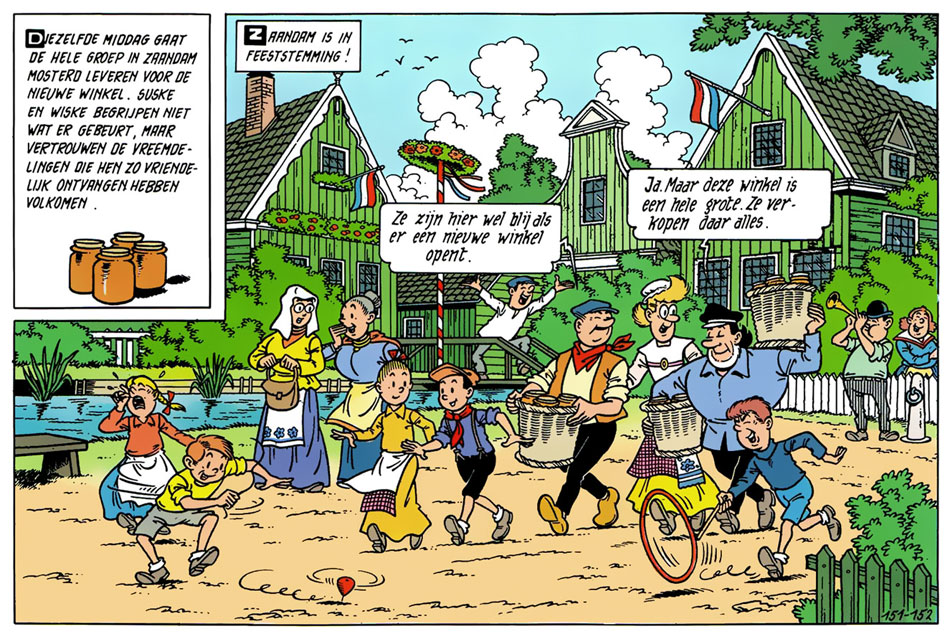
Suske en Wiske - 'Witte Zwanen, Zwarte Zwanen' (1987).
Eugeen Goossens was a longtime co-worker of Studio Vandersteen, working on several of its productions from 1965 to 1990. Mainly an inker, he had stints on most of Willy Vandersteen's series, notably on 'Suske en Wiske' and 'De Geuzen'. In addition, he was on the art team of 'Jerom' stories for the German market, and penciled a couple of 'Suske en Wiske' stories for commercial clients. As a solo artist, he made the short-lived comic strip 'Dolle Mina' for Tele-Tip magazine (1977), as well as commercial comic strips for clients like Bayer and Touring (1990s).
Early life and career
Eugeen Goossens was born in 1942 in Mortsel, near Antwerp. Coming from a modest family - his father was a harbor worker and his mother had a job at the Grand Bazar department store in Antwerp - the household didn't have a newspaper, so young Eugeen didn't grow up with any of the Flemish newspaper comics. However, on his birthday and during seasonal holidays, he was traditionally given an album of Willy Vandersteen's 'Suske en Wiske' series. When he was 13 years old, Vandersteen came to sign his books at the Grand Bazar, where his mother worked. Meeting the artist in person and seeing him make a special drawing for him was a magical moment for the boy.
As he had an interest in drawing, Goossens participated in several art contests. One of his school mates was Dirk Boumans, whose older brother Karel Boumans was already working for Studio Vandersteen in the 1950s. Seeing Karel Boumans' drawing material stirred up Eugeen's ambitions even further. However, his parents didn't want an artistic career for their son, and sent him to an Antwerp vocational school for metalworking. The training wasn't a success, but luckily, a colleague made his mother change her mind about art school. So finally, Goossens enrolled at the Antwerp Art Academy, where one of his teachers was the graphic artist and painter Gustaaf De Bruyne. Among his fellow students were the future sculptor Jean-Pierre De Coster, the graphic artist Walter Brems and the painter Renaat Veris, who remained lifelong friends. While Goossens enjoyed painting and being in artistic circles, his true passion remained comics. After fulfilling his military service in 1964, Goossens got in touch with Willy Vandersteen's co-workers Eduard De Rop, who arranged a job interview for him with his boss.
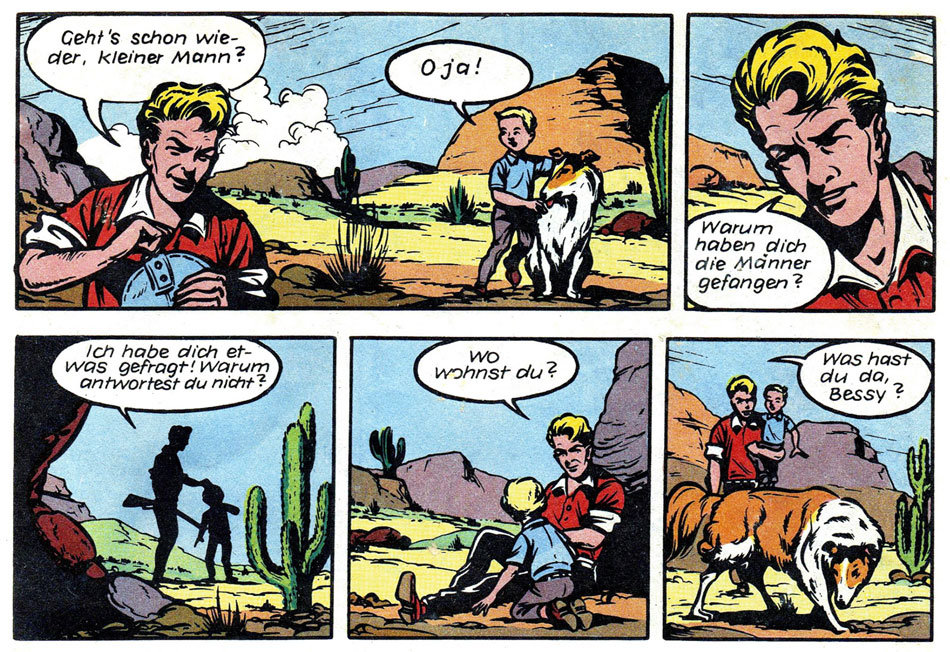
German Bessy #79 ('Kinderraub in Arizona'), presumably with artwork by Eugeen Goossens.
Studio Vandersteen
After his meeting with Willy Vandersteen, Goossens was instantly hired to work in the studio, first in Brussels and from the following year in Kalmthout. In Vandersteen's team, he quickly felt at home, as there was a sense of cameraderie. Within no time, Goossens received the nickname "the professor", because of his precision and tendency to engage in political or philosophical discussions. At Studio Vandersteen, his first job was inking Eduard De Rop's pencil work for the rebooted family gag strip 'De Familie Snoek' (1965-1969) in Pats, the junior supplement of the newspaper De Standaard. After a year of working freelance, he was offered a staff position in the Spring of 1966, although he returned to freelancing in the 1970s.
During the second half of the 1960s, Goossens became a productive inker for Vandersteen's other series, starting with the 'Karl May' western stories. In 1968, Studio Vandersteen began a separate story production for the German publisher Bastei Verlag with the character 'Jerom', the strongman from the 'Suske en Wiske' comics. Artists like Goossens, Eduard De Rop, Paul Geerts and Merho were tasked with doing pencil and inking duties on the heavy production schedule of a full story every two weeks, and later even every week. In 1972, this project came to an end after about 173 stories, although the 'Jerom' spin-off comic series continued in several Flemish magazines, but at a slower pace.
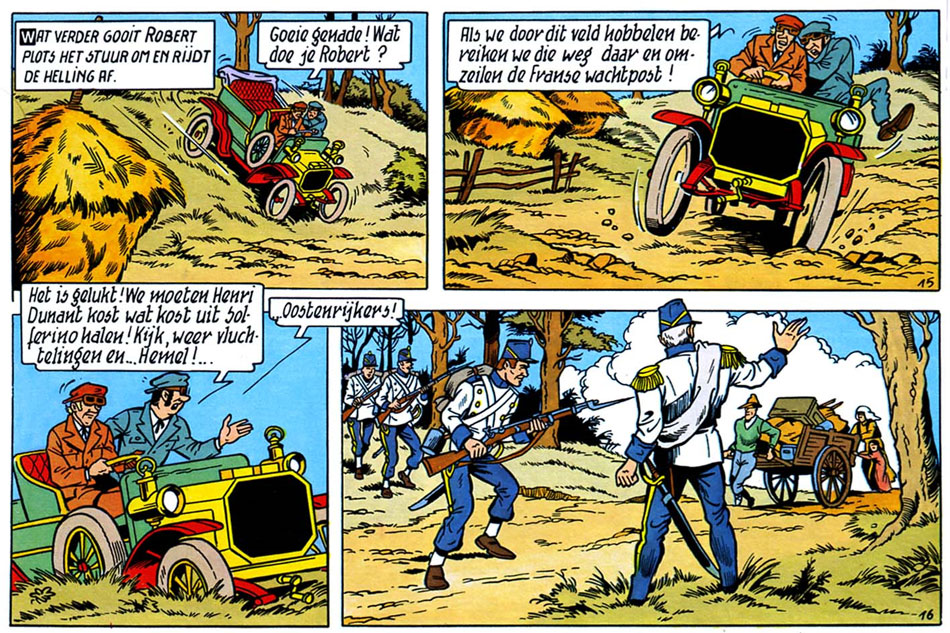
Robert en Bertrand #35 - 'De Hel Van Solferino' (1980).
As Studio Vandersteen had many ongoing series, co-workers often had to do fill-in duties on certain series, whenever the regular artist was ill or on holiday. In the late 1960s, Goossens did cover art for five books in the chivalry series 'De Rode Ridder', drawn by Karel Biddeloo at the time. Around this same period, he also drew an occasional 'Bessy' story for the German market. His artwork can be recognized in issues #79 ('Kinderraub in Arizona'), #91 ('Jagd nach dem Roten Tomahawk') and #94 ('Vom Hass Vergiftet'), although he mostly drew for Bastei's separate 'Bessy' pocket books in a smaller format. Starting in 1977, Goossens was assigned to 'Robert en Bertrand', Vandersteen's comic book series based on the two happy-go-lucky tramps from the youth novels by Raf Verhulst. However, in an interview in Stripschrift #461, Goossens recalled that 'De Hel van Solferino' (1980) was the first album he drew. This could mean that he also did the pencil art for this story. Still, his 'Robert en Bertrand' tenure didn't last long, as he had to replace Eduard De Rop as the regular inker of 'Suske en Wiske'. In the following years, the 'Robert en Bertrand' series was continued by Jeff Broeckx and then by Ron van Riet.
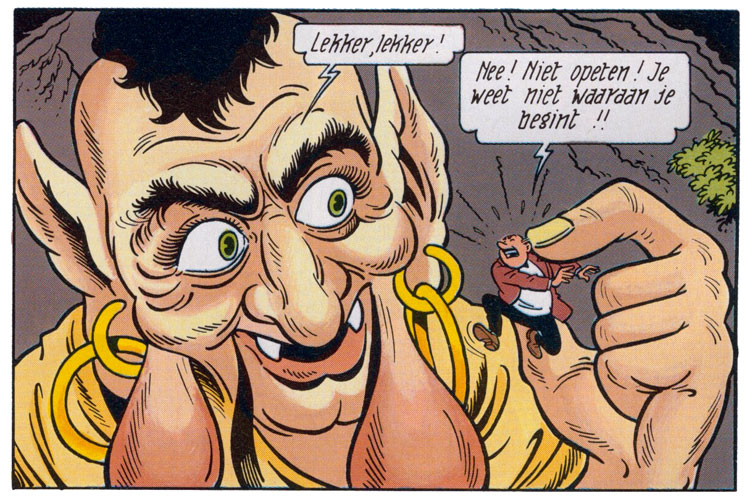
Suske en Wiske - 'Fata Morgana' (1988).
Suske en Wiske
In the late 1960s, Goossens had already done some inking jobs on Willy Vandersteen's signature series 'Suske en Wiske', for instance on the episodes 'Jeromba de Griek' and 'Wattman'. Along with Merho and Eric De Rop, he also participated in the modernization and redrawing of older 'Suske en Wiske' stories, like 'Op Het Eiland Amoras', 'Lambiorix' and 'De Witte Uil'. He received a cameo in the story 'De Briesende Bruid' (1968-1969) outside the city hall when aunt Sidonia gets married, alongside other studio employees Karel Verschuere and Lucienne van Deun.
During the 1980s, Goossens was the main inker of 'Suske en Wiske', with his tenure lasting from 'De Pompenplanters' (1979) to 'De Jolige Joffer' (1986). Working from pencil art by Paul Geerts, one of the most notable stories Goossens worked on was the extra long volume 'Angst op de "Amsterdam"' (1985). His inked drawings were characterized by their smooth, soft linework, and the little notches in the black ovals that formed the characters' eyes, giving them a certain "Disney-esque sparkle".
In the second half of the 1980s, Eric De Rop became the regular 'Suske en Wiske' inker, while Goossens joined the studio's merchandising department. There, he produced artwork for several 'Suske en Wiske' products, as well as special promotional and educational comic stories commissioned by third parties, mostly from The Netherlands. Between 1983 and 1990, he drew several of these advertising-themed 'Suske en Wiske' stories, of which the best remembered are 'Witte Zwanen, Zwarte Zwanen' for Albert Heijn supermarkets (1987), 'Fata Morgana' for amusement park De Efteling (1988) and 'Het Gouden Kuipje' for ERU cheese (1989).
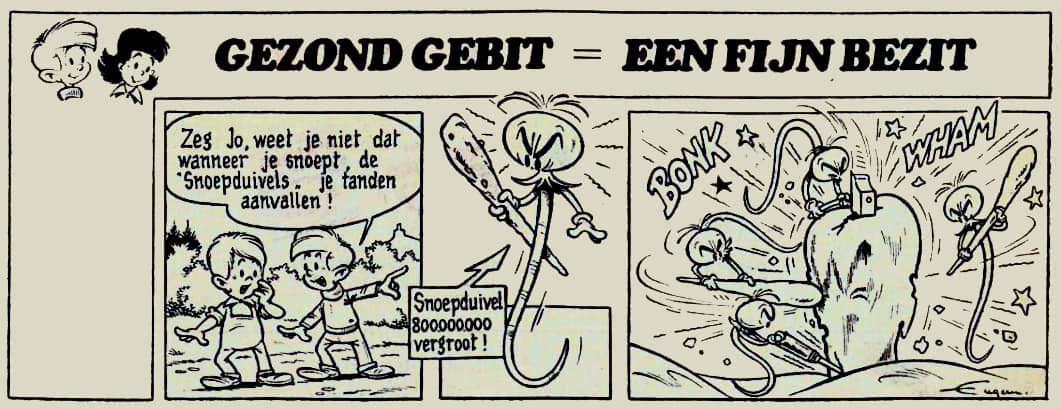
One of the dental care strips by Eugeen Goossens, published in De Standaard in 1976.
Leaving Studio Vandersteen
By the time Eric De Rop became the inker of 'Suske en Wiske' in 1987, Goossens swapped places with him and took over his role as inker of Willy Vandersteen's final series, 'De Geuzen', about the Dutch resistance movement against the Spanish occupiers in the 16th century. Starting with album #4, Goossens provided the inking of Willy Vandersteen's pencils, working with his taskmaster until the tenth and final installment of the series. In 1990, Vandersteen died, after which several of his series were canceled. This also marked the end of Goossens' tenure with the studio, which was by now managed by the publisher, Standaard Uitgeverij. Afterwards, Goossens participated in the production of the animated TV series based on 'Suske en Wiske' (1989-1991), produced by Guido Staes and his Atelier 5. However, the studio went bankrupt and Goossens was again without a job.
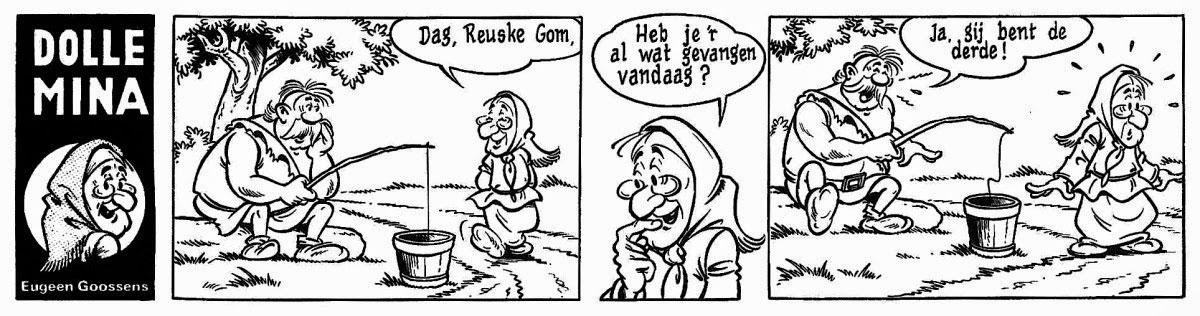
'Dolle Mina' (1977). Translation: "Hi Gom the Giant. Did you catch anything today?" - "Yes, you're the third one."
Solo comics
On occasion, Goossens worked on solo comic projects. When in the 1970s Studio Vandersteen's production for the German market slowed down, he created the gag strip 'Dolle Mina' (March-October 1977) for the advertising magazine Tele-Tip, starring a witch and her sidekick giant Gom. Another non-Vandersteen project was a series of educational strips for about dental care, published under the banner 'Gezond Gebit = Een Fijn Bezit' (1976) in the newspaper De Standaard. After his departure from Studio Vandersteeen in the early 1990s, Goossens collaborated for a while with scriptwriter Marck Meul on some commercial strips, commissioned by Standaard Uitgeverij. For the staff magazine Bayer-Echo of the pharmaceutical company Bayer, they made the strip 'Sam Safe', about occupational safety. For the Belgian roadside assistance organisation Touring Wegenhulp, they additionally produced a comic feature about the Vandemeuleplasbroucke family.
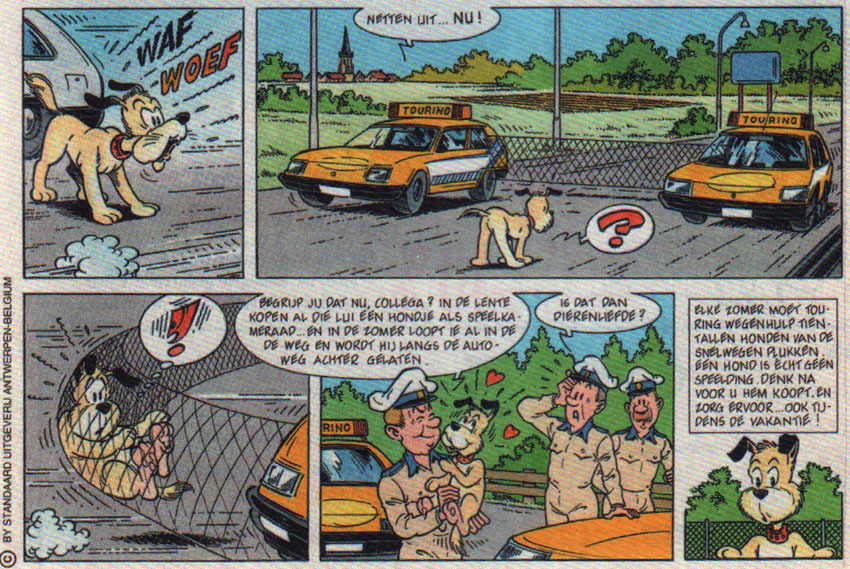
Comic for Touring Wegenhulp.
Later years
In later years, Goossens has been making oil paintings, while becoming a regular guest at comic festivals. In 2023 and 2024, he made the cover drawings for the new luxury book collections of Willy Vandersteen's 'Biggles' comics. Between October 2025 and February 2026, an exhibition of Goossens' commercial 'Suske en Wiske' art was held under the name 'De Toffe Tentoonstelling' at the former Studio Vandersteen building in Kalmthout.
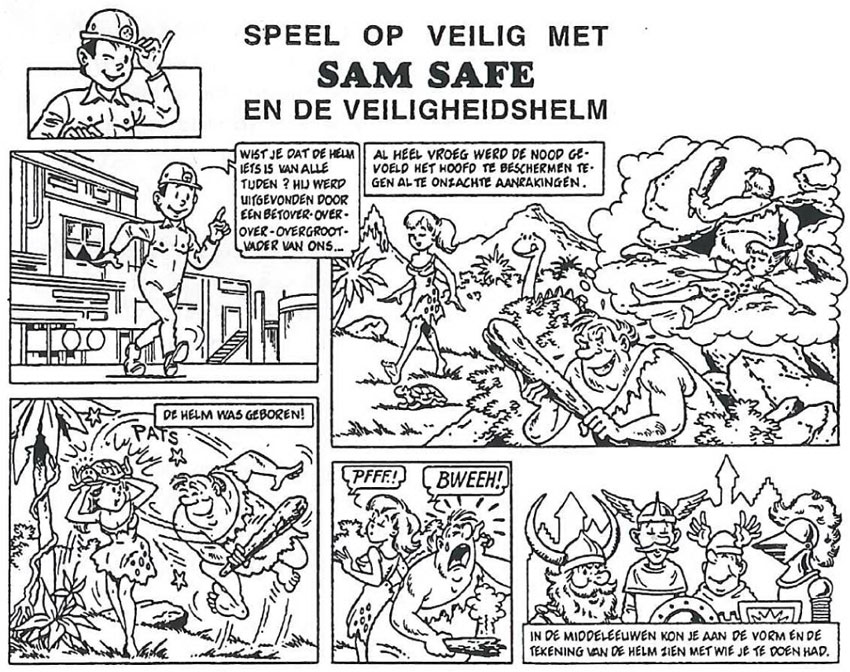
'Sam Safe'.