


Gaga - 'Requiem Fortissimo'.
Peter Pontiac was one of the most prominent artists and designers of the Dutch alternative art scene. As the "godfather" of Dutch underground comix, he rose to prominence in the 1960s hippie scene, before reinventing himself during the 1970s-1980s punk era with his comic character Gaga. He later became a productive illustrator for newspapers, music magazines, posters and record covers in the Netherlands. Mostly staying within the realm of subcultures, Pontiac was widely praised for his raw, personal, and highly detailed artwork. His stories about sex, drugs and rock 'n' roll pioneered the genre of autobiographical comics, before other artists made it mainstream. While early Pontiac comics like 'The Amsterdam Connection' (1977) openly detailed his heavy drug abuse, his later graphic novels showed the artist dealing with the Nazi collaboration and mysterious disappearance of his father ('Kraut', 2000) and his own upcoming death ('STYX of de Zesplankenkoorts', 2016). One of the most recognizable artists in the Netherlands, Peter Pontiac's art is still well-sought after today and enjoys an enduring cult following.

'Miss Holland', illustration for Tutti Frutti (1994).
Early life and influences
Pontiac was born in 1951 as Petrus Josef Gerardus Pollmann in Beverwijk, a town in the province of North Holland. He was the eldest of five children, growing up in a Catholic family in Haarlem. His father Joop Pollmann (1922-1978) was a journalist for the women's magazines of the publishing house De Spaarnestad with a dubious war past. During World War II, father Pollmann had served in the Waffen SS, and he remained ultra-conservative in his later years. The creatively talented Peter had a troubled relationship with his father, and started to rebel as a teenager. Intrigued by the youth subcultures of the 1960s, he painted his entire room black and started buying rock 'n' roll records, adoring their edgy, free-spirited sound. At school, he drew pictures of nude girls, which he sold to his classmates for two guilders apiece. At age seventeen, Peter dropped out of school, ran away from home and joined a hippie commune in Leiden, where he lived until the early 1970s. There began his fifteen-year long relationship with drugs, which included experimentations with marijuana, LSD, peyote, opium and heroin. In his early twenties, he moved to Amsterdam, where he spent the better part of the 1970s living in mostly temporary locations. For many years, he enjoyed living on the fringes of society, and this lifestyle strongly reflected in his comics and illustrations. In interviews, Pontiac always spoke openly about this period of his life. He acknowledged he was a junkie, but he kept his moral compass and didn't succumb to criminal behavior.

Pontiac revisiting his teenage years in an early comic strip (The Pontiac Review #1).
Among the early artists that caught young Peter's attention were Europeans like Hergé, Frans Piët, Carl Barks, Henk Sprenger, Carol Voges and J.J. Koeleman (of 'Pinkie Pienter' fame). As a teenager, he became enthralled by Mad Magazine and the U.S. underground comix movement, particularly the work of Robert Crumb and Rick Griffin. Another U.S. influence was Will Eisner. Closer to home, he found inspiration in the work of cartoonists Willem, Peter van Straaten and Mark Smeets. Thematically, Pontiac's work remained strongly connected to rock 'n' roll music and the good-versus-evil doctrines of his Catholic upbringing. Spending only two months at the Free Academy of The Hague, Peter Pontiac was a largely self-taught artist, who learned his craft from studying other artists. In a 2011 interview with Michael Minneboo, Pontiac admitted that he had "horror vacui" ("fear of empty spaces"), which resulted in his trademark detail-heavy style. He assumed that if he put in as many things he could, at least some of it would be good. His earliest work was signed with the pseudonym "Holy Cat", which he symbolized by drawing a vignette of a cat with an exclamation mark between its ears. Later he started using "Pontiac" as a middle name, referencing the classic U.S. car brand. In 1973, he learned that Chief Pontiac was also a Native American tribal leader who resisted white domination until his last breath. This motivated him to make "Peter Pontiac" his permanent pen name.
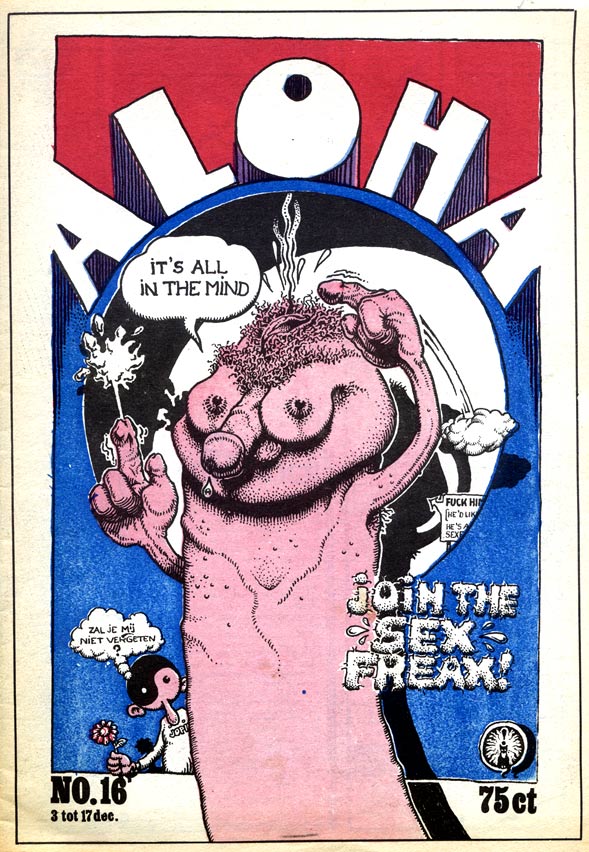

Cover illustrations for Aloha issue #16 (2-17 December 1971) and Tante Leny Presenteert issue #24 (1977).
Rock 'n' roll illustrations
During his commune period in Leiden, Pontiac debuted as an illustrator in 'The Living Guide to Amsterdam' (1969), a booklet published by the Headshop. After that, he got himself noticed by designing covers and other artwork for bootleg songbooks. In those days, lyrics weren't always printed inside single or album sleeves, making them liable for misinterpretation, especially by non-English speakers. As a result, these books sold well among teenagers who wanted to know what their favorite artists were singing about. Several were published on stenciled paper by the Reinaert de Vos imprint, for which Pontiac also designed the logo. Even though these booklets were distributed illegally, Pontiac recalled that these bootleggers' main goal was promoting their favorite rock music, and much of their money was not made by selling books, albums and stickers, but by dealing drugs.
Among the musicians whose lyrics Pontiac livened up were Bob Dylan, Jimi Hendrix, Frank Zappa, Country Joe and the Fish and The Rolling Stones. His lavish artwork emphasized the "coolness" of these countercultural figures. In the 1970s and 1980s, Pontiac followed up with illustrating books about Jackson Browne, CSNY, David Bowie, Eric Clapton, Deep Purple, The Eagles, Elton John, Bob Marley, The Police, Elvis Presley, Queen, Lou Reed, Simon & Garfunkel, Bruce Springsteen, Rod Stewart, Roxy Music and Neil Young. Several of these illustrations were reprinted in the Dutch underground music papers Hitweek and Aloha, published by Willem de Ridder and Peter J. Muller. Later, they were picked up abroad by the British music magazine International Times, the Swiss publication Hotcha and U.S. music magazine Rolling Stone. At a certain point, Pontiac's bootleg songbooks were even bootlegged themselves by an obscure German company. And in 1978, Lou Reed used the Pontiac artwork from a bootleg lyric book for the sleeve of his album 'Take No Prisoners'.
One of Peter Pontiac's first mainstream clients was the Dutch music monthly Muziek Express, published by the VNU group (1974-1975), for which the artist made portraits of rock artists, printed on the final page. After John Lennon's murder in 1980, his Muziek Express portrait of Lennon was bootlegged as a poster.
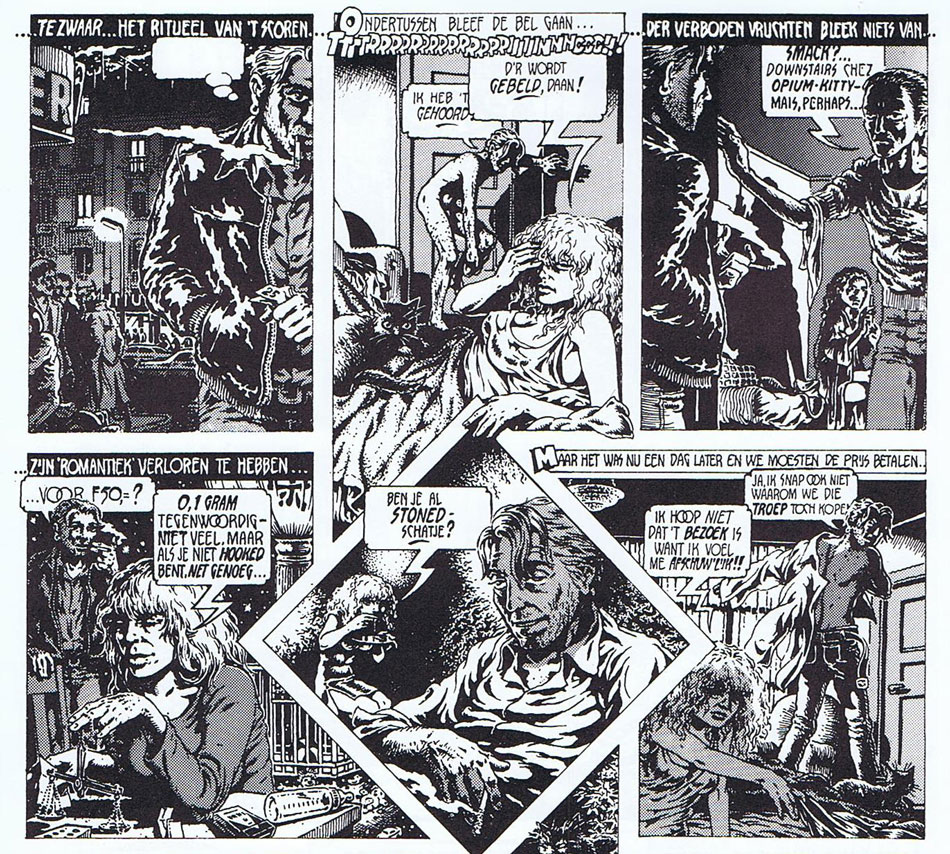
'The Amsterdam Connection', from Gummi #3 (July 1977).
Underground comix
By the early 1970s, Peter Pontiac was one of the pioneers of the Dutch underground comix movement, creating comics and illustrations with subversive content that glorified sex, drugs and especially rock 'n' roll. Pontiac's work for the songbooks got him noticed by the Dutch underground comix scene, prompting illustrator Joost Swarte to invite him to publish in his comix magazine Modern Papier. His first story was 'Pighead Acidtest', published in Modern Papier #10 (1972). After that issue, Swarte's magazine was absorbed by Tante Leny Presenteert, the underground magazine published in The Hague by Evert Geradts and Leny Zwalve. Between 1974 and 1977, Pontiac was a contributor to this publication with stories like 'What's Life', 'Ora et Labora', 'Sincity Showdown' and 'The Ratprince Versus the Magic Messiah'.
Pontiac's work also appeared in Dutch comix anthologies for the international market, like Joost Swarte's Cocktail Comix (Tango, 1973) and Robert Olaf Stoop's Wipe Out Comics (Real Free Press, 1973, 1975). This increased his global fame, and Pontiac's artwork soon found its way to the Spanish magazine El Víbora and the U.S. comic books Dutch Treat (Kitchen Sink Press, 1977), Mondo Snarfo (Kitchen Sink Press, 1978) and Anarchy Comics (Last Gasp, 1979). In the Netherlands, Pontiac's work additionally appeared in Sextant, the monthly magazine of the Dutch Association for Sexual Reform, and the women's glossy magazine Elegance.
Of all the artists exploring underground comix in the Netherlands, Pontiac was most strongly influenced by the U.S. artists of that movement. His work was also socially conscious and very autobiographical, openly discussing his own drug experiences. An early story with this theme, 'Mixed Up Memory Samba', was intended for an international comic project by the Canadian Michel Choquette. However, the book wasn't published until 40 years later, when it appeared under the title 'The Someday Funnies' (2011). One of the most notable autobiographical comic stories by Peter Pontiac was 'The Amsterdam Connection' (1977), printed in issues #3 and #5 of Gummi magazine. It features Pontiac's alter ego, Daan Doem, exploring junkie life in the Dutch capital, and has cameos by Pontiac's then-girlfriend Rita Dolce Vita and publisher Ger van Wulften. Later stories discuss meetings with legendary rock 'n' roll junkies, such as Nico (in an untitled 1986 story, published in Wordt Vervolgd and El Víbora), and then Herman Brood (1992) and Ramses Shaffy (1993) in Pontiac's comics column 'Stof aan de Naald' for the drug users' magazine Mainline.

Illustration for one of Willem de Ridder's travel stories about the USA, which appeared in Vrij Nederland in 1974-1975.
Work with Willem De Ridder
Throughout the 1970s and 1980s, Peter Pontiac had a fruitful creative partnership with Willem de Ridder, founder of subversive cultural magazines like Hitweek, Aloha, Suck and The Fanatic, and one of the masterminds behind Amsterdam pop temples like Paradiso, Fantasia and De Melkweg. In the late 1970s, Peter Pontiac spent two years living with De Ridder and his girlfriend in a macrobiotic community in the Italian town Santa Margherita Ligure, where they worked on their joint projects. Among Pontiac's first jobs for De Ridder was designing the cover for a book published at the occasion of the 1973 Wet Dreams festival, organized by the underground sex paper Suck. Even though he had lived in a hippie commune, Pontiac still had difficulties with the magazine openly promoting sex with multiple partners, as he expressed in the second issue of his 'The Pontiac Review' series (1991).
Pontiac felt more at ease making artwork for music-related projects, like his drawings of great events in rock and roll history for the alternative music magazine Aloha. He also produced artwork for books, records and flyers, and for cassettes released on Willem de Ridder's 1980s Radio Art cassette label. Together with Elsa Del Puerto, Rita Dolce Vita and Hans Claessen, Pontiac participated in Willem de Ridder's radio plays about 'Prince Wilhelmus en Mussolini', which were broadcast on VPRO radio. He also illustrated poems and stories by the Amsterdam-based American poet William Levy, which were published in De Ridder and Levy's magazine The Fanatic (1976), and in the booklets 'Jeremiad Chants' (1979) and 'The Jewboy' (1983). In 1983, Peter Pontiac made a comic story for 'De Ridder Retrospective', an overview book about Willem De Ridder's many cultural activities, published to coincide with an exhibition about the artist/entrepreneur at the Groninger Museum.

Pontiac used his punk-inspired artwork to object to the use of bombs in terrorist attacks, which the squatter’s movement in the Netherlands had threatened to use in upcoming protests. The drawing refers to a real-life I.R.A. terrorist attack on a Birmingham pub, Mulberry Bush, on 21 November 1974. A fireman had discovered a writhing, "screaming torso" and asked the police to let a TV crew film this victim dying at the scene. The police refused out of fear that the reprisals would be even more excessive. Pontiac was later happy to hear that some actual wannabe terrorists had seen his drawing and were so shocked that they refrained from their initial plan to start a bomb attack.
Punk
While Pontiac's early work was closely related to the hippie era of the late 1960s and early 1970s, he went along with the times. By the mid-1970s he got enamored with new subcultures like reggae and punk. In his late 1970s and early 1980s work, Pontiac absorbed the DIY approach of the punk movement. Many punk magazines were cheaply photocopied on small leaflets, and then folded into booklets. Besides artwork, these booklets had black-and-white photographs with text typed or handwritten next to the imagery. Pontiac absorbed similar photo and text collages into his own comics. He cut out newspaper clippings, advertisements, quotes from books and pasted them together in new, ironic juxtapositions. By adopting new techniques, Pontiac's art remained fresh and relevant so that the new subculture easily accepted him as one of their own, instead of regarding him as a hippie era relic.
Around the same time, Pontiac was also hanging out with the Amsterdam squatter's movement. By the late 1970s, people who break into abandoned homes to live there in groups were a genuine subculture in The Netherlands, and their riots often made headlines. On 30 April 1980, the Amsterdam squatters gained international notoriety, when the police tried to crack down the squatters' protests against the overall housing shortage during the coronation of Beatrix as Queen of the Netherlands. By 1982, Peter Pontiac was living in the Amsterdam Zebra House, a squatted house serving as a punk club, studio and gallery. But even though he embraced the squatters' anarchistic ideology, the mild-mannered Pontiac was opposed to the movement's violence and vandalism.

'Gaga'.
Gaga
Peter Pontiac's best-known character, Gaga (1980-1988), debuted on 30 April 1980, the very day Queen Beatrix' coronation celebrations were disrupted by the violent squatters' riots. Gaga is a nihilistic, buck-toothed punk living a squatter's existence. He spends his days going to concerts, shooting up drugs, sleeping with women and fighting authority. Gaga is later accompanied by a girlfriend, Gigi, and a sidekick named Gogo. Using Gaga as an alter ego, Pontiac provided his views and commentary on the inconsistencies and militant behavior of the punk and squatters' movement. While the squatters were shaking up Amsterdam with their riots, Peter Pontiac was drawing his first 'Gaga' comics in a cottage in the Veluwe countryside. Several comic stories with the character appeared in the alternative comic magazine Talent and various punk fanzines. Gaga also appeared on the cover of the 1981 punk album 'Wielingen Walgt' by The Nitwitz and The Götterflies. In 1988, Gaga starred in a longer story, the post-apocalyptic punk fable 'Requiem Fortissimo', serialized in the comic monthly Wordt Vervolgd and in 1990 collected in book format by Casterman. As Gaga didn't survive this story, it marked the end of this character's adventures for a long time. In 2010, he was briefly revived in Pontiac's self-published "glossy" zine Gaga, subtitled "Glossy-mijne" (a pun on the Dutch expression "Gossie-mijne", meaning "Oh my gosh").

Map that Pontiac made of the Lambiek store at Kerkstraat 78 in 1989. Behind the counter, we see Kees Kousemaker and Klaas Knol. The comic characters around the textfield are, clockwise, Lambik (Willy Vandersteen), Mickey Mouse (Walt Disney), Lucky Luke (Morris), Professor Pi (Bob van den Born), Asterix (Albert Uderzo), The Spirit (Will Eisner), Sjimmie (Frans Piët), a Smurf (Peyo), Blueberry (Jean Giraud), Fat Freddy's Cat (Gilbert Shelton), Agent 327 (Martin Lodewijk), Miele (Milo Manara), Charlie Brown (Charles M. Schulz), Abraham Tuizentfloot (Marc Sleen), Rockin' Belly (Windig & De Jong), Hobbes (Bill Watterson), Bécassine (Emile-Joseph Pinchon), Joop Klepzeiker (Eric Schreurs), Natacha (François Walthéry), Marsupilami (André Franquin), Eric de Noorman (H.G. Kresse), Anton Makassar (Joost Swarte), Olivier B. Bommel (Marten Toonder), The Old Witch from E.C. Comics (Al Feldstein), Popeye (E.C. Segar), Jordan (Mark Beyer), Lady in Blue (Enki Bilal), Gaston Lagaffe (André Franquin), Batman (Bob Kane), Krazy Kat (George Herriman), Ranx (Liberatore), Betty Boop (Max Fleischer), Little Helper (Carl Barks), Thorgal (Grzegorz Rosinski) and Tintin (Hergé). Inside the store we can also spot comic characters like Kapitein Rob (Pieter J. Kuhn), Pa Pinkelman (Carol Voges), Bulletje & Boonestaak (George van Raemdonck), Kick Wilstra (Henk Sprenger), Sjef van Oekel (Theo Van Den Boogaard), Sally (Robert van der Kroft), Dick Bos (Alfred Mazure), Franka (Henk Kuijpers), Jopo de Pojo (Joost Swarte) and Pontiac's own Gaga. The little statue behind Kapitein Rob depicts Paulus de Boskabouter (Jean Dulieu).
House artist of Lambiek
By 1984, at age 33, Pontiac decided to settle down. He had enough of his bohemian lifestyle and decided to kick off heroin, since he and his girlfriend Ipie were expecting a child. With the help of methadone, he managed to kick his habit completely, and a couple of weeks after his daughter's birth, he was clean. At the suggestion of Kees Kousemaker - owner of the Amsterdam comic shop Lambiek - the artist had moved to the quiet town of Bussum, not far from Amsterdam. Now that Kousemaker was practically his nextdoor neighbor, Pontiac became the house artist for Lambiek, making much promotional artwork for the store and its gallery. Already in 1979, Pontiac had made a wonderful drawing of Kees Kousemaker flying over the Kerkstraat to illustrate Lambiek's move from Kerkstraat 104 to 78. In 2010, the drawing was reused for Kousemaker's mourning card. Among Pontiac's most impressive works for Lambiek are the overview of the store at Kerkstraat 78, and the highly detailed map of Amsterdam with directions to Lambiek, both from 1989. In November 1987, Gallery Lambiek organized Peter Pontiac's first big exposition, consisting of a series of lifesize cardboard figures. That same year, the artist made similar constructions for Willem de Ridder's interactive "Walk-o-rama" attraction, in which people were guided through a maze while listening to instructions on their walkman. This traveling festival was first showcased in Den Bosch, and then in Amsterdam, Rotterdam and The Hague.

Peter Pontiac meets one of his "weather mice" in Algemeen Dagblad, 14 September 1994. The statue in the first panel is 'Verwoeste Stad' ('Destroyed City') by Ossip Zadkine, still prominent in Rotterdam, while the scene in the second and third panel spoofs Edward Hopper's painting 'Nighthawks'.
Illustration work
Another early client for Pontiac artwork was Rico van Kranen, publisher of advertising material and stickers, as well as owner of the Elpee record store. For some of his more commercial artwork, Pontiac ironically used the pen name "P. de Rent" ("Pay the rent"). Starting in the 1980s, Pontiac expanded his activities as an illustrator. His art appeared in magazines like Vrij Nederland, Elsevier, De Gids and VPRO-Gids, as well as more specialized publications like De Filmkrant, Rood (the magazine of the socialist party PvdA) and Crimelink. In 1991, Peter Pontiac participated in the thematic series 'Een Hollands Drama' ("A Dutch Drama") of newspaper De Volkskrant, in which ten Dutch artists were challenged to create a comic page starting with the sentence "That day there was a strong breeze on the dike". In the newspaper NRC Handelsblad, he made the illustrations for the pop history articles by Roel Bentz van den Berg, which were later collected in the book 'De Luchtgitaar' (Meulenhoff, 1994). Between 1995 and 2001, Pontiac drew his daily 'Weermuis' ("Weather Mouse") strips and illustrations to illustrate the weather reports in the newspaper Algemeen Dagblad. In addition, he was a prominent illustrator of articles in the "trashcountrypunkblues" magazine Muleskinner and the mainstream pop magazine OOR. For Mainline, a subsidized magazine for drug users, he made several short comics about his junkie past, as well as a header drawing for each issue. He also made a detailed drug map of Amsterdam for this magazine, titled 'Junkie Mokum'. It featured all the hotspots for hedonistic tourists and local lowlifes, while Satan, the mafia, the Grim Reaper and a literal "cold turkey" look down from the skies.

'De Krantenpoes' (2004).
Little Golden Books
Lighthearted in tone were Peter Pontiac's illustrations for 'De Krantenpoes' (2004) and 'Krantenpoes, Waar Was Je Nou?' (2009), two booklets written by Nienke Denekamp in the "Little Golden Books" series of the publishing house Rubinstein, starring a cat with a fur made out of newspaper text. The first volume was also serialized on the children's page of the newspaper NRC Handelsblad, and published as the special 50th edition of Piet Schreuders' Poezenkrant, an irregularly appearing magazine about cats. During the summer of 2006, Peter Pontiac additionally made a daily current events drawing with the "Krantenpoes" - for the occasion renamed to 'Krantenkat' - for newspaper De Volkskrant. In 2008, Pontiac wrote and illustrated another picture book in the "Golden Books" series, titled 'Muis aan Zee'.
Album covers
Between 1987 and 1997, Peter Pontiac's artwork livened up album sleeves for several punk and indie rock bands, including B.G.K. (Balthasar Gerards Kommando), The Schizofenics, The Bouncers, Dead Moon and several albums for the bands The Boulevard of Broken Dreams and Paradogs. He also designed the cover for a CD recording of Belgian novelist Herman Brusselmans reading his columns, 'Val Dood!' (1997). In the 2000s, Pontiac collaborated with fellow graphic designer Juice and hip-hop artist Def P (best known as the frontman of Osdorp Posse) on five triptychs built around the theme 'Planets'. One of them, 'Planet Mokum', was used inside the gatefold sleeve of the Osdorp Posse album 'Tegenstrijd' (2003). In 2004, Peter Pontiac provided sleeve artwork for the psychobilly album 'A Thing Called Rock 'n' Roll' by Dicemen, which had graphic design by his brother Paul Pollmann.
The Pontiac Review and other collections
Between 1990 and 2004, Peter Pontiac revisited his older work in his 'Pontiac Review' series, published by Het Raadsel/Oog&Blik. The seven thematic volumes contained most of Pontiac's older work, annotated with handwritten captions. With friend and colleague Typex, he regularly created comics and other artwork for the Lowlands music festival. Pontiac's experiences of their visit to the 1995 edition of the festival were collected in the self-published comic book 'Lost in the Lowlands' (1996). In 2021, a collection of Typex and Pontiac's Lowlands artwork was published by Concerto Books under the title 'Lowlands Love Letters'. In 1997, comic shop Lambiek published 'The Quick Brown Fax' (1997), a collection of illustrated fax correspondence between Peter Pontiac and Typex. In 2011, Oog & Blik published 'Pontiac Rhythm', a voluminous book collecting all Peter Pontiac's other comics work, compiled and designed by Borinka Beeke.
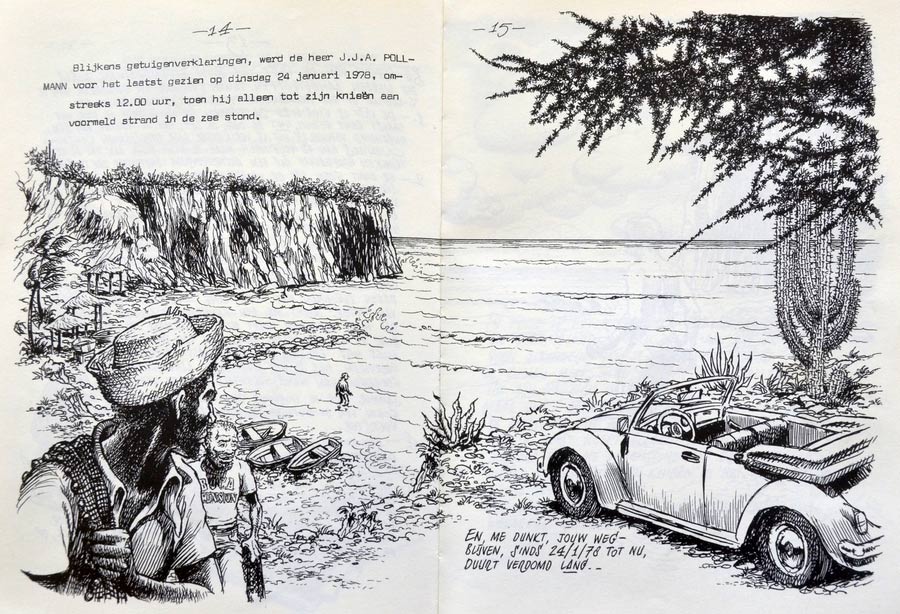
'Kraut'.
Kraut
Together with Flip Fermin, Pontiac provided the hand-lettering of the Yiddish phonetic translation of a 1984 re-edition of Will Eisner's 'A Contract With God' by Les Éditions Lambiek. Ten years later, he provided the lettering for the first part of the Dutch translation of Art Spiegelman's 'Maus' (Oog&Blik, 1994) - the second part was lettered by Roel Smit - and later also gave Robert Crumb's 'Kafka' (Oog&Blik, 2005) its Dutch lettering.
While lettering the translation of 'Maus', Spiegelman's gripping comic about his Holocaust-surviving parents, Pontiac got the idea to make a book about his own father. During World War II, Joop Pollmann (1922-1978) had served in the Waffen-SS as a war correspondent on the Eastern front and in Normandy. After the war, he was sentenced to four years imprisonment, mostly because of the speeches he had given in Austria and Germany to groups of Dutch forced laborers in an attempt to recruit soldiers for the fight against Bolshevism. Back in civilian life, he never abandoned most of his war-time sentiments, though. As a result Pontiac rebelled against his father as a teenager and eventually had little to no contact with him. Later in life, Joop Pollmann was a heavy drinker, who eventually lost his journalist job. In 1978, Joop Pollmann disappeared without a trace on the island of Curaçao, having presumably drowned in the Daaibooi bay.
As Peter Pontiac grew older and wiser, he regretted that he never asked his father about his dark past. The artist spent most of the late 1990s working on 'Kraut', a graphic novel presented as an illustrated and handwritten letter to his father, described by the author as a "biographic". Production of the book was an emotional journey for Pontiac, who studied his father's correspondence, talked with former colleagues and friends, and visited locations from his past. He stated that after the project was finished, he finally knew his father, an observation shared by members from his family after they had read the book. When in December 2000, 'Kraut' was finally made available through the publishing house Podium, it was praised as a masterpiece by both critics and readers. In the years that followed, Pontiac found new documents that shed a new light on his father's life. In 2003, he also found additional information while visiting Curaçao during the filming of Chris Kijne's documentary about the artist's life and work. An updated edition of 'Kraut' was released in 2005, followed by a definitive edition in 2011.

'Mad Musicians', illustration for Oor magazine (1994) depicting various famous lunatics from the music industry. In the back row, from left to right, is funk artist George Clinton with PF (P-Funk) glasses and in the background UFOs from his stage show. Paranoid soul musician James Booker and his iconic star-shaped eyepatch follow, standing next to gunslinging music producer Phil Spector in a Napoleon hat. In the center is reggae producer Lee "Scratch" Perry blowing out marijuana smoke. The middle row shows shock musician G.G. Allin at the left, eating excrement. Fleetwood Mac member Peter Green is confronted by the green devil from his song 'The Green Manalishi'. Pink Floyd recluse Syd Barrett holds up a Rorschach test-like blob, which is a nod to the group silhouette on the back cover of 'The Piper At The Gates of Dawn'. His head also mimics the prism lens effect from the front cover. Next to him stands troubled Beach Boy Brian Wilson. He has a smiley button on his shirt, in reference to the 1967 record 'Smile', which wasn't released until 2004. The flames on his head are a nod to the song 'Fire', which, according to the paranoid Wilson, inspired a real-life fire in his neighborhood. In the far center right Captain Beefheart appears, with his fishy head as depicted on the cover of 'Trout Mask Replica'. Next to him is a detail from Edvard Munch's painting 'The Scream'. In the front row, at the bottom of the image, we spot 13th Floor Elevators frontman Roky Erickson next to the "Bloody Hammer" from his song of the same name. Shock rock pioneer Screamin' Jay Hawkins is put in a straight jacket with a bottle of 'Alligator Wine' (one of his musical hits) in his pocket. Pontiac also gave himself a cameo in the lower right corner, barely visible behind Hawkins.
Later years
In 2008, after 24 years in Bussum, Peter Pontiac and his wife returned to Amsterdam. During this later period of his life, Pontiac often collaborated with Roel Smit on producing artwork for the Haarlem pop stage Patronaat. He continued to provide comics and illustrations to a wide variety of projects, both mainstream and small press. He contributed a story to 'Roes' (Prometheus, 2005), a book by Hafid Bouazza about drugs. Pontiac then adapted the song 'Meisjes' by the Belgian rock singer Raymond van het Groenewoud into a short comic for the anthology 'Strips in Stereo' (2006), and gave the same treatment to Tommy Wieringa's coming-of-age novel 'Joe Speedboot' for the anthology book 'Mooi Is Dat!' (2011). He also paid homage to Marten Toonder in the tribute book 'Was Tom Poes Maar Hier - Een Hommage aan Marten Toonder' (De Bezige Bij, 2006). New comics and illustrations appeared in the literary comic magazine Eisner (2009), the alternative comic magazine Zone 5300, and small press initiatives like De Legendariese Lijn (2006) and Menno Kooistra's Dutch horror comic anthology 'Bloeddorst' (2007). Pontiac was additionally one of several people to write a foreword for the 2006-2017 reprints of Lo Hartog van Banda and Thé Tjong-Khing's classic comic series 'Arman en Ilva', published by Sherpa.
Recognition
On 11 October 1997, Peter Pontiac received the annual Stripschap Prize for his entire body of work. A year later, he received the Professor Pi Illustrator's Prize for his book 'De Pen en het Zwaard', the sixth installment in the 'Pontiac Review' series. On 9 September 2011, he was awarded the Marten Toonder Prize, a prize for artists that have left their mark on Dutch comics.

'Styx'
STYX
In 2010, Peter Pontiac found his former life catching up with him. He was diagnosed with hepatitis C, presumably the result of using a dirty needle during his heroin addiction. Adding on top of this, he also had to cope with liver cirrhosis. He dealt with this dire news by making a graphic novel about his rapidly approaching end, 'STYX of de Zesplankenkoorts'. The book featured some black comedy, such as Pontiac arm wrestling with the Grim Reaper, but also expressed his more intimate sentiments about dying. One chapter looked back at his mother's death, as well as the deaths of his friends Flip Fermin and Kees Kousemaker. By September 2014, he had completed about 80 pages. In November of that year, he managed to gather enough money to complete the book through a crowdfunding campaign. Unfortunately, Pontiac was too ill to finish the project. He ultimately decided not to undergo a transplant and quit his treatment. To him, spending the rest of his days in a hospital wasn't worth it, even if he could prolong his life a bit more. On 20 January 2015, Peter J.G. Pollmann passed away.
The 'STYX' book project was picked up by his friends - graphic designer Fake Booij and publisher Joost Nijssen - and relatives, his brother Joost Pollmann and his widow Ipie. The finished pages of the graphic novel were supplemented by additional material, such as the correspondence between Peter Pontiac and his brother Joost, as well as previously unpublished sketches. The book was released posthumously by publisher Podium in 2016.

Kees Kousemaker and Peter Pontiac at the opening of the Charles Burns exposition in Gallery Lambiek in November 1998.
Legacy and influence
With the death of Peter Pontiac, the Netherlands lost one of its greatest comic artists. His talent and influence were recognized far outside of the Dutch language borders, and his work has remained in the public attention. In April 2016, about one year after the artist's death, the Groningen pop stage Vera organized an exposition about Peter Pontiac's work, called 'Pontiac Forever - a tribute to Peter Pontiac'. The May-June 2016 exposition '¡VIVA PONTIAC!' in the Nieuwe Vide Artspace in Haarlem showed the original pages of 'STYX', as well as tributes by several of his peers. Pontiac's artwork was also featured prominently in the group expo about underground comics 'Van Pontiac tot Guthrie', held in the Haarlem Vismarkt (June-July 2016). In May-June 2022, the KeK gallery in the artist's birthplace Beverwijk showed a selection of his many artworks.
In his home country, Peter Pontiac pioneered the genre of autobiographical comics. In his slipstream followed artists like Gerard Leever with his "Gleever's diary", and the wave of small press authors from the 1990s and 2000s, including Barbara Stok, Maaike Hartjes, Floor de Goede and Michiel van de Pol. The 2000 publication of 'Kraut' called in a new era in which the Dutch literary graphic novel came to blossom with authors like Guido van Driel, Milan Hulsing, Erik Kriek, Marcel Ruijters and many more. In the field of rock 'n' roll illustration, Typex and Roel Smit are Peter Pontiac's true heirs. Peter Pontiac was also an influence on comic artists like Chris Berg, Eric Schreurs, Menno Kooistra, Erik Kriek, Bert Bleek, Marc de Boer, Pic, Yiri T. Kohl, Marcel de Jong, Maia Matches, Marcel Ozymantra, Ernst van Veenendaal, Herwin Walravens and Johannes van de Weert. With his exquisite promotional artwork, Peter Pontiac has additionally helped put comic shop Lambiek on the map as the homebase for alternative comics.
Family in the media
Peter Pontiac's brother is Joost Pollmann (1957), a comics publicist and reviewer for newspapers like De Volkskrant. For many years, he was also the driving force behind the Haarlem Comics Festival. Peter's other brother Paul Pollmann (1961) is a graphic designer for books and magazines, operating through his Studio Pollmann. In this capacity, he has often worked with his brother's illustrations. Peter Pontiac's daughter Godelinde (1984) is a film editor whose credits include the TV series 'Verliefd of Ibiza' (2013), 'Soof' (2019) and 'Mocro Maffia 4' (2022) and the films 'De Masters' (2015) and 'Single Street' (2019).
Documentaries and books about Peter Pontiac
During his lifetime, Peter Pontiac's artwork has been the subject of many expositions, but also of TV reports and documentaries. In May 1990, the Dutch TV documentary 'De Wereld van Peter Pontiac' was broadcast, which was followed in 2003 by Chris Kijne's documentary 'Pontiac', about the artist's life and work, particularly in relation to 'Kraut'. In 2024, publisher Nieuw Amsterdam published a highly recommended biography about Peter Pontiac by Jeroen Thijssen, titled 'Peter Pontiac. De Biografie: Het Turbulente Leven van een Gedreven Tekenaar' (Nieuw Amsterdam, 2024).

Cover illustration for VPRO Gids (2002).