


'Paulus de Boskabouter' illustration from one of the Margriet magazine serials.
Jean Dulieu was a Dutch multi-disciplinary artist, best remembered as the creator of 'Paulus de Boskabouter' ('Paulus the Woodgnome'), who first appeared in a newspaper comic strip (1946-1957, 1963-1967, 1973-1984). Over the course of the strip's three runs, Dulieu crafted a magical world with many colorful characters. Besides Paulus, there are Oehoeboeroe the Owl, Salomo the Raven, Gregorius the Badger and the gruesome witch Eucalypta. Dulieu also adapted his charming children's fantasy stories into other media, including illustrated novels, a puppet play, a radio show and a television puppet series. For these media, he made additional color plates, merchandising art, puppets, sets and provided his own voicework. In his private life, Dulieu was a slightly tormented person, whose obsessions regarding his Catholic faith, troubled family history and closeted homosexuality sometimes found their way into his work.
Early life
Jean Dulieu was born in 1921 as Jan van Oort. By the time of his birth, the family was living with the maternal grandparents at 298 Overtoom in Amsterdam. Four years earlier, his sister Cok (1917-2005) had been born. The household was filled with intrigue, scheming and deceit, leaving Van Oort with lifelong issues regarding affection, romance and trust. His father was concert singer and teacher Hendrik C. van Oort (1873-1953), who had left his first wife in 1915 to marry one of his Conservatory students, namely the young and inconsistent Mien Braakensiek (1889-1967), who'd become Dulieu's mother. From his first marriage, Hendrik van Oort already had three children. Initially, Hendrik and Mien van Oort performed together, and to positive reviews, but their musical collaboration ended abruptly when their son was four. Explanations as to why are uncertain, but apparently Mien either lost her voice, or she wasn't that knowledgeable about the technical aspects of music, which irritated her husband. Dulieu's parents grew more and more apart. Dulieu's father was a very self-absorbed, distant personality. Since his father often gave singing lessons at home, Dulieu wasn't allowed to bring any friends over, while his overprotective mother kept him inside, out of fear something might happen to him when playing in the street. It made him a solitary personality, often playing alone in his room, drawing, sculpting puppets and thinking up fantasy stories.
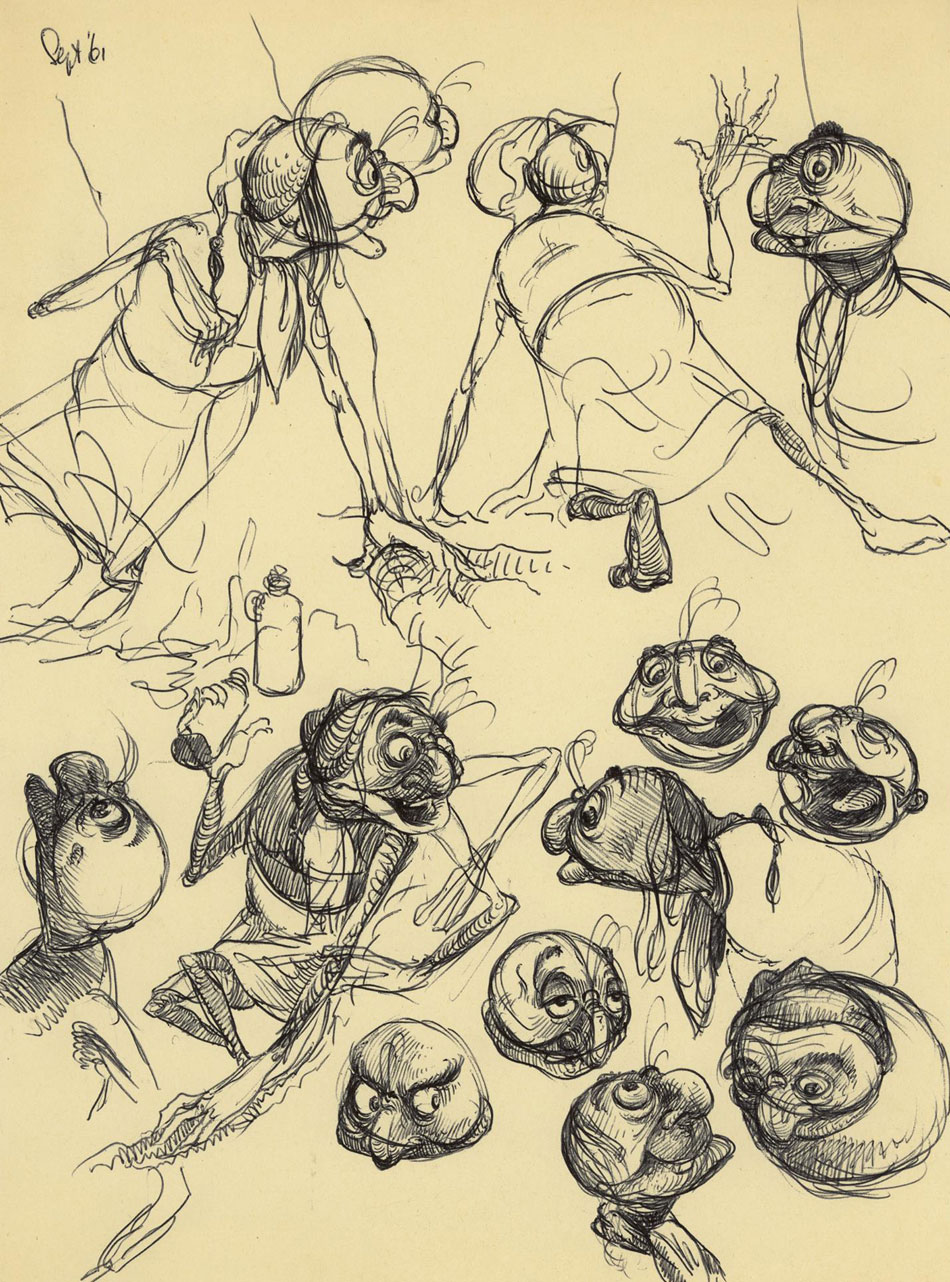
Elements from several of the women in Jean Dulieu's early life were incorporated in the Eucalypta character.
Feeling neglected by her husband, Dulieu's mother started an affair. Her lover often visited the household and five-year old Dulieu once caught them together after having woken up from a bad dream. He was beaten for his "disturbance". Out of guilt and overcompensation, Dulieu's mother often spoiled and cuddled her son, going so far as to kiss him on the mouth. As a child, Dulieu didn't grasp all these marital troubles, until he reached a certain age and grew cold and distant towards his mother, blaming her for "ruining" the family bliss. He was irritated with her constant melodramatic bellowing over her husband and threats that she might "run away" or "kill herself". In his diary, he also hinted at sexual abuse, which only added to his repulsion to her.
In the meantime, grandmother Braakensiek schemed with next door neighbor and family friend H.C. Oud (1861-1939). They planned that if the latter would pass away, her son-in-law Hendrik would remarry Oud's wife An Beets, who was coincidentally also Mien Braakensiek's best friend. After catching Mien with her lover again, Hendrik van Oort left the Amsterdam house and relocated to Zandvoort, taking his son Jan with him. There, he married a third time, indeed with An Beets, but couldn't escape more drama. His new stepmother introduced Jean Dulieu to her niece and his future wife, Kitty Sijmons (1923-1986). In 1941, the family relocated to the Klein Vosseveld estate in Soest, where Dulieu moved into the separate coach house, which he also used as his atelier.
Influences
During his eventful upbringing, one of the few people Dulieu felt close to was his grandfather, the famous political cartoonist Johan Braakensiek. As a children's book illustrator, he enjoyed additional notability for livening up the pages of C. Joh. Kievit's classic novel 'Dik Trom'. Dulieu remembered that his grandfather often read to him from 'Dik Trom' and also introduced him to the artwork of Gustave Doré and Arthur Rackham. His earliest exposure to comics were Rodolphe Töpffer's 'Mr. Vieuxbois' ('Meester Prikkebeen'), George van Raemdonck's 'Bulletje en Boonestaak', E.C. Segar's 'Popeye' and Disney comics. The feature film 'Snow White and the Seven Dwarfs' especially made a strong impression on the 17-year old. Its dwarfs, forest creatures and vivid witch were an obvious influence on the characters and atmosphere of 'Paulus de Boskabouter'. Perhaps a bit too much, because his daughter Dorinde later recalled that Dulieu didn't allow Disney comics in his household and even tore them apart if he discovered some. In interviews he never mentioned 'Snow White' either, despite still going to theaters with his children to watch Disney films. Another early influence on Jean Dulieu was his aunt, Grietje Braakensiek (1891-1973), who was a painter and dancer, and one of the supporters of his early experiments with puppet creation.
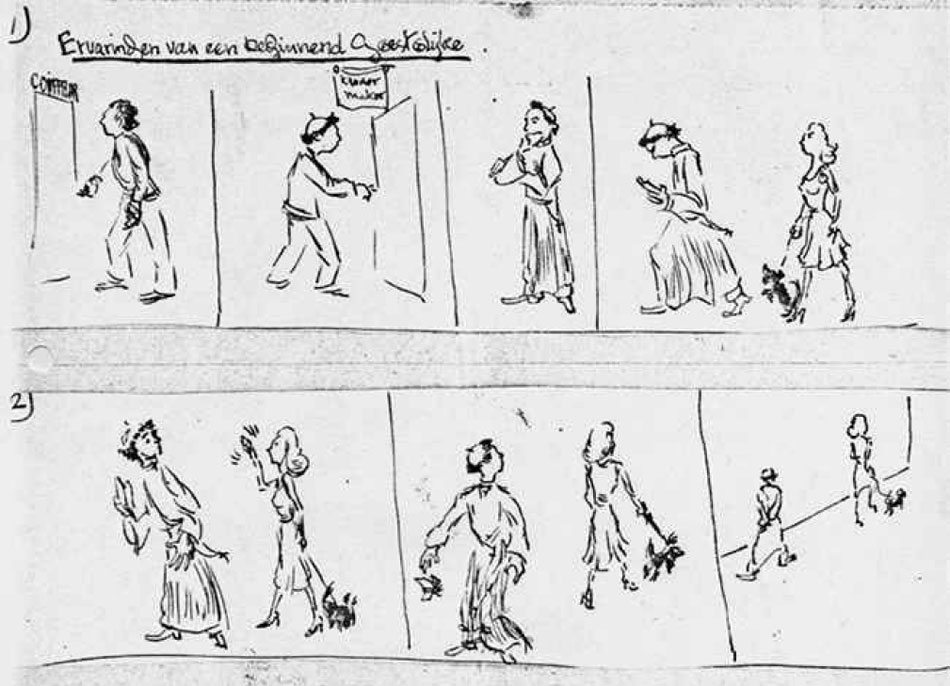
From Jan van Oort's diary: 'Experiences of an Emerging Clergyman'.
Early career
Dulieu began his career in another art form, namely music. For his ninth birthday, his father had given him his first violin and instantly saw a natural talent in him. At his insistence, Dulieu studied violin at the Amsterdam Conservatory, where he graduated in 1940. In October 1941, he was asked to fill one of the vacant spots in the Gooi Orchestra, where he also had his first radio appearance. He subsequently joined the new opera orchestra of the Municipal Theatre Company in Amsterdam as deputy concertmaster of the second violins. On 1 September 1944, he made the switch to second violinist at the Royal Concertgebouw Orchestra in Amsterdam.
While Dulieu's musical career took up most of his free time throughout the 1930s and first half of the 1940s, he also developed interests in literature, astronomy, parapsychology and spiritualism. Growing more fascinated by Roman Catholicism, he drew a humorous comic strip in his diaries, titled 'Experiences of an Emerging Clergyman'. During World War II, The Netherlands were occupied by the Nazis. In September 1944, the Allied Forces liberated the Southern part of the country, but the Northern half remained under Nazi control for another gruelling half year. The circumstances caused severe famine in the North, while a harsh winter made the situation even worse. Dulieu was left without a job when his orchestra decided to disband. Despite six months of hardship and misery, it actually left him with more time to stay home, rediscovering his love for drawing. Delving into a graphic dream world provided him with much-needed escapism and the realisation that this was what he really wanted to do for a living. After the Liberation (May 1945), Dulieu and his wife moved to the Frysian isle of Terschelling, all the way in the North of the country. Between 1946 and 1953, the couple had four children: Dorinde (1946), Annelies (1947), Piet (1949-1965) and Franc (1953).
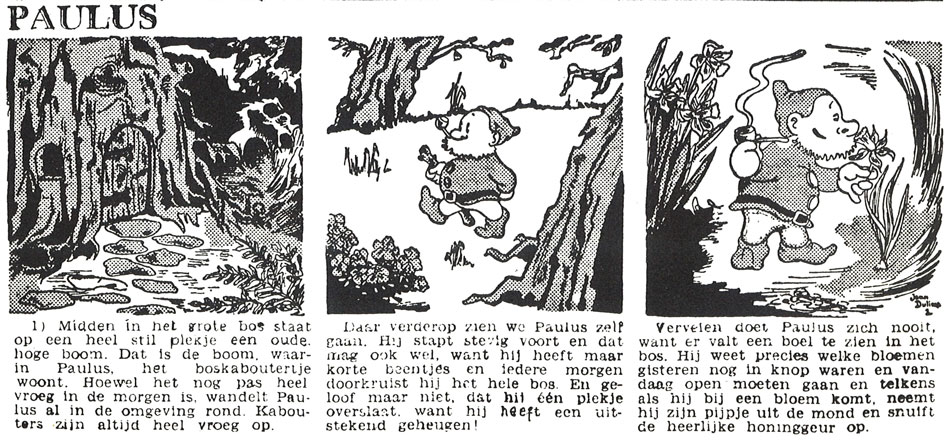
First 'Paulus' episode of 2 February 1946.
Het Vrije Volk
In 1945, Dulieu's earliest drawings appeared in print in newspaper Het Vrije Volk, starting with some caricatures of musicians. Since he didn't have any academic training, Van Oort decided to sign all his writings and artwork with the pseudonym "Jean Dulieu", a literal French translation of his full name. If his new life goal failed, it would at least not harm his reputation in the music scene. On 25 November 1945, his official association with Het Vrije Volk started. At the suggestion of his artist friend Henk Gorter, he presented the editors some earlier drawings of a gnome called Paulus and his forest friends. To appear more professional, he had numbered his very first drawing "Nr. 35", as if he merely took one of several previous projects to them. His proposal was accepted, but the editors wanted to read the script too. Lying that he had left it at home, Dulieu dashed back to quickly write it from scratch. Luckily he had been brainstorming about his characters for so long that the plot basically wrote itself.
The timing for Jean Dulieu's career-change was perfect. In the early post-World War II years, many national and regional newspapers were launched in the Netherlands, and all in need of a comic strip. Since international contacts weren't fully restored, this offered opportunities for local comic creators. Some disappeared from the scene after a couple of years. Others, like Jean Dulieu, as well as Hans G. Kresse, Pieter Kuhn and Henk Sprenger, became icons of Dutch comics culture. On 2 February 1946, the first episode of Dulieu's 'Paulus De Boskabouter' was printed in the newspaper Het Vrije Volk. Like most Dutch newspaper comics at the time, it was presented in text comic format, with narration and dialogues underneath the images. As his series became an instant success, Dulieu ended his association with the Royal Concertgebouw Orchestra and never looked back.

Paulus De Boskabouter and Professor Punt.
Paulus de Boskabouter
The title character of Dulieu's comic is a nice, wise gnome called Paulus, who often hangs out with his three animal friends: Oehoeboeroe the owl, Salomo the raven and Gregorius the badger. Both Oehoeboeroe and Salomo are erudite birds, who talk in highbrow language. Particularly Oehoeboeroe uses very old-fashioned words and expressions. His name has proven to be difficult to pronounce or spell among fans, with some settling on "Oeroeboeroe". In sharp contrast, Gregorius is dim-witted, gluttonous and lazy. The badger also has his own distinctive way of talking, mixing up words and syllables in a manner that makes him come across as a dyslexic. Among the wood comrades of Paulus who appear less frequently are field gnome Pieter, Wipper the rabbit, Pluim the squirrel, Pak the magpie, Radboud the otter, an unnamed mole and Priegeltje the elf princess. Several characters were inspired by the Paulus abbey where Dulieu spent some time during World War II, namely brothers Paulus, Gregorius and Pieter.

Early 'Paulus De Boskabouter' strip from 1947.
The 'Paulus' stories are straightforward but charming children's stories, set in an idyllic forest, where all animals talk and legendary creatures are rampant. Dulieu rarely went beyond this set-up, giving his tales a very cosy, inviting atmosphere. His early artwork was simple, while his characters had silhouetted eyes, reminiscent of Disneyseque cartoon characters. Later in his career, Dulieu drew in a more naturalistic and realistic style, particularly when his stories ran in weekly magazines, where he could spend more time on atmospheric artwork and benefit from coloring printing. Some narratives were inspired by personal anecdotes. In 'Paulus en Wawwa' (1952), for instance, Paulus finds a stuffed toy elephant, lost by a girl named Dorinde. This was inspired by a real-life experience of Dulieu's six-year old daughter, who was also called Dorinde. Still, not all is well in the forest. Sometimes Paulus has to fight a gluttonous fox, Reintje, who wants to guzzle up his friends. Dulieu based him directly on his mother's extramarital lover.
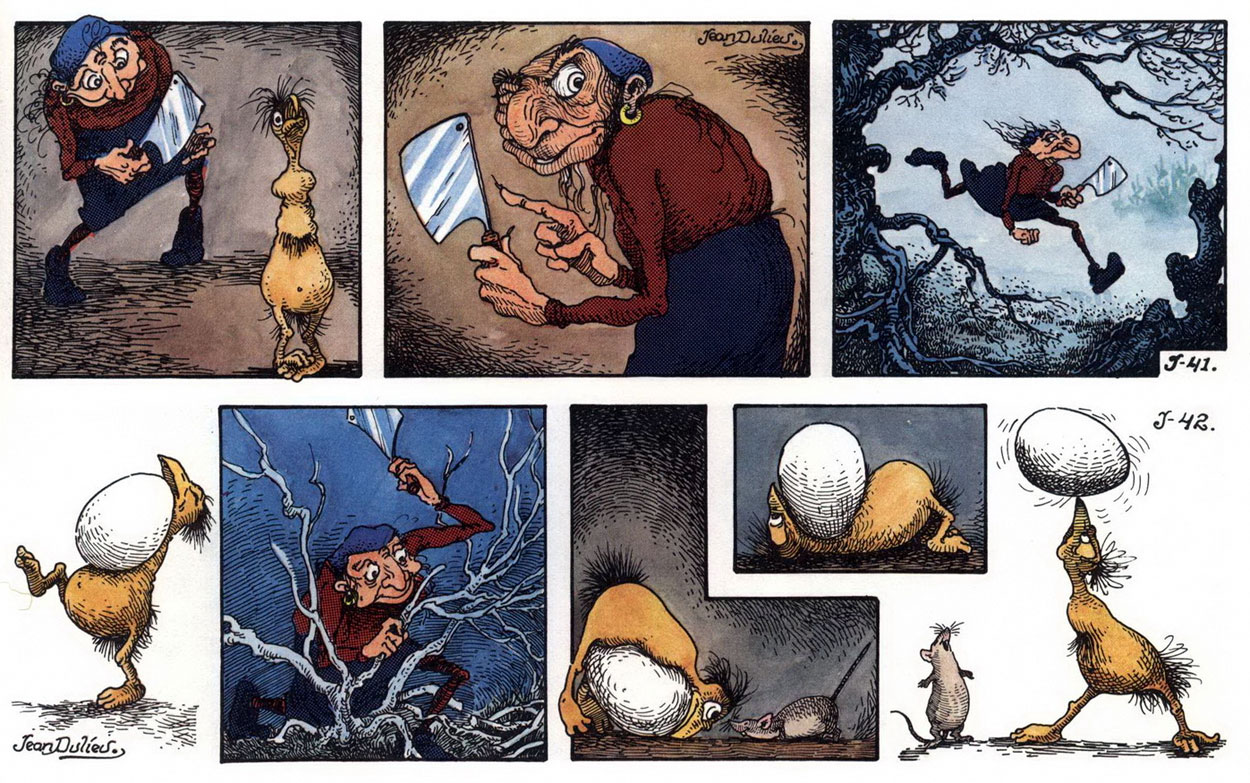
Paulus De Boskabouter - 'De Mussenklus' (1974).
Eucalypta
In the fall of 1946, Dulieu added a final but very significant main character to his 'Paulus' comic strip: the witch Eucalypta, who lives at the other end of the forest. Her pet is the featherless chick Krakras, who acts as her bumbling servant. Dulieu already had a witch in mind when his 'Paulus' comic debuted, but deliberately didn't introduce her in the series until about half a year later. He feared that readers, who had just endured World War II, might not be in the mood for such a chilling character. Readers quickly got used to Eucalypta, who grew into arguably the series' most memorable creation. As Paulus' greatest nemesis, she provides a genuine menace in what otherwise would have been a rather bland and safe children's comic. Many young readers who grew up with 'Paulus de Boskabouter' vividly remember being intrigued and scared of Eucalypta. Dulieu drew her with bulgy eyes, a grotesque hook nose and toothless grin. Since she's much larger than little Paulus, she towers over him, making her all the more intimidating, especially in large color illustrations. Eucalypta also disturbed young audiences in the later 'Paulus' radio and TV adaptations, particularly her uncanny puppet and Dulieu's vivid vocalisation.
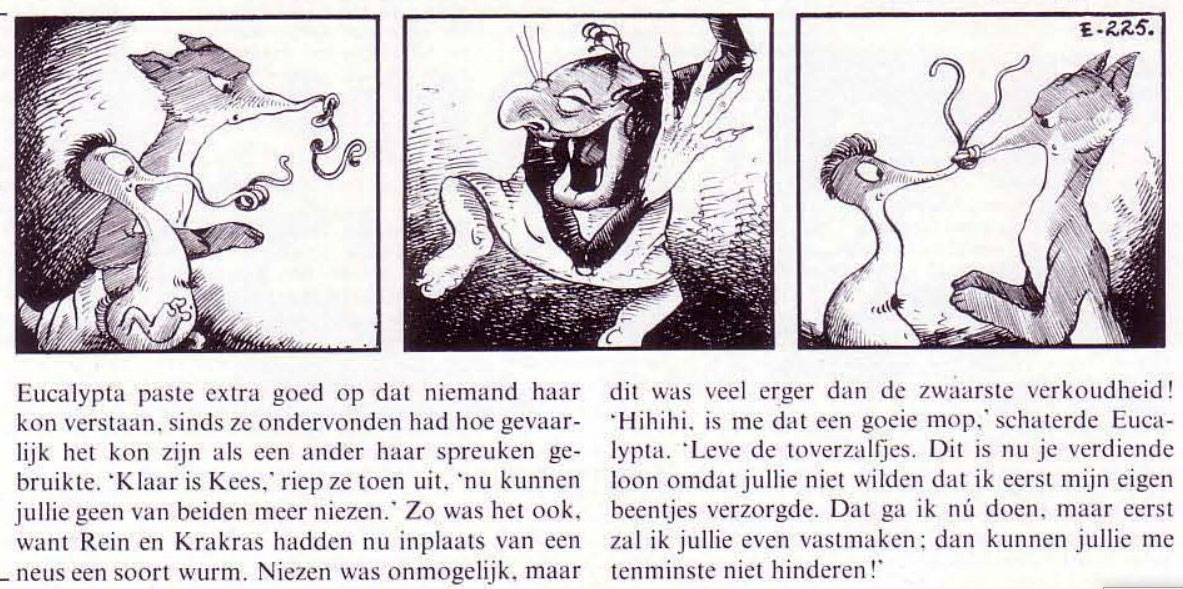
Paulus de Boskabouter - 'Een Beer in het Bos' (1965)
In a 1981 interview conducted by Renée Douwes for Hervormd Nederland, Dulieu was asked where Eucalypta "came from", but defensively and mysteriously said that he didn't wish to answer that question. In her book 'Paulus de Boskabouter of het Dubbelleven van Jean Dulieus', his daughter Dorinde suggested that the witch is an alter ego for Dulieu's own hated mother, but noted that he also disliked his grandmother (whose wrinkly appearance repulsed him) and stepmother (a flamboyant woman who had her own medicine cabinet and frequently conducted séances). This brought her to the conclusion that Eucalypta was more a general expression of Dulieu's troubled view of women.
Nevertheless, Dorinde van Oort also pointed out that Eucalypta isn't always threatening. The sorceress can be quite playful, even amusing, when cackling or moving and tumbling about on her long lanky legs. In a sense, she is a pitiful villain, whose plans are always thwarted. Paulus isn't even that scared of her either, regarding her more as an occasional nuisance whom he even feels sorry for. Many stories end with Eucalypta being humiliated and sometimes expressing regret for her mischief. Last but not least, Dulieu actually named Eucalypta his favorite character, since she made plots more interesting. Many fans share the same view.
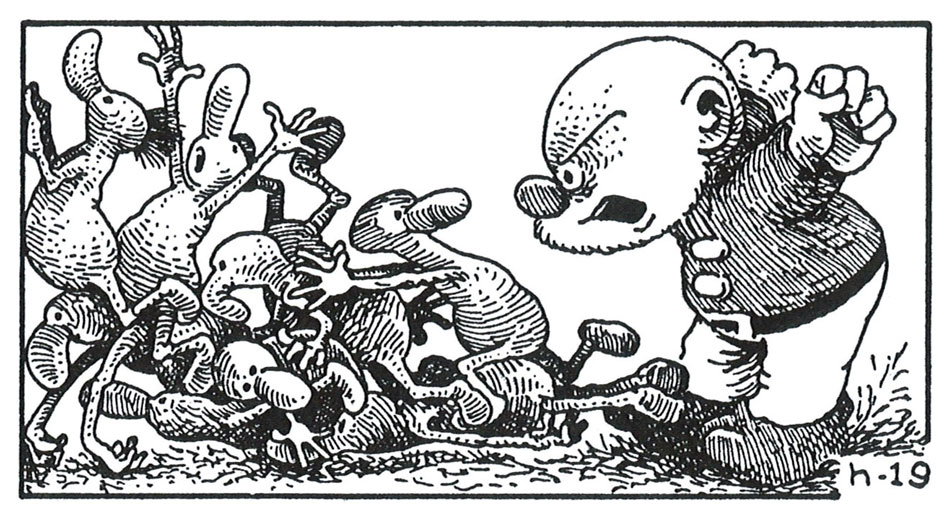
Paulus and the "Pliepen" ('Bouterbijters in het bos').
Fantasy creatures
In general, Dulieu made his illustrations first and wrote the narrative afterwards. A genuine workaholic, he was active literally every day, including weekends, to stay ahead of his deadlines. He never went anywhere without his sketchbook. If he was outside in nature, enjoying the tranquillity, he would typically make atmospheric illustrations. When angry, he took it out by drawing his characters in the same stormy mood. He also kept these drawings in case he needed these emotion-driven scenes for a potential story, "so I don't have to wait until I get furious again."
In the early episodes of 'Paulus de Boskabouter', Dulieu's universe was largely populated by real-life animals such as ducklings, wasps, spiders, butterflies, chickens and ants. But as the series progressed, so did the author's fantasy and graphic skills. An early example was the story in which Paulus went underground, into the realm of Koning Wortelneus ("King Rootnose"), ruler of a tribe of bign-nosed underground goblins ("aardmannetjes"). Around this time, Dulieu also let his hero wander outside of his forest, traveling the world while encountering a great many other animals, notably Pam the monkey and Pimpie de lion. But when Paulus was in his own habitat, Dulieu's imagination went into almost proto-psychedelic directions with all kinds of fantasy creatures that couldn't be linked to any folkloric tradition. Often, they had imaginative names, based on wordplay or an unlikely combination of words, resulting in "wateraap" ("water monkey"), "klaplip" ("flaplip"), "schapenwolkherder" ("fleecy"-cloud-herder"), "vleerkat" ("batcat"), "nachtmerrie" ("nightmare"), "zeegeit" ("seagoat"), "soepketelvis" ("soupkettlefish") and "oorkraai" ("ear-crow"). Especially in his later color stories for magazines these fantasy creatures came to blossom. For instance the "hinderdistel", a living thistle who obstructs your every movement, or the "pleep" people ("pliepen"), known for their grumpy, stubborn and very straightforward behavior. Another notable creation was Eucalypta's living broom Dorus Bezem and his wooden offspring.
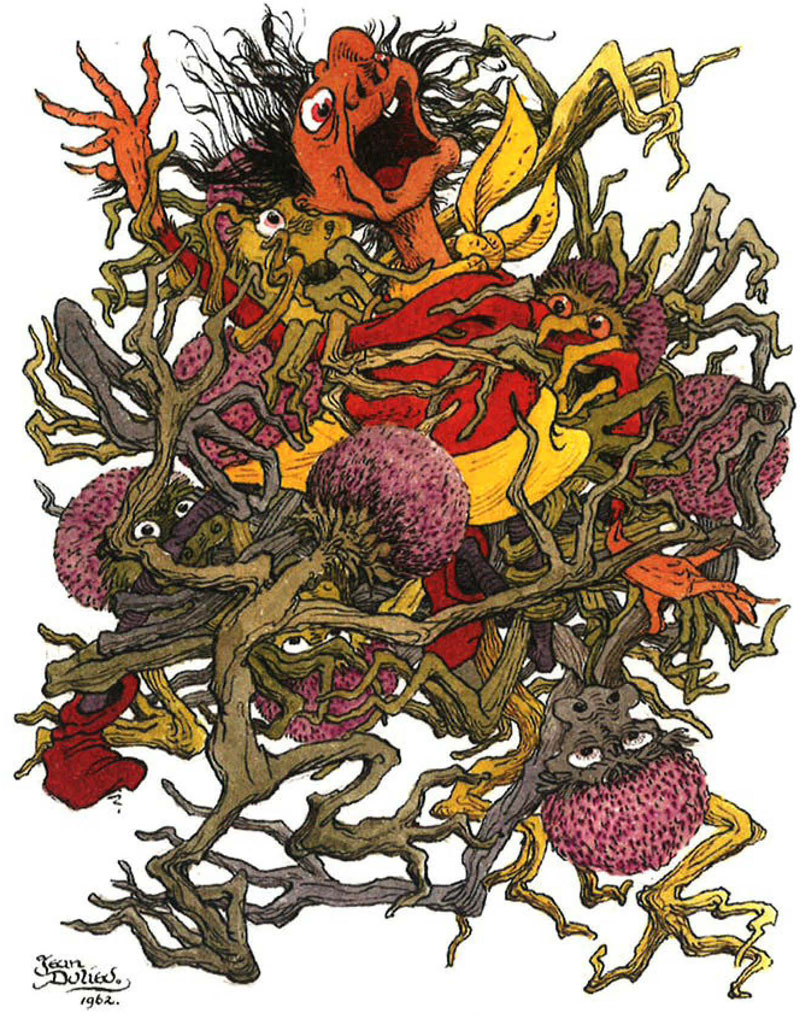
Eucalypta and the "hinderdistel" (1962).
Since 'Paulus de Boskabouter' was a highly personal work for Jean Dulieu, these creatures also gave insight into the artist's state of mind. Several creations stemmed from his belief in forest and field gnomes, his interest in the supernatural, or his own moods, hallucinations and nightmares. Especially the latter kind was generally not suitable for publication in a comic strip, such as the gruesome "griepers" ("flus"), of which only a couple of drawings exist.
Although many people praised Dulieu as an excellent children's storyteller, who appealed directly to this demographic, he claimed to never have young readers in mind. Many of his stories were inspired by his love of nature and the fantasies he conjured up while playing alone in his room as a child. He considered it a bonus that others liked them, yet made them mostly for himself. This also explains the darker undertone of his comic, compared with other comics from the same era about "happy gnomes and forest creatures", which, in contrast, were actually intended for very young readers.
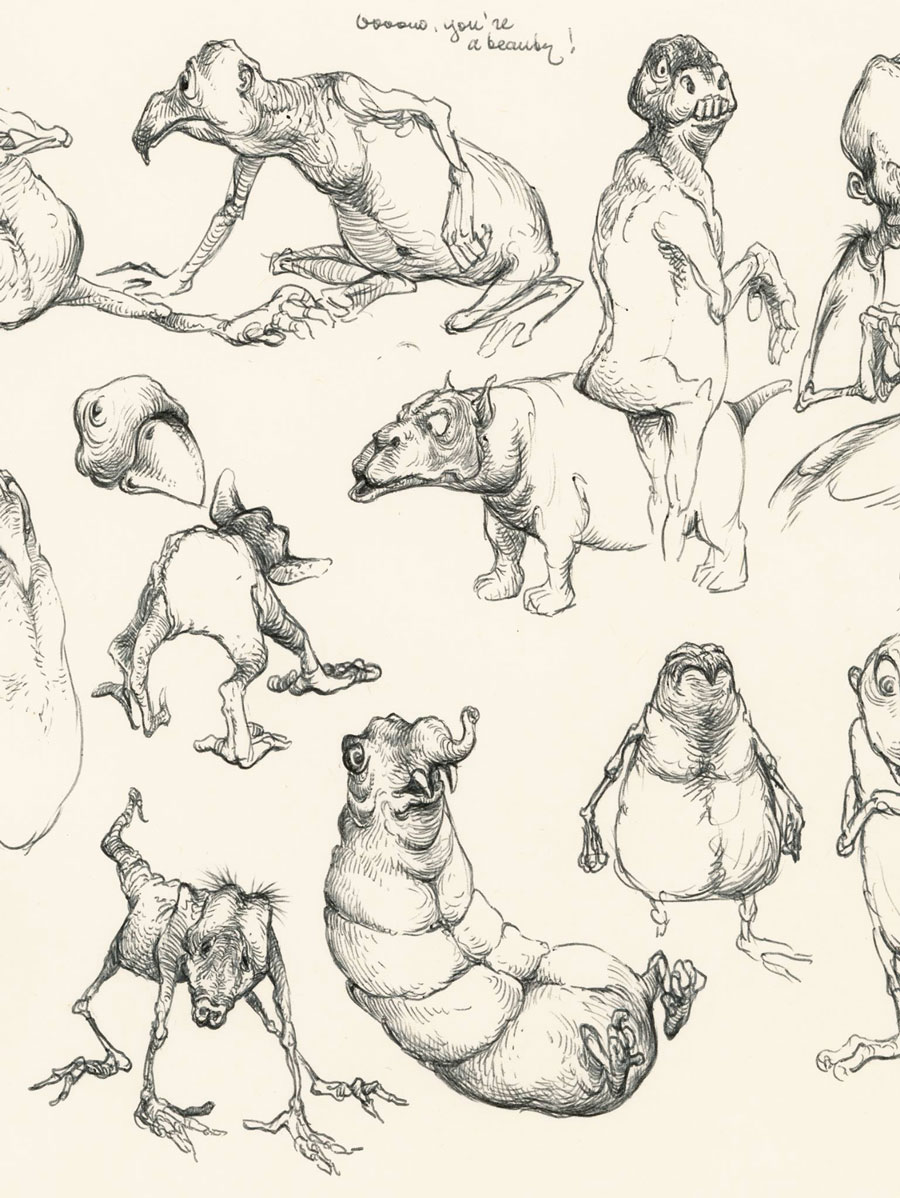
"Griepers", creatures that Dulieu envisioned during a feverish nightmare.
Paulus: publication history
On 2 December 1957, after 3,571 daily strips, the final episode of 'Paulus' appeared in Het Vrije Volk. This gave Dulieu more time to work on its radio adaptation and illustrated magazine stories. Between 1963 and 1967, the gnome returned to the newspaper with 1,392 new daily episodes. These "new" adventures were mostly reworked versions of older stories, with improved artwork and rewritten captions. For this second series of newspaper strips, Dulieu divided his narratives into seven stories, identifiable by their numbering. In the subsequent book collection, three more stories appeared without previous newspaper serialization. After another hiatus, Paulus returned on 18 June 1973, but now as a feature in several local papers, like the Apeldoornse Courant, Arnhemse Courant, Gelderse Courant and the Zeeuwse Courant. This third series of completely new stories ran until 1984.
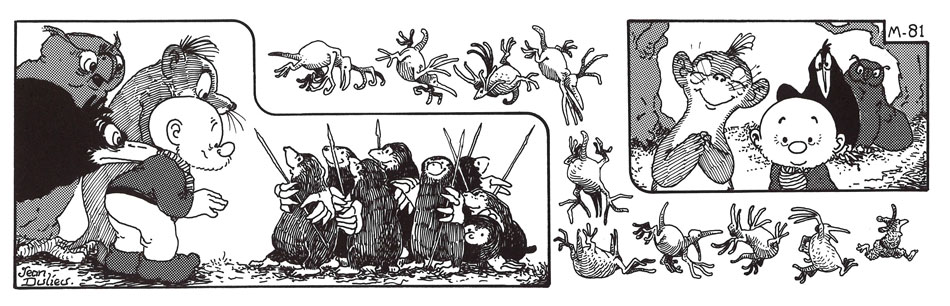
In the third series of 'Paulus' newspaper strips, Jean Dulieu often experimented with panel lay-outs ('De Kraakvogels', 1975).
During the 1950s, the adventures of 'Paulus' had become a popular appearance in magazines, mostly in richly illustrated prose stories, for which Dulieu applied the watercolor technique. From the start in 1954, he was a regular contributor to the literary and pedagogically oriented children's magazine Kris Kras, which appeared 24 times a year. Until 1963, the magazine ran many illustrated 'Paulus' stories - some new, others based on earlier newspaper stories with new illustrations. In addition, Dulieu wrote and/or illustrated non-Paulus fairy tale stories for Kris Kras, and took the initiative for the 'Kris Kras Kolder Krant' (1964), a completely nonsensical newspaper insert with weird news stories and funny illustrations.
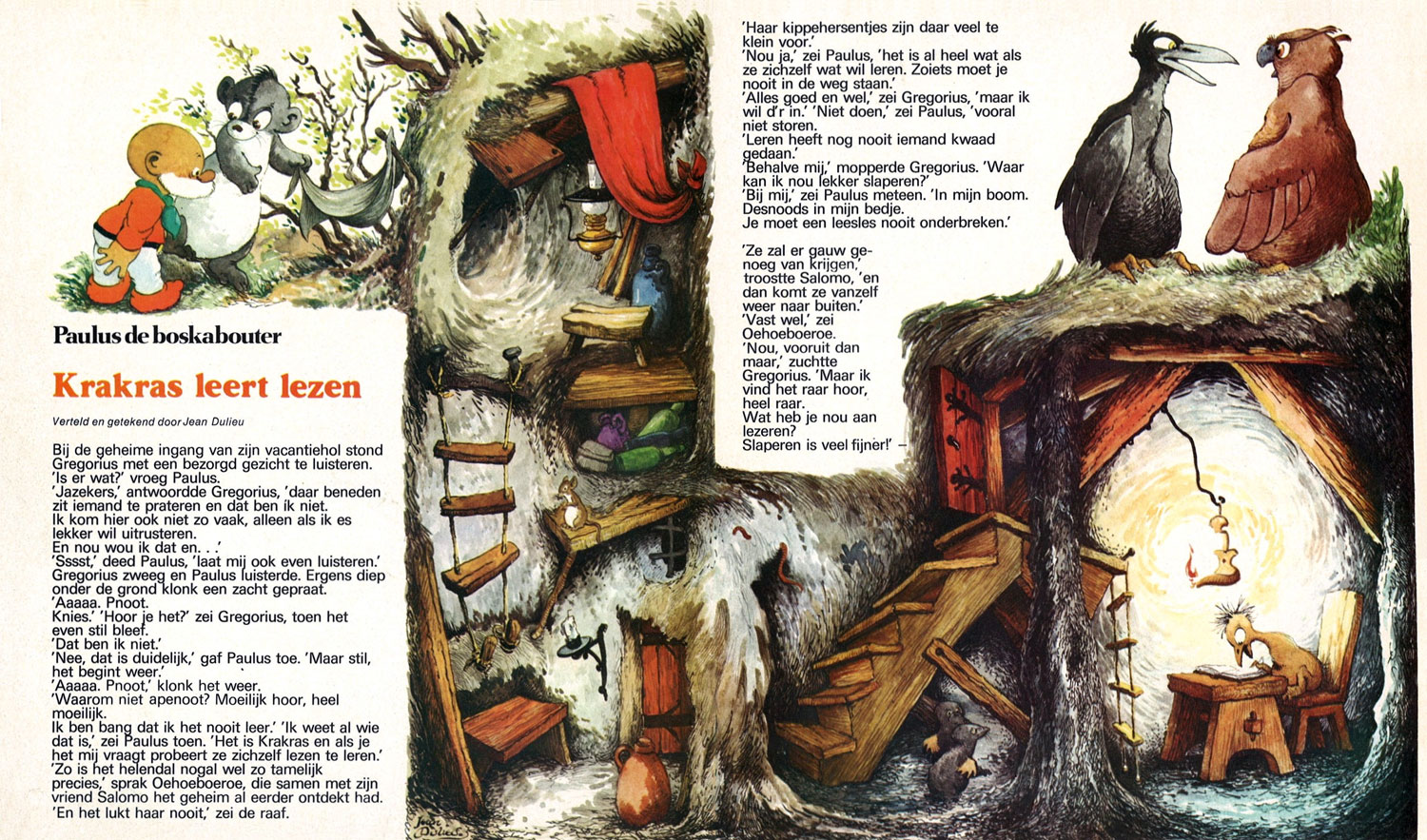
'Paulus' spread from Bobo magazine.
Following the character's appearance on VARA radio, Paulus' adventures were also printed in the broadcaster's radio and TV guide VARA-gids (1955-1958). These were mostly text strip adaptations of the radio plays. Between 1957 and 1963, illustrated text stories in color of 'Paulus de Boskabouter' appeared in the Dutch women's magazine Eva of the Nederlandse Rotogravure Maatschappij (NRM). In addition, they also ran in the magazine's juvenile companion title Fix en Fox. Between 1964 and 1966, the illustrated 'Paulus' stories were continued in another women's weekly, Margriet, published by De Geïllustreerde Pers. 'Paulus de Boskabouter' subsequently appeared in the NRM children's magazine Het Blad van Barend de Beer (1967-1968) and in the TV guide Televizier (1968). Between 1975 and 1977, reworkings from the Eva and Margriet stories were printed in the toddler's magazine Bobo.

'Paulus De Boskabouter' book collection.
Book collections of 'Paulus de Boskabouter' were published by De Arbeiderspers, and later by C.P.J. van der Peet, Ploegsma, Leopold and De Meulder. Besides collections of the newspaper and magazine stories, the 'Paulus de Boskabouter' often contained original stories that hadn't been serialized before. The first was 'Het Winterboek van Paulus' (1948), and about twenty more followed. In 1965, Dulieu released what is often considered his masterpiece: the extensive book 'Paulus en de Eikelmannetjes' (1965). For this volume, Dulieu experimented with new techniques for his many color illustrations, while also giving the story a subtle and well-conceived death motif that was acceptable to readers of all ages. For the publisher, it was an extremely expensive production that could only be financed because the book had recently been sold to the American market, where it appeared under the title 'Paulus and the Acornmen' (World Publishing Company, 1966).
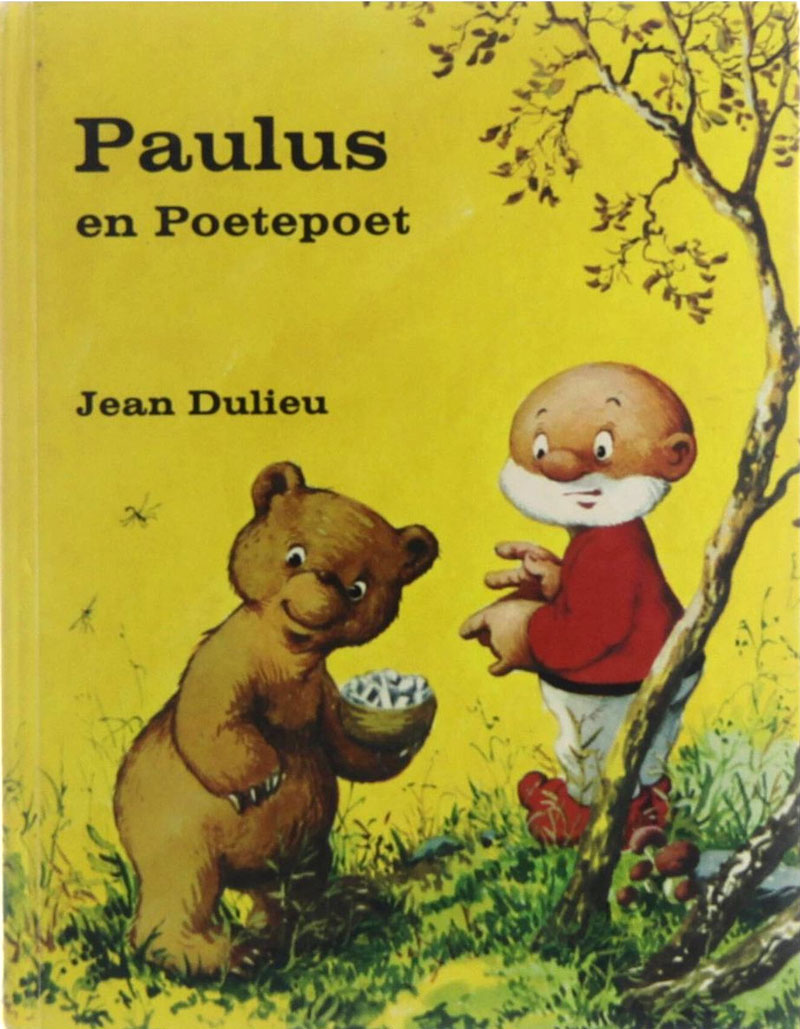
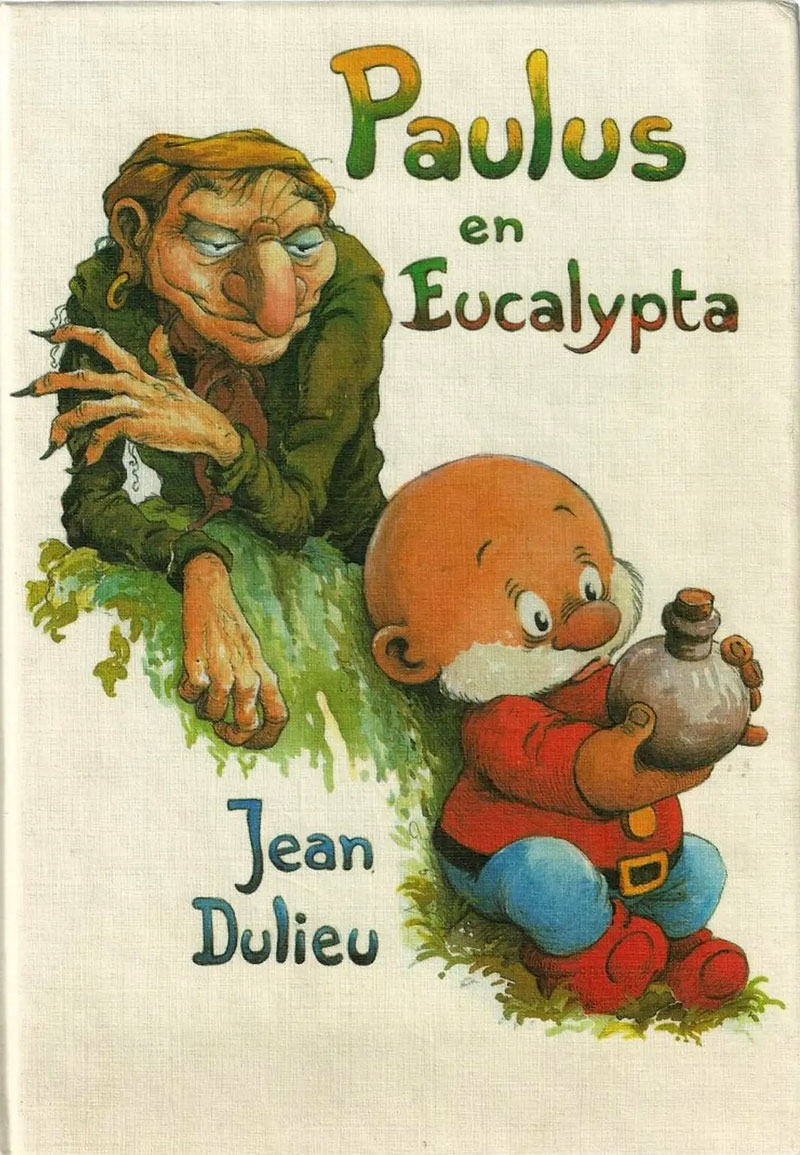
Book covers for 'Paulus en de Poetepoet' (1965) and 'Paulus en Eucalypta' (1981).
The series was also translated into English ('Paulus the Woodgnome'), German ('Waldwichtel Paulus'), Swedish ('Paulus'), Indonesian ('Pak Kerdil'), Afrikaans ('Paulus') and Japanese. In the Flanders part of Belgium, 'Paulus' appeared in Pum-Pum (1964-1966), the children's supplement of the newspaper Het Laatste Nieuws. In Germany, one story ran in the newspaper Engelbert Post (1962). After reading the English translation of the story 'De Eikelmannetjes', Dulieu spotted a serious error. The line "Ze stonden op een kluitje" ("They were standing tightly packed together") had been translated literally as "They stood on a lump of earth". This motivated him to translate his story personally. In 2018, one 'Paulus' story was also published in the dialect of the island of Terschelling.
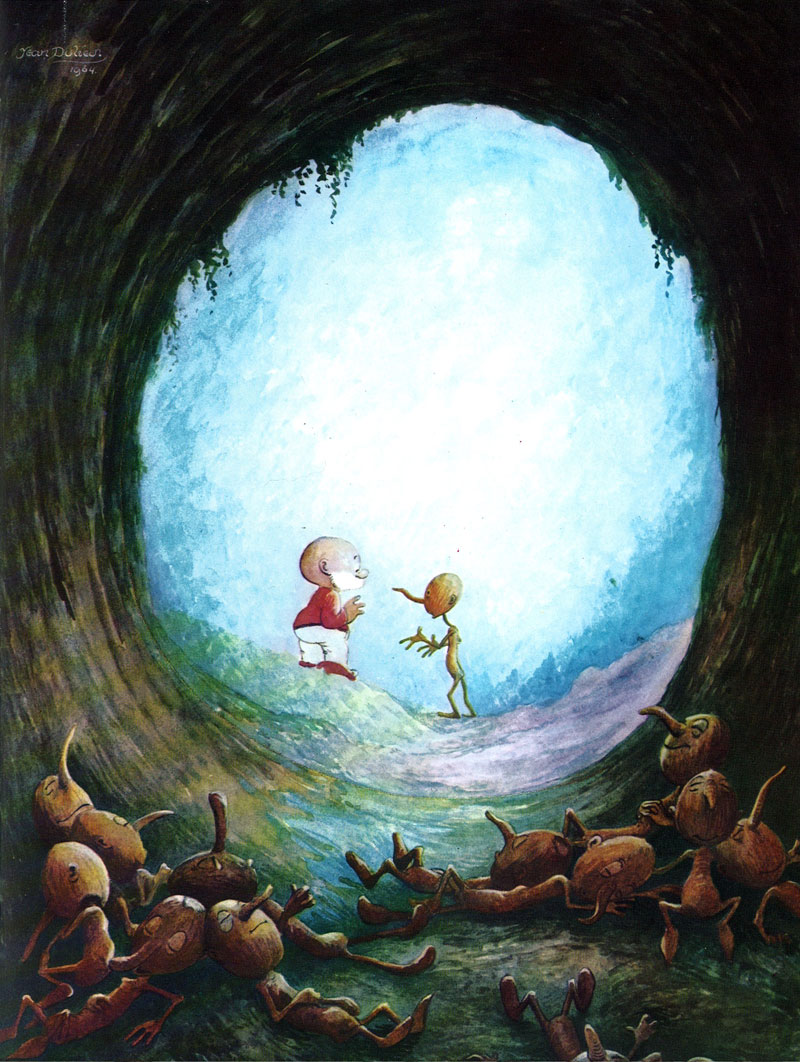
'Paulus en de Eikelmannetjes' (1965).
Puppet theater and radio adaptations
Shortly after the launch of the 'Paulus' newspaper strip, the multi-disciplinary artist Dulieu began experimenting with other forms of expression. From a young age, he had been interested in making hand puppets and marionettes. Also skilled at imitating voices, he began crafting puppets of his creations, and performed with them in front of Terschelling school children. Following their success, he began touring the country with his puppet theater De Sprokenspiegel in the Summer of 1947. Joining him on these shows was Henk Gorter, who had also been an important inspiration and supporter for the creation of the series. However, as Gorter later fell into Dulieu's disfavor, his contributions have never been acknowledged.
Dulieu increased the fame of his characters by adapting them personally into various media. The first was a series of audio plays, 'Paulus de Boskabouter' (1955-1964), broadcast on VARA radio. He provided his own narration, while voicing almost all of the characters himself. For Paulus, Dulieu used a high falsetto voice. Interviewed for the news TV program 'NOVA', he said that if he had known that he would make so many episodes for years on end, he would have picked out something less straining for his vocal chords. Prinses Priegeltje was voiced by his daughter, Dorinde. The only element that Dulieu had no involvement in was the broadcasts' theme music, for which Frederic Curzon's whimsical instrumental 'Dance Of An Ostracised Imp' (1940) was used. The radio show drew strong ratings and several of the in total 900 episodes were made available on children's records.
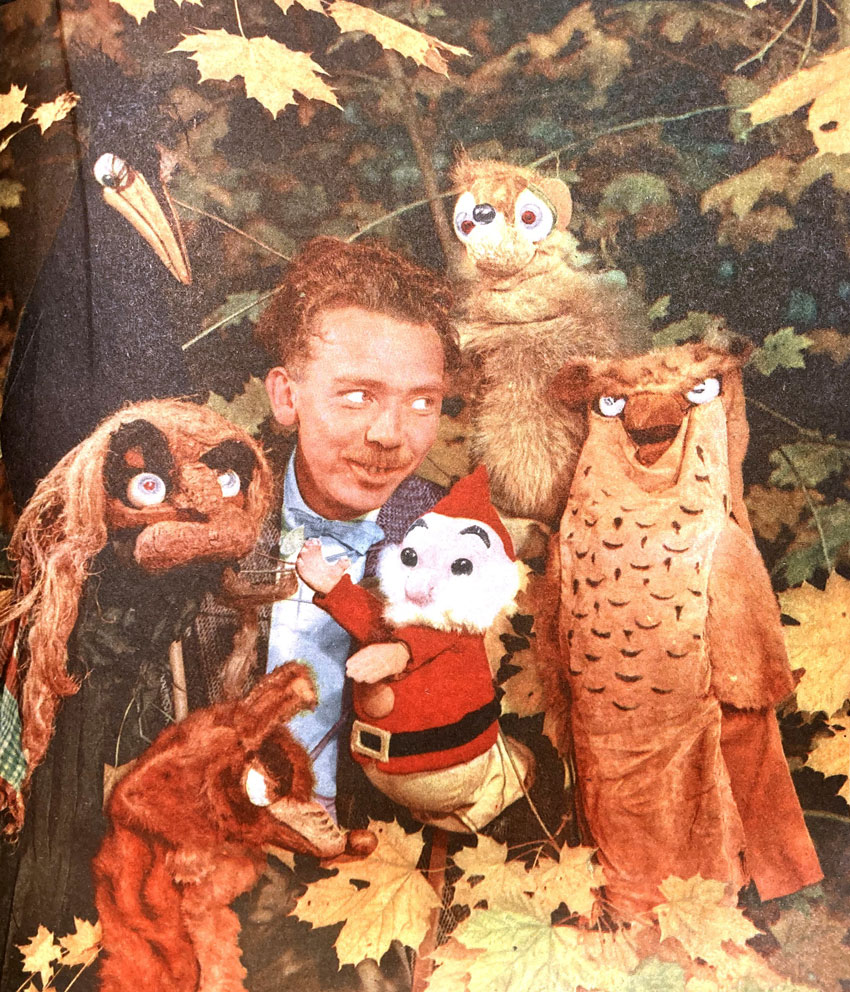
Jean Dulieu with the puppets from his puppet theater, portrayed in VARAgids.
TV adaptations
Having built up experience with his radio adaptation, Dulieu decided to also bring his creations to the small screen too. He had acted in a TV show before, namely as ventriloquist Koning Noppie in the children's TV show 'De Mallemollen' (1956-1957). Given his past in puppeteering and interest in marionettes, the choice for a puppet TV series was a logical evolution. Dulieu created his own miniature forest set, built little houses and crafted his own handpuppets and marionets, which he also voiced, except for Prinses Priegeltje, again done by his daughter Dorinde. When Paulus smoked his trademark pipe, Dulieu had constructed a little hole in the gnome's mouth, through which he blew smoke rings. Unlike the radio show, the TV version received an original sing-a-long theme song. Many people admired or, on the opposite end, disapproved of Dulieu's decision to do everything on his own, but to him it was only natural, since it was "his world" and involvement from others only led to "a mess and misery".
'Paulus de Boskabouter' first aired on the NTS TV network on 1 October 1967 and ran until 29 December 1968. Various children's books using stills from the 'Paulus' TV shows were released. The snapshots were taken by Dulieu himself. The 'Paulus' TV series was also exported to other countries, airing in the United Kingdom, Canada, Australia, New Zealand and Japan. Despite the somewhat wooden performances, occasional awkward pacing and jerky marionette movements, 'Paulus' was charming in its handicraft, especially considering it was an almost complete one-man show. It held young viewers' attention and received good ratings.
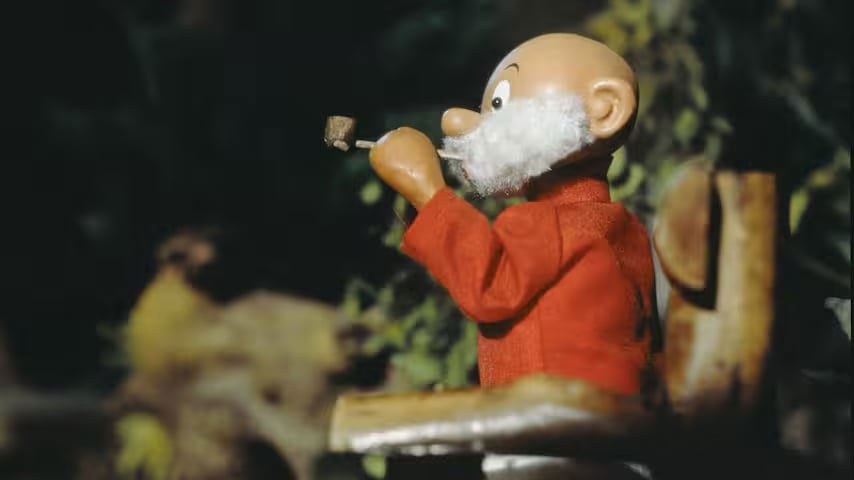
'Paulus' from the first TV series, created by Jean Dulieu.
In the 1970s, Dulieu considered an animated TV version of his comic strip and again he wanted to do the entire production on his own. However, after a year, the national broadcasting corporation NOS pulled out, since it would have been too expensive. On one hand, Dulieu was glad that he didn't have to continue these exhausting, time-consuming and money-guzzling preparations. On the other hand, it had cost him a lot of time and energy, bringing him into considerable debt. In 1974, he sold the media rights of 'Paulus' to producer Thijs Chanowski, the creator of the popular TV puppet show 'De Fabeltjeskrant'. That same year, Chanowski began collaborating with the puppet designers brothers Eric and Ronald Slabbers on a reboot of 'Paulus'. Four people who also worked on 'De Fabeltjeskrant' were involved in the production, namely scriptwriter Leen Valkenier and voice actors Frans van Dusschoten, Ger Smit and Elsje Scherjon. Van Dusschoten voiced Paulus, Krakras and Salomo, Ger Smit Oehoeboeroe and Gregorius, while Scherjon's performance as Eucalypta marked the first time the witch was voiced by an actual woman.
The 'Paulus' reboot aired between 29 September 1974 and 31 May 1975. Despite the more professional production, purists felt it looked just like any other puppet series on Dutch television, destroying the charm and atmosphere of Dulieu's original. Always the control freak, the creator himself was predictably dissatisfied with this reboot, not in the least because he had no involvement in it. Dulieu also disliked the choice of making the character Krakras male and the addition of various side characters created by the Slabbers brothers.
Reruns of the show ran on Dutch television until 2006. Following the success of the TV series, 'Paulus de Boskabouter' inspired various merchandising items, including figurines, calendars, puzzles, balloons, keychains, post cards, sweets, pins and curtains - however, mostly with artwork from the Chanowski puppet version. On 18 June 2025, the original 1970s 'Paulus' puppets were auctioned and sold for 105,000 euros (round 125,000 dollars), along with original drawings.
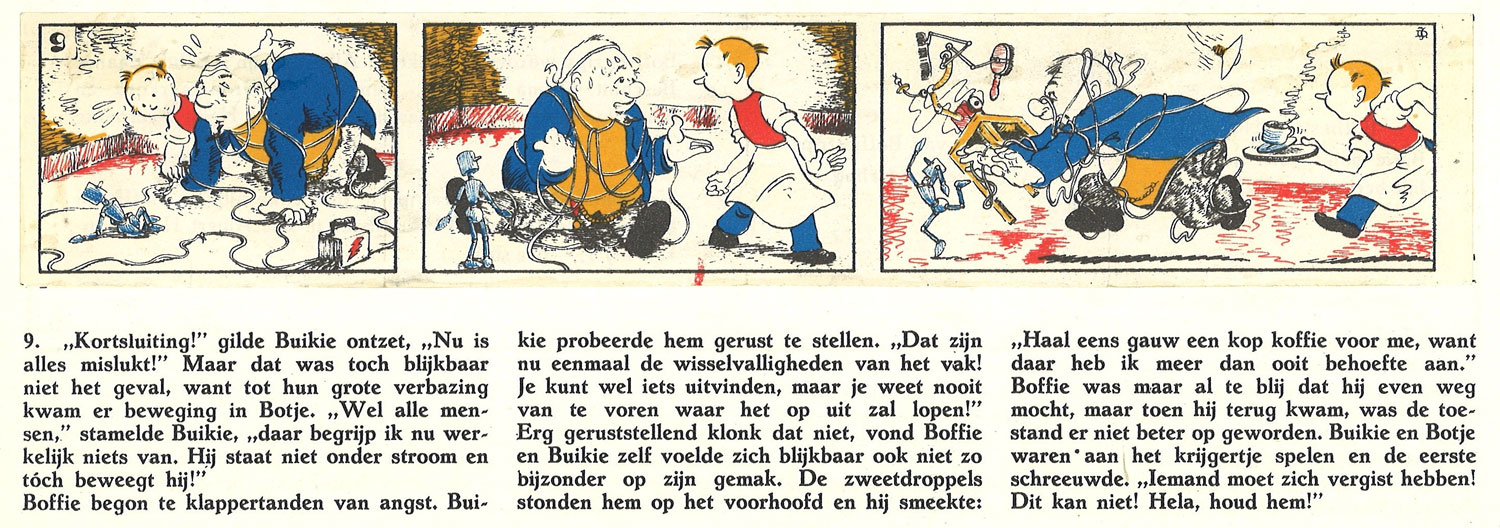
'Boffie en Buikie in de Knoop' (1953).
Other publications
While 'Paulus' was Dulieu's main focus throughout his entire career, he also worked on a couple of other projects. Since the early 20th century, many Dutch brands brought out picture books in which customers could paste in collectable images. Especially in the industrial Zaan region, north of Amsterdam, companies like Verkade and Hille were pioneers in this field. In 1953, the Zaan region grocery chain Albert Heijn also jumped on the bandwagon with their second release 'Boffie en Buikie In De Knoop' (1953), illustrated by Jean Dulieu. Customers could receive some of the 96 collectable images while shopping at Albert Heijn. The simple story stars friendly coffee waiter Boffie, who meets the strange professor Buikie, with whom he has all sorts of strange adventures. Everything comes to a happy end with a nice cup of coffee. Dulieu wasn't the first artist to illustrate a story with Boffie, the mascot of Albert Heijn's own coffee brand. In 1947, Huibert Vet had already drawn six booklets, including the popular story 'Boffie en de Verdwenen Koffie'. In 1964, Albert Heijn released another booklet by Dulieu, 'De Zeven Wonderdaden van Kevertje Plop' (1964), which sold out in a week. 'Kevertje Plop' was also translated for the US and Japanese markets (though in the latter case re-illustrated by Hiroshi Tada).
Dulieu additionally published a book about St. Francis of Assisi, 'Francesco' (1956). Two other novels by his hand, 'Maledictus' (1954) and the autobiographical 'Verspeelde Muziek' (1967) remained unpublished. All in all, his other publications always remained in the shadow of his popular gnome.
Graphic contributions
By request of longtime 'Paulus' fan and expert Maarten J. de Meulder, Dulieu collaborated with comic artist Piet Wijn on an illustration where Wijn's dwarf Douwe Dabbert shakes hands with Paulus. Originally appearing on the August 1976 cover of comic news magazine Striprofiel, the image was reprinted as a poster in 1981. Wijn also used the illustration as the first panel of the 'Douwe Dabbert' story 'Het Bedrog van Balthasar' (1989), only leaving out Eucalypta in the background.
Recognition
Jean Dulieu's work was awarded many times, the first time in 1956, when he received the Literature Prize of the Youth Friends Association of New York for 'Francesco', a book also crowned with the Diploma of Merit (1958) at the International Congress of the Foundation for Juvenile Literature in Florence. In 1962, the book 'Paulus de Hulpsinterklaas' was crowned "Best Children's Book", and the vinyl record adaptation received an Edison Award for "Best Children's Repertoire". On 20 September 1981, Dulieu was honored with the Stripschap Prize, awarded by Dutch comic appreciation society Het Stripschap. In 2003, Dulieu was commemorated in the "Comics Heroes" district of the Dutch city of Almere, where a road was named after himself, a street after Eucalypta and a court after Paulus. After Jean Dulieu's death in 2006, a small sculpture of Paulus was placed in the Gravinnenbos forest in Arnhem, made by Henk Evertzen. Also posthumously, in 2016, a bridge in Amsterdam was also named after Dulieu.
In 2012, Jean Dulieu was the subject of the exhibition 'The Art of Jean Dulieu', held in the Dutch Comics Museum in Groningen. A catalogue with the same name was released by publishing company De Meulder.
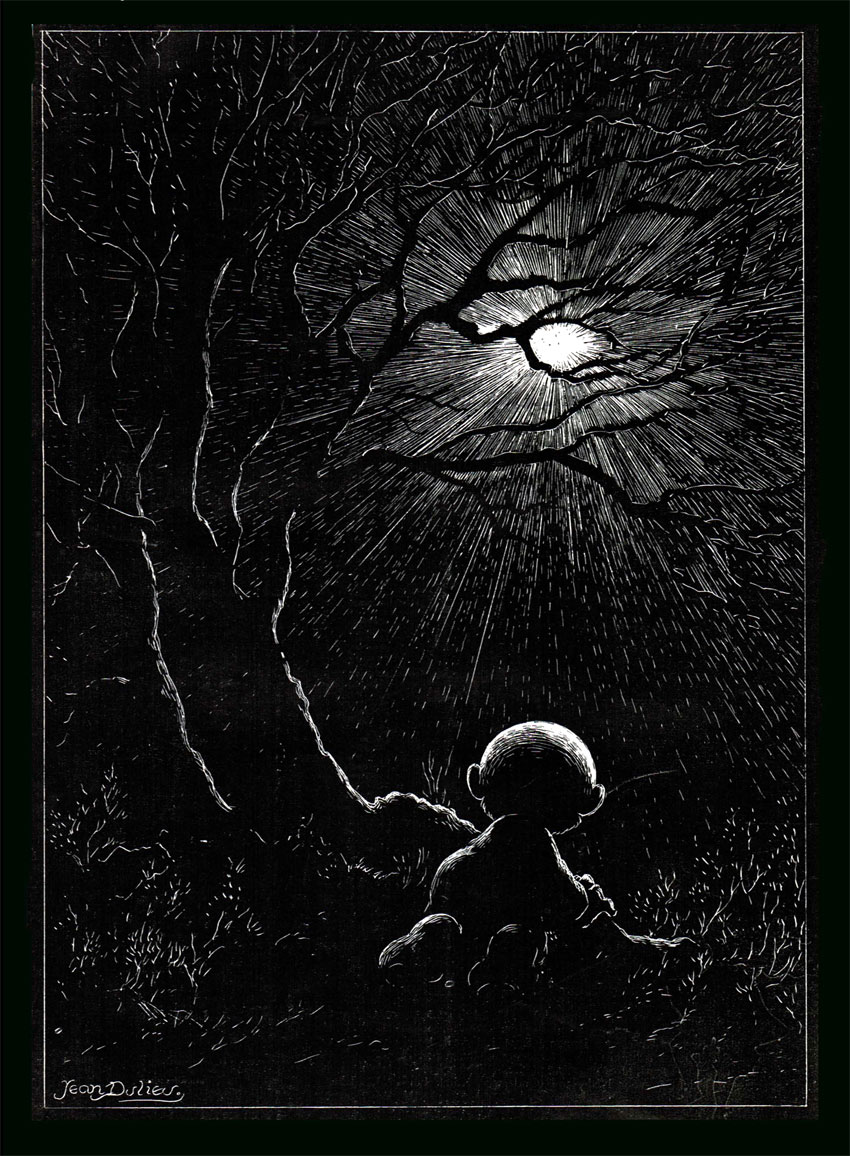
Illustration from Kris Kras magazine.
Personal life and death
Following the North Sea flood of 1953, which mostly harmed the province of Zeeland, but also threatened Terschelling, Jean Dulieu and his family decided to leave their farmhouse on the island and return to the mainland. Returning to Soest, they first settled in a regular house, before going back to the Klein Vosseveld estate in 1957, which was still owned by stepmother An Beets, who was however in ill health. In 1979, Dulieu moved to Arnhem, where he would stay for the rest of his life. He was a conflicted soul, who tried to find solace in Roman Catholicism, despite not really believing in God and remaining critical of the Church. What really appealed to him was the hermit-like lifestyle of monks, although his latent homosexuality may also have been a factor. Before his marriage, he had a romantic affair with a friend, but didn't follow up on it and married a woman. Though instead of spending his wedding night with his bride, Dulieu stayed in a monastery for months, seriously considering joining it. Had he not been married, he might even have done so.
Dulieu's marriage was just as unsettled as that of his parents. His first daughter was stillborn. His oldest son went through a rebellious phase as a teenager and died at age 16 while he was joyriding on a stolen motorbike, ignoring the warning signs of an approaching train. Relationships with his other children - Dorinde, Annelies and Franc - were precarious. Still struggling with his homosexuality, Dulieu often tried to develop lasting friendships with other men, which his wife actually supported, since she felt emotionally neglected and therefore welcomed any other men in her life. In her biography about her father, Dorinde described these friendships as pseudo-ménage à trois between her parents and these male friends. But Dulieu often seemed to have high, idealized expectations of his friends and co-workers. When they unavoidably disappointed him, he instantly burned bridges. The same applied to people with whom he worked professionally and simply couldn't compromise with. It was the main reason why he, for instance, never took an assistant for his work. In his diaries, Dorinde also found several passages where Dulieu appears to have been shocked by confrontations with other gay men. Some pages from her parents' diaries about certain incidents in their marriage have also been torn out, leading to speculation what drove either her father or mother to remove these.
Throughout his life, Dulieu was most at ease during field trips, either in his home country or elsewhere in Europe. It gave him inspiration for the romantic nature world he put on paper at home. A fantasy universe where he at least had complete control and which he tried to recreate on radio and TV, again limiting other people's input to the minimum. When Dulieu revived the 'Paulus de Boskabouter' comic strip in the 1970s, he merely wrote and drew for his own pleasure. Fans observed that the narratives from this period are his most "mature" and revelatory of his obsessions. They featured more temper tantrums and slapstick violence than usual. Some scenes even have subconscious erotic innuendo.
In 1984, tired of slaving towards deadlines, Dulieu retired. It bothered him that the newspaper format required constant action and cliffhangers, while his novels had more room for character development. After Dulieu's wife passed away in 1986, the veteran artist grew even more reclusive. The few people who occasionally paid him a visit recalled that his stubborn viewpoints were sometimes a sign to start returning home again. In 2006, Jean Dulieu died at age 86.
Dulieu's oldest daughter Dorinde van Oort became a fine artist and writer, who has worked for newspapers and magazines like NRC Handelsblad, De Volkskrant and Elegance. Since 1989, she has also released several books. In 1985, youngest son Francesco (Franc) moved to Canada, where he has been a successful graphic artist in his own right, known for his etchings inspired by the landscapes of Italy and Canada. Dulieu's work has been named an influence by Dick Vlottes.
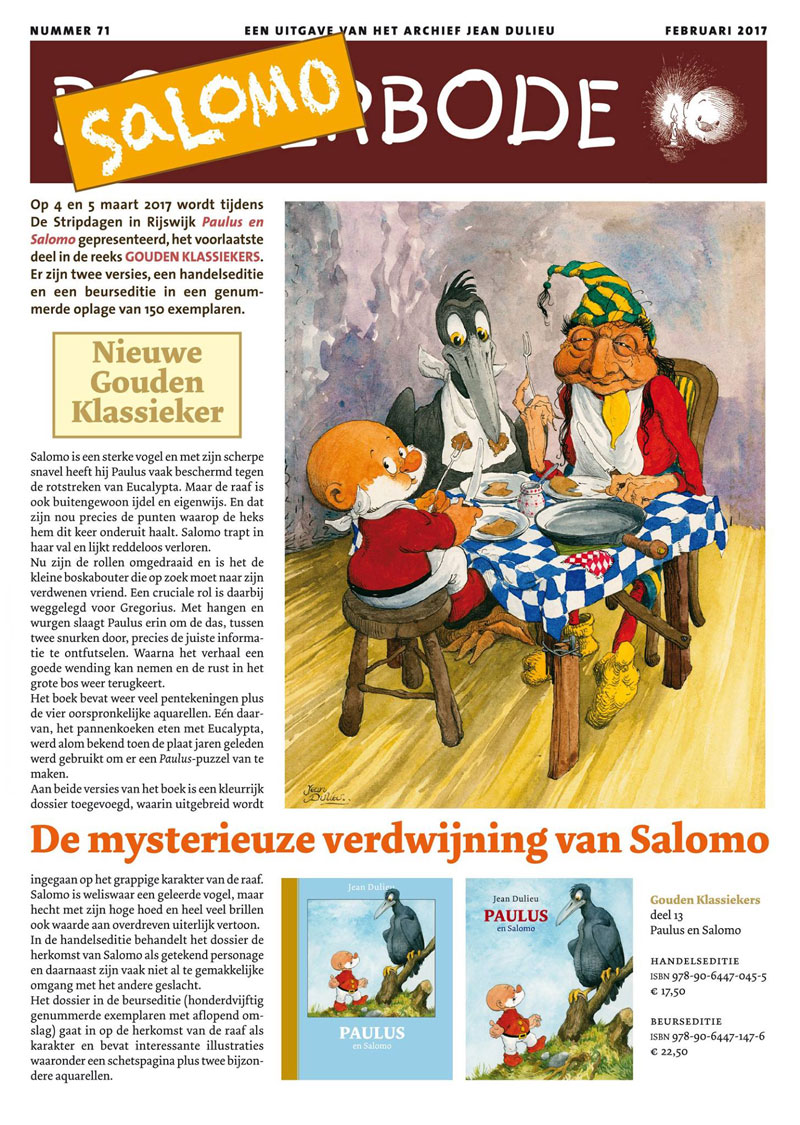
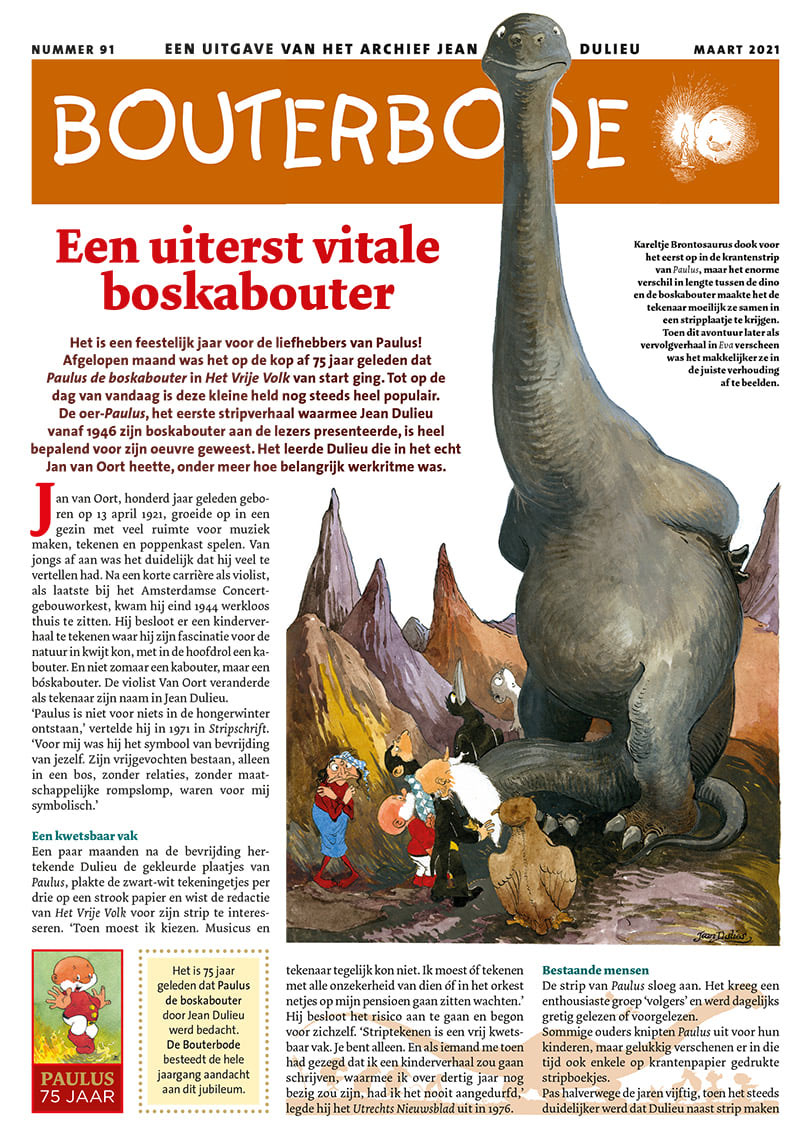
Issues #71 and #91 of Maarten J. de Meulder's Bouterbode.
Books about Jean Dulieu
Along with Marten Toonder, Jean Dulieu is perhaps the Dutch comic artist whose life and work has been the most carefully studied. In 1976, Hans Matla released 'Imago: Paulus de Boskabouter-special', an early study and bibliography of Dulieu's work. The most prominent 'Paulus de Boskabouter' expert in the Netherlands is Maarten J. de Meulder. Already the editor of comic news magazine Striprofiel, De Meulder also established the "Paulus Archieven" in 1985, an archive devoted to Dulieu's life and career. Thanks to his efforts, a lot of the writer-artist's original artwork, puppets and other private material has been rescued from being carelessly tossed away. Since the 1990s, De Meulder's imprint Uitgeverij De Meulder has been the main publisher of 'Paulus' book collections, secondary literature and other print products in the Netherlands. Between 1997 and 2022, De Meulder released 100 issues of his 'Bouterbode', a small newspaper with news and background articles related to Dulieu's work. In addition, he has sent his updates through his 'Post voor Paulus' e-mail newsletters.
In 2006, Dulieu's daughter Dorinde van Oort published the novel 'Vrouw in De Schaduw', in which she indirectly dealt with her family history, using fictional characters. One of them, Lepel Mansborg, was based on her father. Six years later, she published a biography about her father, 'Paulus de Boskabouter, of het Dubbelleven van Jean Dulieu' (Cossee, 2012), dealing with his life and career, but also delved deep into the often troubled relationships he held with his family and friends, his religious convictions and his closeted life as a hidden homosexual. In the past, Dorinde already felt there were many family secrets that impacted her father's mindset and behavior. She was able to construct his private life and the repercussions it had on his work through her father's and mother's personal diaries, several letters and other chronicles by relatives.
Lambiek will always be grateful to Jean Dulieu for illustrating the letter "P" in the encyclopedia book 'Wordt Vervolgd – Stripleksikon der Lage Landen' (1979). Dulieu was incidentally also the first artist with an exhibition held in Lambiek, which was held in our original Kerkstraat 104 store between February and March 1976.
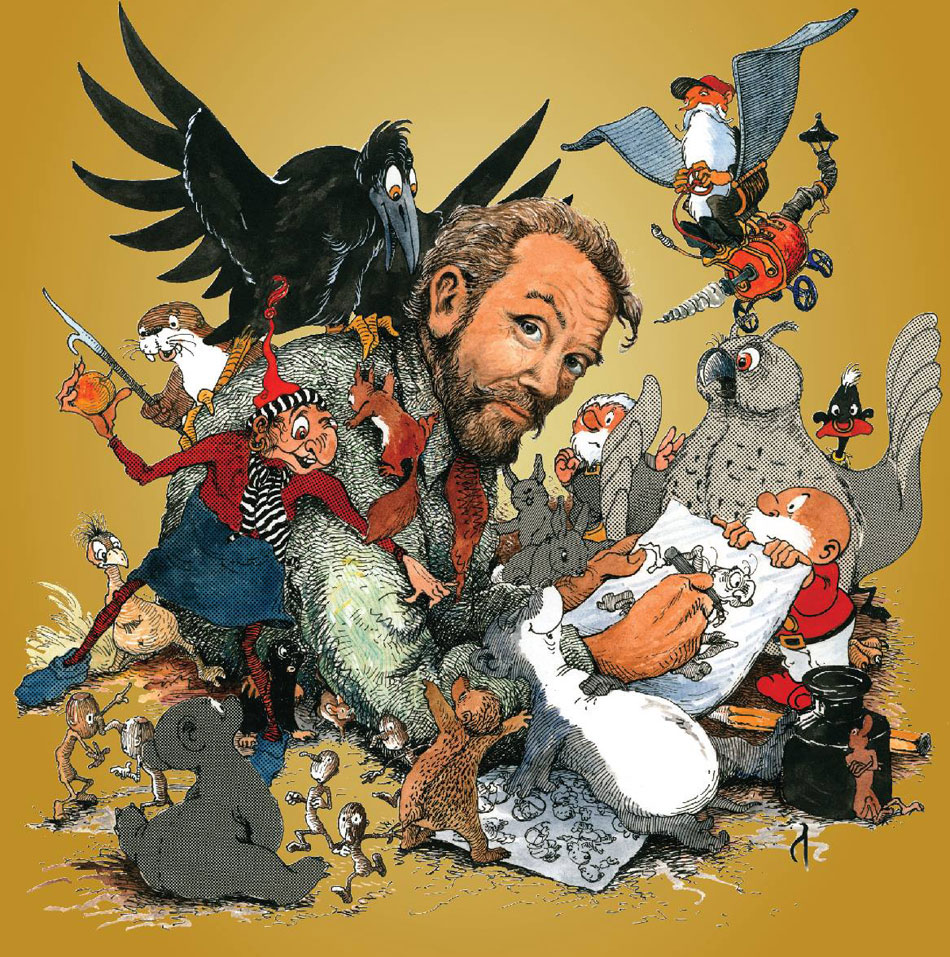
Self-portrait with his characters (1974).