


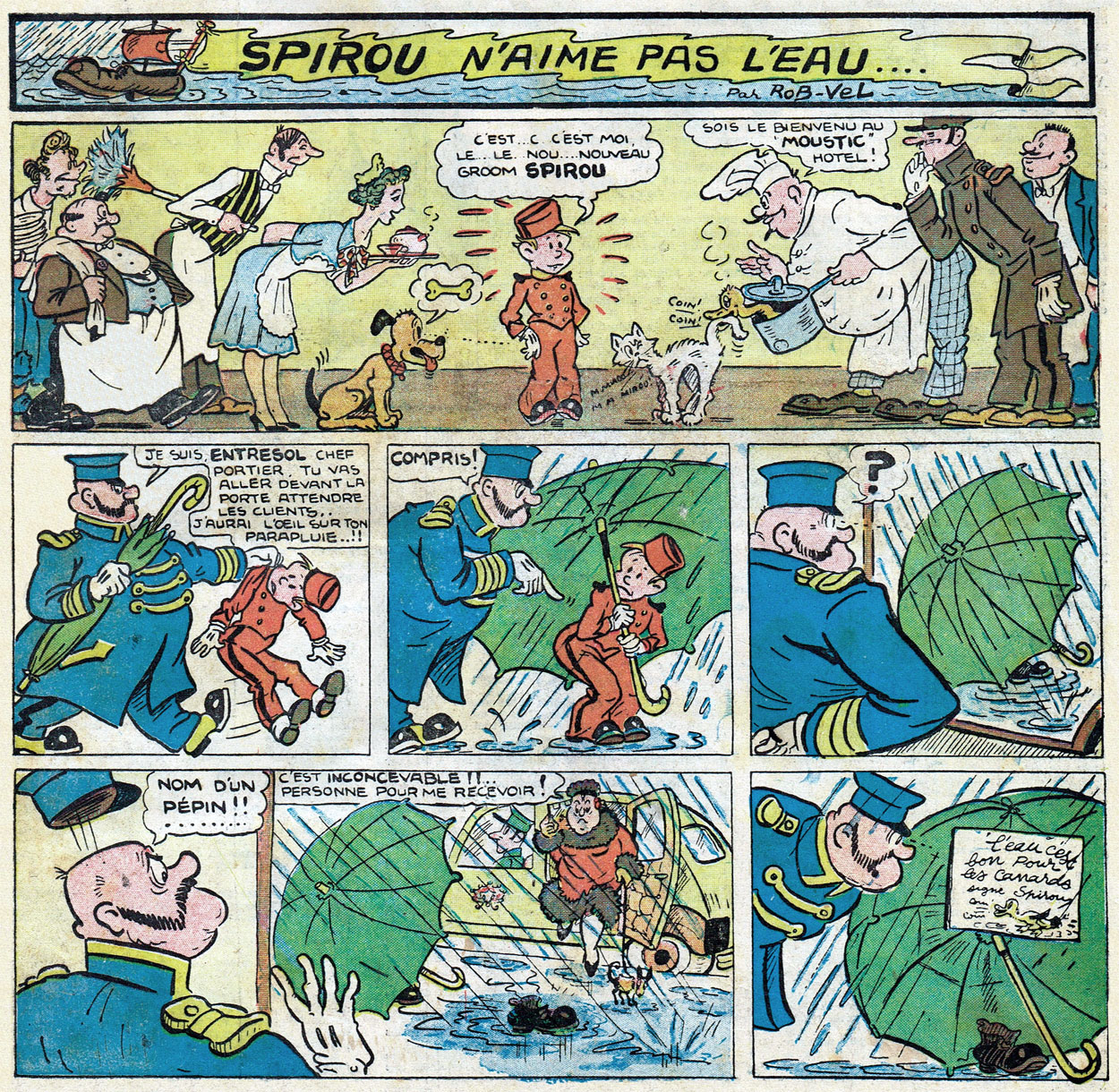
'Spirou' episode from Spirou #2 (28 April 1938). Spirou is told to stand outside and help customers in, even during pouring rain. But he left a note reading: "Water is good for ducks."
The French comic artist Robert Velter, who went by the pen names Rob-Vel and Bozz, is best known as the main creator of the famous bellboy 'Spirou' (1938- ) for the Belgian magazine of the same name. He also created Spirou's faithful pet squirrel Spip, who is still part of the ongoing series. Prior to creating the character of Spirou, Velter already had a long and adventurous life, working as steward on transatlantic cruise ships and as assistant to the American cartoonist Martin Branner. In France, he had become successful during the 1930s with the pantomime newspaper strip 'Monsieur Subito' (1936-1969) and the title comic of Le Journal de Toto (1937-1940), often in steady collaboration with his wife, Blanche Dumoulin. This led to his assignment by the Belgian publisher Dupuis to create a mascot for their new children's magazine, Spirou. Although Velter's name was attached to the 'Spirou' series for only five years (1938-1943) and his contributions have been overshadowed by his successors, he laid the foundations for one of the icons of Franco-Belgian comics, and of the longest-running Belgian comic series and magazines of all time.
Early life
Robert Pierre Velter was born in 1909 in Paris, into a family of Lorraine origins. His father, Pierre Velter, was the French director for the Remington typewriter company, but always looking out for new adventures. In 1920, the Velter family moved from France to England, where Robert and his brother spent much of their time at English boarding schools. After living in London, the Velters settled in Liverpool, where young Robert was fascinated by the arrivals and departures of the great ocean liners, resulting in a lifelong passion for ships and the sea. He also showed a talent for drawing. A self-taught artist, he painted the sets for theater plays during patronal festivals in an Irish convent.
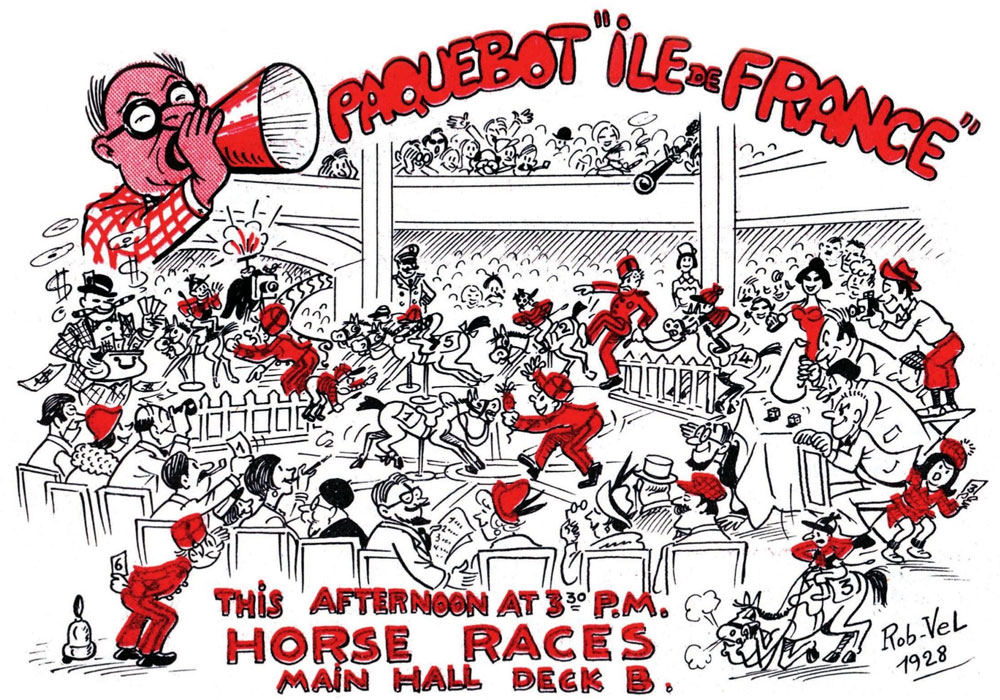
Announcement drawn by Rob-Vel on board of the Île-de-France (1928). The bellhops already bring to mind his future creation, Spirou.
When still a teen, Velter had to find a job to complement the meagre family income - his father was by then first maître d' on the long-haul trade. Like his most famous creation, Robert first earned his income as a 16-year old clerk at the Ritz Carlton hotel in London. Shortly afterwards, he found work as a head waiter on a merchant ship. In 1928, at age 19, he became head waiter on the Majestic, an ocean liner of the White Star Line. After about a year, he found employment with the Compagnie Générale Transatlantique, where he spent the next seven years as steward and game instructor on board of the Île-de-France, the Lafayette, the Champlain and the Normandie. Since he had spent a large part of his childhood in England, he also served as a translator on board these ships.
It was during his transatlantic trips on the line Le Havre-New York that Velter made caricatures of the passengers and adorned menu cards and announcement posters with drawings crowded with red-suited bellboys. Among the many onboard celebrities he caricatured have been Mahatma Gandhi, comedy actors like Laurel & Hardy, Charlie Chaplin and Buster Keaton, the Swiss scientist Auguste Piccard, the journalist-adventurer Joseph Kessel and the singers Maurice Chevalier and Joséphine Baker. When Velter noticed Walt Disney on one of these voyages, he didn't have the audacity to ask the famous animator for a job in his studio. He had more luck when meeting the American cartoonist Martin Branner, who invited him to his New York studio. Between 1934 and 1936, Velter lived in the USA, working as maître d' in the Roosevelt restaurant, but also serving as Branner's assistant background artist on the 'Winnie Winkle, the Breadwinner' strip. Learning the trade from an established U.S. cartoonist like Branner gave Velter's own work an "American touch" uncommon among French artists at the time.
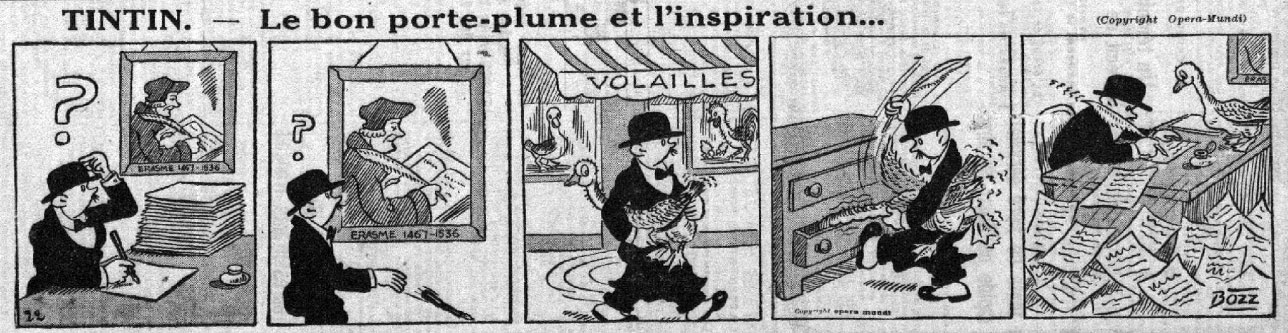
'Tintin', Robert Velter's first comic character and a predecessor to 'M. Subito' (1936). The man portrayed in the painting is 16th-century Dutch writer Desiderius Erasmus.
M. Subito
When he returned to France in 1936, Robert Velter initially lived with his aunt in Clamart, a town in the Parisian region. Dedicated to becoming a professional cartoonist, he began submitting work to agencies and magazines in Paris. In 1936, Velter sold his first strip to the Opera Mundi agency. Remarkably enough, it was called 'Tintin', just like the Belgian reporter character created by Hergé seven years earlier. Velter's version, which ran on a weekly basis in Le Petit Parisien, was however a completely different character, and mostly a predecessor to the cartoonist's long-running pantomime gag strip 'Les Avatars de M. Subito' (1936-1969). The title character, Mr. Subito, is a little man with a pointy nose, tiny mustache and bowler hat. Among the other characters are Subito's wife Dorothée, their dog Presto (modeled after the Velter family dog Presto) and his friend Narcisse. The comedy is absurd and slightly British, underlined by the fact that Velter signed the cartoons with the pseudonym "Bozz", in reference to Charles Dickens' similar pseudonym Boz. During the 1930s, Velter also translated American comic strips printed in Le Petit Parisien and other newspapers of the Excelsior press group.

'M. Subito'.
After World War II, between 1946 and 1969, 'M. Subito' continued its syndication as a daily strip through the Opera Mundi agency. The 8,597 strips most notably ran in the Brussels newspaper Le Soir, but also in regional French papers like Nord Matin, Franc Tireur, L'Union de Reims, Le Républicain Lorrain, Centre-Presse, Le Dauphiné Libéré and Les Dernières Nouvelles du Haut-Rhin. At one point, its popularity was such that the journalist Hubert Claisse adapted the comic into a theater piece, performed for six weeks in a Reims theater.

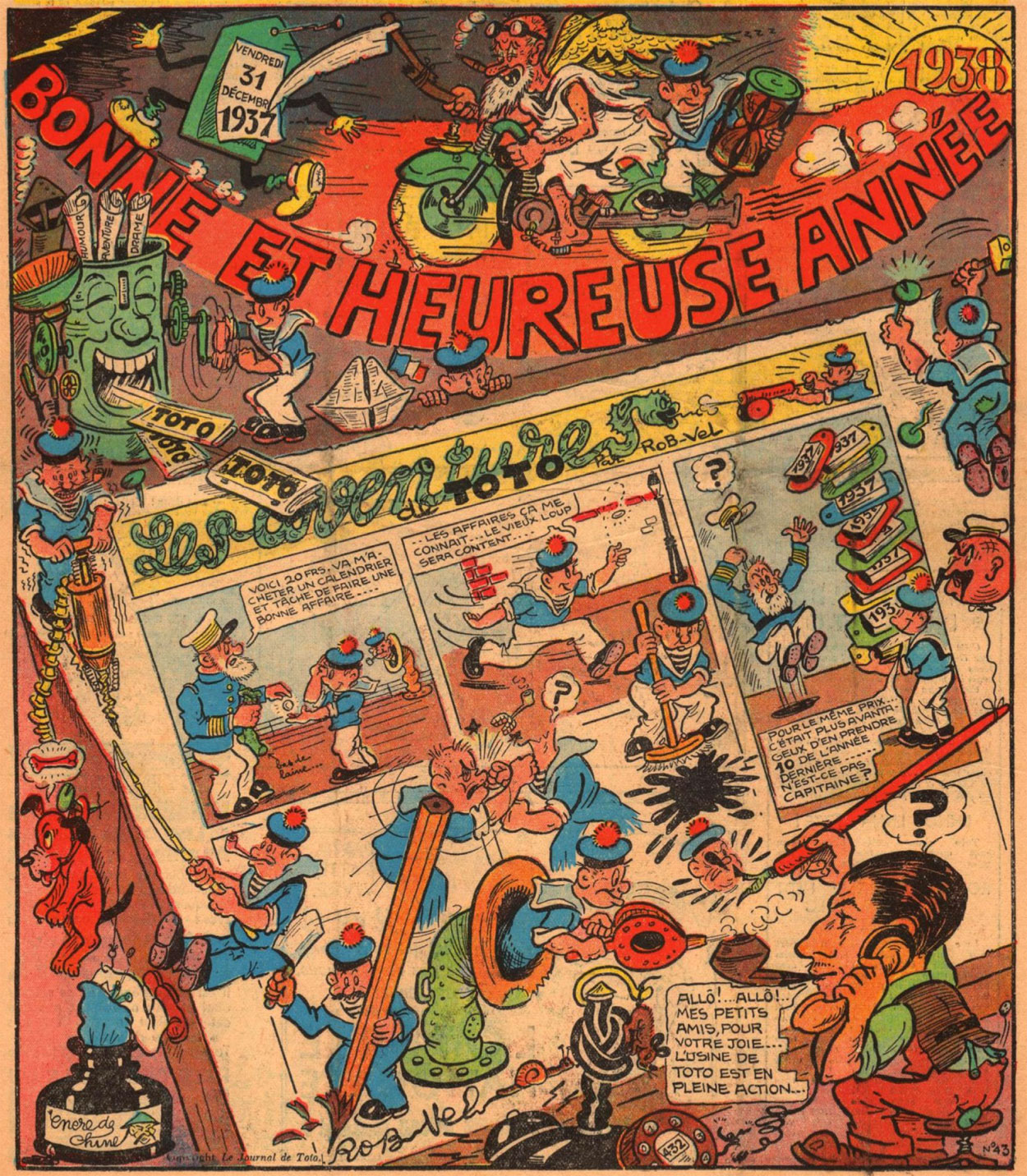
'Toto' (April 1938).
Le Journal de Toto
In 1937, Robert Velter was hired as the lead artist of a new weekly youth magazine published in Paris, Le Journal de Toto. Starting with the first issue of 11 March 1937, Velter created the adventures of the magazine's title character Toto, a bellboy on board of the Navy cruiser Pictouville. Instead of using Bozz, the artist returned to the signature he had used during his naval days, Rob-Vel, a contraction of his first and last name. For the stories, he was helped by his Belgian wife Blanche Dumoulin, who also assisted with gag ideas for the 'Subito' strip. Le Journal de Toto ran until 6 June 1940, when the Nazi invasion of Belgium led to the title's cancellation.
Spirou: creation of a character
Still in 1937, the year he started 'Toto', Rob-Vel was approached for a new assignment by the Belgian publisher Dupuis. By then, the company had two popular family magazines in its portfolio, Bonnes Soirées and Le Moustique, and planned to launch a youth magazine. For the lead character, company patriarch Jean Dupuis envisioned a youthful boy, boisterous but with a heart of gold, that could embody both the company's playfulness and its devout Catholic morale. For his name, the Dupuis family picked "Spirou", the Walloon word for squirrel, also used to describe a clever and mischievous boy. During one of his visits to Paris, the publisher's son Charles Dupuis found exactly the artist they needed in Le Journal de Toto, Robert Velter. Coincidentally, Rob-Vel's wife Blanche Dumoulin and her friend Luc Lafnet were by then already working for the Dupuis magazines as illustrators under the pen name Davine.
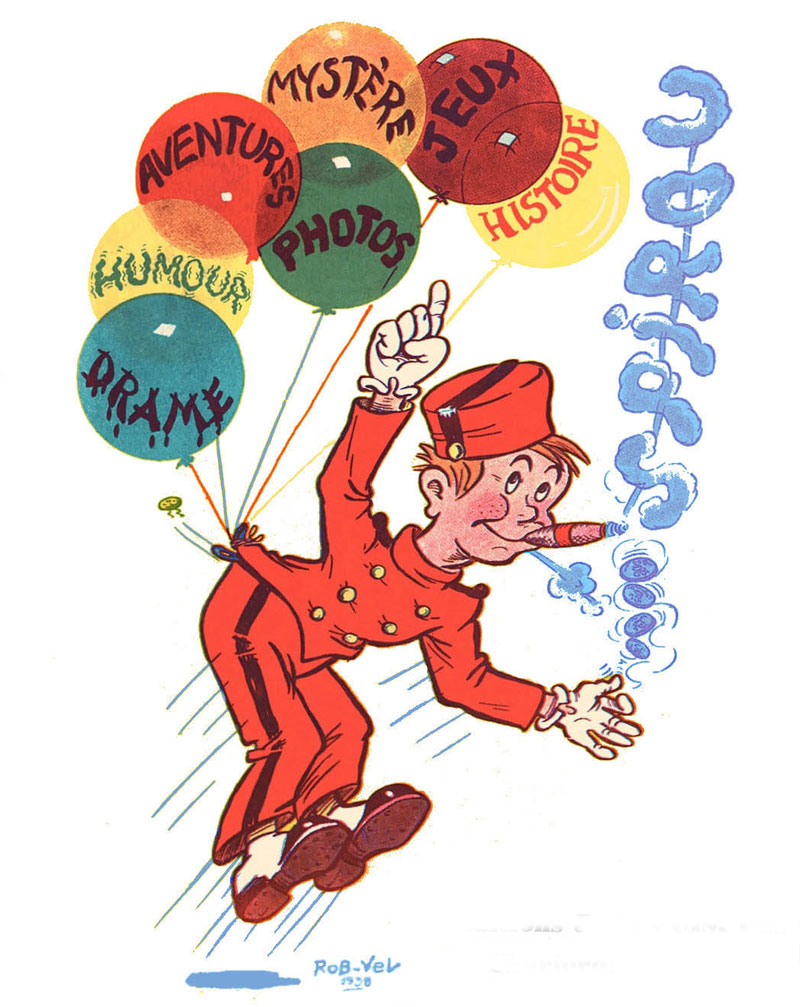
Cover illustration for the first collection of Spirou magazine editions.
In close collaboration with the publisher and his wife, Robert Velter set out to give Spirou a proper visual appearance. He found inspiration in the bellboys he had observed during his ocean liner days. During one of the transatlantic crossings, the young bellhops were playing hide-and-seek, when one of them fell from the deck into the ship's hold. Severely injured, the boy was brought back on deck, where he asked the captain forgiveness for his lack of attention, shortly before dying in the man's arms. Deeply moved by this boy's youthful innocence and dedication, Robert Velter picked him as inspiration for his new comic hero. Instead of an ocean liner, Rob-Vel's Spirou was working as a bellboy in the Moustic Hotel, a name that playfully referred to the popular Dupuis magazine Le Moustique. Rob-Vel wasn't the first comic artist to create a comic strip about a bell-hop, though. Almost 40 years earlier, the American cartoonist Richard F. Outcault had created a short-lived feature named 'Buddy Tucker' (1898), which also featured a character with the same profession. However, it is unlikely that Rob-Vel was aware of this comic strip's existence.
Le Journal de Spirou
On the front page of the first issue of Le Journal de Spirou, on 21 April 1938, Rob-Vel's 'Spirou' literally came to life from a painter's canvas. Over the next couple of months, the character appeared in a variety of front page gags, in which he constantly goofs up his hotel work, angering his brutish chief of staff Entresol. To emphasize the magazine's belgitude, several of these pages embodied typical elements of Belgian folklore, current affairs and national holidays. On 27 October 1938, a Dutch-language edition of Spirou magazine was launched under the title Robbedoes. By then, Rob-Vel switched from gag pages to longer narratives with his bellhop character, turning him into an adventurous globetrotter. Even though the character of Spirou never returned to the Moustic Hotel, he has continued to wear his trademark red bellhop uniform for decades on end. The Belgian references, however, were downplayed once Dupuis also distributed Spirou in France.

Introduction of Spip (1939).
Much like an American newspaper adventure comic, the 'Spirou' serials had an ongoing narrative, with each adventure flowing into the other. During his adventures, Spirou encountered gangsters, mad scientists and even magical creatures. On 8 June 1939, he found a loyal companion in a squirrel, Spip. The choice for this animal was no coincidence, as "Spirou" is Walloon dialect for squirrel. Over the years, Spip remained Spirou's loyal pet sidekick, much like Snowy is for Tintin. During one of his later serials, Spirou was teamed-up with a black strongman called La Puce (literally: "The Flea"), but this character quickly disappeared from the Spirou universe. All in all, Spip is the only secondary character created by Rob-Vel to survive within the series. Most of the other well-known additions to the comic were introduced by the artist's successors, most notably Jijé and André Franquin.
Additional Spirou features
Besides Spirou's title comic, Rob-Vel and his wife contributed several additional features to the brand new magazine. Already in the first issue, Velter picked up one of his earlier unused concepts and introduced the readers to 'Bibor et Tribar' (1938-1939), a serial about two bumbling sailors. It ran in Robbedoes under the title 'Janmaat en de Sinjoor'. During the first year, Rob-Vel also contributed a gag strip about a mischievous kid called 'Babouche' (1938), while his wife wrote the melodramatic adventures of 'Zizette'. Most of the magazine's further comic content were translated American comics - the only other original artist in Spirou was Fernand Dineur with his 'Tif et Tondu' feature. In 1941, Dupuis released a comic book compilation, 'Les Avontures de Bibor et Tribar - Tif et Tondu' (1940), collecting adventures of both 'Bibor et Tribar' and Dineur's 'Tif et Tondu' comic. It was the second comic book of the publisher, following 'Les Aventures en Afrique de Fred, Mile et Bob, Gamins Belges' (1940) by François Gianolla.

'Spirou et La Puce' (1943).
Rob-Vel and his assistants
For many years, it was assumed that Rob-Vel was the sole creator of the 'Spirou' comic. His wife Blanche Dumoulin was believed to be the artist behind the pen name Davine, responsible for several text story illustrations in the magazine. It was also known that Davine had taken over the 'Spirou' comic when Rob-Vel was mobilized during World War II. Later in life, Velter had mentioned that his wife had already been writing the 'Spirou' comic during its early years, and the couple also received assistance from an artist friend of theirs, the painter Luc Lafnet. It wasn't until Spirou magazine's 75th anniversary in 2013, that the full extent of these contributions by Dumoulin, Lafnet and other artists were discovered. For the books 'Spirou par Rob-Vel: L'Intégrale 1938-1943' (Dupuis, 2013) and 'La Véritable Histoire de Spirou: 1937-1946' (Dupuis, 2013), Christelle and Bertrand Pissavy-Yvernault researched the early years of the weekly, and came to remarkable discoveries.
As he had worked in Martin Branner's studio himself, Rob-Vel was no stranger to the American way of creating comics. To reduce his workload, he too began working with assistants. By the time he got the assignment to create Spirou, he already had 'M. Subito' and 'Toto' as ongoing comics. For both features, his wife had been contributing scripts, and in this capacity, she also worked with her husband on the 'Spirou' comic. During the period Rob-Vel created the Spirou comic (1938-1943), a variety of art styles can be spotted, varying from playfully caricatural, to dramatic realism. It is now believed that much of the early artwork of the 'Spirou' comic was done by Luc Lafnet, with Robert Velter only drawing the main character. Even the painter that gives Spirou life in the very first episode appears to be a self-portrait of Lafnet. Recognizable for his grotesque characters, Lafnet presumably also drew the majority of the 'Bibor et Tribar' comic. Some episodes are even signed "Luc & Rob-Vel". It is now also known that the pen name "Davine" was shared by Luc Lafnet and Blanche Dumoulin (although some strips of the 'Zizette' strip are signed with "Laf & Dav").
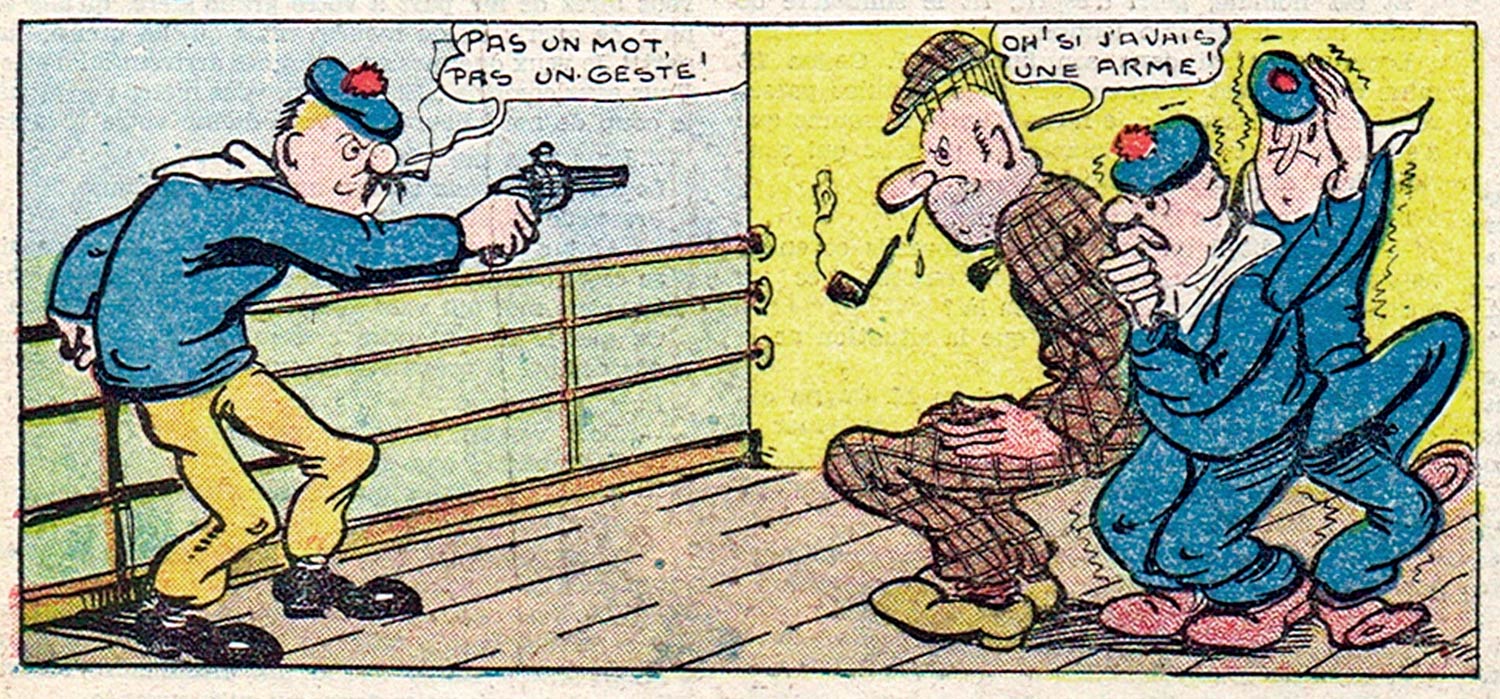
'Bibor et Tribar', presumably drawn by Luc Lafnet.
As Luc Lafnet died suddenly in September 1939, much of the later art credits remain sketchy. Around the same time, Nazi Germany occupied Poland, while the United Kingdom declared war on Germany. Many European countries feared an escalation of this war and mobilized their citizens. Velter was one of them, stationed for six months in the Dragons Portés regiment in Saint-Quentin, Aisne, serving the French army. For a while, he continued to work on his pages, finished and inked by his wife in Paris, before she sent them to the Spirou offices in Belgium. By then, Dumoulin had fully assumed the Davine signature, and co-signed the pages with her husband. During this period, Davine received aid from J. van Straelen and a couple of other artists, of whom the names have been lost in history.
Spirou during World War II
In May 1940, despite having mobilized citizens for their respective armies, Norway, Denmark, The Netherlands, Belgium and France were still surprised by a blitz Nazi invasion. Rob-Vel was wounded during the battle of Carvin, and captured by the Nazis. For months on end, Blanche Dumoulin didn't hear from her husband, while the couple's main sources of income, Le Journal de Toto and Le Journal de Spirou, had disappeared from the market due to the invasion. While Spirou did return by August of that year, the war-time chaos still made it impossible for Dumoulin to send new pages from France to Belgium. For a while, the publisher used the remaining Davine pages they had in stock to secure continuation, but after that, they assigned the local Belgian artist Jijé to temporarily continue the adventures of 'Spirou'. Between October 1940 and March 1941, Jijé improvised an end to the ongoing narrative and started a new adventure of his own.
By February 1941, Rob-Vel was back in civilian life, and resumed his contact with Dupuis. Between March 1941 and September 1943, he continued to work on his signature character, by now fully on his own. In late 1942, to be prepared for future disasters, publisher Dupuis bought the rights to the Spirou character from Rob-Vel. It turned out to be a clever precaution, since in September 1943 the Nazis banned Spirou magazine. It took more than a year, when the Allied Forces liberated Belgium in September 1944, before the situation improved. In October 1944, Spirou returned to the market. As new issues rolled from the press, Dupuis reassigned Jijé to the 'Spirou' comic, which was quickly retitled to 'Spirou et Fantasio'. Fantasio was a sidekick character originating from Spirou's editorial pages, which Jijé had introduced to the 'Spirou' comic for a 1943 anthology book. He was quickly established as Spirou's best friend, providing much of the comic relief. When in 1946 Jijé passed the pencil to his pupil André Franquin, the 'Spirou et Fantasio' comic turned into the classic it is today.
In 1970, Robert Velter drew the Spirou character one last time, for a special six-page anniversary story written by Raoul Cauvin, published in issue #1682 of Spirou magazine.

'Ce Pauvre Plouk'.
Pierrot and other magazines
During the uncertainties of the World War II years, Rob-Vel decided to not rely solely on Spirou magazine as a source of income. From 1941 on, he also began a collaboration with the French magazine Pierrot, for which he created a wide variety of serials. Among them were 'L'Homme au Gant' (1941), 'Le Père Purée', 'Ce Pauvre Plouk' (1941-1942), 'Un Ténor a Disparu', 'Le Secret de Kornaki' and 'Le Collier du Bouddha', as well as new adventures of the sailors 'Bibor et Tribar'. However, by May 1942, publication of Pierrot was also cancelled. Unwilling to work for magazines under German supervision, Rob-Vel instead tried his luck in animation, working for the Parisian studios of André Rigal.

'L'Homme au Gant' (Pierrot, 1941).
In May 1947, Pierrot magazine returned on the market, with Rob-Vel reappearing in its pages. During the post-war period, the artist contributed more adventures of 'Bibor et Tribar' (1947-1948 and 1950-1951), but also new serials like 'Le Bassin du Roi Bétiock' (1947-1948) and 'Le Père Pictou' (1948), and the gag strip 'Les Tribulations du Chien Petto' (1949). Between 1947 and 1949, Rob-Vel worked for the Belgian comic magazine Bravo!, creating a new adventure of his Toto character ('Toto au Mexique'), and also 'Mic Mac aux États-Unis' (1947-1949). Velter was also present in Le Journal de Bébé-Poucet with 'Polydore et Zanzibar', 'La Famille Souriceau' and 'Sibémol'. In this magazine, Velter also restarted 'Bizouk et Pélik' (1947), a comic created by Davine (Luc Lafnet) before the war. For Pierrot's sister magazine Lisette, he reprised his 1938 Spirou character Babouche for the 'Babouche et Babouchette' feature (1947-1958), about two naughty Arab kids.
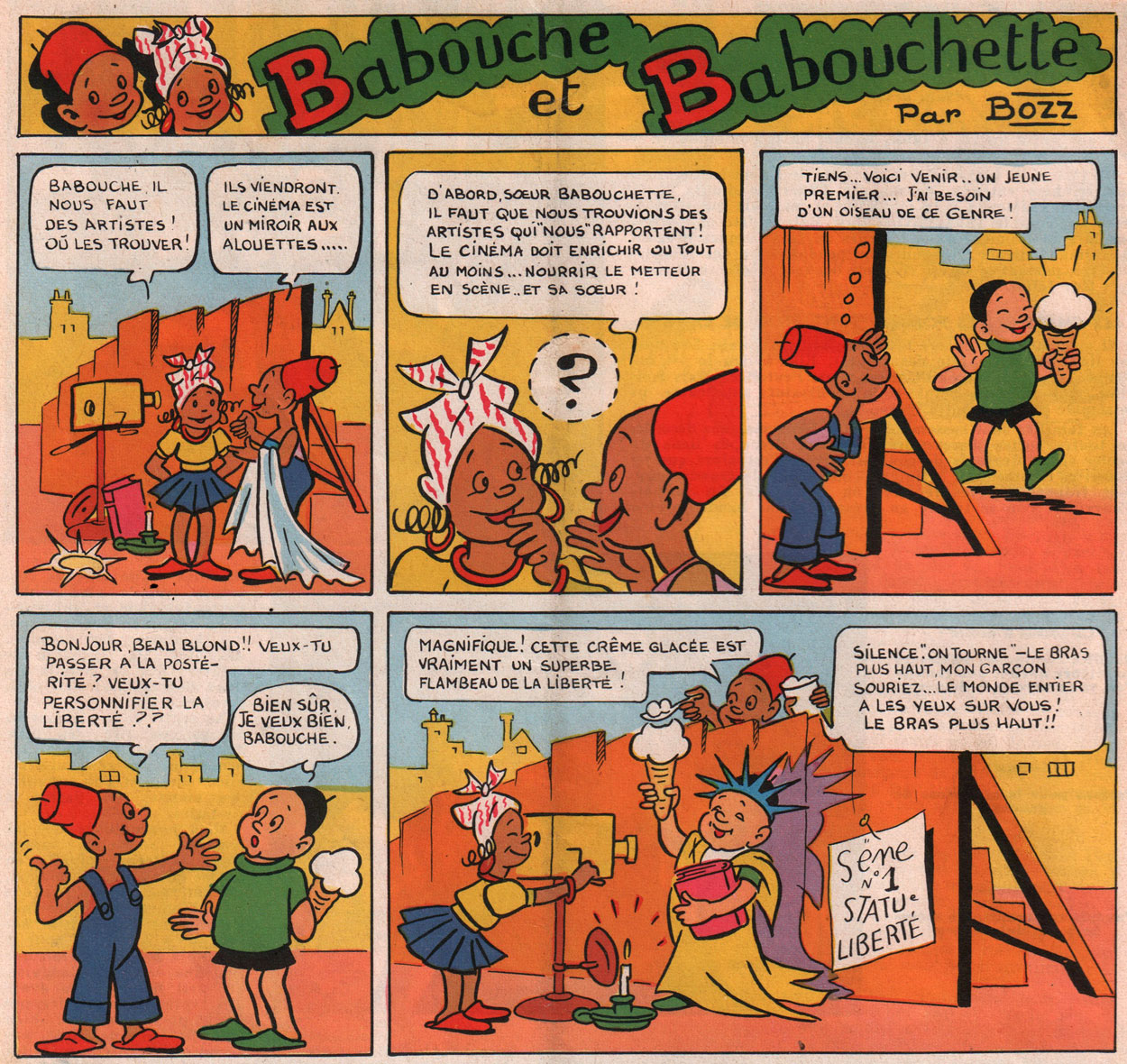
'Babouche et Babouchette' (Lisette, 3 March 1957). The kid is tricked into playing the Statue of Liberty, so that Babouche can scoop away his ice cream.
Newspaper comics
While appearing in a host of magazines during the second half of the 1940s and early 1950s, Rob-Vel remained mostly active for the daily press through the Opera Mundi agency. Between 1946 and 1969, he resumed his 'M. Subito' strip, but also introduced other creations, again using the signature Bozz. In the late 1940s, his comic strip about the boy scout 'Jean-Loup' ran in an agricultural paper. Between 1956 and 1958, he resumed his Pierrot strip 'Ce Pauvre Plouk' as a newspaper comic in the Récreation supplement of the Belgian newspaper La Dernière Heure. This comic starred a semi-anthropomorphic dog, who embarks on various detective adventures with his human companion.
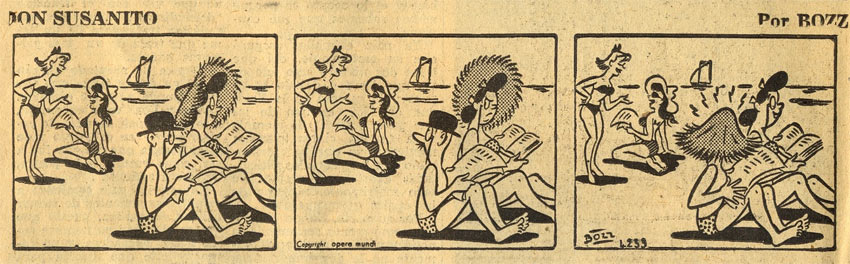
'Monsieur Subito'. Spanish-language version.
Between 1971 and 1974, Rob-Vel continued the classic newspaper strip 'Le Professeur Nimbus', originally created during the 1930s by André Daix. After the war, the Opera Mundi agency had relaunched the strip, by now created by a succession of artists, all working under the pen name "J. Darthel". Most of these artists have remained anonymous, although the name Léon d'Enden has been associated with the 'Nimbus' strip during the 1950s and 1960s. During the 1970s, Bozz was the first to take over the art duties. Like his own 'Subito' strip, the feature presented the pantomime adventures of an absent-minded character, in this case a professor called Nimbus. When Velter retired from the comic, additional contributors during the 1970s and 1980s were the gag writer Claude Seignolle, agency chief Paul Winkler, an unknown creator known only as Lefort and Pierre Le Goff.
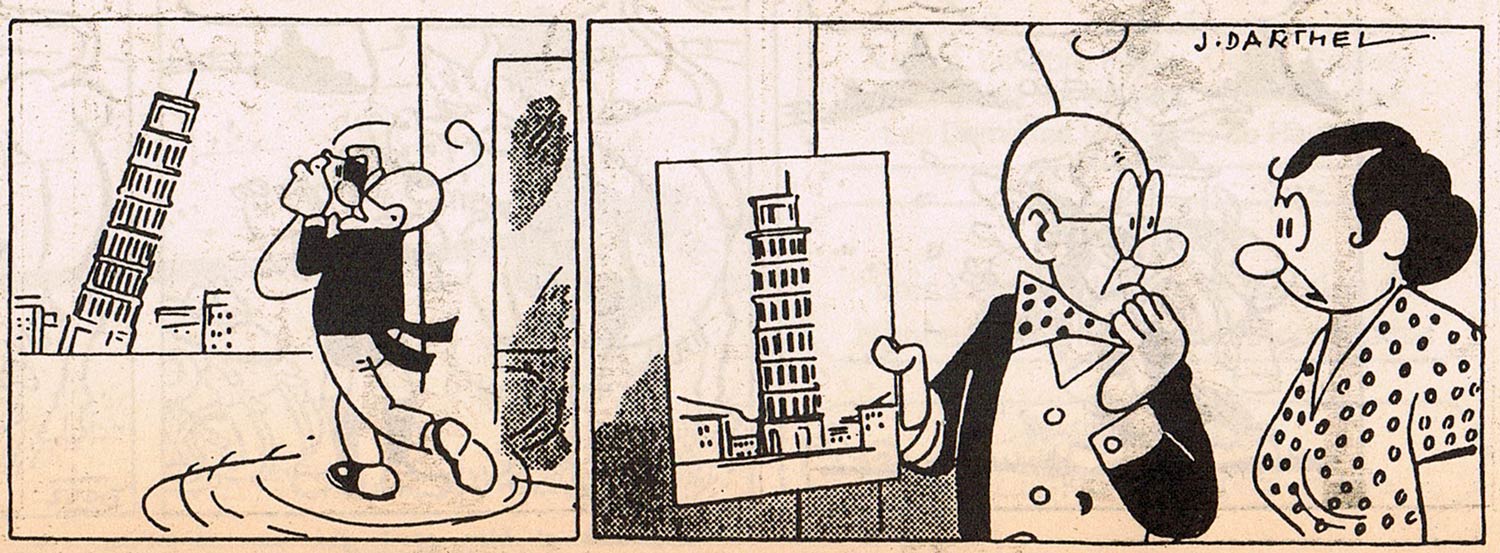
'Professeur Nimbus'.
Final years and death
After World War II, Robert Velter created many other comics, but none ever reached the same level of general success as Spirou did. In addition, he also made hundreds of illustrations for postcards, biscuit boxes and other products. In the later stages of his career, Velter also provided artwork to the magazines Confidences (1971) and Lectures Pour Tous (1974). After his wife's death in 1975, Robert Velter retired to the harbor town of Saint-Malo, Brittany. He regularly attended local comic festivals until he passed away in 1991.
Since his stories had never been properly collected in the official 'Spirou' album series, Rob-Vel's work was largely forgotten, though Buth did cite him as a strong influence on his work. In 2013, he came back to the public attention, when Éditions Dupuis released a large volume re-edition of Rob-Vel's original 'Spirou' stories, 'Spirou par Rob-Vel: L'Intégrale 1938-1943'. It was accompanied by an extensive background dossier by Christelle and Bertrand Pissavy-Yvernault. The two historians further chronicled Rob-Vel's run on 'Spirou' in the first volume of their series 'La Véritable Histoire de Spirou, 1937-1946' (2013), which provides extensive background information about the history of Spirou magazine and the publishing house Dupuis.
Legacy: Spirou's many incarnations
Rob-Vel's most famous creation 'Spirou' far outlived its spiritual father. Over the decades, the main series has been continued by Jijé (1943-1946), André Franquin (1946-1969), Jean-Claude Fournier (1969-1980), Raoul Cauvin & Nic Broca (1980-1983), Tome & Janry (1982-1998), Jean-David Morvan & José Luis Munuera (2004-2007), Yoann & Fabien Vehlmann (2010-2016) and Olivier Schwartz, Sophie Guerrive & Benjamin Abitan (2022- ). Velter's successors added several side characters, while the drawing style and general tone changed regularly. Since the 1980s, the series has also seen several spin-off series, most notably Tome & Janry's 'Le Petit Spirou' (1987- ), presenting a junior version of the character with more naughty jokes and sexual innuendo. As can be expected with a popular franchise, parody couldn't stay behind, with prime examples as F'murr's 'Spirella, Mangeuse d'Écureuils' (1988), Mikaëlof and Sergueï's 'Pirates!' (1999) and Fred Neidhardt's 'Spouri et Fantaziz' (2010-2011) and 'Spoireau et Fantaspèrge' (2015) by Sti.
In 2006, a special one-shot collection in which authors could have their own take on the character was launched as well. Some of these creators specifically returned to Rob-Vel's initial bellboy concept and a World War II setting, for instance Olivier Schwartz and Yann with 'Le Groom Vert-de-gris' (2009) and 'La Femme-léopard' (2014), and Émile Bravo with 'Le Journal d'un Ingénu' (2008) and its four-volume follow-up 'L'Espoir Malgré Tout' (2018-2022). Both the Moustic Hotel and its grumpy chief of staff Entresol returned for the occasion. Another special one-shot was 'Il s'appelait Ptirou' (Dupuis, 2017) by Laurent Verron and Yves Sente, which depicted the fictionalized life of the ocean liner bellboy that inspired Velter to create 'Spirou' in the first place.
Throughout all these transformations and interpretations, the spirit of the young bellboy has remained unaltered. Even though the Dutch-language edition Robbedoes has been canceled since 2005, the francophone Spirou weekly has remained a leading title in the comic magazine market.
In his 'Toto' comics, Rob-Vel sometimes drew himself (Le Journal de Toto, 30 December 1937).
Media success
Rob-Vel lived long enough to see his creation become and remain a bestseller. He could even have observed some of its spin-offs become classics, such as André Franquin's 'Gaston Lagaffe' (1957-1991) which originally featured the character of Fantasio as Gaston's boss in the Spirou offices. Franquin's 'Le Petit Noël' (1957) and 'Marsupilami' (1987- ) both revolved around side characters that had debuted in the 'Spirou et Fantasio' series. 'Spirou' remains a global succes, with translations in Dutch ('Robbedoes'), German (originally 'Fridolin', later 'Pit', then 'Rotarin' until eventually simply 'Spirou'), Italian ('Spirú'), Spanish, Portuguese ('Spirou'), Danish ('Splint'), Norwegian ('Sprint'), Swedish, Finnish ('Piko'), Icelandic ('Piko', in other translations 'Baráttan' or 'Svalur'), Polish ('Sprycjan'), Serbian ('Spirua'), Croatian, Turkish ('Sipru') and even Vietnamese, Chinese and Japanese. So far the English translations have been scarce, despite attempts to launch the comic in the English-language countries as well.
Over the years, 'Spirou' has been adapted into a marionette play by André Moons and Jean Doisy (1940s), a series of radio plays (1961-1963), video games and a 2018 live-action film by Alexandre Coffre. Between 1992 and 1995, Michel Gauthier adapted the Tome & Janry version of the comic into an animated TV series. One of the animators for this TV series was Raymond Parent. Another animated TV series based on 'Spirou et Fantasio' was created in 2006 by Daniel Duda.
Monuments to 'Spirou'
In 1991, Spirou, Fantasio and Spip received their own statue in the Avenue du Général Michel in Charleroi. On 26 October 2018, Spirou was given another man-size statue in the same city in front of the Central Station. Since 2003, Spirou and Spip both have a statue in Middelkerke, as part of the local Comics Route. The same city also has a mural (2016) in the Strandlaan depicting the characters, designed by Hanco Kolk. On 21 March 2013, Spirou received a huge portrait on a glass window in the Rue Sainclette/Sainclettestraat in Brussels. Spirou, Fantasio and Spip have also decorated a mural in the Rue Notre Dame des Grâces/Onze-Lieve-Vrouw van Gratiestraat as part of the Brussels' Comic Book Route. Inaugurated on 5 September 2014, the mural was based on a design by Yoann and Vehlmann, and depicts Spirou being hassled by all of his creators, including Rob-Vel. Another mural, based on an image by Olivier Schwartz from the Spirou story 'La Femme Léopard', was inaugurated on 17 September 2015 at the corner of the Rue de la Croix/Kruisstraat in Brussels.

Artwork by Rob-Vel.
'Une Spirou de Rob-Vel' by Stéphane Alexandre at Inedispirou.com