


Front cover of 'Mad About the Movies' (1998). Mad's mascot Alfred E. Neuman appears as Humphrey Bogart in 'Casablanca', alongside Ingrid Bergman. In the upper corners we see Bob Clampett's 'Tweety' to the left and Tex Avery's Bugs Bunny to the right, with Daffy Duck in the left corner below holding the Maltese Falcon. In the center left corner we recognize Clint Eastwood as 'Dirty Harry', Whoopi Goldberg, James Dean, Barbra Streisand and Edward G. Robinson. Below them, Joan Crawford and Bette Davis in 'What Ever Happened To Baby Jane?' and a young Marlon Brando holding a popcorn bag. In the lower left, Dustin Hoffman and Robert Redford in 'All the President's Men', Danny Glover and Mel Gibson in 'Lethal Weapon', Al Pacino in 'Dog Day Afternoon' and Malcolm McDowell in 'A Clockwork Orange'. In the upper right we notice Batman, Christopher Reeve as 'Superman' and a Gremlin. Below them, Faye Dunaway and Warren Beatty appear as Bonnie and Clyde with Errol Flynn as Robin Hood. In the row below, we spot Humphrey Bogart, James Cagney, Paul Newman and Jack Nicholson in 'The Shining'.
Mort Drucker was famous as one of Mad Magazine's "usual gang of idiots." He mostly illustrated their film and TV parodies, which allowed him to show off his immense talent for caricaturing. Together with Al Jaffee, he was one of the magazine's longest-running contributors, having joined the staff in 1956 and drawing his last comic for them in 2011. With a career spanning 60 years, he drew over 500 titles and that's just for Mad alone. During the 1950s and 1960s, Drucker also drew war comics for DC and celebrity comics based on Bob Hope and Martin & Lewis. In the 1980s, he was co-creator of Jerry Dumas' political-satirical newspaper comic 'Benchley' (1984-1986).
Early life and influences
Morris Drucker was born in 1929 in Brooklyn, New York. His father was a Jewish-American businessman. While he showed a talent for drawing and was encouraged to take art classes at the Pratt Institute, the boy was actually more interested in sports. Only after finishing high school, he became more dedicated to exploring his artistic potential. Yet he never went to any art school, except a brief stint at the Parsons School of Design in New York City. Drucker therefore mostly learned to draw by studying great masters. Among his main graphic influences were Austin Briggs, Albert Dorne, Robert Fawcett, Harold Foster, Al Hirschfeld, David Levine, Norman Rockwell, Ronald Searle, Charles M. Schulz and E.C. Segar. Drucker's grandfather was a friend of Will Eisner's grandfather. Thus the two future comics legends got to meet one another as a child.
Early comics career
Wil Eisner guided Drucker to his first job as a comic artist, assisting Bert Whitman on the newspaper strip 'Debbie Dean' in 1947. He then joined the staff of National Periodical Publications (DC Comics), where he worked as a retoucher. Among the titles Drucker worked on as a ghost artist were Paul Webb's 'The Mountain Boys'. Drucker also tried to launch his own comics. 'Hey Mac' never found a syndicate, but his monthly pantomime western comics 'Rancho Pancho' and 'Little Wah'Hoppin' did. Drucker also worked on a more serious cartoon feature, 'Origins and Superstitions', which delved into the nature of popular superstitions and why people tend to believe them.
Around 1950, Drucker began freelancing for comic books. All throughout the decade he contributed to mystery, war and science fiction titles, published by both DC and Stan Lee's Atlas line. He also drew for Dell ('Luke Short', 'Steve Donovan', 'Western Marshall'), ACG ('Lovelorn'), St. John ('Abbott and Costello Comics') and Better Publications. Additionally notable were his cover illustrations for DC's funny animal comic book 'Fox and the Crow' during the 1950s. Drucker also contributed to DC's 'War Stories', 'Sgt. Rock' and their celebrity comics 'The Adventures of Martin & Lewis' (1952-1957) and 'The Adventures of Bob Hope' (1959-1963), based on the famous Hollywood comedians.
Originally, Drucker worked predominantly in black-and-white because: "I never owned crayons as a child." In reality he was color blind. When Time Magazine asked him to design a cover, he was so nervous that he asked Frank Frazetta for some professional advice. The final result came out so good that he felt more at ease making color drawings afterwards.

'In Enemy Territory' (Battlefront #29, March 1955).
Mad Magazine
In 1956, Mad Magazine editor Nick Meglin recognized Drucker's talent and suggested applying for a job at their magazine. Their original founder Harvey Kurtzman had left and Al Feldstein and William M. Gaines were now the new chief editors. Drucker immediately learned that Mad's approach was different than most other magazines. During his application, Gaines nonchalantly told him he would be hired if the Brooklyn Dodgers won a particular game they were following on the radio. After they indeed did, Drucker got the job, although Gaines later admitted they just wanted to keep him waiting "for fun" and were going to hire him anyway.
Drucker debuted in Mad issue #32 (April 1957). His earliest works were basic parodies. He mostly illustrated articles written by professional comedians Sid Caesar and Bob & Ray. He was also the first artist to illustrate the long-running series 'TV Ads We'd Like To See', which first popped up in issue #46 (April 1959) and featured cynical twists on tired advertising formulas.
Mad: media parodies
One of Mad's major selling points were their monthly parodies of recent films and TV shows, which they lampooned in lengthy satirical comics. They not only spoofed the plot, cast and themes, but also pointed out the narrative inconsistencies, clichés and loathsome marketing behind it. Their earliest media parody comics were scripted by Harvey Kurtzman and mostly drawn by Jack Davis, Will Elder, John Severin and Wallace Wood.
In Mad issue #48 (July 1959), Drucker drew a parody of the TV drama series 'Perry Mason'. Two years later, he also illustrated his first film spoof, 'The King and I', in issue #61 (March 1961). Editors and audiences liked his approach so well that he soon made several others, realizing, in his own words, "my destiny". In the following half century, Drucker would draw dozens of film and TV spoofs. Countless readers fell in love with the magazine by paging through it and first noticing one of Drucker's spoofs. Since his comics ridiculed a Hollywood movie or TV show they were familiar with, it held their interest and eventually made them read the rest of the magazine too. In that sense, Drucker's media spoofs weren't just his trademark contribution to Mad, but may very well have been their most significant sales generator.
Drucker drew so many film and TV parodies for Mad that general audiences incorrectly assume he made each and every one of them. This is not the case. Apart from the aforementioned Davis, Elder, Severin and Wood, artists like Ray Alma, Grey Blackwell, Tom Bunk, Bob Clarke, Paul Coker, Anton Emdin, Drew Friedman, Gary Hallgren, Al Jaffee, Bernard Krigstein, Don Martin, Hermann Meija, Jack Rickard, Walt F. Rosenberg, Timothy Shamey, Sam Viviano and Bill Wray have all at one point or another drawn film or TV spoofs for the magazine. Some artists' styles are so similar to Drucker's that readers have often confused them with him, particularly the work of Harry North, Tom Richmond, Bruce Stark, George Woodbridge and especially Angelo Torres. But Drucker is, without contest, the most iconic media parodist of Mad. His contributions ran in almost every issue from 1957 to 2011.
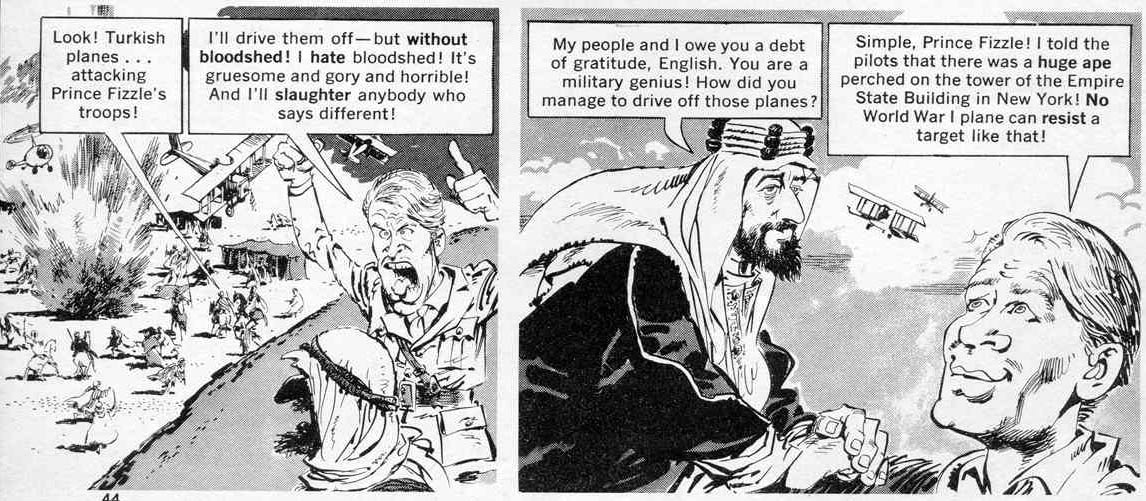
'Flawrence of Arabia' (Mad #86, April 1964). Script by Larry Siegel, Stan Hart and Frank Jacobs.
Mad: film parodies
Among the many film classics Drucker lampooned are 'Lawrence of Arabia' (issue #86, March 1964, written by Larry Siegel, Stan Hart and Frank Jacobs), 'Easy Rider' (i#135, June 1970, written by Larry Siegel), 'Butch Cassidy and the Sundance Kid' (#136, July 1970, written by Arnie Kogen), 'Dirty Harry' (#153, September 1972, written by Arnie Kogen), 'The Godfather' (#155, December 1972, written by Larry Siegel), 'The Exorcist' (#170, October 1974, written by Larry Siegel), 'Jaws' (#180, January 1976, written by Larry Siegel), 'One Flew Over The Cuckoo's Nest' (#184, July 1976, written by Dick Debartolo), 'Rocky' (#194, October 1977, written by Stan Hart), 'Saturday Night Fever' (issue #201, September 1978, written by Arnie Kogen), 'Grease' (issue #205, March 1979, written by Stan Hart), 'An Officer And A Gentleman' (#238, April 1983, written by Stan Hart), 'Rambo II' (#259, December 1985, written by Dick DeBartolo), 'Jurassic Park' (#323, December 1993, written by Dick DeBartolo) and the first 'Harry Potter' movie (#412, December 2001, written by Desmond Devlin). His most ambitious spoofs were the entire 'Planet of the Apes' series (#157, March 1973) and 'James Bond' franchise (#165, March 1974) up that point, both scripted by Arnie Kogen. For Mad’s 300th issue, the duo dove back in time and parodied the classic movie ‘Casablanca’ (issue #300, January 1991).
Out of all the parodies he drew, Drucker was most proud of his spoofs of 'The Godfather', both the first as well as the second part. Naturally he picked out this spoof when Mad Magazine created a TV special in 1974 and wanted to animate one of Drucker's film parodies. Although Mad's TV special was fully produced, complete with an adaptation of Drucker's 'The Godfather', the pilot never aired. Network executives felt its style of comedy was too crude and non-family friendly.
Some Hollywood stars have shown appreciation for Drucker's artwork, especially if they themselves are satirized. For instance, in issue #95 (June 1965), 'Mad Visits A Typical Teenage Beach Movie', Larry Siegel spoofed all the clichés of beach movies, with artwork by Drucker. Two issues later, a letter by actress Bobbi Shaw was printed, announcing tongue in cheek: "I was going to invite you all to the preview of my new picture 'Beach Blanket Bingo' - but after seeing what you did to 'beach movies', I changed my mind." After 'Who's Afraid of Virginia Woolf?' (1966) was satirized in Mad, Elizabeth Taylor and Richard Burton purchased Drucker's original comic pages. Actor Jon Voight also wrote to Mad in issue #136 (July 1970), regarding Stan Hart and Drucker's spoof of 'Midnight Cowboy' two issues earlier, saying that, despite "not being much of a reader" he read it all in "just one sitting." After Lou Silverstone and Drucker poked fun at the film 'Five Easy Pieces' (issue #145, September 1971), a photo was printed in issue #148 (January 1972), depicting Jack Nicholson, Helena Kallianiotes and Michele Phillips reading the Mad spoof of the film they appeared in.
Hart and Drucker's parody of 'Summer of '42' in issue #148 (January 1972) received an appreciative letter in issue #150 (April 1972) from actor Jerry Houser ('Husky' in the film), calling it "both a shock and thrill". Detective Eddie Egan, on whom the character Popeye Doyle from 'The French Connection' was based, received issue #152 (July 1972) from editor Nick Meglin, in which DeBartolo and Drucker spoofed 'The French Connection'. His reactions were printed in issue #154 (October 1972), where he said he "almost split a gut" laughing at the spoof.
Clint Eastwood wrote a letter to Mad, printed in issue #155 (December 1972), praising them for their spoof of ‘Dirty Harry’, with the request: “Warner Brothers has been asking me to do a sequel to ‘Dirty Harry’. Could you please write your story now, so I could have something to go by? All of us here were absolutely knocked out with ‘Dirty Harry’.” After Hart and Drucker parodied 'Death Wish' in issue #174 (April 1975), actor Vincent Gardenia (who played chief Frank Ochoa in the film) expressed his delight in a letter printed in issue #176 (July 1975), with an enclosed photo of him reading the issue. In issue #205 (March 1979), a letter was printed by actress Karen Lynn Gorney, who complimented Mad with their spoof of ‘Saturday Night Fever’, in which she plays the love interest Stephanie: “For years I’ve dreamed of being immortalized in your turkey magazine and the truth is that’s the real reason I made the film.” In issue 435 (November 2003), a photo of John Travolta holding the Mad issues that spoofed ‘Saturday Night Fever’ and ‘Grease’ was printed.
In issue #207 (June 1979), in Kogen, Debartolo and Drucker’s spoof of the comedy ‘Animal House’, a student asks what a “Toga party’ is, to which another replies: “It gives us a chance to put on sheets and go berserk!” This causes the first student to remark: “Y’know, there’s another bunch of guys into that: (…) The Ku Klux Klan.” Imperial K.K.K. Wizard Bill Wilkinson felt so offended that he wrote a letter of complaint to Mad, printed in issue 209 (September 1979). He not only criticized the “slanderous attitude” in the “Jew-communist run Mad Magazine”, but also objected to other articles that promoted “race-mixing and trying to turn youth against their parents”. Wilkinson demanded an apology and threatened with legal action if it would happen again. A few months later, ‘Animal House’ director John Landis and actor John Belushi wrote to Mad, printed in issue 211 (December 1979), to thank them for their parody of Landis’ film ‘Animal House’, because “it is an honor to be associated with any insult to the Klan.”
One time, LucasFilm tried to sue Mad for parodying 'The Empire Strikes Back' (1980), particularly because many key plot elements were spoiled . As a counterattack, Mad's editors mailed a copy of a letter from George Lucas, in which the director thanked Drucker and scriptwriter Dick DeBartolo for their amusing spoof and added a request to obtain the original artwork. Lucas even wrote: "Special Oscars should be awarded to Drucker and DeBartolo, the George Bernard Shaw and Leonardo da Vinci of comic satire. Their sequel to my sequel was sheer galactic madness. (...) Keep up the good Farce!" This letter, which was also printed in Mad issue #222 (April 1981), was framed by DeBartolo to hang it in his house. In issue #199 (June 1978), Mark Hamill (Luke Skywalker in ‘Star Wars’) also sent a letter and photo of him reading Mad’s spoof of ‘Return of the Jedi’. Decades later, Lucas hailed Drucker as "the artist who defines Mad for me." He also wrote the foreword to the compilation book 'Mad About Star Wars. 30 Years of Classic Parodies' (2007).
After spoofing ‘Dressed to Kill’ in issue #222 (April 1981, script by Dick DeBartolo, artwork by Mort Drucker), Mad received a letter from actor Anthony Perkins, printed in issue #225 (September 1981). It had a photo of him slashing the magazine, with the message: “Get the point!”. Michael Pressman, director of 'Some Kind of Hero', wrote an appreciative letter, printed in issue #238 (April 1983) , after his movie had been spoofed by Larry Siegel and Drucker in issue #235 (December 1982). DeBartolo and Drucker also ridiculed the film 'The Jewel in the Nile' in issue #263 (June 1986), receiving a congratulatory letter and photo from the screenplay writers, Mark Rosenthal and Larry Konner, and actor Spiros Focas, printed in issue #266 (October 1986). Actor Gilbert Gottfried did the same after DeBartolo and Drucker mocked 'Beverly Hills Cop 2' in issue #275 (December 1987), saying in issue #279 that he found his picture in Mad "with great joy and great shame."
In issue #291 (December 1989), a photo was printed of Jack Nicholson reading Hart and Drucker's spoof of Tim Burton's 1989 movie 'Batman' (in which he played The Joker). In issue #292 (September 1990), actor Rick Moranis was snapped reading the parody of 'Honey I Shrunk the Kids' by Dick DeBartolo and Drucker, from issue #292 (January 1990). Actors Joe Mantegna and Ben Kingsley were photographed in issue #319 (June 1993), holding issue #312 (July 1992), in which their movie 'Bugsy' was spoofed by Stan Hart and Drucker. Hart and Drucker poked fun at 'Interview With The Vampire' in issue #335 (May 1995) and received a letter from Anne Rice, the novelist on whose book the movie was based, praising it as "right up there with a mention on 'Jeopardy' or in The New York Times Crossword Puzzle! Hell, this is better." It was printed in issue #340 (October/November 1995).
In issue #370 (June 1998), a photo was printed of Mia Farrow, posing next to two Mad issues depicting her on the cover (namely #121 and #124, of which the first was drawn by Norman Mingo and the second by Drucker). In 2002, actor Tom Hanks was photographed holding issue #404 (April 2001), in which Arnie Kogen and Drucker had spoofed his movie ‘Castaway’. An Israeli reader of Mad, Ira Kirschner, was able to get a snapshot of Arnold Schwarzenegger holding Mad issue #359 (July 1997) when the actor visited his country. It was printed in a 2004 issue. According to Kirshner: "(...) When the governor saw that I had a MAD magazine that spoofed him in 'Batman and Robin' [scripted by Arnie Kogen, drawn by Drucker] he pushed it away!".
Film critic Roger Ebert claimed he learned his profession from reading Mad's film parodies, which taught him "all the clichés and formulas underneath the pictures." As such, he was honored to write the foreword to Drucker's compilation book 'Mad About The Movies' (1998). Funny enough, a photograph of Ebert's fellow critic Gene Siskel was printed in Mad issue #379 (March 1999), holding the book and giving it a "thumbs down" in the presence of Mad editors John Ficarra, Charles Kochman and Nick Meglin, making the same gesture. Hollywood actor Michael J. Fox stated in an interview with Larry King that he knew he had "made it" when "Drucker drew his face". Film director Joe Dante compared Drucker to Al Hirschfeld as "the master American caricaturist", while fellow director J.J. Abrams confessed that, as a school boy, he tried to imitate Drucker's caricatures and signature. Steven Spielberg praised Drucker for making him "aware of the culture of our generation": "(...) Mort's irreverent and historical caricatures have never been nor will they ever be equalled. He poked fun at all my favorite movies when I was a teenager and when I was a filmmaker, he started going to town on the ones I was making and I loved every frame of his."
When film director Mike Nichols was interviewed in Entertainment Weekly (15 February 2008) about his film 'The Graduate' starring Dustin Hoffman (spoofed by Stan Hart and Mort Drucker in issue #122, October 1968), he said: "My unconscious was making this movie (...). It took me years before I got what I had been doing all along - that I had been turning Benjamin into a Jew. I didn't get it until I saw this hilarious issue of MAD Magazine after the movie came out, in which the caricature of Dustin says to the caricature of Elizabeth Wilson, 'Mom, how come I'm Jewish and you and Dad aren't?' And I asked myself the same question, and the answer was fairly embarrassing and fairly obvious."
Mad: TV parodies
TV shows pastiched by Drucker are 'Dr. Kildare' (#74, October 1962, written by Lou Silverstone), 'The Fugitive' (#89, September 1964, written by Stan Hart), 'Batman"'(#105, September 1966, written by Lou Silverstone), 'Star Trek' (#115, December 1967, written by Dick Debartolo), 'Dallas' (#223, June 1981, written by Lou Silverstone), 'The A-Team' (#242, October 1983, written by Stan Hart), 'The Fresh Prince of Bel-Air' (#303, June 1991, written by Stan Hart), 'Seinfeld' (#327, May 1994, written by Stan Hart), 'NYPD Blue' (#329, July 1994, written by Stan Hart) 'Friends' (#339, September 1995, written by Josh Gordon), 'The Sopranos' (#389, January 2000, written by Arnie Kogen), 'Sex & The City' (#407, July 2001, written by Josh Gordon), and 'Prison Break' (#465, May 2006, written by Dick DeBartolo), among others.
The article 'Music Report' in Mad issue #43 (December 1958), written by Tom Koch, Bob & Ray and illustrated by Drucker, was praised by pop singer Pat Boone (who was ridiculed in the article). In the first episode of his variety show on ABC, he named "making Mad Magazine one of my greatest accomplishments." Actor Tom Selleck wrote to Mad (printed in issue #231, June 1982) to praise their spoof of his TV series 'Magnum, P.I.' (issue #227, December 1981) by Lou Silverstone and Drucker, adding a photo of him and the main cast reading the very issue. Drucker drew a caricature of wrestler Hulk Hogan holding Alfred E. Neuman for the cover of issue #264 (July 1986). In issue #492 (August 2008), a photo of Hogan was printed, holding the aforementioned issue.
In issue #274 (October 1987), Frank Jacobs and Drucker spoofed the TV series 'L.A. Law' and drew a cover depicting all the characters. The cast liked it so much that they sent back a photograph where they mimicked the poses their caricatural selves took on that cover. After Kogen and Drucker ridiculed the TV sitcom ‘Empty Nest’ (issue #294, April 1990) (a show Kogen actually wrote comedy material for), actor David Leisure (neighbor Charley in 'Empty Nest') wrote Mad a complimentary letter in the guise of the family dog, Bear. It was printed in issue #296 (July 1990). Drucker also drew the cover of issue #299 (December 1990), depicting Alfred E. Neuman mowing down Bart Simpson's spiky hair. In issue #352 (December 1996), 'Simpsons' creator Matt Groening was photographed posing with the very issue and talking to Drucker at a comics convention.
'Star Trek: Deep Space Nine' actors Mark Allen Shepherd (Morn in the series) and Armin Shimerman (Ferengi Quark in the series) were photographed in issue #325 (February 1994), holding the cover of issue #321 (September 1993), in which Drucker spoofed their show. On the cover of issue #329 (July/August 1994), Drucker announced Mad's parody of the police show 'NYPD Blue', notorious at the time for occasionally featuring actors' naked behinds, by caricaturing the entire cast naked, hiding their genitalia behind title cards. In issue #332 (December 1994), the show's producer and writer Steven Bocho thanked Mad for "a great laugh", though wondered why his caricature lacked a right hand "and is that why I'm grinning and Amy isn't?".
In Mad issue #330 (September 1994), a letter appeared by TV journalist Dan Rather, who'd received a cameo in their spoof of 'Seinfeld', three issues back. Rather wrote to complain about the fact that he never watched 'Seinfeld', since it appears opposite 'Eye to Eye with Connie Chung', therefore not understanding why he was randomly added in the parody. He also informed Mad that his haircut wasn't up-to-date with the way Drucker had drawn it: "Mort Drucker may be the most talented caricaturist in America, but he's working from outdated, inaccurate publicity stills." More enthusiastic feedback came from Jerry Seinfeld who, interviewed by Howard Stern on 6 February 2014, declared being caricatured in Mad, particularly on the cover of issue #364 (December 1997) by Drucker, "the greatest thing that ever happened to me."
William Shatner was photographed, printed in issue #362 (October 1997), holding Mad's Star Spectacular special, of which Drucker designed the cover. Actress Marlee Matlin posed with issue #402 (in which Arnie Kogen and Mort Drucker spoofed 'The West Wing', February 2001), giving it a thumbs down, printed in issue #427 (March 2003). In issue #415 (March 2002), DeBartolo and Drucker spoofed ‘Smallville’. In issue #419, a photo of actress Kristen Kreuk was printed, posing with the magazine with the 'Smallville' parody. One issue later, another photo appeared of Kreuk and fellow 'Smallville' actors Michael Rosenbaum, John Schneider and Tom Welling also reading the 'Smallville' parody issue.
After ridiculing ‘Joan of Arcadia’ (issue #440, April 2004, script by Arnie Kogen), the cast sent a photo back, printed in issue 450 (February 2005), depicting them reading their spoof with mock tears. In issue #453 (May 2005), scriptwriter David Shayne and Drucker spoofed the TV series 'Desperate Housewives', with Shayne making a joke that a mysterious note that the character Mary Alice received was a direct rip-off of the horror film 'I Know What You Did Last Summer'. A few months later, the show's scriptwriter, Marc Cherry admitted in an interview in TV Guide (25 September 2005) that he indeed borrowed this idea from this film and praised Mad for catching him on this. The interview excerpt was printed in Mad issue #461 (January 2006).


Cover illustration for Mad issue #176 (July 1975), parodying the disaster movie 'Airport', and for Mad issue #314 (October 1992), spoofing 'Batman' actor Michael Keaton.
Style
Nick Meglin famously said: "Drucker is able to caricature somebody from the back and you'd still be able to recognize him." While his caricatures exaggerate people's faces, he always kept an eye on their anatomic proportions. Drucker studied hands, wrinkles, costumes and people's body language in order to understand how humans are "constructed". He strove for capturing the essence of their personalities; not just how they looked, but also how they moved and talked. This was also necessary because he had to portray them as characters in comic strip narratives. They had to be shown from different viewpoints and angles, but also taking on many different expressions. Above all, he wanted to make his characters look appealing, no matter how ugly or despicable they were in real life.

'Bore of the Worlds', a spoof of Steven Spielberg's 'War of the Worlds'. written by Arnie Kogen (Mad #458, October 2005). We recognize Tom Cruise and Tim Robbins.
Lay-out was just as important. Drucker strove for mimicking the overall atmosphere of the original. He imitated the cinematic style by composing his panels in a similar way. He picked out just the right poses and camera viewpoints. As a result, both the characters as well as the comic strip panels resemble a genuine movie or TV adaptation, making the spoof elements all the funnier. In the early decades, Drucker had to acquire most of his documentation personally. He cut out photographs from magazines, newspapers or promotional stills, because Hollywood and TV studios refused to send him images. Many were distrustful of Mad and didn't like the fact that their pictures and series were ridiculed. From the late 1960s on, when the first generation of Mad readers had grown up, it became easier to find old fans willing to grant him the desired documentation.
Despite his fondness for realism, Drucker deliberately made his parodies silly. In the best Mad tradition, he often snuck in funny background gags or odd cameos from his favorite comic characters, including Ronald Searle's cats, Charlie Brown, Linus, Lucy, Snoopy and Schroeder from Charles M. Schulz' 'Peanuts' and Matt Groening's Bart Simpson. Particularly many side characters are drawn in a Searle-esque style.
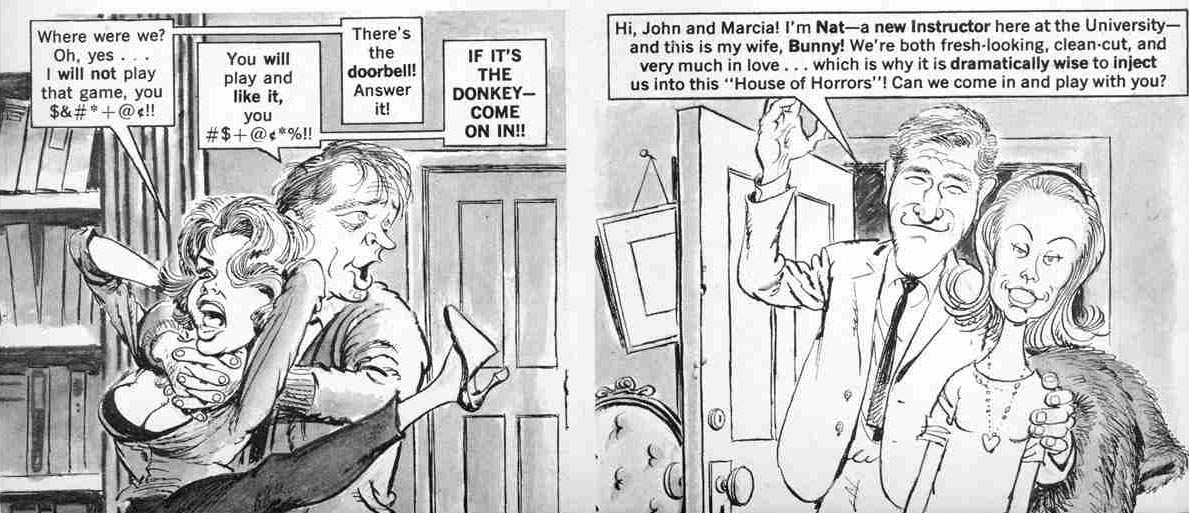
'Who In Heck is Virginia Woolfe?' a spoof of 'Who's Afraid of Virginia Woolf?', written by Larry Siegel (Mad #109, March 1967).
Last-minute alterations
Together with Norman Mingo, Drucker created the cover of Mad issue #122 (October 1968), which featured Mad mascot Alfred E. Neuman with a bunch of balloons depicting all the candidates for the upcoming presidential elections, while holding a needle nearby. One of the politicians was Robert Kennedy, who unfortunately was assassinated a few months before the next issue was due. Drucker was asked to remove RFK's caricature and replace it with one sporting Alfred's face. Issue #429 (May 2003) featured a parody of the TV series '24', written by Dick DeBartolo and clearly drawn by Drucker. But since he felt unsatisfied with the digital coloring and grayscale shading, he took his name of the credits, replacing it with the pseudonym "Bob Julian".
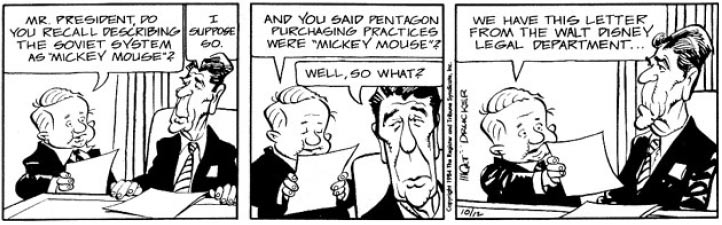
'Benchley'.
Benchley
Between 1984 and 1986, Drucker drew the syndicated daily gag strip 'Benchley' in cooperation with Jerry Dumas (writing) and John Reiner (assistant artist). The comic strip spoofed U.S. president Ronald Reagan through his supposed assistant Benchley. The satire required some restraint, since the creators were not allowed to be too biting in their political commentary. Drucker also had to keep his artwork simple in order to "read" properly in newspaper prints. 'Benchley' was quite popular and gave Drucker the opportunity to caricature many famous politicians and media celebrities, including Reagan, Margaret Thatcher, Henry Kissinger, Walter Mondale, Prince Charles (the future Charles III) and Princess Diana. He also received many complimentary letters, including from White House speaker Tip O'Neill, politician Geraldine Ferraro and even President Reagan himself! A book compilation, 'Benchley' (1987), was published by Blackthorne.
Book illustrations
Drucker has illustrated children's books, as well as the covers of the political satires 'John F. Kennedy Coloring Book' (with Paul Laikin, 1961), 'The Ollie North Coloring Book' (with David Duncan, 1987) and 'Farewell Tribute to Ronald Reagan Coloring Book' (with Lee J. Ames, 1988). Drucker livened up the pages of Frank Jacobs' 'The Highly Unlikely Celebrity Cook Book' (New American Library, 1964), which featured funny recipes supposedly written by famous politicians, actors, TV hosts and and sports figures.
TV animation
In 1974, a Mad animated TV special was made, complete with an adaptation of Larry Siegel and Drucker's 'The Godfather' parody, from issue #155 (December 1972). Unfortunately the special was never broadcast, because network executives found the comedy too family unfriendly for prime time. Drucker's artwork was also featured in the opening credits of the sitcom 'Syznick' (1977-1978).
Advertising and film poster artwork
Drucker also created advertisements for Heinz Ketchup, Vita herring, Whirlpool refrigerators, the U.S. Postal Service and Seagram's vodka. His artwork was featured in a one-minute public service commercial for the Heart Fund on how to prevent heart attacks. Drucker additionally created the "Frugies", characters who promoted the United Fruit and Fresh Vegetable Association. In the same vein he made the comic book ads for The Shrunken Head Apple Sculpture Kit.
Naturally, it was only a tiny step for Drucker to design film posters too, including 'Casino Royale' (1967), 'It's Alive' (1974), 'Finders Keepers' (1984) and George Lucas' 'American Graffiti' (1973). Lucas later said that Drucker was his "first and only choice" to illustrate that poster. Not afraid to bite the hand that fed him, Drucker also drew Mad's parody of that film, under the name: 'American Confetti' (issue #166, 1974).
Graphic contributions
Drucker designed the cover of Mad issue #277 of National Review (9 October 1987). He also livened up the album cover of 'The Bears' (1988) by The Bears and the back cover of 'State of Euphoria' (1988) by Anthrax. He also illustrated the horror comic 'Christopher Lee's Treasury of Terror' (edited by Russ Jones, 1966) and Jean Teasdale's 'A Book of Jean's Own' (2010). Few people knew that Jean Teasdale was in fact a pseudonym for cartoonist and satirist Maria Schneider (not to be confused with film actress Maria Schneider (1952-2011)).

Showcase of Mort Drucker's ability to draw beautiful women, featuring actor Burt Reynolds (from Mad's parody of 'My Fair Lady', retitled 'My Fair Laddie', in which feminists try to turn a male chauvinist into somebody who respects women, issue #167, June 1974). The bespectacled woman on the left, looking on in disgust, is famous feminist Gloria Steinem.
Recognition
Mort Drucker received many accolades over the years, including a Reuben Award for 'Outstanding Cartoonist of the Year' (1987) and a 'Special Features' Reuben Award the same year, for his cover spoofing 'L.A. Law' (MAD issue #274). In 1995, the Art Institute of Boston named him "doctor of fine arts", while he also received an Inkpot Award (1996). His covers for Time Magazine have been exhibited in the National Portrait Gallery and the Smithsonian Institution. In 2010, the veteran was inducted in the Eisner Award Hall of Fame and, five years later, the National Cartoonists' Society's Medal of Honor (2015).
Final years, death, legacy and influence
Mort Drucker retired in 2011. His last exclusive artwork in Mad appeared in issue #509 (June 2011). He passed away in Woodbury, New York, on 8 April 2020 at the age of 91.
In the United States, Mort Drucker has been an influence on Frank Cho, Guy Gilchrist, Raye Horne, Everett Peck, John Reiner, Tom Richmond, Jason Seiler, Bruce Stark, Rick Tulka, Angelo Torres and Sam Viviano. In Canada, he inspired John Kricfalusi. In Europe, he has followers in France (Jean-Claude Morchoisne, Jean Mulatier, Patrice Ricord), The Netherlands (Eric Heuvel, Daan Jippes, Theo van den Boogaard), Norway (Sven Nordqvist) and the United Kingdom (Andrew Currie). Charles M. Schulz once claimed that Drucker "draws everything the way we would all like to draw".
Books about Mort Drucker
Mort Drucker's work has been compiled in 'Draw 50 Famous Caricatures' (with Lee J. Ames, 1990) and 'Mad's Greatest Artists: Mort Drucker' (2012). The latter features written essays about Drucker's art, written by film directors like J.J. Abrams, Frank Darabont, George Lucas and Steven Spielberg and actors like Michael J. Fox.

Self-portrait.