


'St. Trinian's School'.
Ronald Searle was a highly productive, versatile and influential British illustrator, painter, cartoonist and occasional comic artist. He is most famous for his one-panel cartoon series 'St. Trinians' (1946-1952) and his charming depictions of plump, cottony cats. However, both are only the tip of the iceberg in a career that lasted more than 70 years. Searle drew in a distinctive, instantly recognizable style. His characters tend to be tall and skinny, with bulbous eyes, stilt-like legs and hilariously personified facial features. The drawings have an old-fashioned charm, combined with a morbid, sometimes surreal, satirical undertone. Searle's comedy is observational. His cartoons don't always revolve around a clear gag, but are mostly witty interpretations of people, animals and life in general. During his lifetime, Searle received numerous awards and became one of the most influential cartoonists of the second half of the 20th century. Besides cartooning, he also explored other art forms: caricature, painting, book illustration (most famously Geoffrey Willans' 'Molesworth'), as well as graphic reports of crime trials and travels across the globe. He also designed advertisements, film posters and made animated opening titles for a few comedy films.

'Full Cry', 1975.
Early life and career
Ronald William Fordham Searle was born in 1920 in Cambridge, England, as the son of a post office worker. He loved drawing from an early age and was lucky that both his parents, who had no artistic backgrounds, and his teachers supported his creative aspirations. At school, he was even allowed to draw with his left hand, which was a social taboo at some religious schools, where lefthandedness was associated with "the Devil". Among Searle's graphic influences in the field of painting were Pablo Picasso, Francisco de Goya, Otto Dix, George Grosz, William Blake, William Hogarth, J.M.W. Turner, Henri de Toulouse-Lautrec and Pieter Bruegel the Elder. His favorite cartoonists were Max Beerbohm, Thomas Rowlandson, James Gillray, H.M. Bateman, Sidney Conrad Strube, George Cruikshank, Richard Newton and John Leech. Later in life, Searle also admired contemporaries like Roland Topor, André François, Jean Bosc, Sempé and Saul Steinberg. Searle loved the grotesque but stylish caricatures of Gillray, Cruikshank and Rowlandson, but considered Rowlandson his favorite. Interviewed for Cartoonist Profiles issue #4 (November 1969), Searle praised Rowlandson for his "wit, genius, ability to handle line, ability to range from the broadest and most clownish grotesque to a cunning subversive charm." The dark, confrontational nature of Goya and bold graphic experiments of fellow countryman Picasso also held a dear place in his heart. But the day he discovered George Grosz was a real life-changer. He admired his graphic talent and ability to express "the rotting military mind; the filth of war and the stench that lingered after it."
Leaving school at age 15, Searle originally wrapped post packets for a living. When in 1936 he heard that Sid Moon, house cartoonist of the Cambridge Daily News, was about to retire, he applied for the job and was accepted. During a period of three to four years, his earliest cartoons and illustrations appeared in its pages, six days a week. In the previously mentioned Cartoonist Profiles interview, Searle reflected on his editors as "dreadful, but they taught me how to draw for reproduction." In 1938, Searle studied at Cambridge College of Arts and Technology, contributing to the student magazine The Granta. The best thing his teachers taught him was to always carry a sketchbook wherever he went and also to go out and sketch in the open air. As Searle put it: "Consequently, the habit of looking and drawing became as natural as breathing." This also resulted in a huge personal archive of thousands of sketches, drawings and paintings.
In April 1939, while still a student, 19-year old Searle joined the British Territorial Army as a volunteer in the Royal Engineers, reaching to the rank of "sapper". He dropped out of university that summer, but continued to make a living by offering his cartoons to newspapers and magazines. In November 1939, one of Searle's cartoons livened up a short story in a national newspaper for the first time, The Daily Express. Two months earlier, Hitler had invaded Poland, leading the United Kingdom to declare war on Nazi Germany.
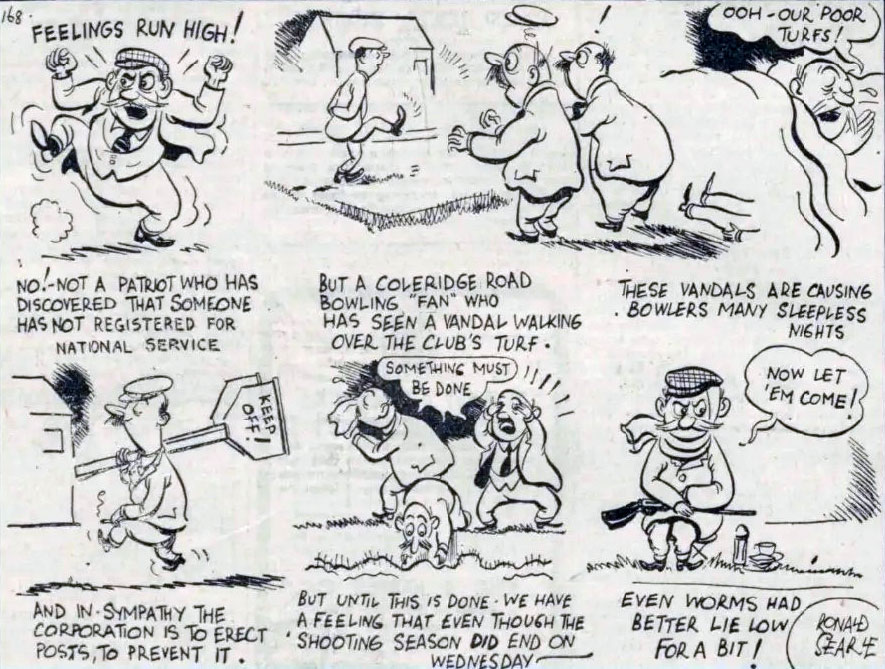
Cambridge Daily News, 4 February 1939.
Prisoner-of-war
In late 1941, Searle embarked for the Far East, where he joined the Royal Engineers of the 287th Field Company in defending British Malaya from the invading Japanese army. After a month of fighting in Singapore, the island fell in February 1942, after which Searle and many others were taken as prisoners-of-war. First he spent fourteen months in the Changi prison camp, where he and another inmate began producing the magazine The Survivor to boost up morale. On 3 March 1943, the paper was forbidden, and Searle was sent to work on the Siam-Burma railway. Deep in the jungle, they marched each day to cut away plant life and granite mountains in order to build a railway between Siam (nowadays Thailand) and Burma (nowadays Myanmar). At the end of the day, they only received one bowl of rice for food. If these circumstances weren't inhumane enough, mosquitoes, flies and other insects annoyed them day and night. Many prisoners died from dehydration, exhaustion, hunger, torture and diseases like malaria and beriberi. Searle also got ill for a while, but recovered. Meanwhile, none of his friends or relatives heard anything from him and assumed he was dead. It wasn't until 29 December 1943 that an encounter with a Red Cross brigade allowed him to send a message to the outside world that he was still alive. On 4 May 1944 on, Searle was sent to the overly crowded camp Changi Gaol.

Detail from a letter sent from Singapore, September 21, 1945 (source: procartoonists.org).
While many fellow prisoners succumbed in this living hell, Searle found a purpose and outlet in his drawings, while also contributing to another magazine, The Exile. He managed to obtain pens, ink and paper and secretly drew eyewitness reports of daily life in the camp. He became determined to show the world what happened here, even if he didn't survive. To avoid capture, Searle put the drawings in bamboo tubes, which he hid underneath the bodies of prisoners who died of disease: the one place where nobody would look. Most of Searle's drawings portrayed the dire working circumstances, his fellow soldiers and the Japanese guards. While many of the latter were merciless and sadistic, Searle drew more sympathetic Japanese guards as well. When one army captain heard that Searle could draw, he summoned him to come to his tent. Out of precaution, the young Briton only took his most innocent drawings. The captain happened to be a painter himself and even gave Searle some crayons. He was also allowed to draw murals at a beach villa and the officers' club. In the Spring of 1945, Ronald Searle was finally freed, and arrived back in the UK on 24 October. All his life he tried to trace down the Japanese captain who had been so friendly to him, but to no avail.
Searle gained his first national fame when his war drawings of camp life were exhibited in London. They are still kept in the British National Archives today as important and valuable historical documents. In 1986, they were compiled in the book 'Ronald Searle: To the Kwai and Back, War Drawings 1939-1945' (Souvenir Press, 1986, reprinted in 2006). Another cartoonist who made secret drawings in the Far East as a prisoner-of-war in a Japanese camp was Dutch artist Frits Kloezeman, although most of his art is lost.
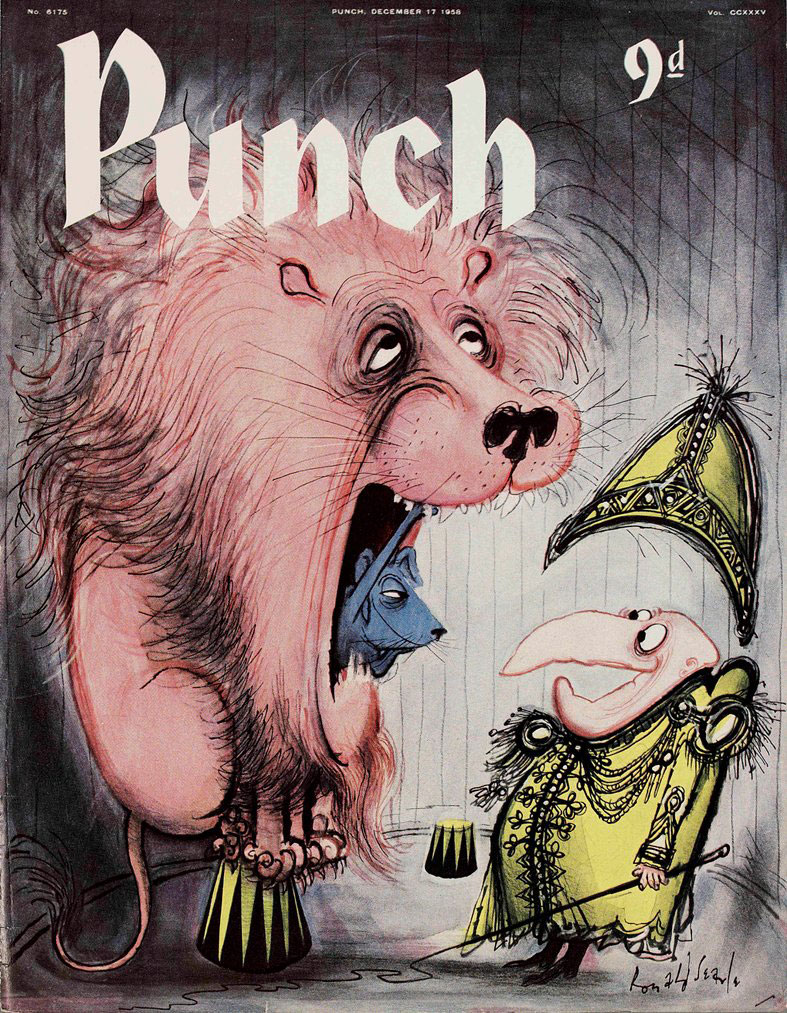
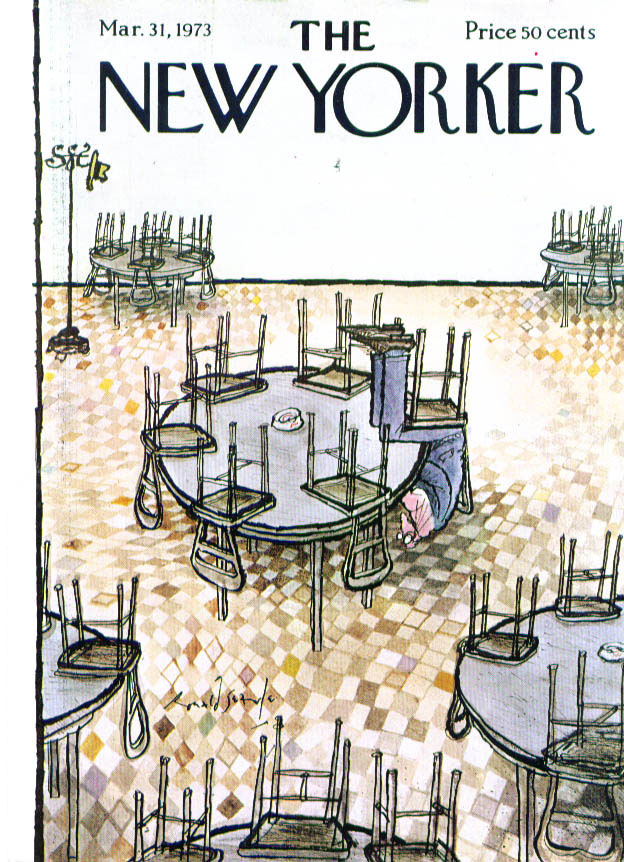
Cover cartoons for Punch (17 December 1958) and The New Yorker (31 March 1973).
Post-war magazine career
After returning home from his military service in 1945, Ronald Searle could rely on a small army pension. Feeling he needed more stable income fast, he started to create cartoons about a variety of topics for an equally diverse amount of magazines. Throughout his lifetime, they appeared in Graphis, Holiday, Life, Lilliput, Look, The London Opinion, Le Monde, The News Chronicle, The New Yorker, Hugh Hefner's Playboy, Punch, The Saturday Evening Post, The Sunday Express, The Tattler, Time and TV Guide. His war-time experience had visibly changed him. His rather corny cartoons from before had now made room for a more personal, eccentric, hardened and mature style.
St. Trinians
The cartoons that would make Searle world famous originated in 1941. That year he made his first drawing of a sadistic all-girls boarding school, titled 'St. Trinian's'. All pupils are naughty little girls who are frequently punished by their headmistresses. Searle was inspired by a real-life school named St. Trinnean's in Edinburgh. He had met two girls who were pupils there and loved the place so much that they couldn't wait to return. At first, he had no idea why, but he later discovered that St. Trinnean's was a progressive school with less strict rules and more emphasis on autonomy. Other inspirations were the Perse School for Girls (nowadays Stephen Perse Foundation) and St. Mary's School for Girls in Cambridge, whose uniformed pupils he often saw passing by. His first 'St. Trinians' cartoon was published in the magazine Liliput in October 1941, but by that point Searle was already stationed in South East Asia. He only happened to see it in print for himself by coincidence, when he was fighting in the streets of Singapore on 9 February 1942 and saw a copy of the October issue lying on the street. Two days later, the Japanese defeated the British, conquered Singapore and Searle became a prisoner-of-war, being cut off contact with his friends and family in England for the further duration of World War II.

'St. Trinians'.
Back in England in the fall of 1945, Searle revived his 'St. Trinian's' concept and drew several additional cartoons. Since audiences enjoyed it, 'St. Trinian's' developed into a full-blown series. In the late 1940s, early 1950s, corporal punishment still existed in British schools. The topic had inspired many British novelists before, such as Charles Dickens and, of course, the 'Billy Bunter' series, originally written by Charles Hamilton, then adapted in comic form by C.H. Chapman and Frank Minnitt. For many people in the anglosphere, it was a recognizable concept. Still, 'St. Trinian's' quickly mutated into something less realistic and far more dark and disturbing. The little girls enjoy underage drinking, smoking and gambling. They also torture each other on the rack, collect mushrooms to poison people or drown each other at the beach. The teachers are sometimes completely oblivious about the girls' violent behavior. Other times they lock the pupils up in damp dungeons. It remains an open question whether the depraved girls are juvenile delinquents who are punished by being sent to a "special" school, or that they became rotten as a result of their oppressive education. Searle's war-time traumas had an understandable impact on the tone. For him, it was a way to cope with his experiences and present it to the outside world in a humorous manner. Since the world also needed to recover from World War II's misery, they could handle this black comedy far better than expected. In 1947, the first book compilation of 'St. Trinian's' was published, 'Hurrah for St. Trinian's'. Many more followed, while gags appeared in countless magazines all over the world.

'St. Trinian's School'.
Amazingly enough, Searle only drew about sixty 'St. Trinian's' cartoons for a period of four successive years. He felt its formulaic comedy severely limited him and didn't like that some readers wanted to emulate the girls' juvenile delinquency. In 1952, he drew a final cartoon in which an atomic bomb is dropped on the dreaded school. To promote his final book, 'Souls in Torment', he even went to a press conference in an undertaker's uniform. But 'St. Trinian's' didn't vanish, as the books have never been out of print. Their influence on later British humor comics can be felt in David Law's 'Dennis the Menace & Gnasher' (1951) and 'Beryl the Peril' (1953), Leo Baxendale's 'Minnie the Minx' (1953) and 'The Bash Street Kids' (1954), Gordon Bell's 'The Belles of St. Lemons' (1971-1972) and Ken H. Harrison's 'Skookum School' (1973-1975).
The 'St. Trinians' cartoons even inspired a long-running series of live-action comedy films which Searle had nothing to do with. Over the decades, seven films in total were made: 'The Belles of St. Trinian's' (1954), 'Blue Murder at St. Trinian's' (1957), 'The Pure Hell of St. Trinian's' (1960), 'The Great St. Trinian's Train Robbery' (1966), 'The Wildcats of St. Trinian's' (1980), 'St. Trinian's' (2007) and 'St. Trinian's 2: The Legend of Fritton's Gold' (2009). They were never critical successes, but made enough money to receive sequels and reboots. Though this could also be attributed to the fact that, as the decades progressed, the devious little girls became far more sexualized young women. To this day, Ronald Searle is still first and foremost associated with his 'St. Trinian's' cartoons, even though the series barely ran a decade, while his entire career spanned half a century. Though, in the general public's defense, this is forgiveable, since it was his only genuine title-driven series.

"The Wonderful World of Wine: The Japanese Wine Ceremony" (The Illustrated Winespeak, 1983).
Style
In the 1950s, Ronald Searle developed his widely imitated trademark style, holding the middle between loose, cartoony drawings and more realistic observational work. He portrayed busy streets, garish cityscapes, buildings and cars down to the tiniest details. In the same manner, he drew people and animals with specific focus on bulbous eyes, fuzzy hair (or fur), noses, wrinkles and angular, stilt-like limbs. Everything is comically exaggerated, but still with attention to the inner structure of anatomy, architecture and machinery. Searle's drawings feature scratchy, jagged and quivering linework, presented in ink, greys or splashy water color paint. His work has a fresh, sprankling, very spontaneous look, but in reality, he made many preliminary sketches, adding ideas and altering compositions. His personal sketch archive also allowed him to use some of his 'serious' drawings as a reference point, distorting it into a caricature of reality. Above all, Searle didn't mind putting a line wrong if it added to the character of the drawing. As he described it: "If (...) the final drawing lacks the immediacy of the original thought, then (time allowing) I scrap the whole thing and use it as a guide for re-drawing. (...) If I ever have the slightest uneasiness about the finished work, I re-draw it at once rather than attempt to scratch and patch. I feel it is essential for work of this nature to appear spontaneous. The moment an illustration appears labored, it loses atmosphere, and with it - life."
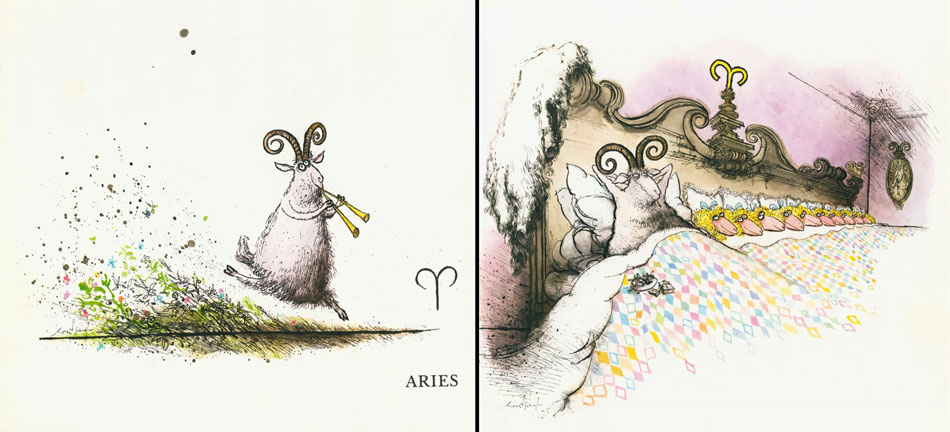
'Zoodiac' (1977).
Searle is often put in the same class as late 18th-century and early 19th-century English caricaturists who satirized their own lifetime in grotesque but witty cartoons. His art is a combination of old-fashionedness and modernism. On one hand, he portrayed the ancient times of theatrical plays, with people in historical costume and strange, out-dated customs. His characters have a quirky look, reminiscent of the stuffiness and pomposity of the days of the British Empire. His comedy can be gentle and refined. As a result, many critics have named him the most "British" of all 20th-century British cartoonists. On the other hand, Searle is also very much of his own time. He lampooned post-World War II society in a surreal manner, with morbid black comedy and eroticism far removed from the prissiness associated with Britain. His graphic style is sometimes scribbly and distorted, at times bordering to abstract art. And despite his "Britishness", Searle also looked for inspiration across the globe, becoming universal enough to find admirers all over the planet.
In his cartoons, Searle rarely used dialogue, and he only occasionally added a descriptive title or just one line. His earliest cartoons from the 1940s and 1950s, were more gag-based, with a clear funny situation and punchline. After moving to France in 1961, Searle became a strictly pantomime humorist. In the Cartoonist Profiles article (issue #4, November 1969), he said that he worked "with no fixed market in mind. (...) The only factor I watch is: that whatever I do is thought of as an international idea that will have equal appeal in any of half-a-dozen countries. Or be equally rejected." In France, contrary to the United Kingdom, he was regarded as an actual artist. It allowed him to apply a more experimental style and publish several books built around a thematic idea, rather than a set of jokes.
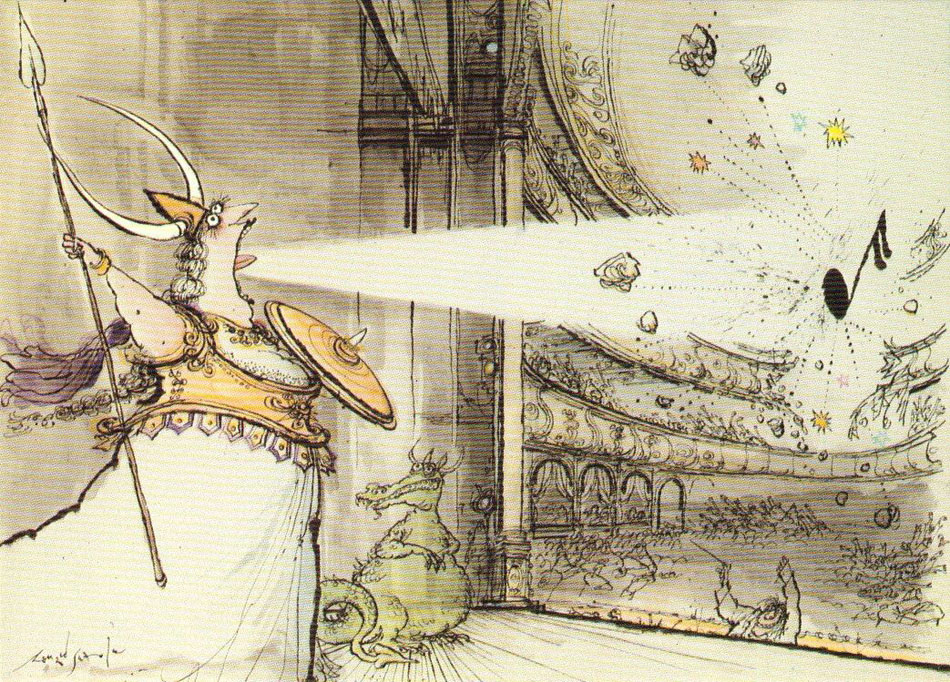
'Brunhilda'.
Searle's book 'Take One Toad' (1968), for instance, visualized strange but authentic ancient remedies against various illnesses. 'The Second Coming of Toulouse-Lautrec' (1969) reimagined 19th-century painter Henri de Toulouse-Lautrec as a grotesque dwarf between huge prostitutes towering over him. The book had a foreword by Roland Topor. 'Zoodiac' (1977) portrayed the zodiac signs as a series of funny animals. 'The Illustrated Winespeak' (1983), 'Parler en Vin' (1984) and 'Something in the Cellar' (1986) were created out of Searle's passion for wine and champagne and his disregard of snobbish liquor experts. The books illustrated genuine and ludicrous wine reviews Searle had read in magazines and imagined what wine culture and traditions might look like in Germany, France, Japan, Iran, Australia and the Netherlands, visualized through witty national stereotypes. All these versatile projects made Searle difficult to pigeonhole. The closest he came to a new "series" were his numerous cartoons, from 1966 on, depicting plump, fluffy and bewildered cats.
Ronald Searle's humor is a mixture between observation comedy and slice-of-life satire. From the 1960s on, his cartoons had less clear punchlines, with the artwork itself being the real joke. The elaborate, detailed drawings force the onlooker to stare at the cartoon longer to take it all in and find the humor in its witty portrayals of human archetypes and quirky animals. Their atmospheric surroundings add to the satirical flavor. Like Russell Davies once said: "Ronald Searle didn't make the world funny, but made us experience it as amusing: it was more of a psychological condition than a style." Throughout his career, Searle surprised audiences, longtime fans and colleagues time and time again with his originality and versatility. Particularly among fellow illustrators and cartoonists, he is regarded as an "artist's artist". Not always a crowd pleaser, but a skillful experimentator, sparking his colleagues' creativity with many visual ideas and interesting techniques.
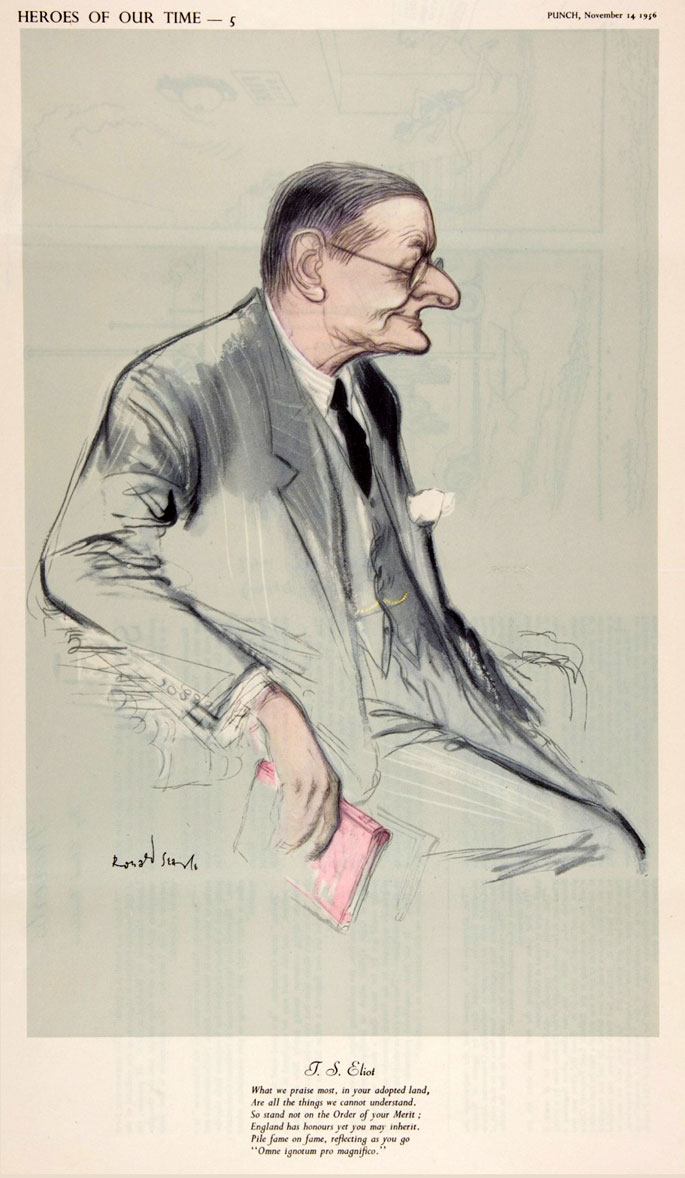
'Heroes of Our Time: T.S. Eliot' (Punch, 14 November 1956).
Caricatures and portraits
Searle frequently provided caricatures of famous politicians, actors, writers and other entertainers. In Punch magazine, he portrayed theatrical actors for the review column, but also full-color portraits of widely admired public figures, like T.S. Eliot, Bertrand Russell and Princess Margaret. Under the title 'Heroes Of Our Time', they were presented as centre-fold spreads. In 1961, he launched a short-lived and peculiar series in Punch under the title 'Searle's-eye View'. This was a series of "imaginary portraits" of celebrities, in which he tried not to portray them realistically or as a caricature, but simply conjure up an image that came up in mind when thinking about them. Alfred Hitchcock, for instance, was represented by an ominous masked figure with gloves, Agatha Christie as an old woman sitting on a bunch of corpses and Walt Disney as an old mouse leaving a fairy tale castle. For TV Guide, Searle made additional caricatures of TV stars. In 1995, the 75-year old artist even reinvented himself as a political cartoonist for the French newspaper Le Monde.
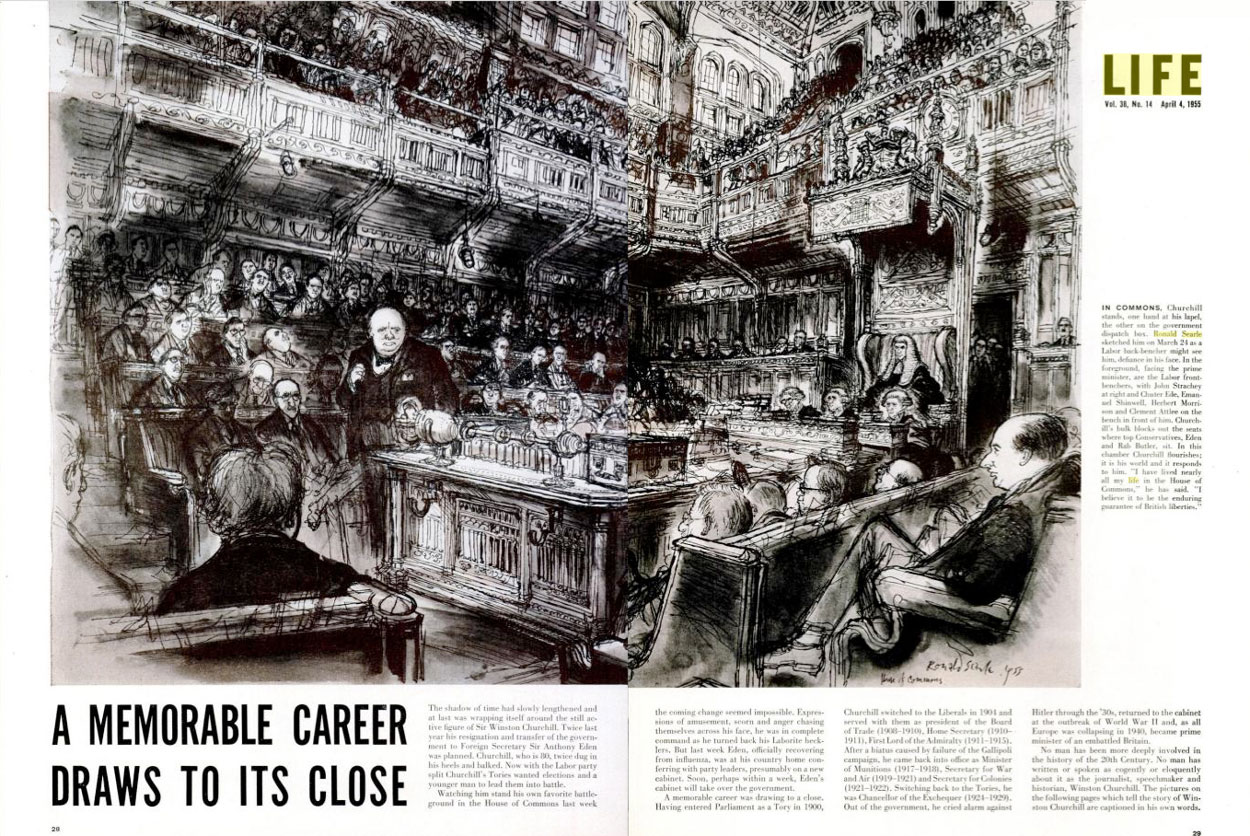
Searle's graphic report about Winston Churchill's final speech in the Houses of Parliament, London, published in Life Magazine, 4 April 1955.
Graphic reports
While first and foremost known as a humorist, Ronald Searle was likewise in demand as a graphic reporter for various magazines. Between 1946 and 1960, Punch commissioned him to attend theatrical plays to provide illustrations for the theatre review column, written by Eric Keown. Searle recalled this wasn't a enjoyable experience. He had to scribble mostly in the dark, with help of a tiny flashlight and an equally small telescope to spot the people on stage. Unavoidably, he annoyed other spectators and embarrassed himself. In collaboration with Kaye Webb, Searle created memorable portrayals of city life in Paris and London, collected in 'Paris Sketchbook' (1950) and 'Looking at London and People Worth Meeting' (1953). Together with Alex Atkinson, he made witty travel reports visualizing picturesque scenes in the United States and Russia, published as 'USA for Beginners' (1959) and 'By Rocking Horse Across Russia' (1960). Particularly for the magazines Holiday and Travel & Leisure, Searle could travel to exotic places like Alaska, Canada, Hawaii and Germany at his own choice and at the editors' expense and bring back vivid picturesque illustrations to accompany articles. Holiday picture editor Frank Zachary recalled that Searle originally made straightforward illustrations, while he wanted something more personal. The editor instructed him to make his drawings more funny and satirical. This led to more cartoony and silly drawings that weren't necessarily a completely realistic impression of local customs and scenery, but did capture its atmosphere, toying around with stereotypes. For instance, Searle's evocation of Hotel Street in Honolulu, Hawaii (Holiday, December 1965) portrayed goofy-looking local prostitutes picking out gullible sailors from a swarming crowd. His drawing of the shrine in the German town of Baden-Baden (Travel & Leisure Magazine, August 1975), showed several middle-aged, overweight Germans relaxing in the local spa town.
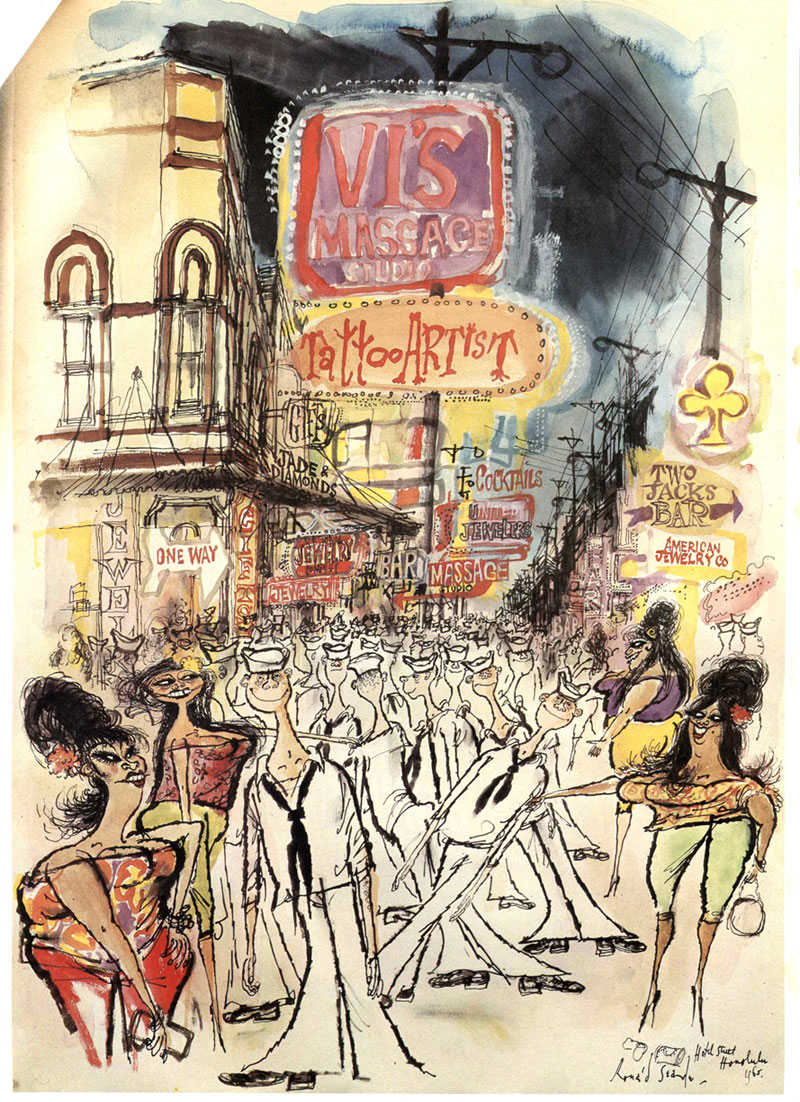
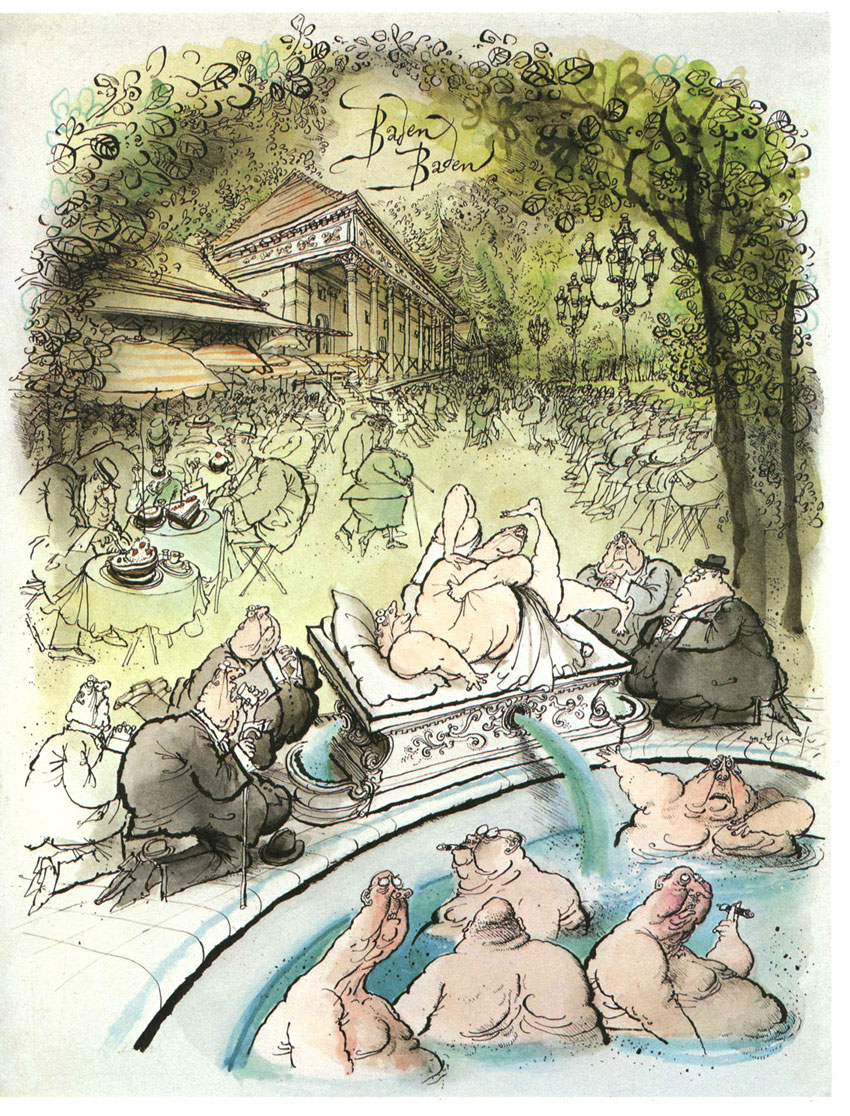
'Hotel street in Honolulu, Hawaii' (Holiday, December 1965) and 'Shrine' (Travel and Leisure Magazine, 1975).
In 1955, Searle visited the Houses of Parliament in London, where he drew Winston Churchill giving his final speech before retiring from active politics. He also covered the 1960 US Presidential elections for Life Magazine. Also for Life, Searle was active as a courtroom sketch artist, covering the John Bodkin Adams case (1957) and, most famously, the trial against Nazi war criminal Adolf Eichmann (1961) in Jerusalem. Since sketching wasn't permitted in British courts, Searle had to work in secret, drawing on a tiny piece of paper on his lap. He pretended to go to the toilet multiple times, so he could take these quick doodles and redraw them properly from memory. With the Eichmann case, it went easier since the Nazi had been photographed multiple times and the trial itself went on for months, allowing Searle to make many sketches. In 1963, Searle also covered the "Pétanque gang" trial in Marseille for Marseille Magazine.

'The Odyssey' (1955).
Comics
Ronald Searle mostly made one-panel cartoons, but in a few cases he used more panels to provide a sequence of events. A classic example is the gag in which a man takes a bath, with his feet sticking out of the water. In the next panel, when he's drying off, it turns out these feet weren't his, but apparently belong to a corpse in his tub. In addition, some of Searle's picture books follow a narrative. 'The Addict: A Terrible Tale' (1971) is basically one stretched-out pantomime gag where the reader follows an old woman getting up from her chair, slowly making her way to the cupboard and back to the living room to fetch cigarettes for a character whose identity is only revealed on the final page.

'The Rake's Progress' (1954).
Literary adaptations and parody comics
As a cartoonist for Punch, Searle drew several comic strip adaptations of literary classics, among them balloon comic versions of William Shakespeare's 'Macbeth' (1949) and Homer's 'Odyssey' (1955). While these were straightforward renditions, he also made modernized and more satirical versions of classic tales. Inspired by William Hogarth's 18th-century series of paintings 'A Rake's Progress', Searle created a similar satirical "rise and fall" story under the same title, but with different characters and a modernized setting. His version portrayed the witty trials and tribulations of the prototypical actor, clergyman, doctor, soldier, girlfriend and so on. 'The Rake's Progress' (1955) was later collected in book format and published by Searle's own publishing company, Perpetua Books. In 1973, Searle created a comic with a similar idea, 'Emergence of MS-tique USA' (1973), published in the New York magazine Town & Country. Presented in a series of sequences comparable to a text comic, the story followed a young woman who is beloved by many men, then studies her way up to become a radical feminist and eventually betrays her ideals to become Secretary of Defense.

'Emergence of MS-tique USA', 1973.
Book illustrations
Between 1945 and 2011, Ronald Searle was also a prolific cover illustrator for books, working frequently for Penguin Books. His artwork adorned the sleeves of new releases, anthologies and reprints, including work by Bill Naughton, Ronald Hastain, Merle Miller, Roy Fuller, Fred Gipson, Noel Langley, H.E. Bates, Luigi Olivero, A.P. Herbert, Harry Hearson & J.C. Trewin, J.D. Scott, Affleck Graves, Winifred Ellis, Reginald Arkell, Angus Wilson, Lord Dunsany, C.H.B. Kitchin, John Symonds, Charles Terrot, James Norma, Diana Grave, J.C. Trewin, Jean Raspail, Leslie Bell, Christopher Fry, Robert Graves, Philip O'Connor, John Steinbeck, L.J. Peter & R. Hull, Romain Gary, Roger Grenier, Jean Dutourd, Henry James, Gonzague Saint Bris, Mary Blume. He also illustrated reprints, like Herman Melville's 'The Confidence Man' (1948) and 'Billy Budd & Other Stories' (1951), Jerome K. Jerome's 'Three Men In A Boat' (1981), 'The Best of Alphonse Allais' (1989) and Ogden Nash's 'Candy Is Dandy' (1994). Only a couple of months before his death, one of his last jobs was the cover artwork for Roger Lewis' 'What Am I Still Doing Here?' (2011).
Searle also livened up the pages of novels and short stories, like Charles Dickens' 'A Christmas Carol' (1961), R.E. Raspe's 'The Adventures of Baron Munchhausen' (1969) and 'Dick Dead Eye' (1975), based on the comical operas of Gilbert and Sullivan. His drawings of 'A Christmas Carol' were later used during the opening titles of the 1970 film 'Scrooge', and 'Dick Dead Eye' was adapted into an animated film, 'Dick Deadeye, or Duty Done' (1975) by Bill Melendez. He also contributed drawings to James Thurber's 'The 13 Clocks and the Wonderful O.' (1962). Many of his portraits of novelists sported the cover of paperback novels published by Penguin Books.
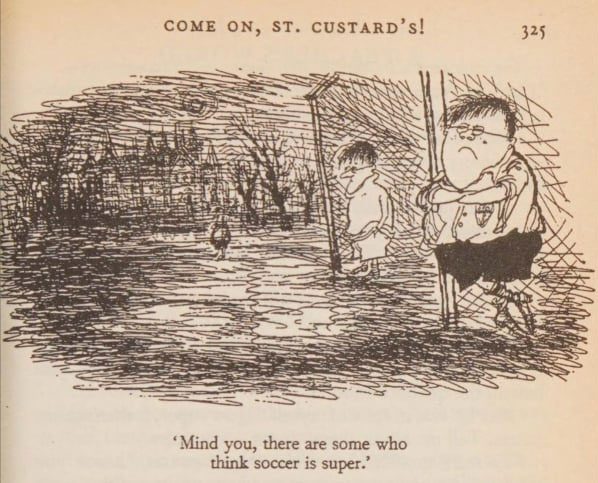
'Molesworth'.
Molesworth
As a book illustrator, Searle is best remembered for his work on Geoffrey Willans' popular book series 'Molesworth' (1953-1959), originally serialized in Punch. The long-suffering bespectacled school boy Nigel Molesworth and his hilariously bad spelling abilities were vividly rendered by Searle. The stories, set at the fictional St. Custards boarding school, have a special nostalgia to people who actually lived in the secluded environment of boarding schools themselves and read the 'Molesworth' books in their personal bedrooms. The short stories were also compiled in the books 'Down with Skool!' (1953), 'How to be Topp' (1954), 'Whizz for Atomms' (1956) and 'Back in the Jug Agane' (1959), for which Searle also designed the covers. Searle also illustrated other books by Willans, namely 'My Uncle Harry' (1957) and 'The Dog's Ear Book' (1958).
Film and animation career
On occasion, Searle did some cinematic contributions. He designed the posters and animated the openings, intermissions and closing sequences of comedy films like 'The Happiest Days of Your Lives' (1950), 'Those Magnificent Men in their Flying Machines' (1965) and 'Monte Carlo or Bust!' (1969). In 1957, Standard Oil commissioned him to create an animated short in collaboration with Dave Hilberman, best-known for the 'Gerald McBoingBoing' and 'Mr. Magoo' cartoons at UPA. Other animators involved with the project were former Disney animators Art Babbitt and Bill Melendez, the latter who later created the acclaimed TV specials based on Charles M. Schulz' 'Peanuts'. The eventual product, 'Energetically Yours' (1957), was a funny visualization of the history of mankind and their discovery of various sources of energy.
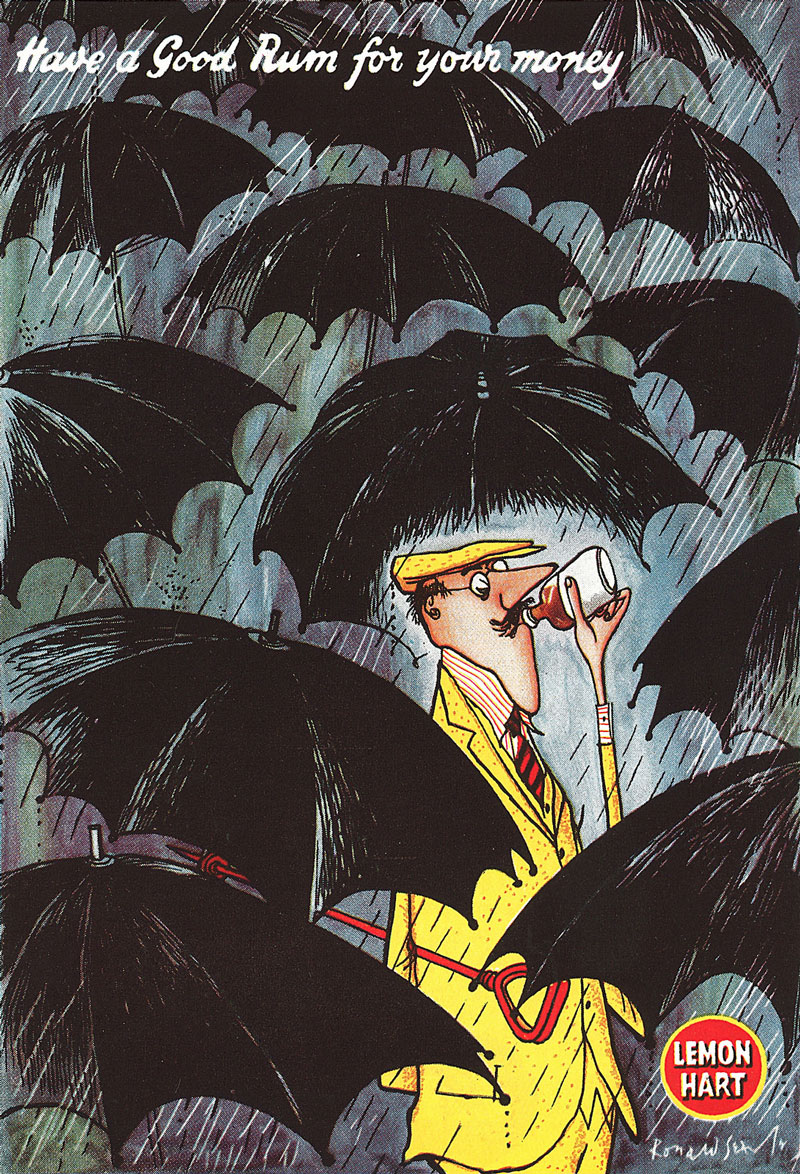
Advertisement for Lemon Hart rum.
Advertising art
As a commercial artist, Searle illustrated advertisements for Jamaica Rum, Lemon Hart Rum, Bev Coffee, Church English shoes, United States Rubber, Allen Soly Hose, Western Airlines, Lloyd's Bank, BP, GATX, Squires liquor, Rose's Lime Juice and many others.
Graphic and written contributions
In 1954, Searle designed a 50-foot sculpture of King Neptune, surrounded by mermaids, sculpted by Peter Krumins, for the Chelsea Arts Ball, under the title 'The Seven Seas'. Searle wrote the foreword to Bruce Petty's 'Australian Artist in South East Asia' (Grayflower Publications, Melbourne, 1962) and made a graphic contribution to Alan Aldridge's 'The Beatles' Illustrated Lyrics' (Houghton Mifflin, 1969). In 1977, he designed a series of medals for the French Mint, under the title 'Six Fathers of Caricature', depicting famous cartoonists throughout the ages: Annibale Carracci, George Cruikshank, Pierleone Ghezzi, James Gillray, William Hogarth and Thomas Rowlandson. New artists were added over the years, with Searle designing Wilhelm Busch, Romeyn de Hooghe, Charles Philipon, Antonio Pisanello, José Guadaloupe Posada, James Thurber, but also other notable historical characters like Tim Bobbin, James Boswell, Charles Dickens, Francis Grose and Samuel Pepys.
In 1981, he provided illustrations to a collection of song lyrics by satirical musician Tom Lehrer, though not each and every one of them, hence the self-deprecating title 'Too Many Songs by Tom Lehrer: With Not Enough Drawings by Ronald Searle' (Methuen Publishing, 1981). Around the same time, he also illustrated the cover of Kenneth Baker's 'I Have No Gun But I Can Spit: An Anthology of Satirical and Abusive Verse' (1980).
Recognition
Ronald Searle won the Advertising and Illustration Award twice, in 1959 and 1965 and, two decades later, again, after these awards had been separated into the Illustration Award (1980) and Advertising Award (1986) (1987). In 1960, he became the first non-American to receive the prestigious Reuben Award from the National Cartoonists' Society. In 1973, Ronald Searle was the first non-Frenchman to have his art exhibited in the Bibliothèque Nationale de France. He was additionally appointed with a CBE (2004), Légion d'Honneur (2007) and the Niedersächsischer Verdienstorden (2009). In 2011, he received the Winsor McCay Award for his contributions to animation.
Searle has been the subject of various exhibitions, for instance at the Bibliotheque Nationale de France (1973), the Chris Beetles Gallery in London (2003) and at the Anglia Ruskin University in Cambridge (September 2007-2008).
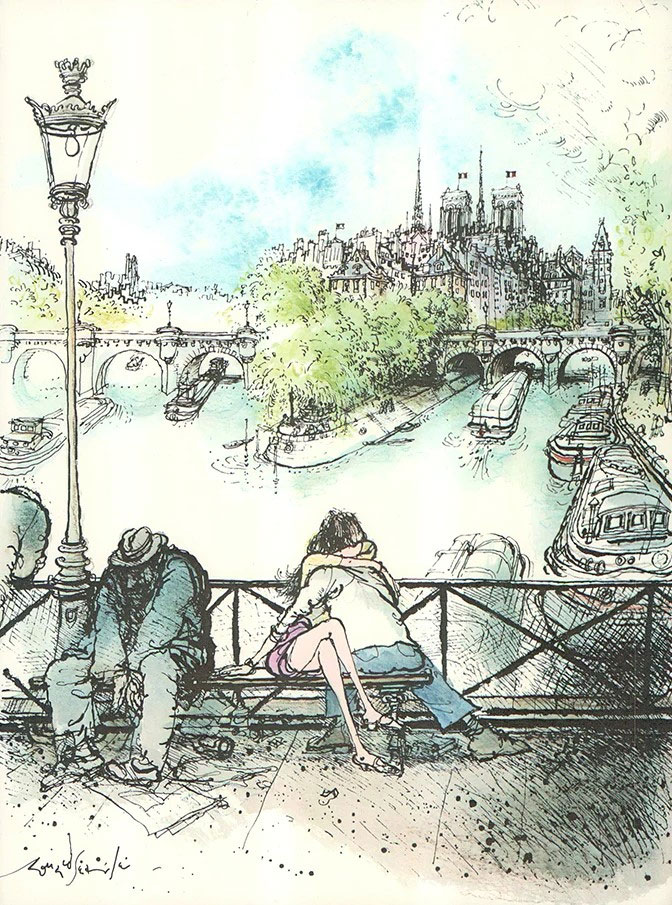
"On the Pont des Arts, Paris (1976).
Escape to France
For years, Searle kept publishing cartoons, paintings, travel sketches and illustrations. However, the workload and success eventually became too much for him. With a wife and twin children to support, Searle suddenly felt trapped. The former prison camp survivor had the impression he had lost his freedom a second time, so he took a drastic and controversial decision. While his family was on holiday for a weekend, he simply packed his things and moved to France. He had waited until his children were 14 years old and at least somewhat less dependable on their mother. His wife never forgave him, his children barely and all ties with his remaining relatives were cut. Though he did have the decency to send his family money on a regular basis. Between 1961 and 1963, Searle made a series of abstract expressionist paintings, 'Anatomies and Decapitations', which have been interpreted as an expression of his feelings after leaving his family behind. These experiments evolved into a more extreme style full of blobs, dribbles, slashes and angles.
Final years and death
Searle remarried in 1967 and spent the rest of his long life in France, moving to the Haute Provence in 1975. He became a recluse. His phone number remained a secret and people could only contact him by fax. Visitors had to have an appointment to see him. He disappeared out of public view and thus the general public assumed he had passed away long since. In reality, Searle only died at the end of 2011, at the age of 91. A year earlier, he'd donated his entire archives to the Wilhelm Busch Museum in Hanover, Germany.

'Young Cat Already Regretting Puberty'.
Legacy and influence
Ronald Searle received praise from film directors Mike Leigh and Tim Burton, comedian Groucho Marx and Beatle John Lennon. He had a massive influence on many cartoonists and illustrators all over the world. Some directly imitated his characteristic graphic style, spawning the eponym 'Searle-esque'. In the United Kingdom, he was an inspiration to Steve Bell, Quentin Blake, Harry Harrison (the British-Chinese political cartoonist), Ian Knox, Roy Raymonde, Martin Rowson, Gerald Scarfe, Posy Simmonds, Mark Stafford, Ralph Steadman, Edward Steed and Adrian Teal. In France, he influenced Jean Bosc, Laurent Colonnier, Serge Dutfoy, Patrice Ricord and Joann Sfar. In the Netherlands, he was an inspiration for Jan Sanders, Peter van Straaten and Jos Thomassen, while in Belgium he counts Benoît, André Franquin, Philippe Geluck, Jean-Louis Lejeune and Picha among his followers. A German admirer is Uli Meyer, who made two animated shorts based on 'St. Trinians' and 'Molesworth', which were shown to Searle in 2007, who was very impressed with the end result. British illustrator Max Beerbohm (one of Searle's idols) wrote to him in praise: "There seems to be no bounds to your strangely inventive faculty, and to your power at converting the macabre into the most pleasurable of frolics."
Self-portrait, 2007.
In the United States, Searle influenced Joel Beck, Dan Collins, Peter De Séve, Mort Drucker (who in his film and TV parodies in Mad often included Searle-esque background characters), Mike Fontanelli, Nick Galifianakis, Matt Groening (who placed Searle's 'The Female Approach' at nr. 26 in his personal list of '100 Favorite Things'), Mark Heath, Chuck Jones, Hilary Knight, Pat Oliphant, Everett Peck, Kevin Rechin, Arnold Roth, Richard Sala, Gilbert Shelton, Edward Sorel, Ann Telnaes, Richard Thompson and Bill Wray. Veteran artist Al Capp (of 'Li'l Abner' fame) also praised Searle. Even the Walt Disney Studios changed into a more scratchy, Searle-esque style from the late 1950s until halfway through the 1970s, visible in most of their animated features made during this period, including '101 Dalmatians' (1961), 'The Sword and the Stone' (1963), 'Jungle Book' (1967), 'The Aristocats' (1970), 'Robin Hood' (1973) and 'The Rescuers' (1977). Last but not least, Searle also influenced artists from Argentina (Quino), Australia (Michael Atchinson, Kaz Cooke, Paul Rigby), Croatia (Oto Reisinger), Denmark (Niels Bo Bojesen), Sweden (Sven Nordqvist) and South Africa (Zapiro).
Books about Ronald Searle
The finest overview of Searle's long and versatile career is the compilation book 'Ronald Searle in Perspective' (Atlantic Monthly Press, 1983). For those interested in his life story, Russell Davies' 'Ronald Searle: A Biography' (Chris Beetles, 1990, updated in 2003 and again in 2012) is a must-read. Another highly recommended spot for Searle fans is Matt Jones' exhaustive blog Perpetua, devoted to the artist.

Ronald Searle.