


The iconic cover for Mad issue #1 (April 1954).
Basil Wolverton was a U.S. comic artist and illustrator, who remains the godfather of all "gross-out comedy" cartoonists. His unforgettable depictions of wacky, grotesque and ugly people gained him a strong cult following. Early in his career, he drew humorous comics like 'Powerhouse Pepper' (1942-1952). He visualized the previously invisible character Lena Hyena for Al Capp's 'Li'l Abner' and designed the hideous woman on the front page of Mad Magazine's 11th issue, arguably the most iconic cover in its history. Apart from humor, Wolverton proved his versatility by creating chilling horror tales for comic books published by Atlas (nowadays Marvel) and Morse. Later in his career, he reinvented himself as a biblical illustrator, drawing various chapters of The Old Testament ('The Bible Story', 1958-1972). Although a polarizing artist, Basil Wolverton's highly original, unique and instantly recognizable style still influences artists today.

'Powerhouse Pepper' (Joker Comics #19, Summer 1945).
Early life and career
Basil Wolverton was born in 1909 in Central Point, Oregon. His father was a jack-of-all-trades who settled in Vancouver, Washington, when the boy was ten years old. Despite being devout Christians, Wolverton's parents divorced when the boy was a teenager. Around the same time, his older sister died unexpectedly from rheumatic fever. This made Wolverton lose his faith for the next 14 years. Wolverton had no formal art training, but loved doodling anyhow. Among his graphic influences were Milton Caniff, Al Capp, Roy Crane, Ed Dodd, Hal Foster, Rube Goldberg, E.C. Segar and Sidney Smith. Later in life, he also expressed admiration for Johnny Hart, Walt Kelly and the work of his good friend Al Fagaly.
Wolverton was only 11 when he sold his first cartoon to American's Humor. After graduating from high school, he worked for Portland News as a reporter, film critic and artist. One of his most exciting assignments for Portland News was visiting the set of the film 'The General' and meeting comedian Buster Keaton in person. In 1928-1929, Wolverton sold his earliest comic strip, the science fiction adventure serial 'Marco of Mars', to the Independent Syndicate of New York. It dealth with the adventures of a Mexican who, in the far future, travelled to Mars. However, soon after Philip Francis Nowland and Dick Calkins' science fiction saga 'Buck Rogers In The 25th Century' debuted and became a huge success. The syndicate felt 'Marco of Mars' looked too much like a concoction (even though it wasn't) and refused to run it. In 1929, the Wall Street Crash caused a global economic crisis and Portland News folded in its wake. For a while, Wolverton earned money as a vaudeville performer. He had a special act where he sang in a baritone voice, played ukelele and tap danced.
In 1936, Wolverton applied for a job at the Walt Disney Studios, drawing four sample comics starring Mickey Mouse. While doing a good job mimicking the company house style, they were still rejected. In 1970, they were printed in Graphic Story Magazine issue #12. Through correspondence with New York publisher Monte Bourjaily, Wolverton received many practical tips on drawing, inking, coloring and what types of material to use. He later even named his son, Monte Wolverton, after Bourjaily.

'Spacehawk'.
Spacehawk(s)
In 1938, Wolverton finally managed to get his work into print, by entering the American comic book market. Unlike many of his contemporaries, Wolverton didn't relocate to Manhattan, but remained in the Pacific Northwest, and sent his work by mail. His early work already stood out for its oddball appeal, and can be compared to the work of other "weird" Golden Age artists like Boody Rogers and Fletcher Hanks. The science fiction comic 'Spacehawks' and the detective comic 'Disk-Eyes the Detective' found a spot in the short-lived comic magazine Circus, The Comic Riot by the Globe Syndicate. In 1940, Wolverton reused much of the themes of 'Spacehawks' to create the nearly identically titled 'Spacehawk' (1940-1942), which appeared in Target Comics by Novelty Press. The zany science fiction saga stars an interplanetary lawman who battles space pirates and other malefactors. It was an early showcase of his talent for creating highly imaginative worlds and creatures. Wolverton later recycled Spacehawk a third time as the SF comic 'Meteor Martin' (1941-1942) in Amazing Man Comics.
All of Wolverton's early comics have been collected by comics historian Greg Sadowski in 'Creeping Death From Neptune: The Basil Wolverton Volume One 1901-1941' (Fantagraphics, 2014). The book also offers biographical information and historical context, while Sadowski was able to receive exclusive information and material from Wolverton's family.
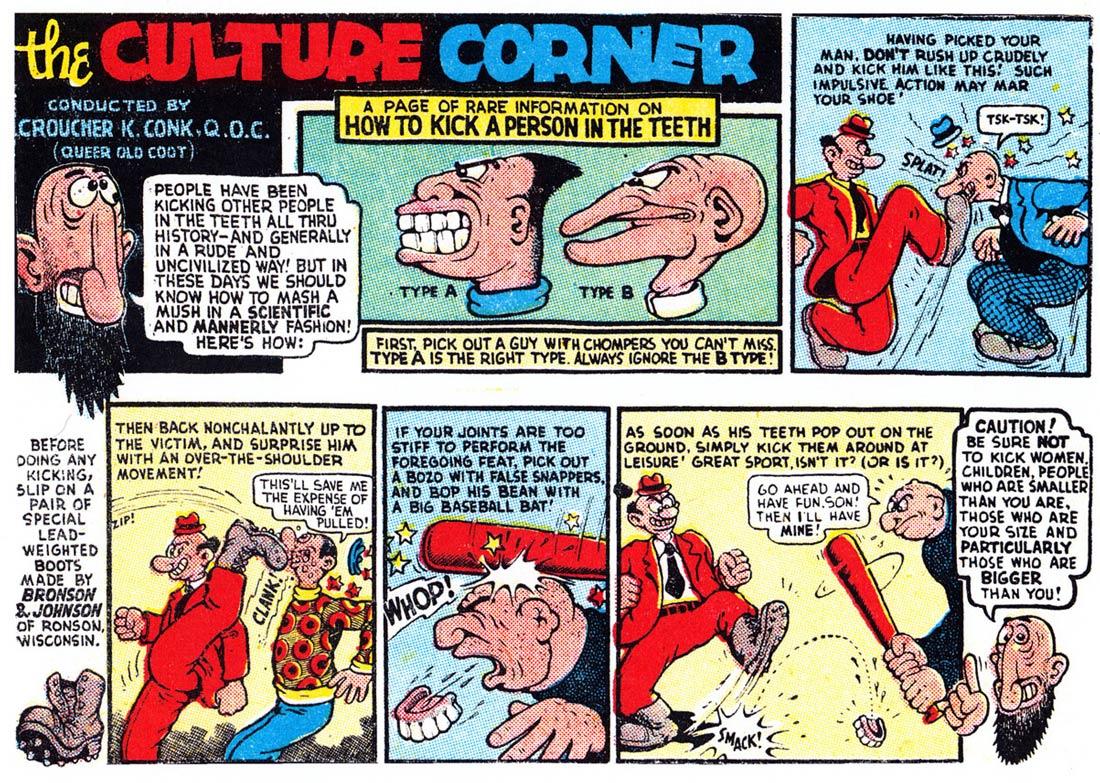
'The Culture Corner', Fawcett's Whiz Comics (November-December 1945).
1940s comics (Centaur Publishing, Lev Gleason, Fawcett Comics)
Another early client of Wolverton was Centaur Publishing, for which Wolverton most notably created the 'Space Patrol' feature (1939-1940), published in Amazing Mystery Funnies, followed by two 'Meteor Martin' (1941-1942) stories for Amazing Man Comics. In Lev Gleason's Daredevil Comics and Silver Streak Comics he had a comic strip named 'Scoop Scuttle' (1942-1945), about a newspaper reporter. But just when the ads had been prepared, the U.S. entered World War II in 1941, whereupon 'Scoop Scuttle' became victim of cutbacks. Another title for Lev Gleason, printed in Black Diamond Western was the cowboy comic 'Bingbang Buster and his Horse Hedy' (1950-1952).
For Fawcett's Whiz Comics, Wolverton made a filler feature called 'The Culture Corner' (1945-1952), a screwball guide to life, hosted by a certain Croucher K. Conk, Q.O.C (Queer Old Coot). Readers were offered advice on the most basic things, like trying to get out of bed gracefully, how to improve their posture or the best way to press pants. As the series went on, the etiquette became gradually more moronic. The expert Conk also felt it necessary to help people on how to cure feet, fall on your face or kick somebody in the teeth. It all offered Wolverton a chance to parody educational comics and draw silly situations with wacky resolutions. 'Mystic Moot and his Magic Snoot' (1945-1948) ran in Fawcett's Comic Comics and parodied Bob Kingett's 'Ibis the Invincible'.
Wolverton was also present in Timely Comics, with such melodiousnessly titled features as 'Prof. Jogg's Travelogs', 'Frink Clinkslink', 'Flap Flipflop', 'Inspector Hector the Crime Detector', 'Dr. Whackyhack the Wacky Quack', 'Hothead Hotel', 'Dr. Dimwit' and 'Supersonic Sammy'. Most were very short-lived, though, except for his first hit feature: 'Powerhouse Pepper'.

'Bingbang Buster And His Horse Hedy'.
Powerhouse Pepper
Wolverton's first major success was 'Powerhouse Pepper' (1942-1948), a humorous series published by Timely (the future Marvel Comics), most notably in the comic booksJoker Comics, Gay Comics and Tessie the Typist Comics. Pepper debuted in Joker Comics' first issue (April 1942). The character received its own one-shot comic book in 1943, and then returned in four more solo issues in 1948. Powerhouse Pepper is a superstrong, indestructable boxer who out-punches everyone who pushes him too far. Unfortunately, he isn't very bright and frequently underestimates his muscle power, with disastrous results. Pepper also wastes much of his energy doing tedious work, that more clever people would do in a more efficient and less time-consuming way. In one story, for instance, the dim-witted boxer digs throughout an entire beach looking for clams, while throwing away piles of treasure. Powerhouse Pepper gave Wolverton the opportunity to draw slapstick fist fights and physically impossible actions. At the same time, the series was also very verbal. Characters used alliterations, spoke in rhyme and made corny puns.

'Powerhouse Pepper'.
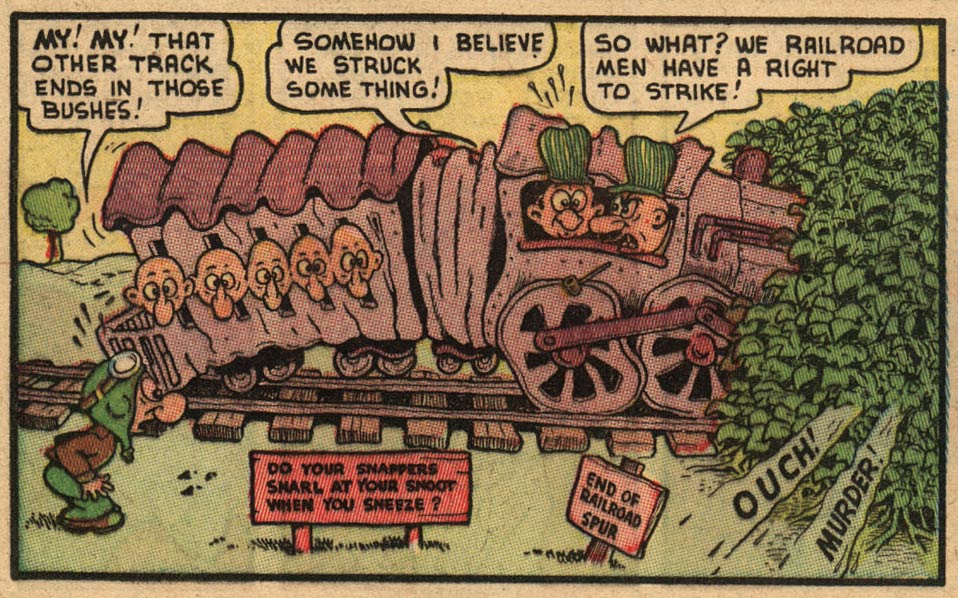
'Flap Flipflop' (Gay Comics #23).
Lena the Hyena
Wolverton's national notability increased when he won a contest held by Life Magazine. In June 1946, Al Capp, creator of the popular comic strip 'Li'l' Abner', had introduced an invisible character named Lena Hyena. She was reportedly the "ugliest woman in the world", but as a running gag she was always depicted off screen or with her head hidden from view. Readers could see how characters reacted to this modern-day Medusa, though. Many were so shocked by her ugliness that they screamed, fainted, ran away or downright went insane.
After intriguing audiences for several months, on 21 September 1946 Capp asked readers to draw their own interpretation of Lena. The winning drawing would be printed in an episode of his comic strip, a month later. The author joked that the jury would consist of Surrealist painter Salvador Dalí, 'Frankenstein' film actor Boris Karloff and singer Frank Sinatra (who was still nothing more than a teen idol in those years and thus hated by many men). The contest was a perfect marketing strategy. About 500.000 readers sent in drawings of the most gruesome females they could imagine. Even some professional artists joined in, like Carl Barks and Jack Cole.
Decades later, comic historian R.C. Harvey discovered that many newspapers that published 'Li'l Abner' at the time also organized 'Draw Lena' contests of their own. Wolverton entered the competition in The Portland Oregonian, where he ended second place of all seven candidates that made the final round. However, when the drawings were sent to Capp afterwards, the 'Li'l Abner' creator felt Wolverton's interpretation was the most striking. He'd depicted her as a lanky hag with menacing eyes, a huge nose, bushy eyebrows, wrinkles, blisters, a twisted neck and fang-like teeth. What made the difference was Wolverton's skill in drawing something hideous with a professional look. When printed in the papers on 21 October 1946, the drawing indeed surprised, shocked and entertained many readers. Wolverton was paid 500 dollars for it and received a lot of fanmail, which he took the time to answer personally. It has often been claimed that Wolverton's career as a comic artist was "launched" thanks to the Lena the Hyena publicity. But in reality, he was already well in demand before entering the competition: above all it made him more notable among publishers, fellow cartoonists and general audiences nation-wide.
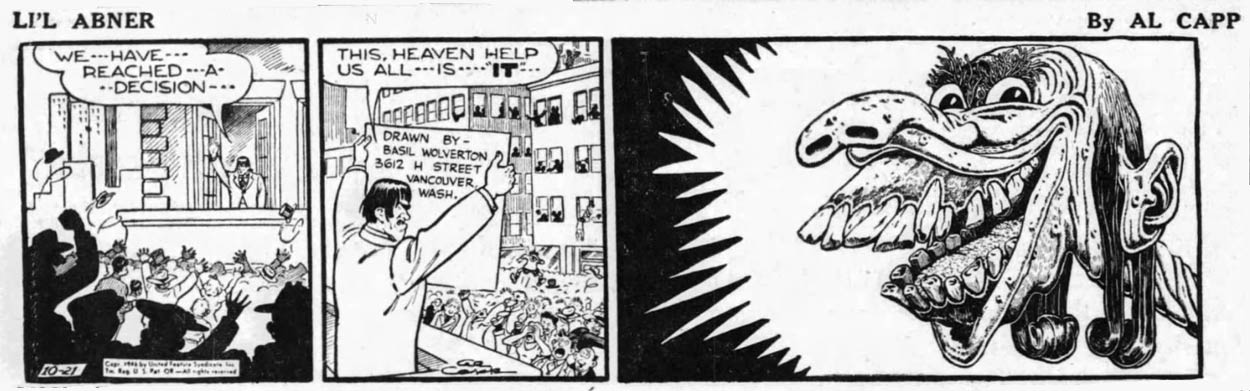
Episode of Al Capp's 'Li'l Abner', with Basil Wolverton's Lena the Hyena, 21 October 1946.
Style
Wolverton was a master in caricaturing the human face and body. He distorted body parts while multiplying others. Noses hang on necks, ears stick out of eye sockets, teeth point out in all directions, skins droops to the ground and virtually everyone has blisters or freckles. His characters seem to be made from plasticine rather than bones. His lack of academic schooling, gives his drawings an otherwordly appearance. They have the same primitive power of an amateur who just draws what he feels. His artwork has often been described as "spaghetti and meatballs", while he referred to himself as a "producer of preposterous pictures of peculiar people who prowl this perplexing planet". A polarizing artist, many people dismissed his artwork as "ugly". Some, like William M. Gaines and Jules Feiffer, utterly hated his work. Roy Crane once said he became "physically ill" whenever he saw Wolverton's "severe portraits". Even today, Wolverton's drawings still cause very strong and divisive reactions.
The attentive observer will notice that Wolverton's art is far more skilled and calculated than it may appear at first sight. Everything is balanced out. He never used a brush, but preferred using pen and ink. Above all it was highly unique. Their zaniness and elasticity had no comparison in the 1940s and 1950s, save perhaps in the animated cartoons of Tex Avery and Bob Clampett. Wolverton drew his bizarre, despicable creations with an infectious sense of fun, elegance and innocence. Right from the start, his work had a natural attraction to children, who love anything that's gross, while teenagers could relate to their own unappreciated bodily changes being mirrored in Wolverton's repulsive characters. nd yet, even the most grotesque Wolverton characters are always happy with their physical appearance. They simply love looking ridiculous, regardless what others may think of them. From this perspective, they add another layer why young people who search for self respect find comfort in his work.
While Wolverton's skill in drawing grotesqueries is unparallelled, it also overshadowed some of his other talents. His humor comics have great energy, with expressive faces and dynamic action that instantly grabs the reader's attention. Precisely because his characters don't follow conventional rules of physics and anatomy, he is able to bend, mold and shape them in any form he wants. This gives his humor comics an overall silly vibe, but his narratives remain easy to follow and are built up in a logical fashion.
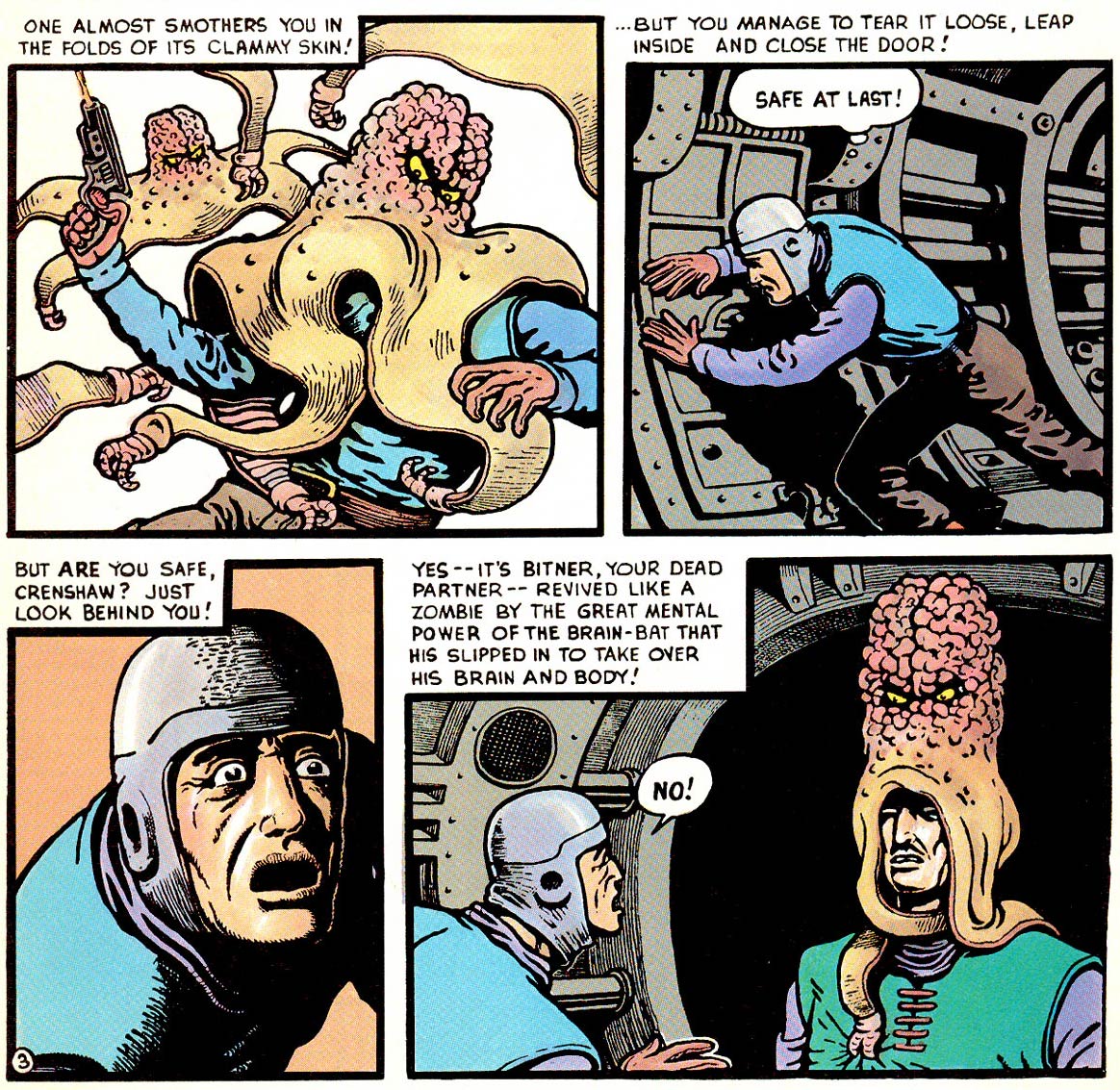
'The Brain Bats of Venus' (Mister Mystery #7, 1952, recolored for a later reprint).
Sci-fi comic books for Atlas Comics (Marvel)
Since 'Li'l' Abner' was such a widely read and highly popular comic strip, Wolverton instantly received more commercial offers. It was only a tiny step for him to go from monstrous faces to drawing actual monsters and extraterrestrial aliens. In the early 1950s, he worked on various horror and science fiction stories for Stan Lee's pre-Marvel Atlas line, including 'The End of the World' and 'Gateway to Horror' (both from 1951), printed in Marvel Tales, and 'The Devil Birds' (1951) and 'The Eye of Doom' (1952) in Mystic. For their Journey Into Unknown Worlds, he drew 'Planet of Terror' (1951), 'One Of Our Graveyards Is Missing' (1952) and 'They Crawl By Night' (1953). In Adventures Into Terror, his story 'Where Monsters Dwell' (1951) was printed.
Sci-fi comic books for Morse
At publisher Stanley Morse, Wolverton's gruesome artwork also thrilled readers. He drew the stories 'Escape to Death' (1952) and 'Flight to the Future' (1952) and 'The Monster on Mars' (1952) and 'Nightmare World' (1952) and 'The Man From The Moon' (1953) for Weird Tales of the Future. In Mr. Mystery, his story 'The Brain Bats of Venus' (1952) ran, while 'Robot Woman' (1952), 'The Man Who Never Smiled' (1953) and 'Swamp Monster' (1953) ran in Weird Mysteries.

'Nightmare World' (Weird Tales of the Future #3, recolored for a later reprint).
Mad
Although Wolverton drew stories for a lot of comic books inspired by EC Comics' trailblazing horror, fantasy and mystery comics, he oddly enough was never hired to draw for EC's comic books in this genre. Instead, he was commissioned to help out with EC Comics' humor magazine Mad, by chief editor Harvey Kurtzman. Kurtzman wanted one drawing of a hideous face, but Wolverton gave him two. The first one was used in Mad issue #10 (April 1954) for a parody of H. Antoine d'Archy's 'The Face Upon the Floor'. The entire story was drawn by Jack Davis, but the final image of the actual face on the floor was illustrated by Wolverton. His second drawing was used on the front cover of Mad's next issue, #11 (May 1954), which parodied Life Magazine's "Beautiful Girl of the Month". The eye-catching image featured a blistery, horse-faced hag who laughed her pointy teeth out. The anarchic parody cemented Mad's counterculture public image. Life actually threatened to sue, but chief editor William M. Gaines sussed them by promising they wouldn't do it again (a promise he broke several times after). Wolverton's hideous hag became the most famous 'Mad' cover of all time and impressed numerous young readers. Both Robert Crumb and Art Spiegelman remembered this cover vividly as their first memory of Mad, the magazine which would change their outlook on life and later inspire their own comics.
Inside Mad #11, Wolverton illustrated an article about a fictional "Mad Reader of the Month" election contest. It was merely an excuse to draw various contestants with repulsive but hilarious goofy faces. In the 17th issue (November 1954), Harvey Kurtzman, Will Elder and Wolverton made the advertisement parody 'Meet Miss Potgold', which featured various unattractive women, with one of them repeatedly being shown again, not coincidentally the niece of the fictional organizer, Mr. Potgold. Several panels of this particular comic had to be retouched because some editors felt they were too sexually suggestive. Certain flabby body parts looked too reminiscent of genitals. Wolverton once analyzed his style: "Sigmund Freud would probably go raving mad over my stuff. Some psychiatrist or editor said my material wasn't fit to publish because it was rife with sex suggestions and symbols. (...) It's like the monkey which, if he pounded away for a million years, might accidentally type out the 'Star Spangled Banner' lyrics."
Wolverton ridiculed table manners in 'Dining Etiquette Quiz' (Mad, issue #29, September 1956). In the 31th issue (February 1957), he illustrated 'What They're Saying Around The Solar System', followed by 'Mad Hats' (issue #36, December 1957), 'Inside Story (Famous Stomachs)' (issue #40, July 1958) and 'Wheelers and Dealers' (issue #82, October 1963). His final illustrations for the magazine appeared in issue #137 (September 1970), with the article 'Sports Cars We'd Like to See'.
Wolverton was one of the pioneers of Mad's early years, when founder Kurtzman scripted their classic stories and came up with some of their best spoofs and satires. He was also one of the few to make occasional comebacks after Kurtzman left the magazine in 1956. His impact was memorable to the point that many Mad readers are amazed that Wolverton's actual contributions to Mad are remarkably low and irregular. Altogether, he only appeared in nine issues and limited to mostly illustration work, rather than comics.
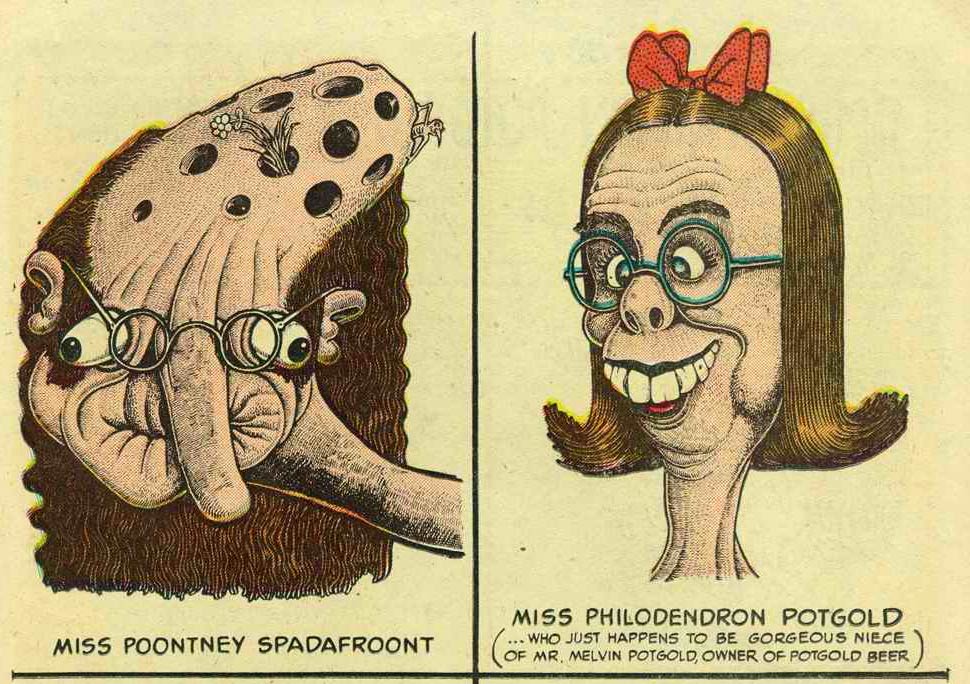
'Meet Miss Potgold', from Mad #17 (November 1954).
Panic
Wolverton also published in another magazine by EC, namely Panic!, edited by Al Feldstein. In the second issue (April-May 1954), he made a contribution to Will Elder's 'The Lady Or The Tiger', while in the third issue Elder and Wolverton satirized Al Capp's humor comic 'Li'l Abner', with Wolverton redrawing Lena Hyena once again.
Topps
Wolverton's gift for grotesquery was put to good use at the chewing gum company Topps, where he created the 'Topps Ugly Hang-Ups' poster series (1968) for editor Woody Gelman. It cannot be denied that Wolverton's elastic and gooey graphic style had a huge impact on Topps' later trading cards series, particularly 'Wacky Packages' (1967) and 'Garbage Pail Kids' (1985).
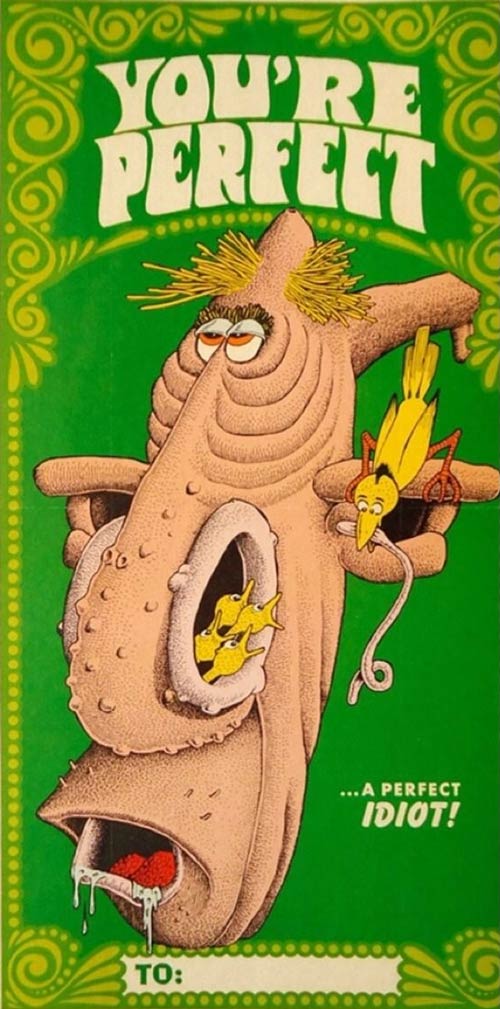

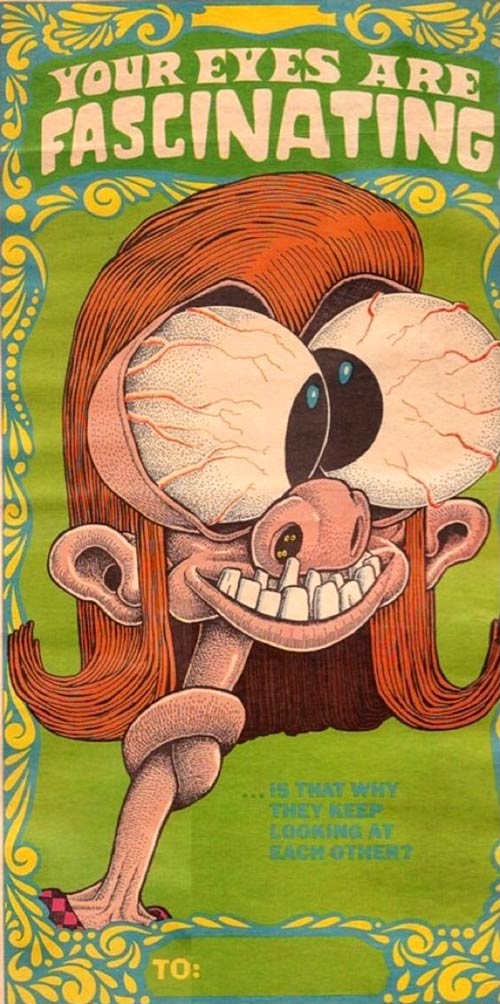
Three beauties from Topps' 'Ugly Hang-Ups' series.
Religious artwork
Just when Wolverton seemed condemned to a lifetime of doodling nothing but goofy and repulsive faces, he switched over to other projects. Despite coming from a religious household, he had abandoned his faith for decades. In 1943, however, he became a born-again Christian. He converted to Herbert Amstrong's cult Radio Church of God (later Worldwide Church of God) and was ordained as one of his ministers. The cartoonist preached in a small congregation in Portland, Oregon. Armstrong offered him a position as evangelist, complete with an office and secretary. But Wolverton declined because he didn't like office jobs, nor the idea of moving to another state. He did take the offer to create some biblical illustrations for Armstrong's books, magazines and pamphlets, though.
In the early 1950s, Wolverton was asked to visualize his idea of The Apocalypse. He did it with the same panache as his humorous comics, but far more disturbing. In November 1958, Wolverton illustrated all chapters of the Old Testament for Armstrong's magazine The Plain Truth. The ambitious project ran until December 1969 under the title 'The Bible Story', after which it continued until April 1972 in another magazine, Tomorrow's World, as 'The Story of Man'.

'The Bible Story', volume II.
Wolverton's biblical illustration work was in line with the teachings of the World Wide Church, particularly their apocalyptic prophecies. He wanted to reach younger audiences, but not through romanticized family friendly junior bibles. To him, all biblical disasters and God's wrath had to be depicted as scary and horrible as possible. His experience with horror comics helped him achieve his goal with ease. When the second volume of 'The Bible Story' appeared in print, editors censored the image of people drowning during The Great Flood to avoid parental complaints.
Wolverton took the project seriously. He abandoned his trademark cartooniness and actually researched the biblical text and the time period. He consulted historians for information and visual documentation regarding ancient Judea. Between 1961 and 1968, the series was published in six volumes by Ambassador College. Afterwards, they were recollected in the books '1975 in Prophecy' and 'The Book of Revelation Unveiled at Last'. A posthumous collection, 'The Bible Story' (1982), followed, but the most recent and complete release is 'The Wolverton Bible' (2009) by Fantagraphics. Wolverton always regarded his biblical illustrations as his personal masterpiece. He never considered a comic book version of the New Testament, since the depiction of Jesus would be a violation of the Second Commandment. But he sincerely hoped that his biblical epics would be the one thing people would remember him for.


Covers for GJDRKZLXCBWQ Comics and Plop Magazine.
Recognition
In 1991, Basil Wolverton was posthumously inducted in the Jack Kirby Hall of Fame and in 2000 in the Will Eisner Hall of Fame. In 2006, his comics were exhibited in Portland Art Center in Oregon and in 2007 at the CSUF Grand Art Center in Santa Ana, California. Between 20 June and 14 August 2009, his artwork was exhibited at Gladstone Gallery on 24th Street in New York City, curated by longtime fan Cameron Jamie.
Final years and death
In 1973, comics collector Glenn Bray brought Wolverton's work back to attention with the release of the "underground" comic books 'Basil Wolverton's "Gjdrkzlxcbwq" Comics' (1973), featuring the most grotesque gallery of freaks and weirdos. Bray followed it up with another book: 'Basil Wolverton's Foopgoop Frolics Frantic Funnies Folio' (1975). Later in his career, Wolverton illustrated several covers for Joe Orlando's satirical comic book 'Plop!' (DC Comics, 1973-1975). In 1974, Wolverton briefly turned to self-publishing and released one issue of 'Common Types of Barflyze'. In October 1974, Marvel Comics and Kitchen Sink Press issued a joint underground comix magazine named Comix Book. The publication was less sexually explicit than actual underground comix, but still quite an unusual work for the company. Many underground cartoonists made a contribution, among them Joel Beck, Howard Cruse, Kim Deitch, Justin Green, Will Fowler, Gary Hallgren, Denis Kitchen, Trina Robbins, Art Spiegelman, Skip Williamson and S. Clay Wilson. Since Wolverton's work for Mad had been such an influence on the underground comix movement, down to his cross-hatching (!), he was brought in as well. He drew two comics for them, 'Calvin' and 'Weird Creatures'. In November of that same year his artwork also appeared in Hugh Hefner's Playboy.
In 1974, the veteran cartoonist suffered a stroke which brought an abrupt end to his career. Basil Wolverton passed away four years later, in 1978.

'Weird Tales Of The Future', issue #2 (June 1952).
Legacy and influence
Basil Wolverton had a huge impact on the U.S. underground comix movement and inspired artists like Robert Crumb, Jay Lynch, Diane Noomin, John Thompson, S. Clay Wilson, Robert Williams and Art Spiegelman. Wolverton's elastic, cross-hatching style is very noticeable in Crumb's cartoony-looking comics, while he too, late in his career, also illustrated 'The Book of Genesis'. Wolverton was also an influence on Eleanor Barnes, Peter Bagge, Glenn Bray, Charles Burns, Tim Caldwell, Daniel Clowes, Mike Diana, Will Elder, Gary Figari, Peter Fitzgerald, Drew Friedman, George Hansen, Cameron Jamie, Kaz, Mike Kelley, Larry Marder, Joe Matt, Jeff Nicholson, Gary Panter, Everett Peck, Larry Rippee, Ed "Big Daddy" Roth, Ed Ruscha, Joe Sacco, Peter Saul, Jim Shaw, Devlin Thompson, J.R. Williams, Gahan Wilson and Bill Wray. American painter Ron English made his own version of Wolverton's 'Life: Beautiful Girl of the Month' parody, printed in Mad issue #3 (October 2018).
In Canada, Wolverton inspired 'Ren & Stimpy' creator John Kricfalusi, while in Europe he found followers in Belgium (Jean-Louis Lejeune, Dieter Van Der Ougstraete), Croatia (Tom Bunk), France (Jacques Pyon), The Netherlands (Flip Fermin, Maia Matches) and the United Kingdom (Hunt Emerson).
It's safe to say that, without Wolverton paving the way for them, many cartoonists who specialize in repulsive, aesthetically "ugly" artwork would've had a far more difficult time getting their work into print. Harvey Kurtzman felt "Wolverton never borrowed, never hacked, and he never short-changed the public. This is a good deal of the reason why he was what few of his contemporaries could claim: Wolverton was an original."

'Spacehawk'.
Availability
Wolverton's early comic book work has been a regular subject of reprints ever since the 1970s. Ron Graham already made an unauthorized fan collection of 'Powerhouse Pepper' in 1974, while Dutch publisher Robert Olaf Stoop published a 'Powerhouse Pepper' collection through his Real Free Press in 1973. 'Spacehawk' was reprinted by Archival Press in the late 1970s and again by Dark Horse in the 1990s. Dark Horse also released 'Basil Wolverton's Planet of Terror' (1987), 'Basil Wolverton's Gateway to Horror' (1988) and 'Basil Wolverton's Fantastic Fables' (1993), which contain selections of his 1950s mystery comic books work. Pure Imagination published a three-issue comic book series called 'Intense!', with mostly 'Powerhouse Pepper' stories. The Seattle-based publishing house Fantagraphics has been releasing luxury collections of Wolverton's work ever since the late 1980s, including 'Wolvertoons: The Art of Basil Wolverton' (1989), 'Basil Wolverton's Powerhouse Pepper' (1994), 'The Culture Corner' (2010) and 'Spacehawk' (2012). 'Lena's Bambinas' (Fantagraphics, 1996) presented a collection of Lena the Hyena's equally grotesque family members, drawn by the author's cartoonist son, Monte Wolverton.
Books about Basil Wolverton
For those interested in Wolverton's work, the book 'The Original Art of Basil Wolverton: From the Collection of Glenn Bray' (Last Gasp, Grand Central Press, 2007) is highly recommended.

Basil Wolverton in 1959.