


'Tom Lucky in 'Kom Op, Jongens!'.
Henk Albers was a legendary Dutch comic artist, whose body of work was unfortunately scattered and limited due to his lifestyle. From his early beginnings as errand boy with the Marten Toonder Studio's, over his work for the comic magazines Donald Duck and Pep to his final years as house artist of comics appreciation society Het Stripschap - Albers' life and career is full of anecdotes. He had a newspaper strip called 'Tom Lucky' (1946-1948), worked for digest-sized comic books like 'De Kat', made cartoons for naughty magazines and had stints as an advertising artist, animator, magazine illustrator, cabaret artist and clown. Most notably, he was during the 1970s the only foreign artist allowed by Morris to draw the iconic cowboy 'Lucky Luke' in original stories for both Pep and the French Lucky Luke Mensuel. Later in his career, he designed Sjoert, the mascot of the Dutch comics appreciation society Het Stripschap, whose image is also featured on their annual comic awards. Albers would have become a household name if he hadn't lost himself in booze, debts and ill-fated love affairs, leading to a steady decline of his production in the 1970s.
Early life and education
Hendrik Wernard Gerard Albers was born in 1927 on the Rozengracht in the Amsterdam Jordaan neighborhood. He grew up in artistic surroundings. His grandmother had a traveling wax figures theater, and his father ran the Asta Theater cinema. The young boy was captivated by the animated shorts of Walt Disney's 'Mickey Mouse' and Pat Sullivan's 'Felix the Cat', which were shown in the venue. His father fully supported his son's desire to become an artist, although his school teacher suggested he should become a clown instead. Still a kid, Albers had his first comic strips published in the children's weekly Doe Mee in 1938.
By 1942, while World War II was in full swing, he applied for an apprenticeship with Marten Toonder. The teen got his first drawing lessons from Toonder's assistant Wim Lensen. They gave him a lifelong frustration with drawing ovals, as Lensen let the boy draw innumerable buckets to train his skills. In the end, Albers was allowed to trace a 'Tom Poes' strip on a light box and practice with ink.
Toonder-Geesink Studio's
By mid-1942, Marten Toonder had begun a partnership with Joop Geesink in order to produce animated films. The Toonder-Geesink Studio's were in need of extra hands. Albers and Albert van Beek were hired as errand boys, mainly tasked with cleaning cells and paint trays, preparing paper and stoking the stove. Outside working hours, the two quickly formed a group of friends with the artist Willy Kuyper and the future singer Willy Alberti. In their spare time they were involved in the illegal trade of potatoes, bread and surrogate cigarettes, while doing occasional chores for the resistance.
They also attended the judo school of Gé Koning. Young and rash, they bragged they could make Koning an animated film to promote his school. They managed to actually produce a film of 42 seconds, made with cells they had "borrowed" from Toonder-Geesink's animation department. During one of his nightly break-ins Albers was caught by Jan-Dirk van Exter, who reported him to Toonder. Several later accounts exaggerated this story to dramatic proportions. Some hinted that Toonder considered shooting the boys, as their act could compromise the studio's illegal wartime activities. Albert van Beek later refuted the claims as ridiculous. He said the entire Toonder crew had even watched their film and applauded at the end. But even if Toonder might have seen some humor in the boys' heedless action, it did cost Albers his job in January 1944.

Henk Albers drew himself and Piet van Elk on the cover of Stripfilm #4.
Stripfilm
Albers and Albert van Beek continued to work together up until 1950. At one point, they shared a studio on the Amsterdam Muntplein. They made picture books for the local publisher Mulder, which however never saw print. By 1945, they found employment at Piet van Elk's Stripfilm studio. Van Elk wanted to make an animated film based on his character 'Bim'. To warm up the public for the upcoming film he launched a magazine called Stripfilm. Five issues were published between 15 October and 23 November 1945. Albers provided the comic features 'Jimmy Stone', 'De Robins en de Baldy's' and 'Chickey Walker' with writer Joop Elenbaas, while Van Beek drew the realistic comic 'Frank Duffard'. Albers was a big fan of Walt Disney and all things American. During the war he had taught himself the English language by reading newspapers and books, and the influence of animated films was apparent in his comics of that time period. He signed his work with the anglicized pen name "Henry Albers". Unfortunately, the post-war Netherlands were not ready for a full-blown animation industry. The 'Bim' film was never completed, and Van Elk's company ventured into the distribution of comic strips to Dutch regional newspapers instead.

'Tom Lucky'.
Tom Lucky
Albers' best known creation was 'Tom Lucky' (1946-1948), a Canadian Mountie. After the Liberation, he had hung out with the Canadian soldiers, and listened to many stories about their country. The artist used them as inspiration for his new comic strip, which maintained a certain amount of naïveté. Three stories were made. 'Tom Lucky en de Veedieven' appeared in local newspapers like Rotterdam's De Maasbode from April to June 1946. 'Kom Op, Jongens' ran in the Belgian magazine Voor Vrouw en Kind from 12 August 1946 to 2 February 1947. It was one of the few comic strips collected in book format by Stripfilm, in 1948. Albers sold his third 'Tom Lucky' strip to the local King Features subdivision Opera Mundi. 'Tom Lucky in het Mysterie van de Negen Gouddelvers' (1948) was published at least in De Noord-Ooster and in Wim Meuldijk's Ketelbinkie Krant.

'Stuffie Mac-Lion's Avonturen in Germandolfië', Overijsselsch Dagblad, 10 January 1947.
Other newspaper comics
Among Albers' other comic strips were the funny animal adventures of the spy 'Stuffie MacLion' in the land Germandolfië. The strip was an obvious parody of Nazi Germany, and appeared in newspapers like Ons Noorden and Overijsselsch Dagblad from 20 December 1946 until 5 February 1947. In addition Albers assisted Siem Praamsma on his 'Jochem Jofel' strip in the communist daily De Waarheid. The episode 'Tube Verf en Heer Jofel Van Toffensteyn' (September-November 1948) was almost completely penciled by Albers. When Praamsma emigrated to Australia, Albers got his spot in the newspaper and created his own strip, starring a chubby fellow called 'Bassie Bol'. Presented as a nephew of 'Jochem Jofel', Bassie's adventures on the moon took off on 22 November 1948. 'Bassie Bol en het Maanmannetje' ran until 23 February 1949, and was followed by 'De Avonturen van Bassie Bol en Apie Krul', in which Bassie befriends an intelligent ape while on a jungle holiday. It appeared in De Waarheid from 24 February until 24 August 1949. But by then interest in local newspaper comics had largely dried up. Papers preferably bought the American strips which had become more and more available for syndication in Europe. Basically, these were of higher quality, and less expensive to license.

'Bassie Bol en het Maanmannetje', De Waarheid, 17 January 1949.
De Kat
During the second half of the 1940s, Albers and Albert van Beek had found other ways to earn some cash. They began an association with Martinus Hoenderop of H.A.T.E. (Hoenderopse Algemene Tijdschriften Exploitatie), one of several publishers of so-called "beeldromans". The market for these digest-sized pulp comics blossomed in the wake of Alfred Mazure's success with 'Dick Bos'. Van Beek succeeded Willy van Dael on the western series 'De Zwarte Ruiter' (1947-1948), while Albers created the masked vigilante 'De Kat' (1948), of which thirteen issues were published. 'De Kat' ("The Cat") was a masked detective, who solved mysteries all over the world (although her homebase was Amsterdam).
But this adventure didn't last long either. The Ministry of Education, Culture and Science felt action-filled "beeldromans" were a bad example and genuine threat to the innocent and impressionable Dutch youth. In 1948, the minister sent a circular to school governors with the urge to apprehend these "harmful" books. Many titles ended up in coal stoves. H.A.T.E. quickly canceled all its activities, bringing a sudden halt to Albers' 'De Kat'. Apparently, the character had left a lasting impression. Years later, in the 1980s, Martin Lodewijk revived the Dutch catwoman and made new comic books with the artists Hendrik J. Vos ('De Kat in Constantinopel', 1980), Bart van Erkel ('De Kat in Katendrecht', 1985) and Adri van Kooten (the unpublished 'De Kat in Kitzbühel'). Vos then initiated another short-lived comeback on his own with 'De Kat in de Karpaten' (2006).


'De Kat'.
Naughty cartoons
Other regular clients for Albers were Pin-Up Magazine (1948-1950) and Studio de Paris (1949-1950), which also appeared under the titles Le Chat Noir and Studio Mondial. These "naughty" biweekly magazines featured cartoons and pictures of pin-ups, as well as spicy stories with illustrations. The magazines also contained the first adverts for partner-swapping. Both magazines came from the same anonymous publisher, based in Amsterdam, while most of the contributors worked under pseudonyms. Albers provided many drawings of sexy ladies in garters under the pen name Jerry Milton. This didn't stop the vice squad from summoning Albers to the police station. The publisher and the editors had been apprehended, but Albers got off with a warning.

Henk Albers meets Walt Disney in June 1951.
Ketelbinkie Krant
By 1950, most of Albers' clients were out of business. Around this time he also lost track of his old partner-in-crime Albert van Beek. He only remained a contributor to Wim Meuldijk's Ketelbinkie Krant, a magazine from Rotterdam which appeared in Amsterdam under the title Rob's Vrienden. With Meuldijk, he made a comics feature called 'Niels Holgersson's Wonderlijke Avonturen' (1948-1949) based on Selma Lagerlöf's children's book 'Nils Holgersson', while he also provided illustrations and cover drawings well into the 1950s. In 1951, Albers was able to meet Walt Disney in person during his visit to the Netherlands. With a falsified press card, he managed to interview the animation legend for Ketelbinkie Krant. According to legend, Albers was even invited to come and work in the Disney Studio's in Burbank, California, but refused the offer. Albers had just started a family with his first wife. He named his firstborn Walter (b.1951), in honor of Disney.


Cover illustrations for Rob's Vrienden, respectively printed on 13 June and 6 June 1952.
Van Leer's Vaten
Between 1950 and 1955, Albers was employed by the advertising department of Van Leer's Vaten in Amsterdam. The company produced oil barrels for clients all over the world, and Albers was tasked with making advertisements with a humorous undertone. He also participated in expositions of the company's barrels at the Foir de Paris and in London's Olympia Hall. Albers was additionally involved with the many hobby projects of the company's owner, Bernard van Leer. He was sent to London to construct the full life story of a business partner who celebrated his jubilee, and made a large painting for one of Van Leer's houses in France.
Stage acts
Albers was the sound operator for Van Leer's hobby circus, where he also took care of the horses and performed a clown act. He later returned to the stage with his own Ensemble Henk Albers, a cabaret act starring Albers, his second wife Nelleke and the young couple George and Anke Groot. The group provided songs and sketches on Dutch radio and television, and performed at an Auschwitz memorial evening in the Amsterdam Minervapaviljoen on 15 October 1961. Under a pen name, Albers wrote a musical about a circus, called 'Elke Keer als Eros voorbijkomt'. George and Anke Groot eventually co-founded the famous comedy group Don Quishocking in 1967.
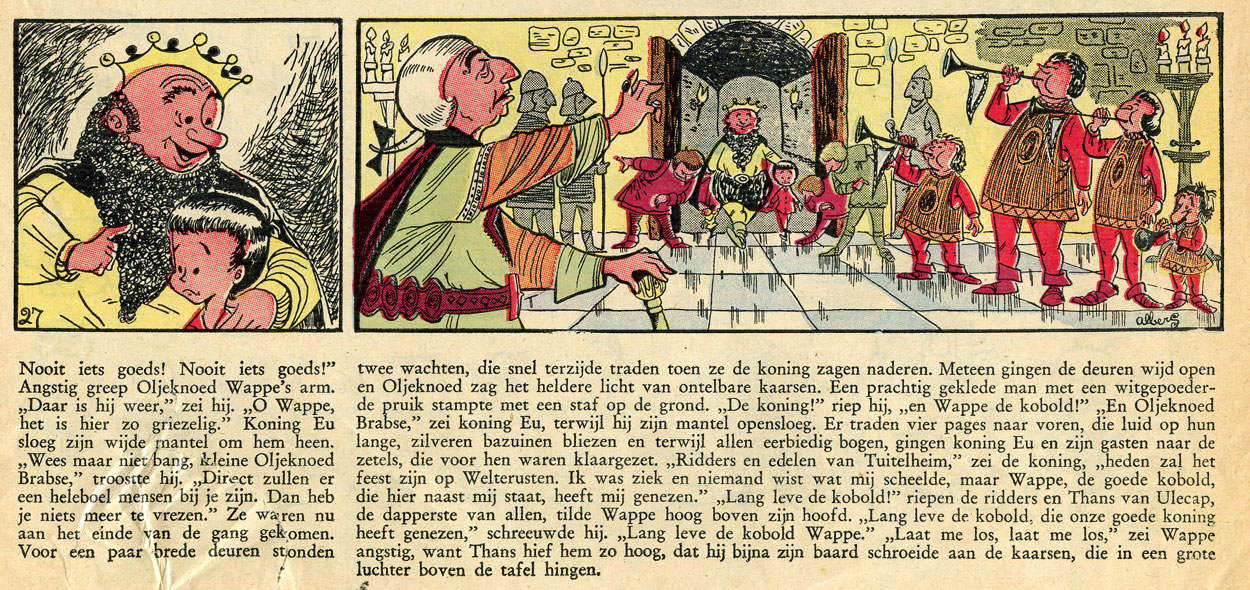
'Wappe de Kobold'.
Freelance career
Turning freelance in the mid-1950s, Albers did a lot of advertising work as well as illustrations for record covers and posters for the Grand Gala du Disque event. One of his clients was Haak In, the magazine of the youth club of margarine brand Leeuwenzegel (and the predecessor of Prins Leo). For the front page, Albers drew 'Wappe de Kobold' (1955), a text comic about a gnome, written by Ton Krielaart. A photo exists of the authors with puppets based on the comic's protagonists, suggesting that there has been a theatrical performance as well. The Leeuwenzegel brand itself played an important role in the text comic strip 'Marianne en het Vervalste Leeuwenzegel' (1955), written by John Lentermans and illustrated by Henk Albers. Haak In was also published in Germany, but the paper came to an end after twelve issues. In 1959, Albers additionally made the pantomime gag strip 'De Belevenissen en Avonturen van de Heer Archibald' (first issue only) and the picture serial 'Arvid en Gudalin' for the local subscription magazine Uw Weekjournaal voor Amsterdam.

'Miss Therie', from De Radiobode #43, 1955.
Avrobode
From the late 1950s until the late 1960s Henk Albers was the regular illustrator for broadcasting association AVRO. For their radio guide AVRObode (before 1959 known as Radiobode), he made spot illustrations related to radio programs, as well as illustrations and caricatures about the comedy acts 'Snip en Snap Revue' and 'De Wama's'. He also made the riddle comic 'Miss Therie' (1955-1956) and several comic strips based on stories sent in by young readers, such as 'Koos de Matroos' (1956), 'Fee Rosalinde' (1957) and 'Brammetje en de Luchtballon' (1957). Albers alternated with Henk Gijsbers and Eppo Doeve on the illustrations of the 'Paul Vlaanderen' serials, based on the radio drama series of the same name. Albers also appeared in another AVRO magazine, Televizier. He made puzzles and illustrations for the children's page, edited by Paul Biegel. Albers and Biegel also made a sci-fi comics serial in color, 'Het Document van Venus' (1961).

'Het Document van Venus'.
Donald Duck - Non-Disney art
In 1965, Albers offered his services to De Geïllustreerde Pers, publisher of comic magazines like Donald Duck and Pep. Donald Duck head Peter Middeldorp was impressed with Albers' work for Avrobode, and hired him to succeed Alison Korthals Altes as the illustrator of the trivia section 'Ditjes en Datjes van Donald Duck'. Albers' autograph appeared for the first time in issue #48 of 1965. For the occasion the section was upgraded from one to two pages. Note that his full color illustrations featured no Disney characters, only general kids. Later on, Albers additionally compiled 'Ditjes en Datjes' pages with background information about Disney's animated films. When the section was gradually phased out in the late 1960s, Albers began making illustrations for other editorial pages, games and calendars. Between 1965 and 1973, he illustrated many text stories published in the magazine. Many of the editorial pages illustrated by Albers were written by editor Renée van Hensbergen.

One of Henk Albers' illustrations for the text story 'Roekoe de vogelpoes' by Nadita.
Donald Duck - Disney art
While drawing for his regular sections in Donald Duck, Albers also provided cover illustrations between 1966 and 1973. Artistically, the weekly was at an all-time low during that period, and covers basically featured one of the characters in a random position against a uniform background. Like other artists, Albers' cover drawings were not that remarkable, with the exception of one picturing Donald and his nephews dressed up as The Beatles (issue #35 of 1968). More inspired were his painted centerfold spreads, like his posters with characters from Disney films (1973) and shorts (1977-1978) and calendars with a "Disney train" theme (1974). In 1973, he drew a comics serial with the Seven Dwarfs from Disney's 'Snow White' film, called 'De Boze Toverik'. His best known contribution to the magazine was however the 'Duckstadkrant' section, which he first presented in issue #1 of 1969. The section offered articles and ads from the Duckburg newspaper, reporting about the eventful lives of the funny animals inhabiting the city. Albers worked on the section until 1971, but it has remained a popular feature in the weekly to this day.

Poster based on Walt Disney's 'Peter and the Wolf' (Donald Duck #20, 1977).
Pep
Albers' job with the Dutch Disney weekly Donald Duck eventually landed him regular assignments from the comic magazine Pep as well. An editorial note in Pep #18 of 1968 stated he also contributed to the publisher's comic books based on Hanna-Barbera's 'Flintstones'. For Pep, he was asked to illustrate the trivia section too. The 'Peppers' (1967-1975), however, offered Albers much more creative freedom than the 'Ditjes en Datjes' in Donald Duck. The pages were montages of text, images and photographs. Albers began using Pep's cast of characters in spoofs, such as a poster with "Sgt. Pepper's Lonely Hearts Club Band" in issue #29 of 1969.
Lucky Luke
The characters who appeared most often in Albers' 'Peppers' column in the Dutch comic magazine Pep hailed from the western series 'Lucky Luke' by Morris and René Goscinny. The series itself also ran in Pep. The editors noticed the similarities between the styles of Morris and Albers, and asked their co-worker to expand on them. Between 1969 and 1972, he and editor Jan van Gelderen made many "variations" of classic world literature featuring characters from the 'Lucky Luke' comics. Later came the section 'De Wereld van Lucky Luke' (1973) with information about the Far West. One of the pages featured the sheet music of the classic song that ended every 'Lucky Luke' story, 'The Lonesome Cowboy' (Pep #35, 1973).

A 'Lucky Luke' take on 'Robinson Crusoe' (Pep #31, 1970).
Lucky Luke Mensuel
'Lucky Luke' artist Morris had personally given Albers permission to draw his characters. A unique gesture, given that Morris oversaw everything himself up until then. When Éditions Dargaud launched a monthly magazine devoted to the heroic cowboy, Morris suggested Albers should be the one to draw the short stories. A total of twelve issues of Lucky Luke Mensuel were published between March 1974 and February 1975. Albers contributed four short stories in collaboration with scriptwriter Yvan Delporte, as well as full color illustrations.

Page of 'De Wereld van Lucky Luke' about the horrors of the Wild West (Pep #36, 1973).
Other work of the 1970s
In addition to his 'Lucky Luke' work, Albers drew several so-called 'Pepspotters' for Pep, featuring one-shot gags and stories. In 1972, he also briefly contributed 'N', a pantomime gag strip starring Napoleon. Albers' role in Pep gradually declined after the departure of both the notorious editor-in-chief Hetty Hagebeuk and the editor Jan van Gelderen in 1972. In 1975, he teamed up with the writer Otto Veenhoven to create a newspaper strip about a street sweeper cat called 'Kobus Kat' (1975). The strip was created on the occasion of the 700th anniversary of the city of Amsterdam, in order to create awareness about pollution and garbage on the streets. It was published in the local newspaper Het Parool from 5 March through 31 December 1975. Albers and Van Veenhoven also collaborated on a flier about dental care ('De Zoete Aanval') and four picture books about 'Kootje Kokkel', published by Mulder in 1978.

'Kobus de Kat' (Het Parool, 1975).
Lifestyle
During the 1970s, Albers' lifestyle caught up with him. The man was a heavy drinker, who enjoyed crawling the pubs with his colleagues Dick Matena and Ed van Schuijlenburg. He hung around Amsterdam's artistic circles, socializing with singer/actor Ramses Shaffy, the cabaret artists Anke and George Groot and actor Rijk de Gooijer, while entertaining them with his stories and jokes. On the one hand he was a bon-vivant, a clown and a womanizer, but he could also be depressed, desperate and violent. His alcohol abuse took a turn for the worse after the divorce from his second wife in 1974. He not only became estranged from his children, but also from his friends, since he never paid back his debts. Many times he was evicted by his landlords, and thus moved around Amsterdam dozens of times in a few year's time. With his trademark cowboy boots and Stetson hat, Albers literally became a "poor lonesome cowboy", wandering the streets with his dog Rataplan. He couldn't bring up the discipline to do his work, and therefore gradually disappeared off the radar in the second half of the 1970s.
Stripschap
In 1980, Albers sobered up, and tried to get his life back in order. He settled in Lelystad, far from the boozing in the capital, but resuming his drawing career was not easy. The times had changed, and his health had taken a heavy blow. Drawing was hampered by the loss of the sight in one eye, presumably the result of a brawl (but he couldn't remember). He took some private commissions, and around 1983 he became house artist of the Dutch comics appreciation society Het Stripschap. He was a regular guest at their conventions, and designed the club's mascot, a gnome-like character called 'Sjoert'. To this day, Sjoert is featured on the "Stripschap Award", awarded annually to a prominent Dutch comic creator. Sjoert is also engraved on the annual Award for Special Merits (since 1996 known as the P. Hans Frankfurther Award) and the "Stripschappenning", a badge for individual albums and other publications in several categories. Albers also made many drawings for the Stripschap calendars.
Final years and death
In ill health for many years, Albers passed away in a Lelystad hospital on 20 September 1987. He had just reached the age of 60.

'Sjoert'.
Legacy and influence
Already during his lifetime, the quality of Albers' work was recognized. The appreciation of the legendary Morris is, of course, a prime example of this. Albers himself was most proud of his work with the poor lonesome cowboy, and especially of the album compiling his work with Morris' creation: 'De Wereld van Lucky Luke' (Oberon, 1980). An exposition of his work for 'Kobus Kat' was held in the Café Theo Ruiter in Amsterdam in 1975. Even though his name was not that well-known among the general public, he was greatly appreciated among his peers. Peter Pontiac and Typex included several tributes to Albers in their correspondence book 'The Quick Brown Fax' (Éditions Lambiek, 1997).
Book about Henk Albers
Henk Albers came back into the spotlight when his daughter Manon (b.1963) wrote a book about her father's life. 'Henk Albers - Een Leven' (self-published, 2007) gave an overview of Albers' eventful life and career, but also featured testimonials of friends, relatives and colleagues. An important part of the book is devoted to the troubled relationship she and her late brother Stef had with their father, and how they got closer again in his final years. Manon Albers also helped organize an exposition of her father's work at the Stripdagen festival of 2013, held at the occasion of the 45th anniversary of Het Stripschap. One of the event's halls has since many years been named after Het Stripschap's loyal contributor: the Henk Albers Foyer. Since 2003, the Comics Heroes district of the city of Almere has had a street named after the man, namely the Henk Albersstraat.

Henk Albers.