


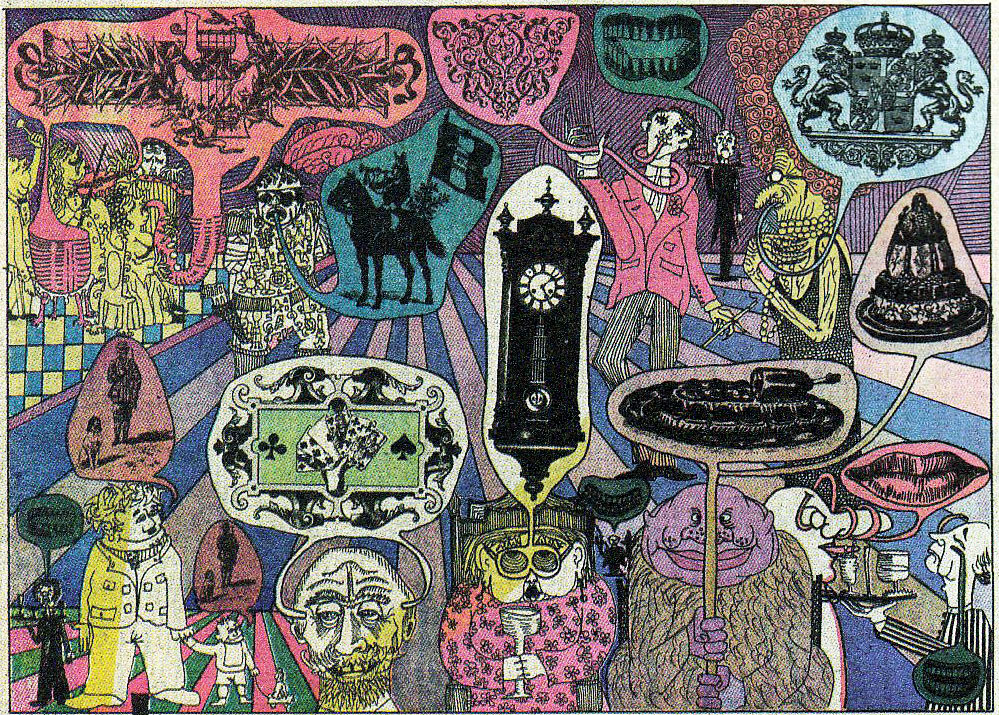
'Fabulas Panicas', 9 July 1967, drawn by Alexandro Jodorowsky.
Alejandro Jodorowsky is a Chilean film director, best known for his surreal cult movies 'El Topo' (1970) and 'The Holy Mountain' (1973). The pictures launched the "midnight movie" phenomenon, while simultaneously establishing him as an icon of counterculture cinema. However, Jodorowsky was active in many different artistic disciplines, including poetry, novels, plays, music, painting, sculpting, puppeteering and also comics. As an artist, he drew one series, the weekly comic 'Fábulas Pánicas' (1967-1973), printed in El Heraldo de Mexico. As a comic writer, he was far more prolific, collaborating with various European and Latin-American artists on realistically-drawn science fiction or historical fiction series. His most praised SF creation is the "Jodoverse", comprised of his comic 'L'Incal' (1980-1988), drawn by Jean Giraud, and its various spin-offs, like 'La Caste des Méta-Barons' ('The Saga of the Meta-Barons', 1992-2003), drawn by Juan Giménez, and 'Les Technopères' ('The Technopriests', 1998-2006), drawn by Zoran Janjetov. Recurring themes in Jodorowsky's work are mysticism, spiritual liberation and the quest for the inner self. Many of his comics follow intriguing stream-of-consciousness thought experiments, which have polarized readers, but also rank among the most fresh, original and challenging stories ever put on paper. Alejandro Jodorowsky is one of the few famous live-action film directors to have created comics in their career, along with Jan Bucquoy, Damiano Damiani, Don Dohler, Federico Fellini, Terry Gilliam, David Lynch, Dick Maas, Robert Rodriguez and Frank Tashlin.


'L'Incal' and 'La Caste des Méta-Barons'.
Early life and career
Alejandro Jodorowsky Prullansky was born in 1929 in Iquique, Chile, as the son of Jewish-Ukrainian immigrants. His parents ran a shop in Tocopilla, but in 1939 moved to the town of Quinta Normal. Jodorowsky's older sister Raquel Jodorowsky (1927-2011) became well-known in adulthood as a poet. Despite the family's Jewish roots, Jodorowsky's father Jaime was a staunch Communist and thus also an atheist. He hid his background, since many people in Chile were very antisemitic and suspicious of Communism. Jodorowsky only learned he was Jewish at age 13. His father was additionally very rational-minded, believing that work was important and all artists were time-wasting "pansies". Jodorowsky's interest in art, spiritualism and esoteric literature was born out of rebellion against his upbringing. After divorcing, Jodorowsky's parents left their children in the care of their grandparents.
Interviewed by Elianna Kan for The Paris Review (8 March 2018), Jodorowsky reflected why all his work revolves around spiritual change: "The universe is changing, the universe is expanding. Everything is constantly changing. So when a human being remains unchanged, like a rock, clinging to what he or she is throughout an entire lifetime, it’s a tragedy. A human being has to be fluid, changing, expanding, developing, and at any given moment, has to ask, Why am I suffering? Why does this bother me? Why am I searching for something? Why do I hate such and such thing? Why can’t I forgive and why can’t I liberate myself from this? All of my work is that, it’s the development of a character who slowly but surely expands, self-actualizes, and reaches a higher spiritual level. My characters obtain wisdom. To arrive at such wisdom is to arrive at the joy of living."
Jodorowsky went to boarding school, sharing his sister's interest in literature, while simultaneously being intrigued by film, puppetry and pantomime. He ranked Vicentre Huidobro, Gabriela Mistral, Pablo Neruda and Nicanor Parra among his favorite poets. His favorite artists were film director Luis Buñuel, poet/film director Jean Cocteau and painter Leonardo da Vinci. Interviewed by Tom Lennon (Borderline, 2002), Jodorowsky said that as a child he enjoyed comics like Hal Foster's 'Prince Valiant', Lee Falk's 'Mandrake the Magician', Alex Raymond's 'Flash Gordon', E.C. Segar's 'Popeye', Harold Gray's 'Little Orphan Annie' and Dick Calkins' 'Buck Rogers'. He particularly fell in love with the 'Prince Valiant' character Aleta. At age 14, he was mesmerized by Will Eisner's 'The Spirit'. Later in his career, he also expressed admiration for Steve Ditko, Moebius, Jack Kirby, Katsuhiro Otomo, Jim Steranko and Goseki Kojima's 'Lone Wolf and Cub'. When Lennon asked with whom else he would like to create comics, Jodorowsky answered: "There are four artists that I admire, and with whom I would like to work together, however, since they are sometimes artists and writers, they do not need me for anything. The deceased Harold R. Foster. The super neurotic [Robert] Crumb. The classical Stan Sakai. The profound Will Eisner. Four genii!"
Alejandro Jodorowsky studied philosophy and psychology at the University of Chile, dropping out after two years. In 1953, he went to Paris, where studied mime and, again, philosophy at the Sorbonne University. At age 26, he broke with his family and never saw them again. In adulthood, Jodorowsky meditated with the Zen teacher Ejo Takata for five years. Between late 1965 and 1974, he spent most of his time in Mexico, to the point that many people still incorrectly assume Jodorowsky was of Mexican nationality, instead of Chilean. In 1980, he naturalized himself as a French citizen. Throughout his career, Jodorowsky has explored almost every art form possible, having worked as, in alphabetical order, an actor, clown, comic writer, composer, costume designer, draughtsman, essayist, film director, film editor, mime, musician, novelist, painter, philosopher, playwright, poet, producer, psychoanalyst, psychologist, puppeteer, screenwriter, sculptor, spiritual guru, storyteller and theater director.
Theatrical career
At age 18, Jodorowsky and a friend established their own pantomime group, Teatro Mímico. While studying at the University of Chile in 1950, he also established an experimental puppet theater, TEUCH (Teatro Experimental de la Universidad de Chile). In 1953, while living in Paris, Jodorowsky was an apprentice of the famous mime Étienne Decroux. He also joined Decroux' even more famous pupil, Marcel Marceau, and toured with his mime collective. After resuming his Philosophy studies at Sorbonne University, Jodorowsky went to Mexico, where he worked as a mime teacher, starting in 1959. One of future famous pupils was Sergio Aragonés. Aragonés didn't particularly want to become a mime, but was interested in Jodorowsky's course because he wanted to know more about movement, which he could be inspirational for his comics and cartoons.
In February 1962, Jodorowsky became co-founder of the innovative "Mouvement Panique" ("Panic Movement"), along with Fernando Arrabal, Olivier O. Olivier, Jacques Sternberg, Christian Zeimert, Abel Ogier and Roland Topor. The collective rejected the commercialization of surrealism by staging many strange but provocative plays. In 1973, Jodorowsky dissolved the group.
Early film career
While studying in Paris, Jodorowsky made his first film. Based on the 1940 Thomas Mann novel 'Die Vertauschten Köpfe', the short film 'Les Têtes Interverties' (also known as 'La Cravate', 1957) was made entirely in pantomime and featured Jodorowsky and Belgian-French comedian Raymond Devos in starring roles. Contrary to his later work, it was a more conventional picture, yet it received praise from the famous poet, playwright, painter and film director Jean Cocteau who, to give the movie more publicity, wrote a prologue for it.
While in Mexico, Jodorowsky made his first professional film, 'Fando y Lis' (1967), based on a play by Fernando Arrabal and dealing with the destructive dependency between two lovers. Some of the shocking scenes with grotesque imagery sparked a riot during the premiere at the Acapulco film festival and Jodorowsky had to sneak out into a limousine. However, protesters recognized him and threw rocks at the car. As usual, the scandal attracted more attention to this avant garde film than might have been the case otherwise. Riots kept erupting during screenings and, between 1968 and 1972, the movie was banned in Mexico. In the United Kingdom, it was released under the different title 'Tar Babies'. In the eyes of the Mexican government, Jodorowsky was a subversive foreigner who needed to be kept under close watch, complete with a file kept in the Department of Intelligence. In February 1971, he was even imprisoned for a short while.

'Fabulas Panicas', 23 June 1968, drawn by Alexandro Jodorowsky.
Anibal 5
While living in Mexico City in the mid-1960s, Jodorowsky made his earliest steps in the world of comics. This career choice was marked by necessity. Due to censorship, he found it increasingly difficult to make a living as a playwright and film director. Through the journalist Luis Spota, who edited the cultural section of the newspaper El Heraldo de México, Jodorowsky was able to earn his bread as a comic writer. For artist Manuel Moro, he scripted the science fiction comic 'Aníbal 5' (1966-1967), serialized in El Heraldo de México. The humorous plot centers on the cyborg Anibal 5, whose physical looks were modeled after actor Jorge Rivero. Working for the European Defense Agency, Anibal has to fulfill many strange commissions, but is only interested if it satisfies his inexhaustible libido. Partially inspired by Jean-Claude Forest's similar erotic SF comic 'Barbarella', 'Anibal 5' was closer to the parody tradition of Mad Magazine. Six comic books were released by publishing company Temporae. Three decades later, Jodorowsky relaunched 'Aníbal 5' (1990-1992) with a different artist, George Bess, at the French publishing house Les Humanoïdes Associés.
Fábulas Pánicas
For the same newspaper, Jodorowsky also drew a comic of his own, 'Fábulas Pánicas' ("Panic Fables", 1967-1973). The stories were basically plots either inspired by the plays he wrote for the Panic Movement, or scripts he couldn't stage. The first episode was printed on Sunday 4 June 1967 in the cultural supplement of El Heraldo de México. Originally, Jodorowsky planned just one story, which would be serialized for three months. Unexpected success enabled him to continue the comic's weekly run for six-and-a-half years. Each episode is a one-page story, drawn by Jodorowsky in a rudimentary style, sometimes including photo collage elements. Not all episodes were drawn and colorized by Jodorowsky alone, though. Sometimes he passed the pencil to his young sons Brontis and Axel, while other episodes were drawn by Pablo Leder, an actor and assistant-director in many of Jodorowsky's plays and films. This explains why the signatures tend to vary. Some episodes are credited to "Alexandro", "Alejandro" or just "Jodorowsky".
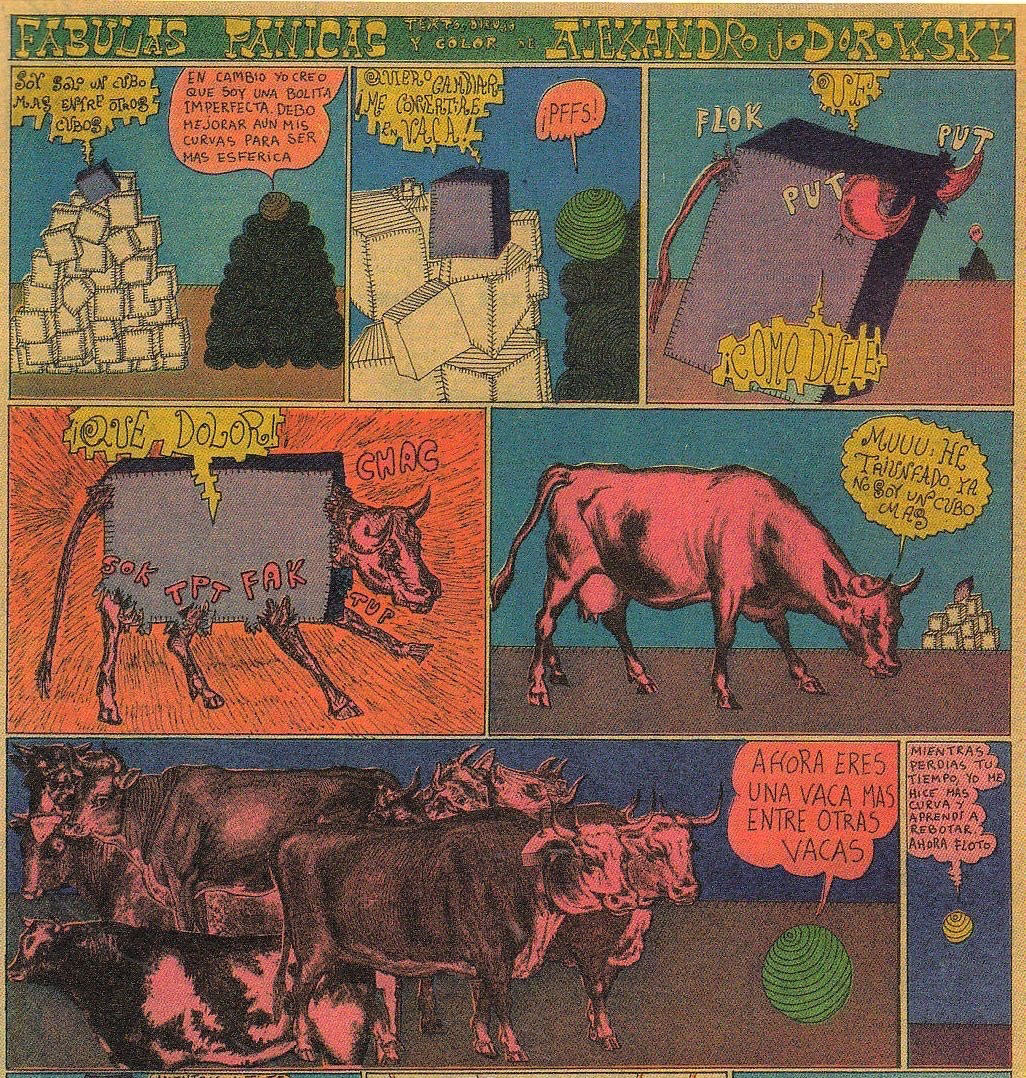
'Fabulas Panicas', drawn by Alexandro Jodorowsky.
Creating the strip when he was very depressed, 'Fábulas Pánicas' was a way for Jodorowsky to raise his spirits and give his readers a positive outlook. Some episodes are surreal and mystic, covering themes from Zen Buddhism, existential philosophy and "sacred" symbolism from Tarot and astrology. True to the psychedelic era in which they were created, the narratives lead to a trippy atmosphere. Other episodes are thought-provoking, visualizing aphorisms and reflecting on the way of the world. Jodorowsky sometimes even toyed with the medium itself, adding a metafictional experience. Given the fact that Mexico was a dictatorship in the late 1960s and early 1970s, and El Heraldo a very right-wing conservative paper, it is all the more remarkable that the otherwise blacklisted playwright and film director was allowed to express such free-spirited views for such a long period of time.
During the strip's run, around 342 pages appeared in El Heraldo, though 58 of these were reprints. Often, Jodorowsky drew himself in the comic: first as an apprentice asking guidance from a guru, later as the guru himself. On 30 December 1973, the final episode of 'Fábulas Pánicas' appeared in print. In 1977, all episodes were collected in book format by Editorial Novaro, and a reprint came about in 2003. While 'Fábulas Pánicas' has its own DIY charm, Jodorowsky never drew his own comics again afterwards. Interviewed by Jay Babcock for L.A. Weekly (1 January 2004), he stated: "I do comics because I think it’s an art form as big as movies or painting or poetry. The graphic novel is a fantastic thing for me. For four or five years every Sunday I drew a comics page, a complete story. But it was very basic. When I saw Moebius making the drawings, I stopped. And I never make any more. Moebius, Boucq, Bess, Juan Giménez, Beltran - they're geniuses. How can they draw like that? It is a miracle. When you see a painting by Travis Charest? He's incredible... some kind of a monster!"
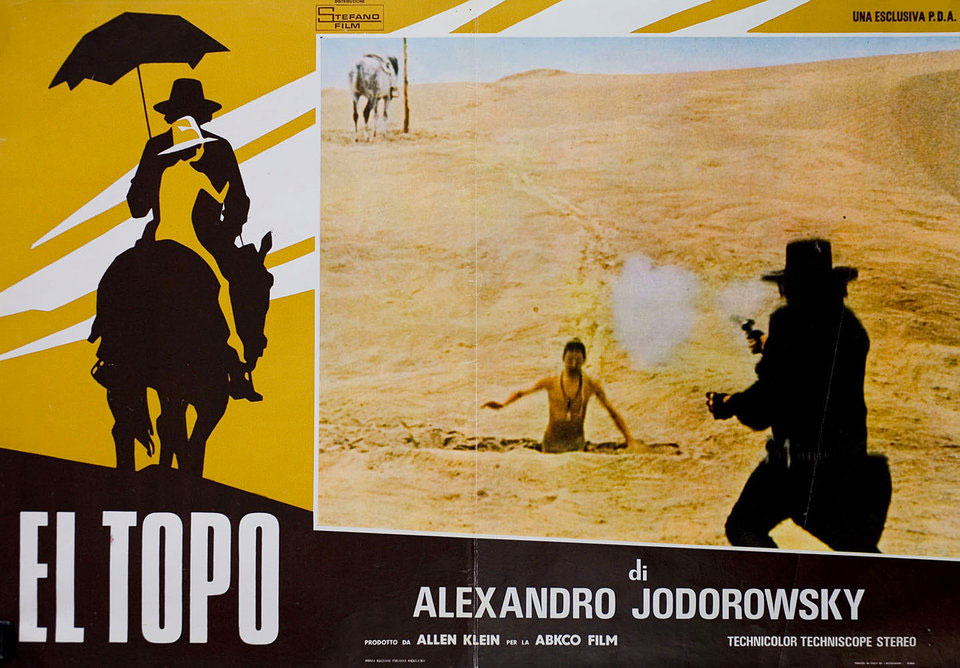
Italian film poster for 'El Topo'.
El Topo
Jodorowsky made his name with his second film, 'El Topo' (1970). Described as an "acid western", it follows a very loose plot. A cowboy dressed in black (played by Jodorowsky himself) roams through the Mexican desert, taking his nude son (played by his real-life son Brontis) with him. He encounters many bizarre people, ranging from a sadistic colonel to real-life amputees. Many surreal and shocking events follow, almost reminiscent of what a heat stroke in the desert might feel like. Jodorowsky added all of his pet peeves, from Zen Buddhism to Mexican shamanism. He deliberately cast unknown people, out of dislike for Hollywood stars who constantly play the same part and whose famous faces always distract from their performance. He also refrained from typical Hollywood plots, which predictably revolve around heroes who don't want to fight, get forced into a conflict and then act revenge in the final act and "win". 'El Topo' is difficult to describe in words, but in Jodorowsky's opinion, this is part of its strength: it can be interpreted in many different ways. Despite a low budget, everything was shot in splendid color, with an atmospheric soundtrack.
To give the film more media attention, Jodorowsky deliberately made outrageous claims in interviews and press conferences, most of which were either blatant lies, or tall tales with a small element of truth in them. Unsurprisingly, 'El Topo' flopped, since it was too incomprehensible and offensive for mainstream viewers. However, its subversive, erotic, violent and blasphemous tone fit perfectly within the countercultural movement. Even in the field of independent cinema, it was as anti-Hollywood as one could get. The mystic and occult themes appealed to youngsters in search for the inner self. Above all, the trippy imagery made it a perfect stoner movie, almost like an LSD trip. Savvy theatre owners decided to market 'El Topo' in a different, unprecedented way. Each screening was programmed around midnight, giving the film a more mysterious "underground" appeal. It helped 'El Topo' build up a cult reputation and become the first official "midnight movie". Movies specifically programmed in theaters at late hours had existed before: 'Night of the Living Dead' (1968) and '2001: A Space Odyssey' (1968) were marketed to tingle the curiosity of viewers interested in something otherworldly. But 'El Topo' turned midnight movies into a phenomenon. Curious teenagers and young adults gathered together in theaters, united in their unconventional taste, some even dressing up for it. More unusual movies were programmed at 12 AM, like John Waters' 'Pink Flamingos' (1972), Doug Henzell's 'The Harder They Come' (1973), Jim Sharman's 'The Rocky Horror Picture Show' (1975), David Lynch's 'Eraserhead' (1978), but also older pictures like Tod Browning's 'Freaks!' (1932). Several films that didn't do well on their initial release, now found an audience. Devoted fans kept coming back for repeat viewings.
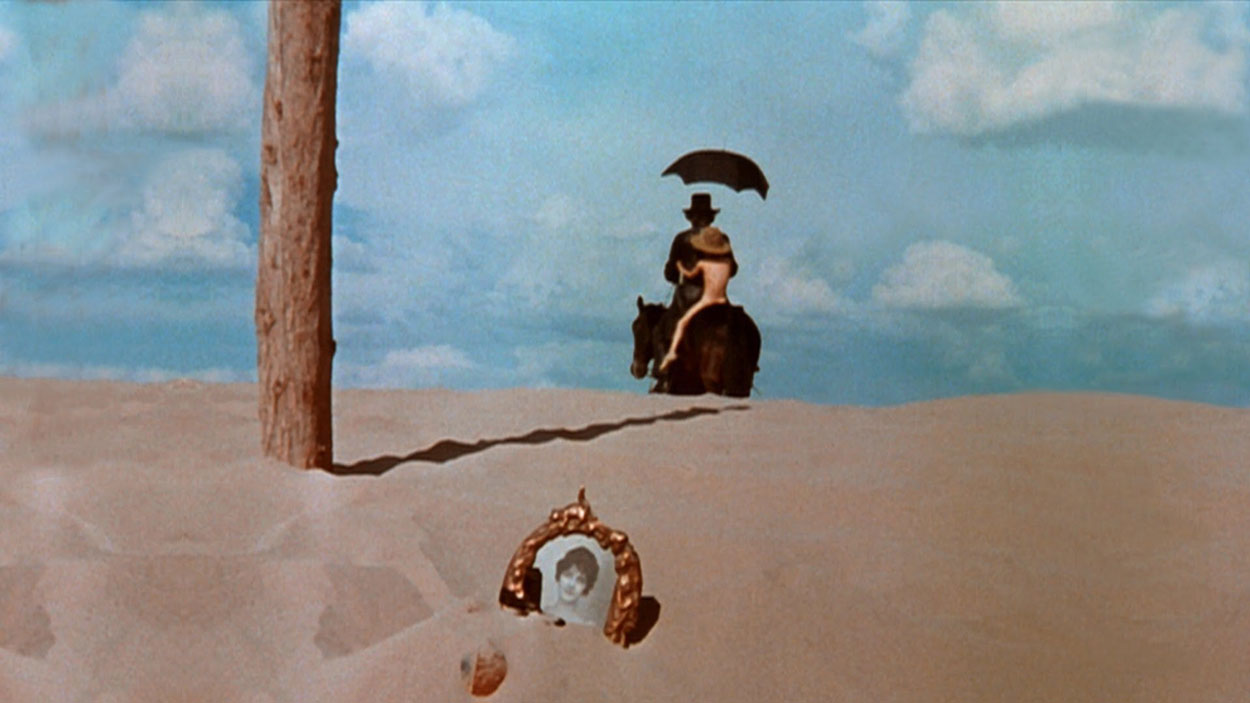
Still from 'El Topo'.
'El Topo' attracted celebrity fans like pop musicians John Lennon & Yoko Ono, George Harrison, Bob Dylan, Roger Waters (Pink Floyd) and actors Dennis Hopper and Peter Fonda. Peter Gabriel's plot of the Genesis concept album 'The Lamb Lies Down On Broadway' (1974) was loosely inspired by 'El Topo'. In later decades, musicians Marilyn Manson, Cedric Bixler-Zavala & Omar Rodríguez-Lópza (The Mars Volta), Kanye West and Erykah Badu also expressed admiration. Jodorowsky recalled that underground comix artist Spain Rodriguez corresponded with him and drew his own homage to 'El Topo'. Lennon declared 'El Topo' his "favorite movie of all time", and convinced Beatles manager Allen Klein to buy the rights to screen the picture in bigger theaters. Predictably, it only lasted a week, before the film returned to midnight movie theaters again.
'El Topo' has remained a cult classic, cemented by its inclusion in Danny Peary's standard book in the field, 'Cult Movies' (1981). Part of the film's enduring reputation was that it wasn't commercially available on home video for decades. In the mid-1970s, Allen Klein insisted that Jodorowsky would adapt Pauline Réage's erotic novel 'Histoire d'O.' into a feature film, which he refused (a movie version did come about in 1975, albeit directed by Just Jaeckin). Out of revenge, Klein kept 'El Topo' out of circulation for decades. Anyone who wanted to see it had to find a movie theater that screened it. A laser disc was released in Japan in the 1980s, but with several scenes censored. Eventually, in the mid-2000s, Klein's son organized a meeting between his father and Jodorowsky. At first, Jodorowsky feared a violent confrontation, but when both men saw each other after all those years, they were surprised and charmed that both were now old, white-haired men. Interviewed by Steve Rose for The Guardian (14 November 2009), Jodorowsky revealed: "My father was a monster. And all the hate I had for my father I put into Allen Klein. Allen Klein hated his father also. For him I was his father and for me he was my father." Having buried the hatchet, 'El Topo' finally received its official, uncensored DVD release in 2007.
Jodorowsky always wanted to create a sequel to 'El Topo' and at one point considered shock rock musician Marilyn Manson for the starring role. Jodorowsky and Manson were good friends and the director even officiated the singer's wedding to Dita Von Teese in 2005 (the couple divorced three weeks later). However, the project remained in development hell. In 2016, Jodorowsky adapted the script into a comic book, 'Les Fils d'El Tope' ('Sons Of El Topo', 2016), illustrated by Mexican artist José Ladronn. Split into two volumes, it focused on the wife and the two sons of the protagonist from the film.
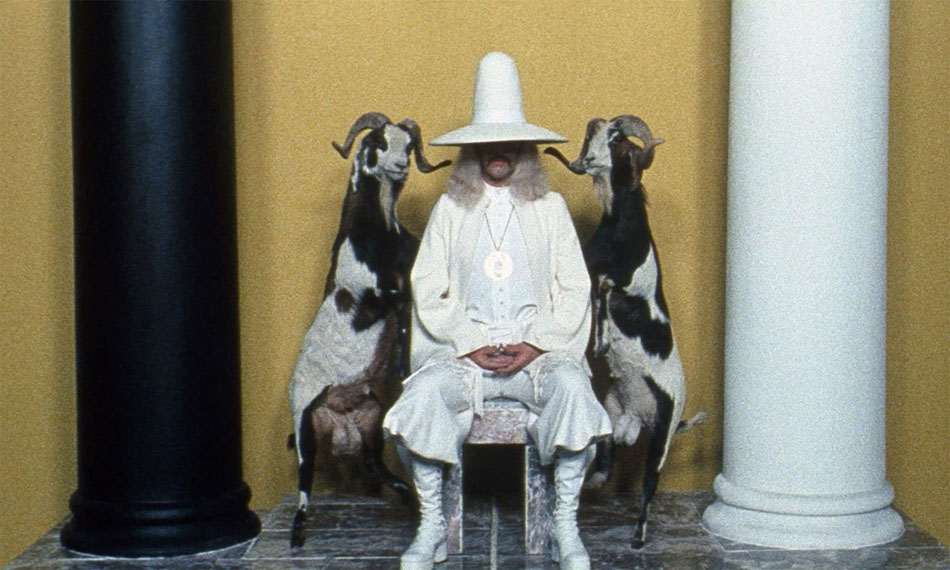
Still from 'The Holy Mountain'.
Later film career
Throughout his career, Jodorowsky created other polarizing films, such as the mystical and mind-boggling 'The Holy Mountain' (1973), which was partially funded by Allen Klein, John Lennon and Yoko Ono. The loose plot follows a thief and his seven spiritual advisors who want to climb a holy mountain in search of spiritual enlightenment. The thief is guided by an alchemist, played by Jodorowsky himself. Originally, George Harrison wanted to play The Thief, but he objected to a scene where an alchemist would clean his anus next to a real-life hippopotamus. Interviewed by Camilo Savalas for Vice (17 March 2015), Jodorowsky recalled trying to convince the former Beatle to do it, "to show the youth that you don't have such a strong ego", but Harrison still pulled out of the project. The final scene was filmed on top of a real Mexican mountain. Since a storm was coming, everybody told Jodorowsky to climb back down. But he wanted to finish his picture and so came up with its famous twist ending on the spot, just to be able to wrap everything up quicker. With a slightly higher budget and more satirical themes, 'The Holy Mountain' became another cult classic.
The 1980s brought forth 'Poo Lorn L'Elephant' (appearing in English as 'Tusk', 1980) and the cult horror film 'Santa Sangre' (1989). The latter movie was partially inspired by Jodorowsky's real-life meeting with journalist Goyo Cárdenas, who confessed that he had been a serial killer in the past and served 10 years in an institution before finally finding a stable family life. In 1990, Jodorowsky directed 'The Rainbow Thief' (1990), which could afford stars like Peter O'Toole, Omar Sharif and Christopher Lee, but disappointed long-time fans by being more conventional.
It took two decades before Jodorowsky had enough funds to create new films. 'La Danza de la Realidad' ('The Dance of Reality', 2013) and 'Poesía Sin Fin' ('Endless Poetry', 2016) marked a return to his old form. 'La Danza de la Realidad' reflected on his troubled relationship with his late father, and 'Poesía Sin Fin' looked back at the years when he was a young rebellious artist in Chile. The latter film was made with crowdfunding through Kickstarter. Jodorowsky always felt that artistic integrity is better than profits. In his opinion, he'd rather make an experimental film and lose money than compromise and have a box office hit.
Dune
By 1976, Jodorowsky was trying to adapt Frank Herbert's epic sci-fi novel 'Dune' into a movie. H.R. Giger, Chris Foss and Moebius designed sets and characters, Dan O'Bannon provided special effects and casted for major roles were David Carradine, Mick Jagger, Gloria Swanson, Salvador Dalí, Amanda Lear and Orson Welles. The soundtrack was to be composed by Pink Floyd and Magma. This ultimate geek's wet dream was however never realized, and most of the budget was spent on pre-production. In 1984, the picture was eventually directed by David Lynch, but with different contributors. Over the years, Jodorowsky's version of 'Dune' acquired a mythical status, sparking many people's imagination of what this film could have been. In 2013, a documentary, 'Jodorowsky's Dune', brought many previously unseen storyboards and photographs to the forefront. Jodorowsky was also interviewed for this documentary, openly speaking his mind about the past events and the film industry in general. However, if anything came from Jodorowsky's failed project, it was the start of his fruitful team-up with Moebius, the experimental alter ego of the French comic artist Jean Giraud.


Book covers for 'Anibal 5' and 'Les Yeux du Chat'.
Les Yeux du Chat
After their first collaboration on 'Dune', Jodorowsky and Moebius continued working together on comic projects, starting with 'Les Yeux du Chat' ("The Eyes of the Cat"). In March 1978, this first joint creation originally appeared in the free, promotional premium "Mistral" story collection of the publishing house Les Humanoïdes Associés. Later, the publisher released it in book format. This dark fable centers on a young blind boy who commands the eagle Méduz to find "cat's eyes" for him. The comic is unusual in the sense that most of the plot is told without dialogue, using only two basic colors: black and yellow. All action is presented through a tall, narrow rectangular panel. By framing all action through this minimalistic means, the reader is limited in what he can see, just like the blind boy. The experimental comic has a poetic feel, which stays with the reader long after they have put the book away.
The Incal
In December 1980, Jorodowsky and Moebius's collective masterpiece 'L'Incal' started serialization in Métal Hurlant, the sci-fi/fantasy comic magazine of Les Humanoïdes Associés. Set on the dystopian planet Terra 21, the plot follows private investigator John Difool, who flies around on a huge seagull named Deepo. One day, Difool receives a mysterious crystal named the "Light Incal". The object holds phenomenal powers, forcing Difool to keep it out of the clutches of people and organizations who want it for themselves. Among them are the Bergs, bird-like creatures from another galaxy. Other rivals are the corrupt government of Difool's home city, a rebellious group named Amok and a cult-like group of priests named The Technopriests, who see elaborate technology as beneficial to society. Animah and her sister Tanatah, keepers of the Light Incal, befriend Difool and try to keep the object in safe hands. On their tails is the Metabaron, a bounty hunter from noble origins. Six volumes were released by Les Humanoïdes Associés under the banner 'Une Aventure de John Difool'.
In many ways, 'The Incal' is a strange comic, taking the reader along on unexpected twists and turns in the character's personalities, physical and mental essence. The stories are also a partial satire of our own modern society. Jodorowsky's inspiration came from a dream in which he floated in space between two pyramids, imagery that Moebius evoked in the comic too. Other strong influences were Mickey Spillane's detective novels, especially 'Kiss Me Deadly'. The authors made John Difool an anti-hero, who is fond of cigars, whiskey and robotic prostitutes and actually not so keen on being given the responsibility over the Light Incal. Jodorowsky's interest in tarot gave the protagonist his name, naming him after "The Fool". Jodorowsky credited Moebius with helping him write stream-of-consciousness tales without relying on drugs. He also praised the artist for evoking the dystopian world of 'L'Incal' in beautiful artwork, bringing all of Jodorowsky's interests together on an epic scale, dubbed the "Jodoverse". Moebius disciplined himself to complete one page a day, skipping over preliminary sketches to instantly start putting his drawings into ink.


Book covers for 'John Difool' and 'Castaka'.
Incal spin-offs and other Jodoverse series
Building on the foundations of 'L'Incal', Jodorowsky launched several spin-off series. A prequel series, also scripted by Jodorowosky, but drawn by the Serbian artist Zoran Janjetov, was later released under the title 'Avant L'Incal' ('Before the Incal', 1988-1995). A tale of corruption and conspiracy, it told the traumatic backstory of protagonist John Difool and his dystopian home. In the sequel 'Après L'Incal' ('After the Incal') a deadly metallic virus threatens to eradicate all organic life in the universe, with the only hope for saving humanity is John Difool. Jodorowsky and Moebius released the first volume of 'Après L'Incal' in 2000, after which the cycle was reworked and completed with two more installments drawn by José Ladrönn in 2011 and 2014. Ladrönn also provided the artwork for the final cycle, 'Final Incal' (2008-2014), which told the same events from 'Après L'Incal', but from a different viewpoint.
In the series 'La Caste de Meta-Barons' ("The Saga of the Meta-Barons", 1992-2003), the Meta-Barons received their own story arc, giving it the allure of a family saga. Published in eight books by Les Humanoïdes Associés, the artwork was provided by the Argentinian artist Juan Giménez. More cycles followed to complete the trilogy: two books of the prequel 'Castaka' were drawn by Das Pastoras in 2007 and 2013, while Travis Charest and Zoran Janjetov provided the art for the one-shot 'Les Armes du Méta-Baron' ("Weapons of the Metabaron", 2008). The Technopriests from 'L'Incal' also received a spin-off series: the eight-volume 'Les Techno-Pères' (1998-2006), scripted by Jodorowsky, drawn by Zoran Janjetov and colorized by Fred Beltrán. The leader of the priests, Albino, is accompanied by the small mouse Tinigriffi on a large Technopriest exodus, searching for truth and meaning in a technologically advanced, but cold, inhuman environment.
Also considered part of the "Jodoverse" is the science fiction series 'Megalex' (1999-2008), published in three albums by Les Humanoïdes Associés. Although 'Akira' artist Katsuhiro Otomo was Jodorowsky's first choice as artist, the series was eventually drawn by the young computer-savvy Fred Beltrán. Also following familiar Jodorowsky themes of "nature versus technology", the title refers to a huge industrial city planet, where the ruling elite is able to live for 400 years, while their royal family can even stretch this out to 4,000 years. Ordinary people are oppressed by cloned police officers, and to keep the masses under control, drugs are spread around on government orders. In the old tunnels underneath Megalex, plans are made for a rebellion.
Starting in 2015, Les Humanoïdes Associés and its international imprint Humanoids, Inc. have released new "Jodoverse" comics scripted by other authors. Between 2015 and 2022, Jerry Frissen wrote 'Meta-Baron' (also known as 'Meta-Barons: Second Cycle'), starring the Meta-Baron from the original 'Incal' series. Artwork has been provided by Valentin Sécher, Niko Henrichon and Pete Woods. In addition, Frissen wrote the two-volume spin-off 'Simak' (2018), which had artwork by Jean-Michel Ponzio. With Jodorowsky well in his 90s, other writer/artist teams stepped in as well, such as Brandon Thomas & Pete Woods ('The Incal: Kill Wolfhead', 2021), Mark Russell & Yanick Paquette ('The Incal: Psychoverse', 2022) and Dan Watters & Jon Davis-Hunt ('The Incal: Dying Star, 2023).


Book covers for 'Les Technopères' and 'Alef-Thau'.
Métal Hurlant (Alef-Thau, La Saga d'Alendor)
In the groundbreaking sci-fi comic magazine Métal Hurlant and its American edition Heavy Metal, Jodorowsky found a fitting homebase for his fantasy creations. Between 1980 and 1986, he was a regular contributor to its pages, and again during the 2002-2004 relaunch. Its publishing house Les Humanoïdes Associés has released nearly every Jodorowsky comic since. After the launch of 'John Difool' with Moebius in late 1980, Jodorowsky teamed up with the artist Arno to create the heroic fantasy series 'Les Aventures d'Alef-Thau' (1982-1998). A limbless human, Alef-Thau learns that he can obtain arms and legs if he manages to find and defeat the tyrant Ner-Ramnus. This "physical and spiritual quest in eight hymns" was collected in eight volumes. When the original artist passed away, the final 1998 installment was drawn by Al Covial. Between 2008 and 2009, the spin-off series 'Le Monde d'Alef-Thau' was launched, drawn by Marco Nizzoli.
Remaining in the fantasy genre, Jodorowsky wrote the stories 'Le Dieu Jaloux' (1984) and 'L'Ange Carnivore' (1986), which were also serialized in Métal Hurlant. Drawn by Silvio Cadelo, they were later collected in book format under the title 'La Saga d'Alandor' by Les Humanoïdes Associés. With a plot difficult to summarize or even follow, the story references many ancient mythologies and J.R.R. Tolkien's novel 'The Silmarillion'. Generally regarded as one of Jodorowsky's less inviting series, the books are carried by Cadelo's magnificent artwork. Years later, Jodorowsky explored the same territory in a comic he made for the publishing house Dargaud, 'Aliot' (1996), drawn by Spanish comics veteran Victor de la Fuente. Aliot is the "child of darkness" who wanders around in a world ravaged by pestilence and leprosy, while many people want to destroy him. This comic was originally intended as a trilogy, but because of the similarities with 'La Saga d'Alandor' he was forced by Les Humanoïdes Associés to quit his project. This ended 'Aliot' with many unresolved plotlines, giving it an overall, messy impression.
When Métal Hurlant was relaunched between 2002 and 2004, Jodorowsky wrote several short stories for artists like Marc Riou & Mark Vigouroux, Igor Baranko, William III, Pascal Alixe, Christian Hojgaard, Jerome Opeña and Axel Medellin. These science fiction short stories were later collected in the book 'Astéroïde Hurlant' (Les Humanoïdes Associés, 2006).
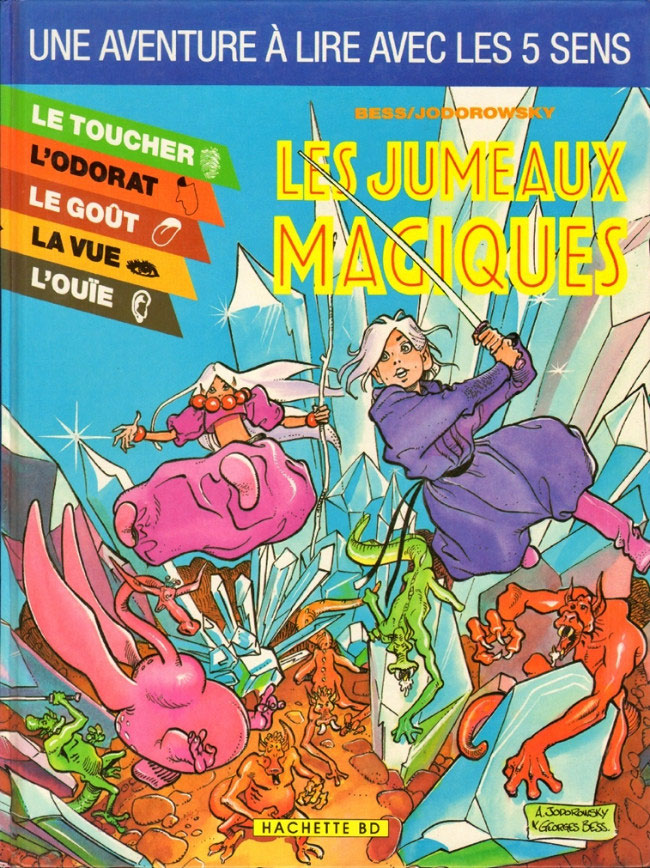

Covers for 'Les Jumeaux Magiques' and 'Le Lama Blanc'.
Collaborations with Georges Bess
While Moebius was perhaps Jodorowsky's main partner in crime, the avant garde scriptwriter also created several comics in collaboration with the artist Georges Bess. Their first joint creation was the children's story 'Les Jumeaux Magiques' (1986), serialized in Le Journal de Mickey. Set in a magic kingdom, the story centers on the princes Mara and Aram, who are informed that their father has been captured by the master of Darkness, Tartarath. A long journey starts, where the young boys have to cross the four forbidden islands in the North to rescue their father. To make the story more interactive, Le Journal du Mickey gave young readers small gadgets that stimulated their senses while reading, including scratch-and-sniff images that revealed certain smells (roses, garlic), a pair of red glasses to help "see" the secrets hidden in the comic panels, images with certain textures that one can touch and feel, a little audio recording that played a melody and two pieces of chocolate to taste. The tale was later published in book format by Les Humanoïdes Associés.
Jodorowsky's collaboration with this Disney magazine is remarkable, since he had a notorious hatred of Walt Disney. Interviewed by Hannah Lack (Dazed & Confused), he called Disney "a monster" and "perverter of children": "He made children idiots. He created many little idiots." In an interview with Bright Lights (2008), he stated the only director he hated more than Disney is Steven Spielberg, whom he referred to as "the son from when Walt Disney fucked Minnie Mouse."
After their children's comic, Jodorowsky and Bess collaborated further on the fantasy series 'Le Lama Blanc' ("The White Llama", 1988-1993), featuring the Dalai Lama reincarnated as a white child, Gabriel Marpa, in the Tibetan mountains. Many people are opposed to his elevation to Buddhism's highest leader, making his life journey not an easy task. 'Le Lama Blanc' was published in six volumes by Les Humanoïdes Associés and later recompiled into three reprint volumes by Glénat, under the new title 'La Légende du Lama Blanc' (2014-2017). Together with Bess, Jodorowsky additionally made 'Juan Solo' (1995-1999), another Humanoïdes series. Set in an undetermined South-American location, it follows the life story of a boy who was abandoned by his parents in a garbage can, but adopted by the transvestite dwarf Demi-Litre. Solo grows up in the slums, where he has to become violent and merciless to survive. Making a career in organized crime, Solo tries to find a way out of his miserable existence.
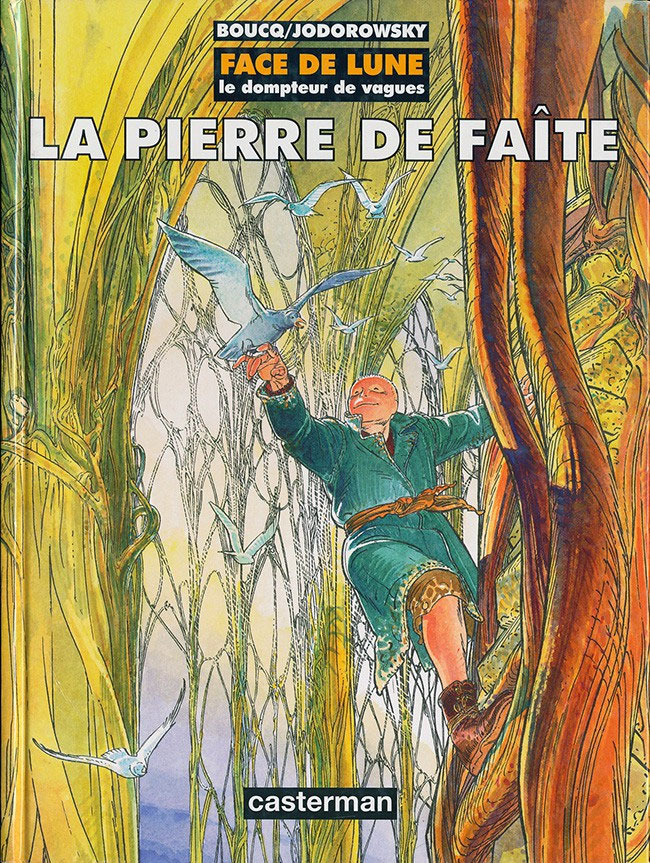
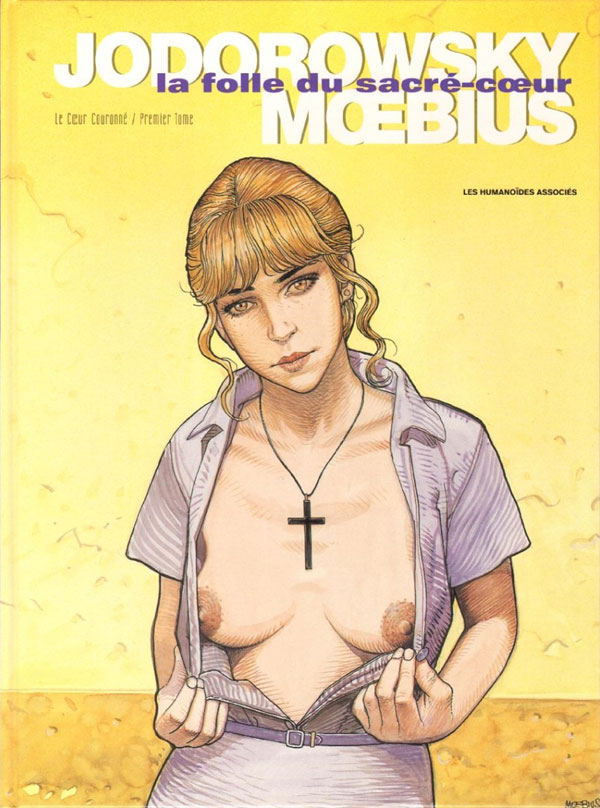
Book covers for 'Face de Lune' and 'La Coeur Couronne'.
The dangers of power
Even though Les Humanoïdes Associés was his regular publisher, Jodorowsky sometimes had excursions to other outlets. In the early 1990s, he appeared in (À Suivre), the comic magazine of the publishing house Casterman, with which ran 'La Cathedrale Invisible', the debut episode of 'Face de Lune', his first collaboration with the artist François Boucq. Yet another series mixing mysticism with fantasy, and where technology forms the core of a dystopian dictatorship, the title character "Moon Face" is a faceless humanoid capable of taming waves and matter. He becomes the center of a power struggle between religious aristocrats, anarchists from the sewers, and a religious counter-order, all stemming from family feuds. Three volumes were released by Casterman in 1992, 1997 and 2004.
Many of Jodorowsky's comics explored themes of mankind versus technology, revolutions and other power struggles. His collaboration with Jean-Claude Gal, 'La Passion de Diosamante' (Les Humanoïdes Associés, 1992) also delved into this territory. A queen whose people suffer from her cruelty, Diosamante will undergo an initiatory journey in search of her spirituality and her true self. The follow-up story 'La Parabole du Fils Perdu' (2002) had artwork by Igor Kordey. An additional Jodorowsky collaboration with Moebius was 'Le Coeur Couronné' (1992-1998), a mystical, philosophical and erotic adventure set against the backdrop of a South American revolution.
In collaboration with Milo Manara, Jodorowsky made the historical series 'Borgia' (2004-2010), based on the 15th-century Pope Alexander VI (Rodrigo Borgia) and his relatives Cesare and Lucrezia Borgia, who devised various schemes to grab and maintain power in the Vatican and Italian politics. The family saga offered Jodorowsky and Manara the perfect opportunity to delve into government corruption with a sleazy display of murder and sex. The first two volumes, 'Du Sang Pour Le Pape' (2004) and 'Le Pouvoir et L'Inceste' (2006) were published by Albin Michel, and the follow-ups 'Les Flammes du Bûcher' (2008) and 'Tout Est Vanité' (2010) by Drugstore. Jodorowsky continued his exploration of papal deviancy with the four-volume 'Le Pape Terrible' (Delcourt, 2009-2013), centering on 16th-century Pope Julius II and drawn by Theo Caneschi.


Book covers for 'Borgia' and 'Le Pape Terrible'.
Moral decay
In his comics, Jodorowsky didn't shy away from portraying mankind at its most cruel and violent. Sleaze formed the center of Jodorowsky's detective comic 'Gilles Hamesh' (1995), drawn by Michel Durand under the pseudonym "Durandur". Debuting in (À Suivre) but published by Les Humanoïdes Associés, it centers on the amoral private investigator Gilles Hamesh (a pun on the Mesopotamian mythological king Gilgamesh), who delves deep in disturbing cases, ranging from mutilated prostitutes to pedophile priests. The entire story is drenched in the stench of urban ugliness, visualized without any compromise in Durand's haunting and often icky images.
While Jodorowsky gained fame with the "acid western" 'El Topo', he only made one western comics series in his career: the unconventional and violent 'Bouncer' (2001-2023), drawn by François Boucq. The son of a prostitute and a Native American, the protagonist is a bouncer working in a saloon in Barrow City. Despite having only one arm, he is a steady marksman, tasked with keeping the staff safe. His older brother is a reverend, his younger brother an outlaw. The series kicked off with the bouncer investigating a series of strange murders in his town, who apparently all died from a "snake bite". After the eighth volume, Bouncer left Barrow City. Jodorowsky and Boucq collaborated on nine albums, seven of which were published by Le Humanoïdes Associés. After the eighth album, Glénat took over the series. Starting with the tenth album in 2018, Boucq has been writing the scripts himself.


Covers for the series 'Bouncer' and 'Pietrolino'.
Historical fiction
Another historical graphic novel was 'Pietrolino' (Les Humanoïdes Associés, 2007-2008), drawn by Olivier Boiscommun. Set in Paris during World War II, the mime Pietrolino is abused by Nazis who crush his hands, leaving him unable to perform his profession any longer. Pietrolino finds a new way, however, by using boxing gloves to accentuate his hand movements. Still, his hardships aren't entirely over. The title character is strongly inspired by famous mime Marcel Marceau (1923-2007), with whom Jodorowsky collaborated in the past, and who incidentally passed away around the time the two volumes of the graphic novel were released by Les Humanoides Associés. Jodorowsky originally wrote it for Marceau himself, whose father died in a Nazi concentration camp. Compared with Jodorowsky's trademark style, 'Pietrolino' shows a more sober, subdued way of storytelling.
Spiritual journeys
With Jean-Jacques Chaubin, Jodorowsky made 'La Vérité est Au Fond des Rêves' (1993), a collection of five short stories where dream and reality are interwoven. The book came about when Chaubin said to Jodorowsky that he would offer his soul for a story. Jodorowsky came up with five challenges that Chaubin had to visualize into tales. Chaubin was expected to (1) remember his first sexual dream, (2) remember a fear that addressed his emotions, (3) visualize an intellectual topic without formulating an idea, (4) draw a nightmare based on your digestion. After these fantasies had been captured, Jodorowsky told Chaubin that the final story should be something left completely to his own creativity, or, as Jodorowsky described it, an expression of the fear of being a free person. Although the short stories are presented as stand-alone tales, few have a clear ending and just continue on the next page, making the reader unsure which tale ended and which has just begun.

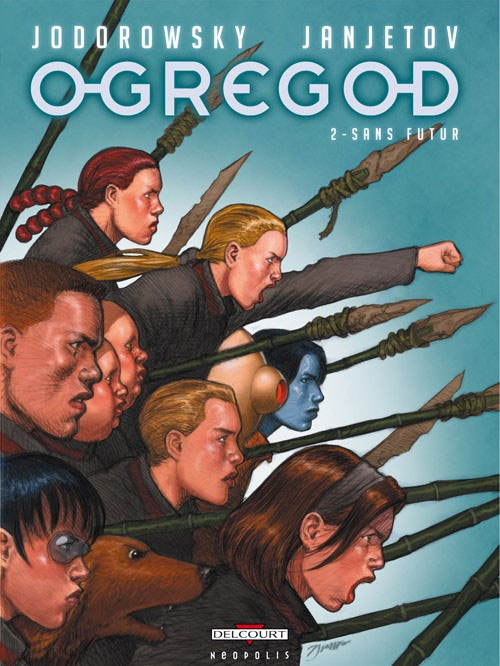
Book covers for 'Showman Killer' and 'Ogregod'.
Fantasy in the 21st century
Even when he was well in his eighties, Alejandro Jodorowsky set out for new collaborations during the 2010s, both with artists and publishers. With the Chinese comic artist Dongzi Liu, the writer returned to historical fiction in the four-volume heroic medieval fantasy series 'Sang Royal' (Glénat, 2010-2020). Alvar is a young and mighty ruler who is betrayed by his own nephew and left for dead. After coping with amnesia, he remembers his traumas and plans revenge. In 'Showman Killer' (Delcourt, 2010-2012), a three-volume science fiction comic Jodorowsky scripted for Nicolas Fructus, the reader follows a mercenary, trained in the lab of an irresponsible scientist to be an emotionless assassin. One day, the Showman Killer is tasked to find the murderers of the Omni queen. A servant gives him the newly-born crown prince, whom he decides to raise under the name Nee. With Zoran Janjetov, Jodorowsky had previously collaborated on 'Avant L'Incal'. In 2010, they joined forces again in 2010 to create another science fiction story, 'Ogregod' (Delcourt, 2010-2012). The story is set on a spaceship, Sloughi, where eight heirs of the most powerful families in the Galaxy plan a voyage through space. However, tensions rise and escalate into arguments and fights, made worse when Sloughi crashes on an unknown planet.
Literary career
Since the 1980s, Jodorowsky wrote five novels, originally published in French by Flammarion, Acropole and Éditions AM Métailié: 'Le Paradis des Perroquets' (1984), 'Enquête sur un Chemin de Terre' (1988), 'L'Arbre du Dieu Pendu' (1996), L'Enfant du Jeudi Noir' (2000) and 'Albina et les Hommes-chiens' (2001). They later received translations in English, German, Italian, Portuguese and Spanish. His debut novel 'Le Paradis des Perroquets' received the Grand Prix de l'Humour Noir (1984). In addition, Jodorowsky has released storybooks with fables and several poetry collections.
Recognition
In 1990, Alejandro Jodorowsky was named an Officer in the French Ordre des Arts et des Lettes. In that same year, an asteroid was named after him. On 27 April 2006, he was honored with the Pablo Neruda Order of Artistic Achievement. At the 1996 Comic Festival of Angoulême, his 'Juan Solo' comic received the award for "Best Humorous Script". The Spanish edition of 'Le Coeur Couronné' ('El Corazón Coronado') was bestowed with the Haxtur Award (2001) at the International Comic Festival of Asturia, along with another Haxtur Award for his entire career. The 'Bouncer' story 'La Pitié des Bourreaux' received the Prix Éléphant d'Or (2006) for "Album of the Year", while the story 'La Vengeance du Manchot' in the same series received a Prix Albert Uderzo (2006).
Legacy and influence
Alejandro Jodorowsky remains one the all-time enigmatic cult figures, a multitalented creator whose films, plays, poems and comics crossed boundaries, challenged audiences and dared to be art for art's sake. His interest in mysticism, occultism, spiritual journeys and rebirth is a running thread through most of his work. Operating in a dream-like stream of consciousness, his stories can sometimes follow a tight narrative structure or go completely off the rails into surreal, incomprehensible ways. Critics have sometimes faulted Jodorowsky for wandering off too much on the latter path. However, nobody has ever denied that his work is always innovative and surprising, and has inspired many creative souls to think in different ways about what their work can be.
As a film director, Jodorowsky influenced Darren Aronofsky, Guillermo Del Toro, Samuel Fuller, David Lynch, Nicolas Windig Refn, Kiril Serebrennikov and Taika Waititi. The Canadian comic artist Dave Cooper credits Jodorowsky's films with inspiring him to move away from realistic narratives into more surreal stories, directly influencing his graphic novel 'Suckle'. In 'Viaje a Tulum' (1986), scripted by Federico Fellini and drawn by Milo Manara, Jodorowsky appears as a character.
Even in old age, Jodorowsky has remained passionate about life and being creative. He refused to let his advanced age stop him. Interviewed by Camilo Savalas for Vice (17 March 2015), when he was 86, he stated: "As you live you find yourself caught in life, which is why you dream, invent, all these things, but little by little your teeth start falling out, your hair, hemorrhoids appear, your skin itches, and you start to say, “Well, on this side I have old age, and on this side I have death” [places each hand on either side of head]. I have these two ladies [indicating his hands]. You have one foot in the abyss, so the art you’re doing becomes much more personal, deeper. Let’s talk about things how they are this time without disguising them."
Alejandro Jodorowsky is the father of stage actor and director Brontis Jodorowsky (b. 27 October 1962), of actor, writer, painter and playwright Axel Jodorowsky (24 July 1965-15 September 2022), and of musician, director and actor Adán Jodorowsky (b. 29 October 1979). His granddaughter is the actress, singer and fashion model Alma Jodorowsky (b. 26 September 1991).
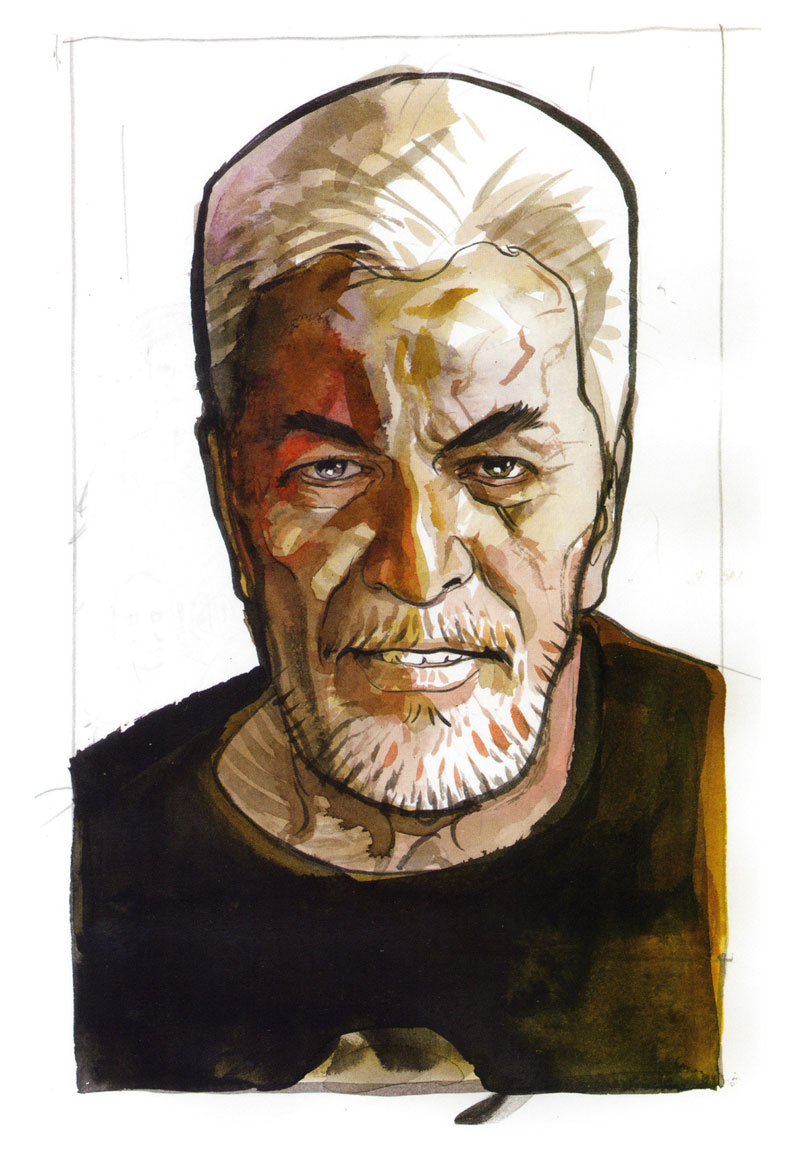
Jodorowsky by Moebius (2008).