


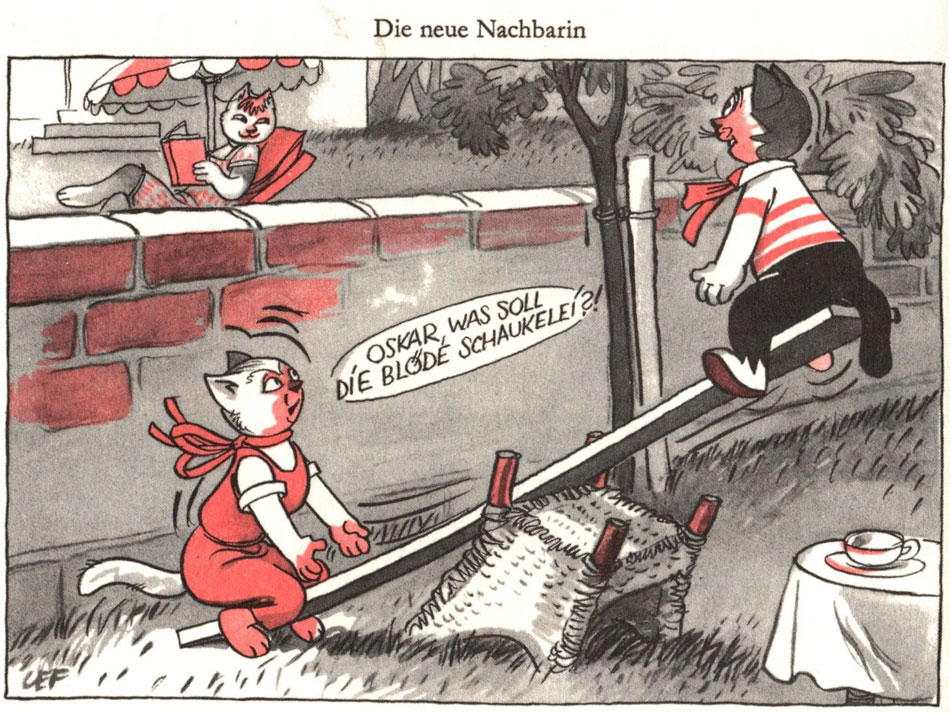
'Oskar der Familienvater'.
Carl E. Fischer, also known as "Cefischer", was a German cartoonist, illustrator and poster artist, active in the Frankfurt region. For many years, he was an artist and art editor with the Frankfurther Illustrierte, which also ran his best-known creation, the anthropomorphic family comic 'Oskar der Familienvater' (1952-1962). Generally seen as one of the most famous serialized comic features in post-war Germany, the comic also inspired book collections and merchandise. On top of that, the cartoonist Cefischer was especially notable for his dedication to his craft: after losing both his arms during an air strike, he taught himself how to draw with his mouth. Carl E. Fischer the cartoonist should not be confused with the Danish painter Carl Fischer (1887-1962).
Early life and career
Carl Ernst Fischer was born in 1900 in the Bornheim district of Frankfurt, where he lived his entire life. After attending the School of Applied Arts, he began his career in the early 1920s working as a commercial artist. From the mid-1920s on, he contributed artwork to several illustrated magazines, for instance Fliegende Blätter and Lustige Blätter. During the late 1920s and early 1930s, Fischer also appeared as an illustrator and picture story artist in children's magazines, for instance Hans Kunterbunt and Die Blauband-Woche, the magazine of the German margarine brand Rama (its main artist was Emmerich Hüber). In the pages of Hans Kunterbunt, Fischer created the penguin Ping (1932), who reappeared in 1950 in his own picture book.
By 1935, Carl E. Fischer had adopted the pseudonym of "Cefischer", which remained his signature. Between 1937 and 1962, he was a press illustrator and art editor of the magazine Frankfurter Illustrierte, which at the time was published by the Frankfurter Societäts-Druckerei.
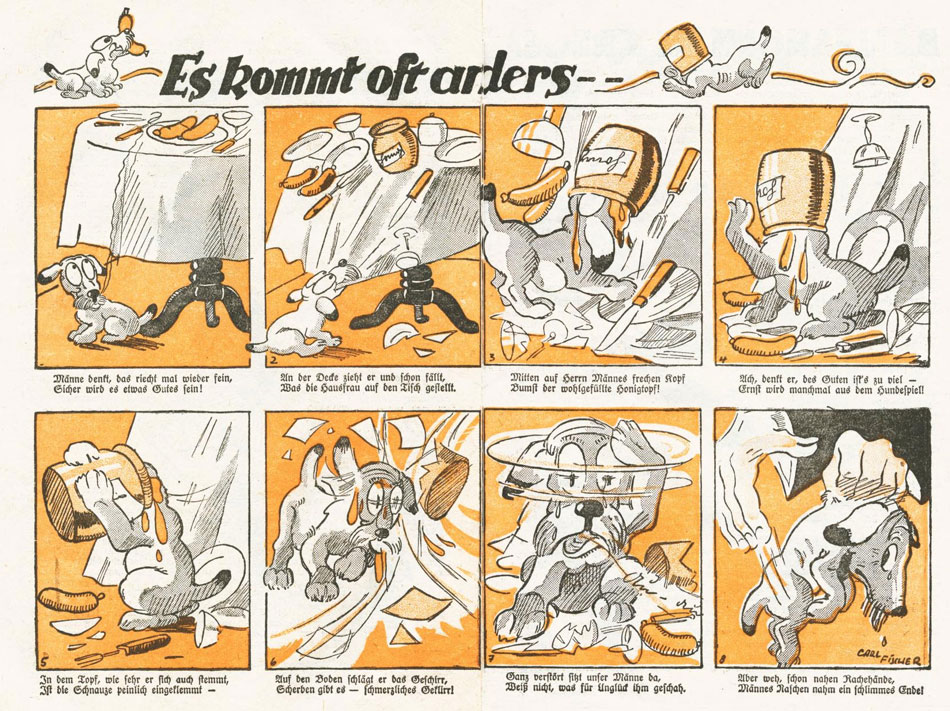
Picture story from Die Blauband-Woche #19, 1927.
Drawing with his teeth
In January 1945, during the final months of World War II, Fischer was severely wounded during an airstrike. The train he was riding had just rolled into Fulda station, when the sirens sounded. As the passengers rushed off to the nearest bunkers as the first bombs dropped, Fischer was hit by shrapnel in the middle of the street. Splinters slashed the main arteries of both his arms and cut into his legs. At the hospital, both arms were amputated.
Although it seems logical that this would end an artists' career, Fischer was determined to draw again, and taught himself to draw by clutching his pencil and crayons between his teeth. The first new drawings he made were two post cards to his friends, for which he used his clinical chart as a pad. In an article appearing between September and November 1954 in several US newspapers about this remarkable dedication, Fischer said: "The drawings came off naturally. I realized then you do not draw with your arms but with your brains. (...) My teeth-written signature, for example, bore the same features as my old one. I wrote letters to my friends and they did not realize I had lost my arms."
When he was released from hospital, he returned to work, also for the Frankfurter Illustrierte, where cartooning again apparently didn't cost him much trouble: "Many said that my drawings were better than before, that they were fresher and more at ease. I certainly did not do my cartoons with any great effort." In 1950, Cefischer released the picture book 'Ping und die Schatzinsel' at H. Cobet Verlag, starring an anthropomorphic penguin, monkey, hare and elephant going on a treasure hunt by boat.
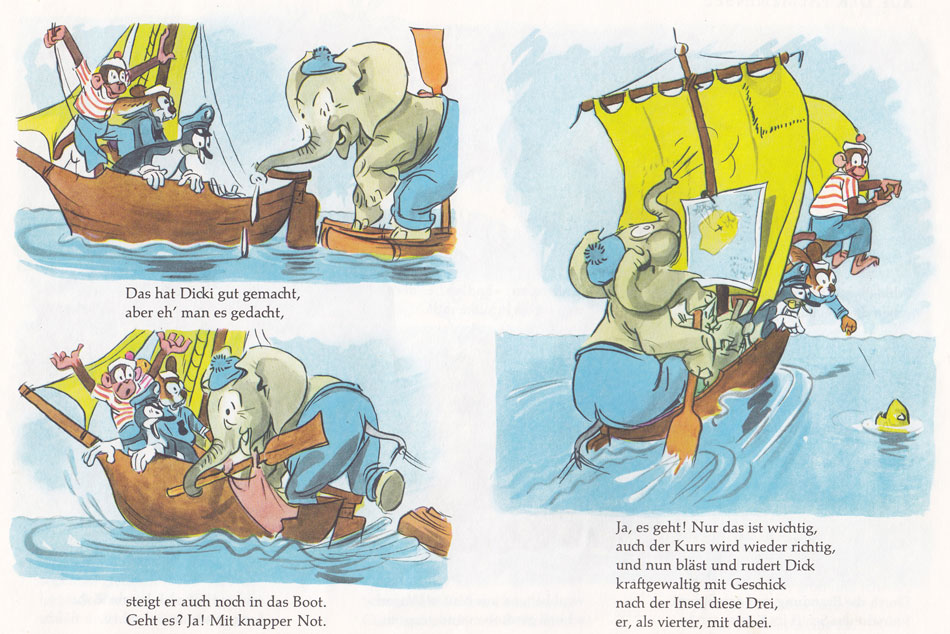
'Ping und die Schatzinsel'.
Oskar der Familienvater
On Christmas 1952, Fischer launched his most recognizable comic character to the readers of the Frankfurter Illustrierte: the cat Oskar. The idea for the feature came from the magazine's editor Werner Wirthle, who had witnessed the success of Pat Sullivan and Otto Messmer's 'Felix the Cat' in England and wanted something similar in his magazine. However, the character originated in another strip Fischer made for the magazine, about sorcerer's apprentice 'Simsala Bimbo'. In that feature's final installment, Oskar managed to conjure his entire family out of a top hat with a magic wand, followed by an announcement for a new comic. Under the titles 'Oskar und seine Familie' and 'Oskar der Familienvater', the feline's everyday adventures ran in the Frankfurther Illustrierte for ten years.
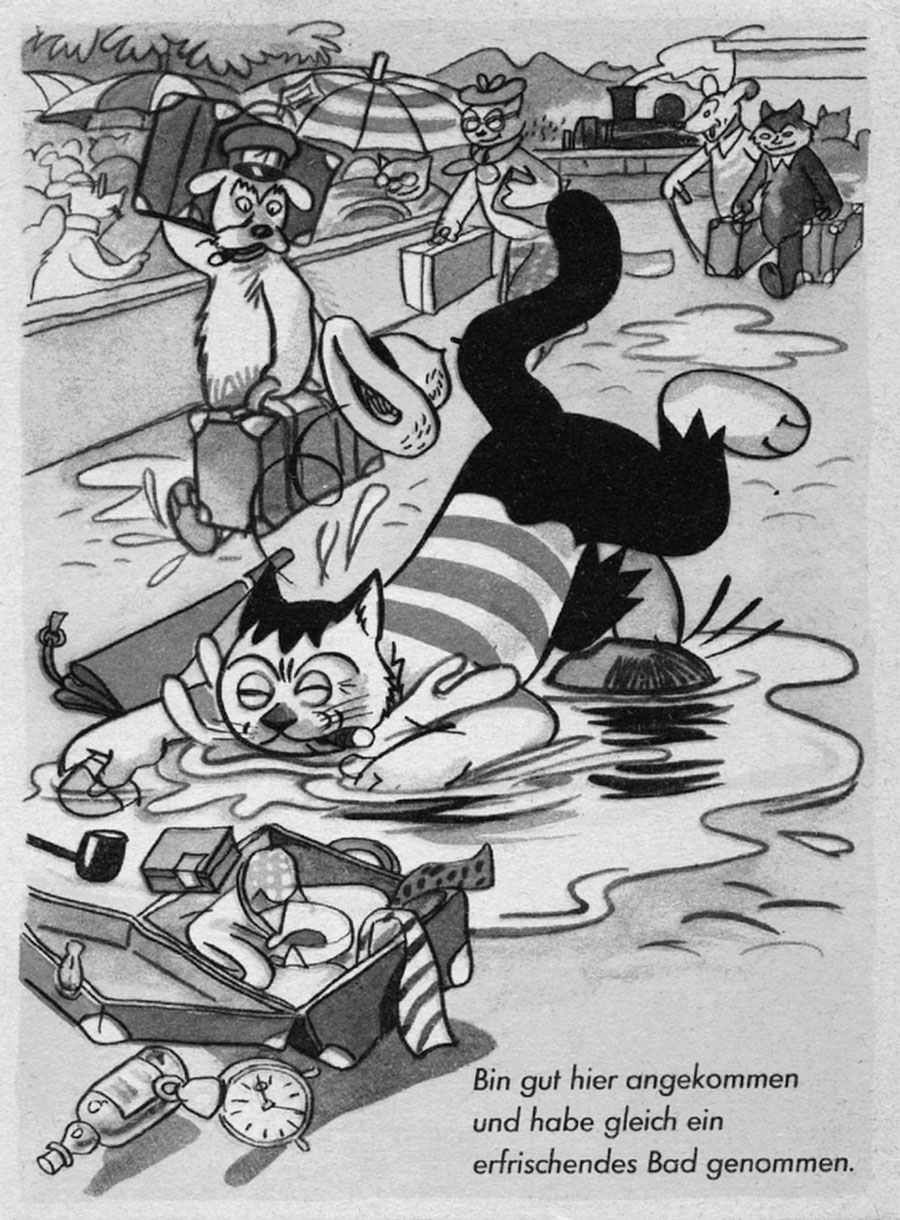
'Oskar der Familienvater'.
Dressed in a red-and-white striped sweater, Oskar is the head of a family of cats, whose everyday and all-too-human adventures gave a good impression of family life in post-War Germany. Together with his wife, only referred to as "Mommy", Oskar has five children - three boys and two girls - who are constantly trying to play pranks. The family wages a petty war against grumpy neighbors and unwanted visitors. Seven stories were collected in book format by the Frankfurter Societäts-Druckerei, with a total print run of 550,000 copies, and the artist received fan mail from all over the world, including Ecuador, Japan and Iran. The character became so popular that the feature also spawned dolls, games and paint books for children.
Named after the character of Oskar, the Frankfurter Illustrierte established an award to honor prominent animal rights activists. In the late 1950s, an attempt was even made to establish the "Silver Oskar", a film award for actors from German-speaking countries, as a counterpart to the Oscars from Hollywood. Recipients included Gert Fröbe (best remembered as Goldfinger in the James Bond film of the same name), Ruth Leuwerik and Liselotte Pulver. During the 1980s, the publishers Droemer-Knaur and Schwager & Steinlein both attempted reprint series of the 'Oskar' books, but at that point, the character's popularity had faded.


'Oskar' books.
Later life and death
Carl Ernst Fischer was a co-founder of the Association of Mouth and Foot Painting Artists and received numerous awards, including the 1965 Federal Cross of Merit of the Federal Republic of Germany. In 1963, Fischer was dismissed from the Frankfurter Illustrierte when the magazine changed ownership. He died in his hometown Frankfurt in 1974, little over a month after his 74th birthday.
Legacy
In the artist's home district of Bornheim, the Citizens' Association and Friends of Historical Bornheim ("Bürgerverein und Förderkreis historisches Bornheim e. V.") has dedicated itself to keeping Cefischer's legacy alive. In 2001, the association's Bernemer Museumslädchen, the smallest museum in Frankfurt, hosted a special Cefischer exhibition. In the years that followed, the museum managed to assemble its own collection that allowed for a permanent exhibition.
Carl Fischer's son, Klaus Hein Fischer (1937-2001) was also active as an illustrator and animator, using the pen name Fischer-Bernem.
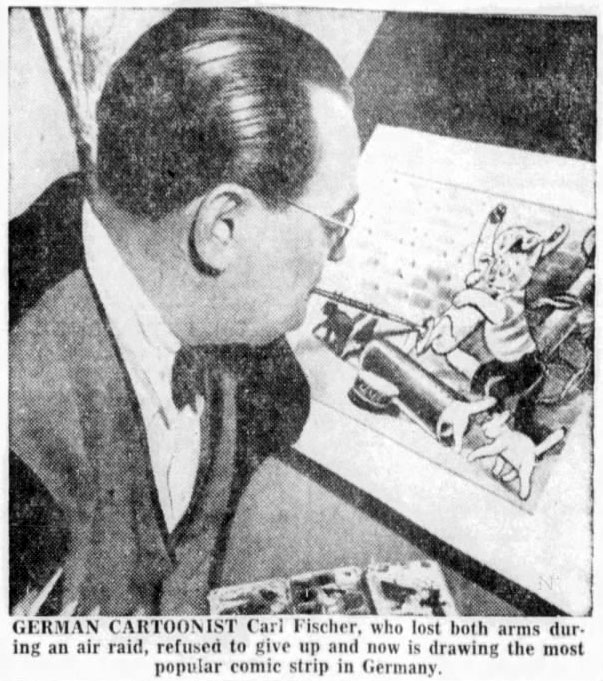
Carl Fischer portrayed in th Daily Register-Mail from Galesburg, Illinois of 5 October 1954.