


'Sherlocko the Monk' (1904).
Charles Augustus Mager was an American painter of German descent, who also built a comic career under the name "Gus Mager". He created various newspaper gag comics starring monkey characters, which eventually evolved into his signature work, 'Hawkshaw the Detective' (1913-1947), a humorous detective comic. He also assisted Rudolph Dirks with his comic 'The Captain and the Kids'. Together with Dirks and Lyonel Feininger, he was one of the most notable early German-American comic pioneers.
Early life and career
Charles Augustus "Gus" Mager was born in 1878 in New Jersey as the son of German immigrants. His father was a jeweler and thus, by the time he was 20 years old, Mager worked as a jewelry stone-setter. Their relatives in Germany often sent the family local humor magazines, exposing Mager to the cartoons and comics of German artists like Wilhelm Busch and Karl Arnold. In U.S. newspapers, he was influenced by T.S. Sullivant's 'funny animal' comics. Gus Mager married in 1907. When the U.S. joined the First World War, Mager was drafted in late 1918, luckily in the final stages of the war.

'In Jungle Society'.
In Jungle Land
In April 1904, Mager became a cartoonist for The New York American and New York Journal, owned by William Randolph Hearst. Mager's early drawings were one-panel gag-a-day cartoons featuring charming anthropomorphic versions of monkeys and hippopotamuses. These eventually evolved into comic strips under the title '(In) Jungle Land' (1904-1906), sometimes retitled as '(In) Jungle Society'. Early installments were still text comics, but the characters quickly adapted speech balloons. The strip was not related to later features with a similar title, such as 'In Jungleland' by Leo O'Mealia for the Associated Newspapers (1915-1915) and 'In Jungle Land' (1927-1928) by Whitey for the Paramount Newspaper Feature Service.

'What Little Johnny Wanted And What Little Johnny Got', 1906.
Short-lived features
From the 1900s until the 1920s, Mager drew many newspaper comics that never quite caught on. They were often based on one paper thin gimmick that quickly grew stale. Most barely lasted a few weeks or months at most: 'And Then Papa Came' (1904), 'Foxy Reynard' (1904), 'Trouble Bruin' (1904), 'It's Too Bad that Willie Stammers' (1905), 'Everyday Dreams' (1905), 'Cecil in Search of a Job' (1905), 'Oily John the Detective' (1905), 'Louis and Franz' (23 December 1904- 3 January 1905), 'What Little Johnny Wanted (And What Little Johnny Got)' (1906), 'Troubles of Pete the Pedlar' (1906), 'Maybe You Don't Believe It' (1907), 'The Nerve of Some People' (1908), 'What Little Sammy Knows' (1908), 'The Merry Widower' (1908), 'Dogs is Dogs' (1909), 'A Misfit Fable' (1909), 'Ain't It?' (1909), 'And Not Only That' (1909-1910), 'O. Heeza Boob' (1912-1913), 'Obliging Otto' (1913), 'Time-Table Tompkins' (1913-1914) and 'Fifty-Fifty Family' (1925).
'Ain't I?' was one of the shortest. Launched on 2 March 1909, it featured a character in a series of mishaps, asking the reader if they didn't consider this too much trouble for one person. By 10 March, Mager already discontinued it.
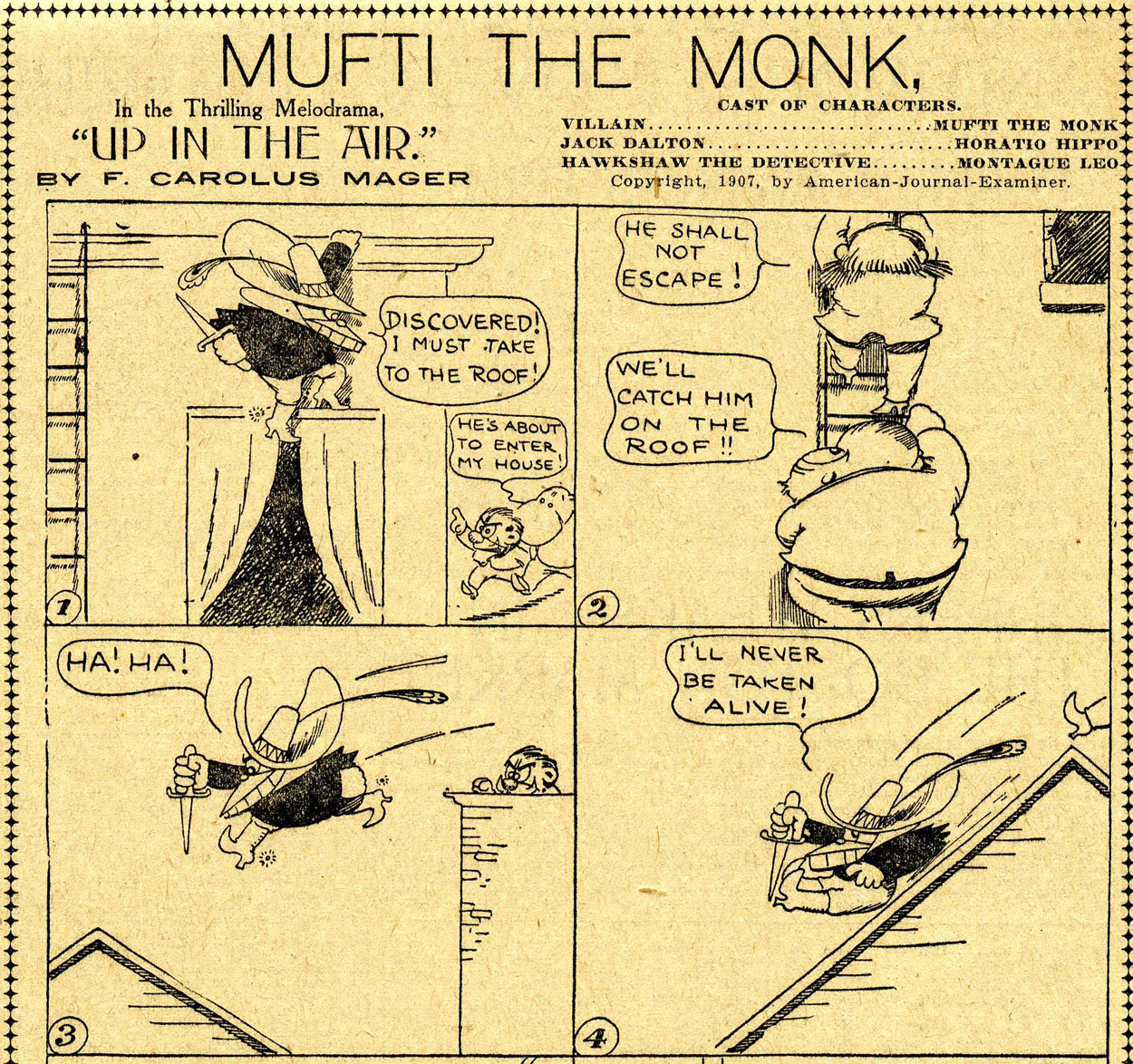
'Mufti the Monk' (San Francisco Examiner, 25 October 1907).
Mager's Monks
On 22 April 1904, Mager started a long-running series with characters nicknamed "The Monk" (1904-1913) and whose first names ended with an "-o". Contrary to what one might assume from the title, they weren't monks, but monkeys. First in line was 'Knocko the Monk', soon followed by a whole group of monkeys all defined by one personality trait. Knocko was posh, Groucho grumpy and Braggo arrogant. Grafto was opportunistic, Tightwaddo stingy, Henpecko submissive and Coldfeeto anxious. Nervo was brazen, Boneheado stupid and Forgetto absent-minded. Joko loved playing pranks, Hamfato couldn't act and Rhymo always spoke in rhyme. Relying on the possible creative ideas this personality trait might offer, some of these character-driven gag comics only ran for a couple of days.

'Henpecko the Monk', 15 June 1912.
Sherlocko
On 9 December 1910, Mager let his 'Monk' characters spoof Arthur Conan Doyle's 'Sherlock Holmes and Dr. Watson', with two protagonists named 'Sherlocko' and 'Watso'. Together with Jack Yeats' 'Chublock Homes' (1897), it was arguably the earliest detective comic directly based on 'Sherlock Holmes' and thus paved the way for artists like Leo O'Mealia, Frank Giacoia, Bill Barry, Gary Reed and Guy Davis ('Baker Street') and parodies like Art Huhta's 'Dinky Dinkerton', Will Elder's 'Shermlock Shomes', Manfred Schmidt's 'Nick Knatterton' and Bruce Jones, April Campbell and Brent Anderson's 'Somerset Holmes'.
For some reason, perhaps because it parodied a famous literary franchise, Mager's 'Sherlocko the Monk' struck a nerve with readers. The feature became very popular and slowly but surely Mager dropped all his other Monko characters in favor of Sherlocko and Watso. It developed from a series of standalone gags into a humorous detective serial. The series was so beloved that it was adapted into two live-action slapstick comedy films: 'The Robbery at the Railroad Station' (1912) and 'The Henpeckos' (1912), produced by the Champion Film Company. Interestingly enough, Mager didn't shy away from referencing Sherlock Holmes' cocaine habit in his comics. Sherlocko regularly asked Watso to bring him a syringe for another junkie shot: "Quick, Watso, the needle!" It even became a catch phrase, printed on pinback buttons and borrowed by another cartoonist, Tad Dorgan, for his own comic strip 'Daffydils'.
Unfortunately, Mager borrowed a bit too much from Arthur Conan Doyle's original. He didn't just spoof the characters, but also plagiarized entire plot elements from 'Sherlock Holmes' stories, including the assassination attempt from 'The Adventures of the Empty House' (1903). Doyle was not charmed and threatened to sue. In 1913, Mager would therefore reboot and retitle his feature as 'Hawkshaw the Detective'...

Mager's 'Hawkshaw' was also syndicated abroad, like to the Québec newspaper Le Petit Journal (1933-1937).
Hawkshaw the Detective
In 1913, Mager's friend and colleague Rudolph Dirks took a sabbatical from drawing his hit series 'The Katzenjammer Kids' in William Randolph Hearst's The New York Journal, despite Hearst refusing to grant him permission. Hearst fired Dirks, whereupon Dirks sued Hearst and joined rival newspaper The New York World, owned by Joseph Pulitzer. Out of solidarity, Mager also left Hearst and joined Pulitzer's paper.
On 23 February 1913, 'Sherlocko and Watso' debuted in The New York World, under the new title 'Hawkshaw the Detective'. To avoid further legal trouble with 'Sherlock Holmes' novelist Arthur Conan Doyle, Mager named his character Sherlocko 'Hawkshaw', although his assistant kept the name 'Watso'. Interestingly enough, the new character and title were plagiarized too, namely from a character in Tom Taylor's theatrical play 'The Ticket-of-Leave Man' (1863). But since Taylor was safely dead since 1880, Mager didn't fear any legal actions. Interestingly enough, another cartoonist, Frank Hutchinson, once had a comic strip named 'Willie Hawkshaw, Amateur Detective' (1905-1906). Mager also stopped drawing his characters as anthropomorphic monkeys, like he did before with his 'Monko' comics. On 6 March 1913, he even terminated his 'Monko' comics altogether to fully concentrate on 'Hawkshaw'. Only between 2 January and 3 April 1924, with a Sunday comic (16-20 April), did he briefly revive the 'Monko' concept under the title 'Radio the Monk'. This time, the gags revolve around an amateur radio presenter.
'Hawkshaw the Detective' ran as a Sunday comic until 12 November 1922. On 13 December 1931, it was resurrected as a smaller "topper" comic above Dirks' popular comic 'The Captain and the Kids'. This topper was not signed by Mager, but by a certain "Watso". It ran until 21 December 1947. During a period when Mager and Dirks were in copyright dispute with United Feature Syndicate in 1932-1933, the strips were drawn by Bernard Dibble.
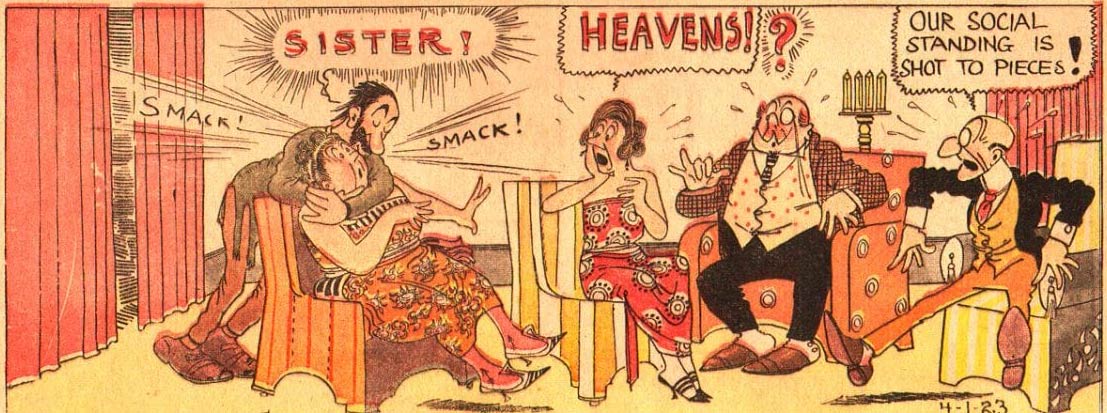
'Main Street' (1 April 1923).
Millionbucks
Apart from 'Hawkshaw the Detective', Mager created other less successful and therefore shorter-lived daily comics. 'Millionbucks' (1913) centered around a multimillionaire who wants to get rid of his wealth. He tries to give or throw it away in each episode, but unfortunately (pun not intended) he always regains it. The comics were notable for the fact that they were told in rhyme. The running gag was stretched from 18 January until 3 June 1913, after which the series was terminated.
The Trewtulyfe Family
Mager's 'The Trewtulyfe Family' (1922-1923) was basically a rip-off of George McManus' 'Bringing Up Father'. It also revolved around a poor family trying to be accepted in high society, while their father continuously blew their plans by getting along with people of lower class. Its Sunday page version, 'Main Street', ran between the same months from 15 October 1922 until 7 October 1923.
Oliver's Adventures
The longest-running series in Mager's career was 'Oliver's Adventures' (May 1926 - 22 October 1934). Much like his previous series, 'Hawkshaw the Detective', it again revolved around a detective, Oliver, but contrary to his other work it was a dramatic comic. Oliver is a poor, pitiful boy who has a series of unfortunate mishaps, but still remains optimistic, despite his hardships. On 21 May 1934, the title changed to 'Oliver And His Dog'. Mager concluded the serial on 22 October 1934. A main reason why 'Oliver's Adventures' kept running for so many years was, first of all, its soap opera nature. The comic was clearly intended as an answer to the popularity of Harold Gray's 'Little Orphan Annie', only with a boy protagonist instead of a girl. But Mager also kept 'Oliver's Adventures' as a reliable back-up, in case his other succesful series, 'Hawkshaw the Detective' might be cancelled. This turned out to be a safe hunch, because in 1932-1933, 'Hawkshaw' was temporarily drawn by a different artist, Bernard Dibble, since it ran as a topper comic with Rudolph Dirks's 'The Captain and the Kids' and Dirks fought a contract dispute with United Feature Syndicate. By 1933, the case was settled and 'Hawkshaw' returned.
Final years, death and legacy
In 1942, when the U.S. had entered World War II, Mager also signed up. He retired in 1947. He spent the rest of his life making paintings. His work was exhibited in various prestigious galleries, among them the Armory Show, the Salon of Independent Artists and the Salons of America. He passed away in 1956 in Murrysville, from brain cancer.
Although Mager's 'Monko' comics are nowadays very obscure, they did have a remarkable impact on popular culture. In the early 20th century, many U.S. vaudeville comedians also started using stage names ending with the suffix "-o". The most famous examples were The Marx Brothers, who named themselves Groucho (directly lifted from Mager's character 'Groucho the Monk'), Chico, Harpo, Zeppo and Gummo. Even Walt Disney may have been inspired by Mager's 'Monko' comics to name the Seven Dwarfs in 'Snow White' (1937) after their personality traits.
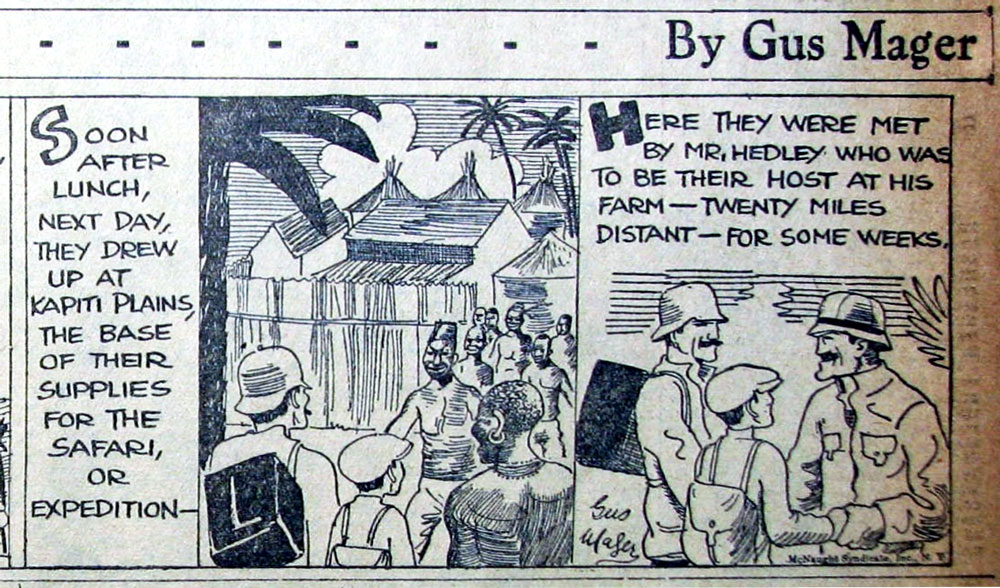
'Oliver's Adventures' (San Francisco Chronicle, 2 April 1928).