


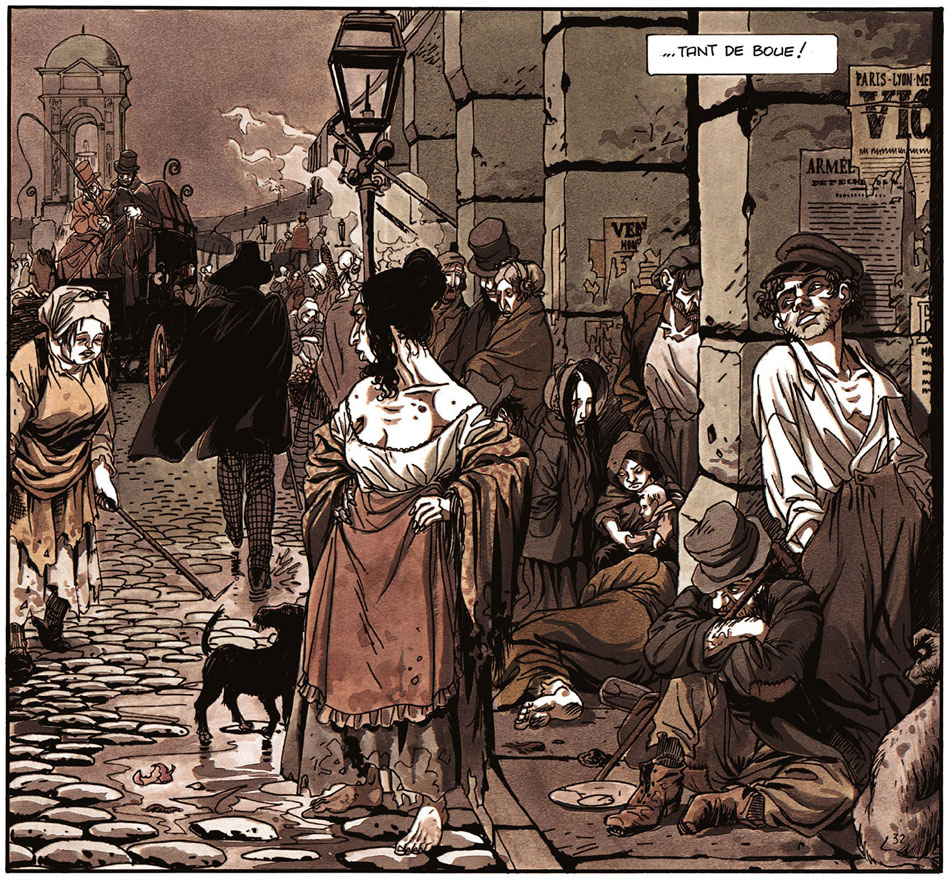
Sambre #2 - 'Je Sais Que Tu Viendras' (1990).
Bernard Hislaire is a Belgian comic creator, known for his poetic and passionate body of work. Throughout his career, he has published under several pseudonyms that are anagrams or respelled versions of his last name, the most recurring being Yslaire. Hislaire is mostly associated with romantic, emotionally layered and sometimes erotic stories, like his charming breakthrough series 'Bidouille et Violette' (1978-1986), published in Spirou, about the young love between two teenagers. With his longest-running series 'Sambre' (1986- ), he reinvented himself with a dramatic, realistic and historic family saga, drawn in a vastly different graphic style. 'Sambre' explores the discouraged romance between a bourgeois and a female tramp, set against the backdrop of various mid-19th-century events. The series was beloved enough to receive a prequel spin-off, 'La Guerre des Sambre' (2007-2019). Yslaire has also been a pioneer in computer-made comics and applying the latest techniques to explore the medium's possibilities, like in his webcomic 'Introduction du XXe Ciel' (1998-2006) and his own online magazine Úropa (2012-), made available as an app. In addition, Yslaire has made socially conscious comics ('Le Ciel Au-Dessus de Bruxelles', 2006-2007) and adaptations of the lives and works of authors like Charles Baudelaire and Georges Simenon.
Early life and career
Bernard Hislaire was born in 1957 in Brussels, where he grew up in an intellectual environment. His father Jacques Hislaire (1930-2015) was a political and cultural journalist with La Libre Belgique, and his mother Anne-Marie Guislain was a senior official at the Belgian Ministry of Foreign Affairs. Comics were also not far away in the Hislaire household. Bernard's aunt worked as a secretary for André Fernez, chief editor of Tintin magazine, which gave him a subscription to this publication and access to their latest comic book releases. The largest treasure trove for the young Bernard Hislaire was his father's large library, where he devoured many literary classics, particularly from the 19th century. The recognizable human dramas mesmerized and moved him. He remembered crying when reading Victor Hugo's 'Les Misérables'.
In his own comic career, Yslaire has often been pigeonholed as a comic artist who focuses on emotions rather than adventures. Interviewed by Nicolas Anspach (Actua BD, 25 September 2003), Yslaire explained that most comics are made by men who have a more objective approach to storytelling instead of evoking emotions. On the other hand, he observed the same phenomenon in literature in general too, save for actual romance novels. Interviewed by Daniel Couvreur (Le Soir, 22 May 2014), Yslaire embraced his status as romanticist, for which he had been criticized by some editors, critics and readers, but also found out that there were actually readers who appreciated his "emotional" stories: "It drives away our fear of death and we have to read sad stories to say to ourselves: 'This didn't happen to me, and there are things worse than what I go through.' It's also a way to face the finitude of death."
Among Hislaire's main graphic influences are the painters Fernand Khnopff and Henri Matisse. While he admires certain cartoonists and comic artists, like Sempé, Hergé, André Franquin, Hugo Pratt, Enki Bilal and Jacques Tardi, he feels that there are few whose stories personally touched him. The same applies to cinema. In the previously mentioned interview for ActuaBD., Hislaire mentioned that he wants to bring energy in his artwork and isn't particularly keen on exact realism in proportions, for instance, since photographs can be deceptive, even one's own eyes for that matter: "When my mother died, I saw her corpse. Her head seemed larger than before. It was just an illusion, because the human body is constantly in movement and the shoulders become more defined. My mother's body had lost a certain dynamism after her death and had shrunk in one way or the other. It's therefore very difficult to define accurate proportions. I appreciate the movements that distort them. I don't mind discovering an arm that's too long or a head that's too big in a drawing. In Florence, I saw Michelangelo's sculpture of David. It's completely disproportional: his lower arms just go on. And still it brims with magic."
'Coursensac et Baladin' (1978).
Early comics career
In 1971, Hislaire made his first steps in the comics scene through fanzines like Robidule, which printed his first comic story in its third issue. Already at age 14, he interviewed comic book legends like Dany, Jean Giraud, Jean Graton, Greg, and also Hergé, though back then he wasn't very interested in his work. Between 1971 and 1974, he studied at the Institut Saint-Luc in Brussels and, in 1975, he got the opportunity to draw a comic story in Spirou magazine's 'Carte Blanche' section, where aspiring amateurs could try making a professional one-shot comic (or established comic artists do something different). Receiving support from publisher Charles Dupuis and writer Raoul Cauvin, he subsequently created the sixteen-page story 'Le Troisième Larron' ("The Third Thief"), which appeared under the "Découvertes Dupuis" banner in issue #1962 (1975).
Hislaire had left home at age 17 and needed a steady job fast. At Spirou, he was taken under the wings of comics writer Jean-Marie Brouyère (at the time best-known as co-creator of 'Archie Cash') and made contributions to several of the magazine's editorial sections, like 'L'Apache Qui Rit'. In a team-up with Jean-Marie Brouyère, Raoul Cauvin and Marc Wasterlain, Hislaire also participated in the creation of two short stories under the title 'Le Pousse-Caillot' (1976).
'Coursensac et Baladin' (1978).
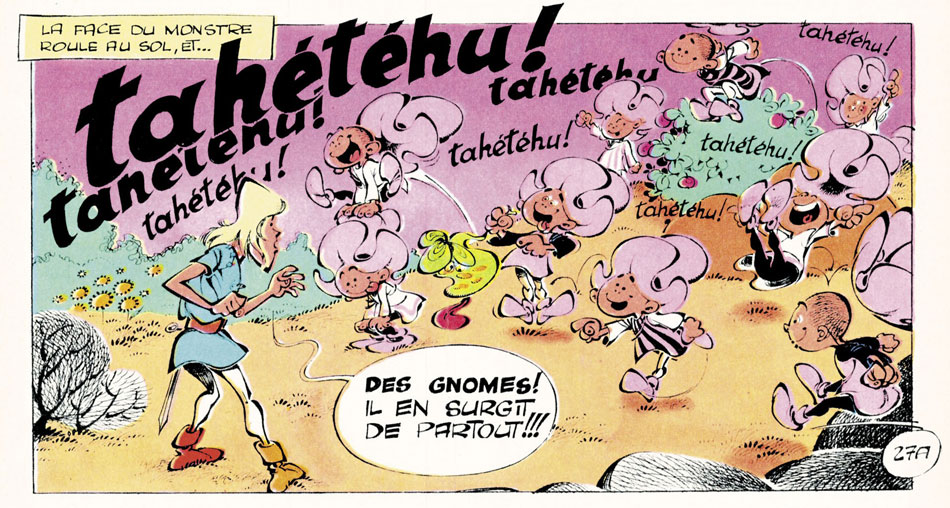
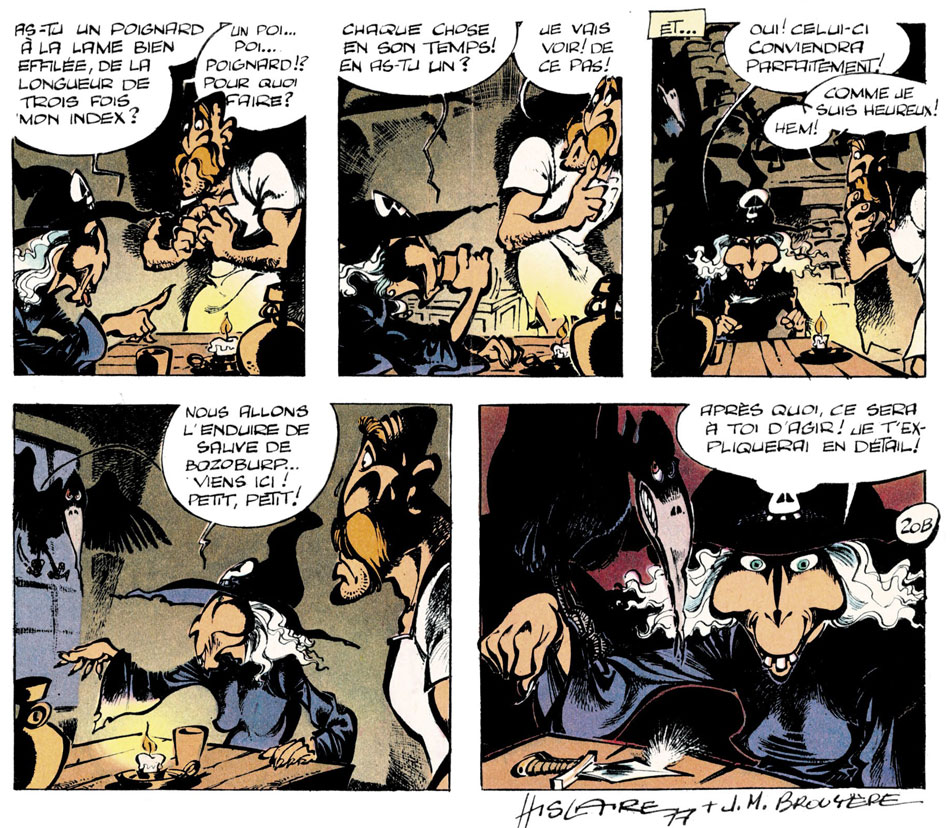
In 1978, Spirou ran his first comic serial, again from a script by Brouyère: 'Coursensac et Baladin au Pays des Tahétéhus'. Simultaneously , the story ran in Spirou's Dutch-language edition Robbedoes as 'Zakkenloper en Blasius bij de Taaietenen'. Hislaire was used to drawing realistically, but now had to work in Spirou's trademark humorous graphic style, the so-called "School of Marchinelle". He mostly drew the story as a personal exercise and to please Brouyère, who was genuinely convinced that this fantasy story about a knight and his squire meeting a group of gnomes would turn into a hit. However, Hislaire personally felt he couldn't really do what he wanted and was basically imitating Peyo's 'Johan and Peewit'. Although Hislaire and Brouyère got along fine, the scriptwriter struggled with alcoholism, making him very unreliable. This made Hislaire realize he had to take matters into his own hands, and the 'Coursensac et Baladin' series ended after only one adventure.

'Les Vacances de Bidouille et Violette' (1978)
Bidouille et Violette
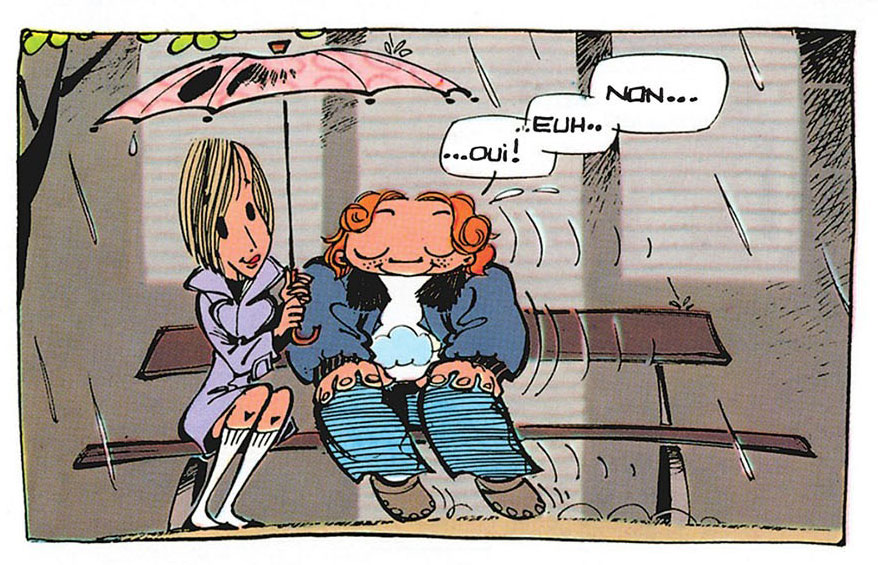
Still in 1978, Hislaire started his breakthrough series, the poetic and romantic 'Bidouille et Violette', again serialized in Spirou from issue #2087 (13 April 1978) onwards. He was lucky that the new chief editor Alain De Kuyssche was willing to take a risk, as the series was completely different from what Spirou otherwise printed. The son of the local French fry maker, Bidouille is a chubby teenager who is insecure about his looks. He is in love with the popular florist's daughter Violette, but doesn't dare to tell her. The reader follows Bidouille's attempts to conquer her heart, while simultaneously also receiving a glimpse into Violette's private life. Eventually they do become a couple and Hislaire follows their excitement of being together in the next volumes, though doesn't shy away from showing that the bloom of love isn't without its unavoidable thorns.
At the time, 'Bidouille et Violette' was a very unusual comic in the Franco-Belgian scene: it wasn't a great adventure set in some exotic location or historic era. It didn't aim at young children and while humorous at times, gags aren't the focus. Instead, Hislaire tells a simple but very universal tale about young love and how it completely entangles adolescents. All action is set in Brussels, where the teen protagonists have everyday endeavors between school, parties and trying to cope with parents, teachers and fellow pupils who just don't seem to understand. The plot isn't overly structured, making Bidouille and Violette's daily activities feel like an organic series of events that just flow about, adding to the realism. In the eyes of outsiders, their romantic attraction might seem like just banal puppy love, but Hislaire remembered how actual teens feel about such things. Their social life centers around school, their town and interaction with people their age, which all receive more importance and weight than outsiders could possibly grasp.
'Les Samedis Après-Midi de Bidouille et Violette' (1979).
In Hislaire's opinion, love is one of the most universal stories. Still, he tried to avoid the clichés associated with cheap romance pulp. For instance, Bidouille isn't an adonis, but just an average boy with red curly hair and an imperfect body. He gave him a rectangular head, since most comic characters have either round or oval heads. Girl characters were just making their mark as protagonists in Belgian comics in the 1970s, with François Walthéry's 'Natacha', Roger Leloup's 'Yoko Tsuno' and Jidéhem's 'Sophie' as the most notable examples in Spirou. As a result, Hislaire tried to tell the story not just from the boy's perspective, but also from Violette's side of things. He also avoided the cliché of "love at first sight". When the teens first meet, Bidouille isn't particularly struck and Violette barely notices him passing by. By the same token, Bidouille and his father often clash, but he isn't a one-dimensional "love-forbidding parent" either. Bidouille's dad is a single parent who, deep down, truly cares about his son and can't bridge their generational gap.
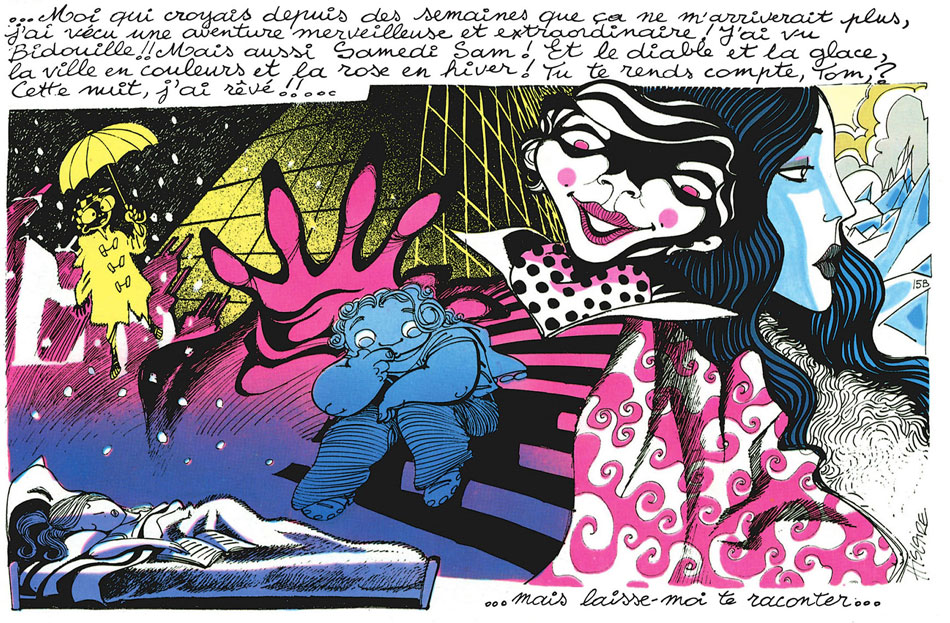
Bidouille et Violette - 'La Reine des Glaces' (1982).
Graphically, the comic also broke new ground in other ways. Hislaire toys around with his lettering, making it appropriate to the personality of the character. In many scenes, Bidouille's T-shirt also subtly changes imagery, reflecting his moods. Additional inside jokes can be found in posters of comic characters by colleagues and in record sleeves he personally liked, like Brian Eno albums. In the third volume, Yslaire experimented with dream sequences to visualize the characters' obsessions. Violette's dream is printed on a light blue background, which was quite expensive for his publisher, but he insisted and got his wish. In one scene, Violette is swimming naked, which Spirou's chief editor found objectionable. The artist redrew her as a silhouetted figure, but always felt that he had been censored.
Unbeknownst to Hislaire himself - he didn't become aware of this until years later - 'Bidouille et Violette' left a mark with readers, who recognized themselves in the young lovers' infatuation, despair and self-absorbed brooding. The stories were collected in four albums. In Dutch, the series was translated as 'Frommeltje en Viola', but never achieved the same popularity. The fourth volume was even never translated. Some interesting changes were also made in the translation. In the first volume, Violette goes to the seaside of a Breton town, Deauville, for a few weeks, which in the Dutch-language version is turned into the Belgian town of Ostend. Hislaire found it amusing that both towns looked enough alike that the difference was barely noticed by readers.
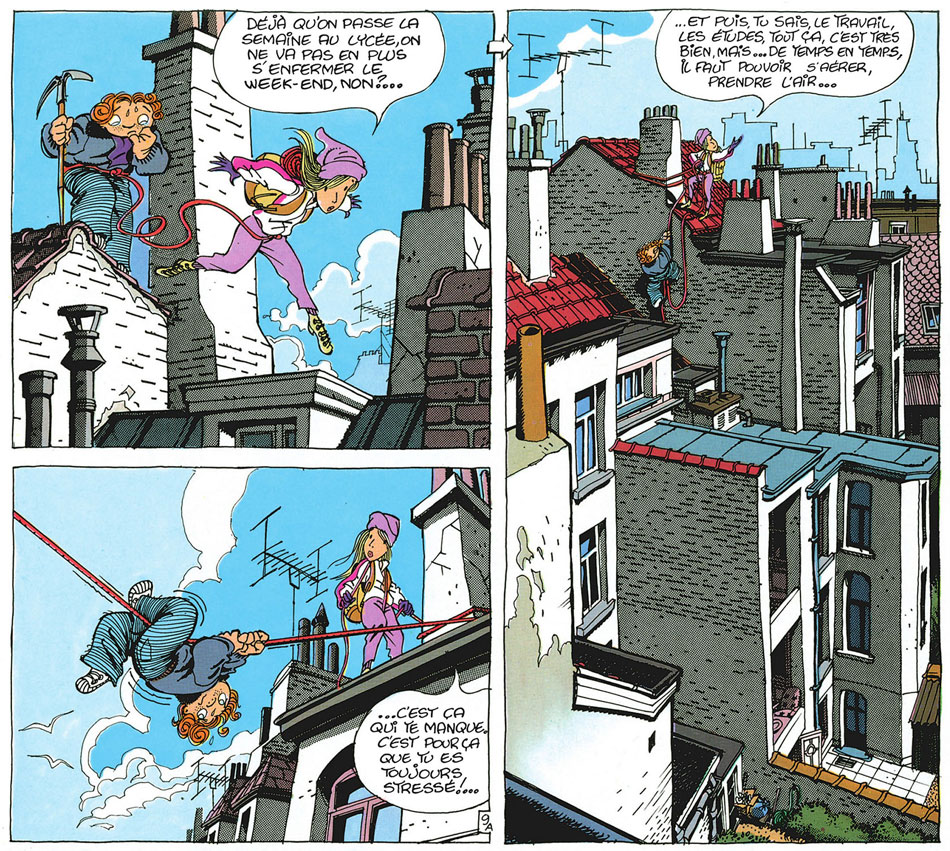
Bidouille et Violette #4 - 'La Ville de Tous les Jours' (1985).
In addition, 'Bidouille et Violette' is interesting as an unintentional time capsule of teen culture in the late 1970s and early 1980s. The characters walk around in bell bottom jeans, listen to transistor radios and songs that were hits during this era. Hislaire mostly drew at night, listening to the radio, which helped the cosy atmosphere of his story. Interviewed in Brabant Strip Magazine issue #186 (2011), he admitted having no affinity with disco, but still included references to it in 'Bidouille et Violette' to make it more authentic. In bizarre sidenote: during the 1981 presidential elections in France, Spirou ran a column in issue #2242 (2 April 1981) in which Bidouille was presented as "their official candidate", complete with an interview and overview of his policies ("making sure that love on public benches is protected and not forgotten, despite that famous song by Georges Brassens" and "grants for parents to ensure they don't ask their offspring questions out of curiosity.").
In the fourth volume, 'La Ville de Tous les Jours', the young lovebirds go mountaineering on the rooftops of Brussels, but have to be brought down by the fire brigade, making Bidouille's father more insistent that the couple should never meet again. Eventually Violette feels it would be best if she simply left the city. Unbeknownst to her, Bidouille chases behind her car and gets hit by another vehicle, seemingly left for dead, ending the series in Spirou issue #2490 (31 December 1985) on a cliffhanger. Hislaire considered making a follow-up story, tying the loose ends together. He wanted the teens to actually have their first night of sex together, but this would be impossible in a magazine like Spirou. He also considered making his characters grow older, to show how love evolves beyond the easy cliché of "and they lived happily ever after". But since comic heroes don't tend to age, he couldn't find a convincing graphic solution. In the end, his interests shifted towards other projects and he decided to leave 'Bidouille et Violette' the way they were.


Cover illustrations for Spirou/Robbedoes issues #2077 (2 February 1978) and 2299 (6 May 1982).
Innovative spirit
At Spirou, Hislaire was part of a new wave of comic artists that brought a certain sensitivity to the otherwise traditional magazine. Instead of sending heroes on exciting adventures all over the globe, this generation chose an approach with more emotionally layered and poetic characters. Spearheaded by Marc Wasterlain's 'Docteur Poche' in 1976, Hislaire's 'Bidouille et Violette' was perhaps the most groundbreaking of this movement. In its wake came other comic creators who worked with characters who were either true-to-life or dreamlike, such as André Geerts, Frank le Gall, Bosse & Darasse, Frank Pé and Alain Dodier. Perhaps against what one would expect, Hislaire was also close to Yann & Conrad, the duo that also innovated the comics medium, but then through biting and cynical satire. All part of De Kuyssche's team, they however had the same goal: modernize the medium and herald in a new era of comics.
Still, in many ways, Hislaire's comic was way ahead of its time. Even though he had the initial support of his editor Alain De Kuyssche, the rest of the editorial staff had serious doubts about a comic "in which nothing actually happens". Editorial changes and the Dupuis family company being acquired by a big corporation made matters even more difficult, and eventually forced Hislaire to cancel his series. In interviews, Hislaire reflected how the comic had been a coming-of-age experience for him too, and in fact an autobiography of his own love life. His own failed relationships, self-doubts and frustrations clouded his initially romantic view on life, as did the divorce of his parents. Along the way, more depressing elements seeped through in the stories. When he started the series, he was a teenager with ideals and dreams, when he ended it, life had happened with all its setbacks and frustrations.
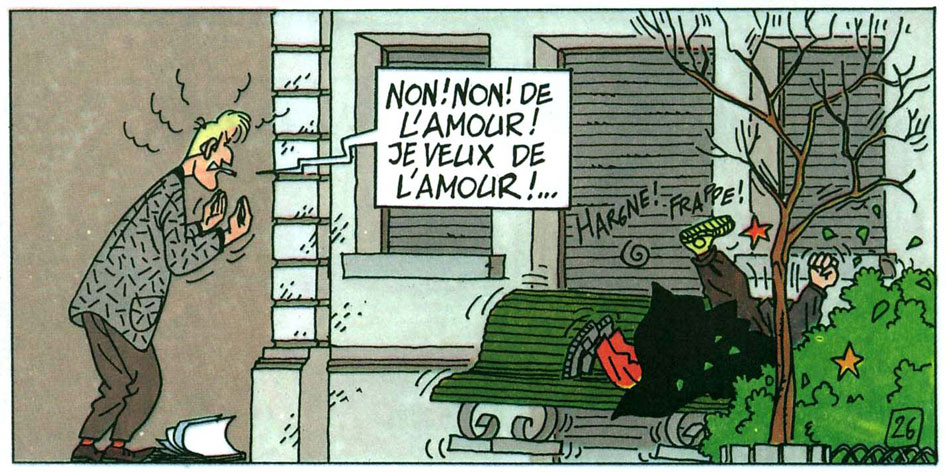
Bernard Hislaire, portrayed in 'Le Gang Mazda' by Christian Darasse.
Le Gang Mazda
During his Spirou years, in the early 1980s, Hislaire additionally made illustrations for the newspaper La Libre Belgique. In 1984, Hislaire joined his colleagues Christian Darasse and Marc Michetz in a studio space above an old Mazda garage. When at one point Darasse had no project at hand, Hislaire suggested to him drawing some partially autobiographical gags about their experiences there. This became 'Le Gang Mazda' (1986-1996), and Hislaire wrote the early gags. His run on the series was collected in the first two book volumes in 1988 and 1989. After that, Darasse began writing his own gags, until teaming up with scriptwriter Tome for the duration of the series.
By the time 'Le Gang Mazda' was launched, 'Kogaratsu' creator Michetz had already left the studio, but he remained a prominent character in the comic with his inseparable samurai sword. Darasse himself was portrayed as a loafer, while Hislaire depicted himself as a dreamer with an endless stream of love interests. Becoming close friends, Hislaire and Darasse continued working in the same studio for several years, eventually changing location, while welcoming new artists like Olivier Neuray, Jung and other friends.

Sambre #5- 'Maudit Soit Le Fruit de ses Entrailles' (2003).
Sambre
Hislaire has never been an artist who wanted to work on one single series for the rest of his life. Interviewed by Daniel Couvreur (Le Soir, 22 May 2014), he described making comics as an "extremely repetitive, almost neurotic artform, and the question that bothered me was how I could reinvent myself. (...) I was looking for beauty." In 1986, comic writer Yann had already gained fame thanks to his comics made in collaboration with Didier Conrad. When Yann and Conrad had a fall-out, Hislaire approached Yann to start a new comic series together. As a new homebase, they signed up with the French publisher Glénat, where their new series, 'Sambre', ran in the magazine Circus from issue #86 (1 June 1985) on.
'Sambre' is an ambitious family saga, set in 19th-century France. The atmosphere is inspired by the Victorian novels he had read. In general, Hislaire has always been fascinated by the 19th century, since it is the time period closest to his own. To make a distinctive break with their previous work, Hislaire used a pseudonym ("Yslaire"), as did Yann ("Balac"). Hislaire also used a far more realistic, detailed graphic style. Bernard Sambre is a member of a bourgeois family whose status is threatened by his romance with the red-eyed Julie, a prostitute's daughter now trying to survive by farming and occasional theft. Bernard's sister believes that Julie has a cursed family line, which will doom their own. The 'Sambre' series is layered with intrigues, while the socialist revolutions of 1848 form the backdrop to this impossible love story.
Interviewed by Nicolas Anspach (ActuaBD, 25 September 2003), Yslaire questioned whether Bernard and Julie's romance is actually about love: "(...) The essence of love is discovering somebody who is different from ourselves. Still, it's often the things we have in common that attract us the most. That's the paradox of love. The love relation between Bernard and Julie holds the middle between a love between adolescents and another, more mature kind of love." He pointed out that the differences in their background also play a major part in why they can't fully understand each other and disillusionment sets in.
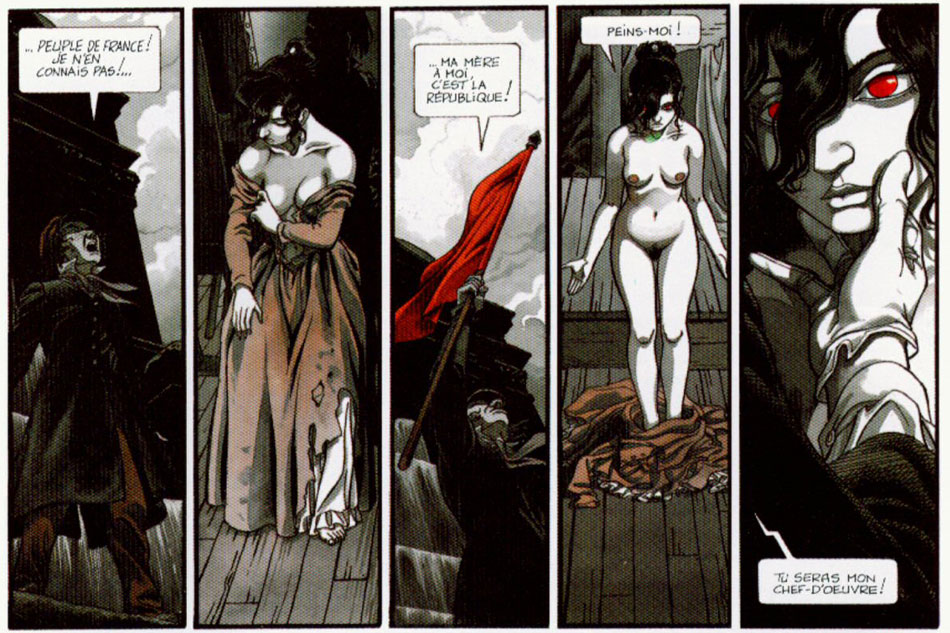
Sambre #3 - 'Liberté, Liberté' (1993).
Interviewed by Planète BD (2014), Yslaire called 'Sambre' a very personal story, but the true scope only became clear decades later. He only hinted that it had a connection to a family secret. Interviewed by Stéphane Jarno (Télérama, 1 October 2016), the artist revealed that many people in his family had been diagnosed with an incurable genetic eye disease (chromosome 19), costing the lives of his father, brothers and sisters. Some even chose euthanasia. Nobody ever discussed it with him, but subconsciously he had a hunch and made a "family curse" a major plot point in 'Sambre', only realizing years later, when the secrets were finally revealed to him, that this was the actual reason why he had been so committed to the story. Although Yslaire is lucky not to have this condition, he is the only one of his family to survive and it might explain why he works on every project as if it might be his last.
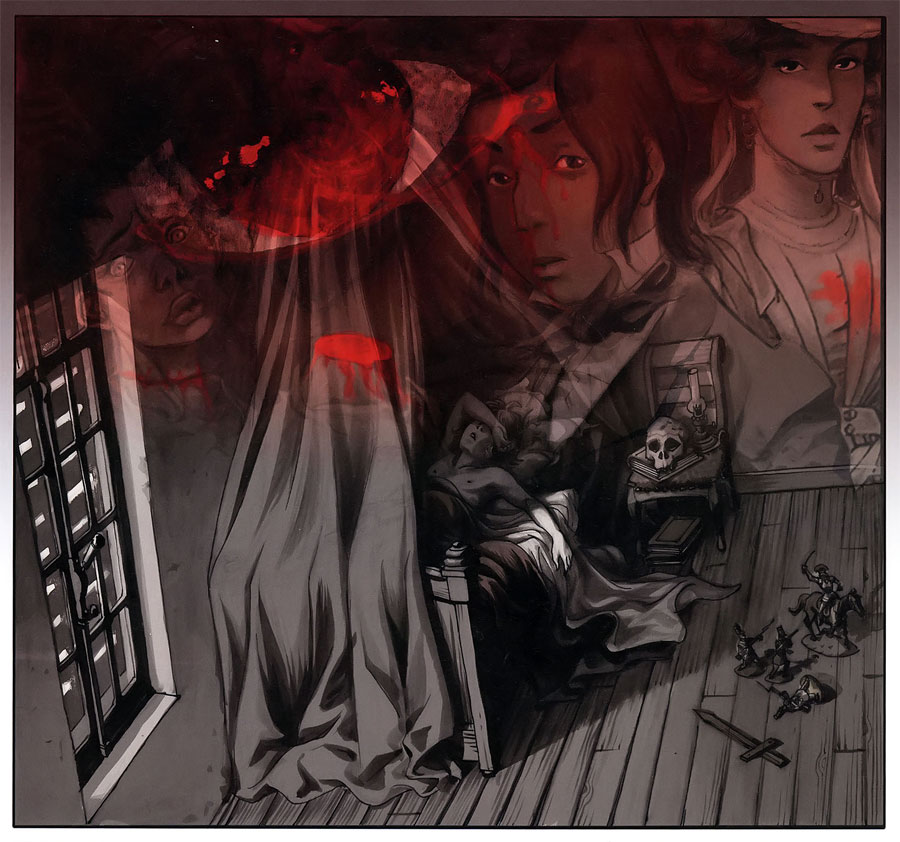
'Sambre' surprised many fans of Yslaire's previous work with his more realistic and dramatic drawing style. Color is an important leitmotif in the stories, from Julie's red eyes to the use of the same color for romance and bloodshed. Certain dialogue is lifted from 19th-century poets and novelists, like Alphonse de Lamartine, Gerard de Nerval, Stendhal and Victor Hugo, though Yslaire dismissed accusations of plagiarism, pointing out that even these literary greats borrowed elements from each other's works. Yslaire also did a lot of historical research regarding the time period, but at the same time he didn't want to lose himself too much in accuracy. He pointed out that there is not much documented about how poor people in the 19th century lived, so details about household objects, for instance, couldn't be retrieved.
After the second volume, Yslaire took over the scriptwriting from Yann, but new albums were released with long intervals. Yslaire felt that if he had to choose between quality and quantity, he was more willing to make quality his priority, hence the slow production process. 'Samber' was nevertheless acclaimed and translated into several languages. Bernard, Julie and their descendants are followed throughout the changing times. The first four albums are set in 1847-1848, continuing in the next installments all the way until 1871, when Paris experienced turmoil as a result of the Communards uprisings.
Sambre #7 - 'Fleur de Pavé' (2016).
Scriptwriting
To further explore the Sambre dynasty, Yslaire launched the prequel spin-off 'La Guerre des Sambre' which also consists of several cycles, following the ancestors of Bernard Sambre throughout the ages. While Hislaire has continued to write the scripts himself, he called in the help of other artists for the artwork. While being a jury member for the end exams at St. Lucas in Brussels, he was so impressed by the work of Jean Bastide and Vincent Mézil that he recruited them to draw the first story cycle, 'Hugo & Iris' (2007-2009), set in 1830-1831. For the 18th-century cycles about 'Werner & Charlotte' (2010-2012) and 'Maxime & Constance' (2014-2018), Marc-Antoine Boidin provided the artwork.
Under the pen name Sylaire, Hislaire ventured into science fiction. Working as a scriptwriter for the artist Jean-louis Boccar, he created the diptych 'Trois Vierges' ("Three Virigins"), published by Glénat in 2003 and 2007. It tells the story of three women of thirty years old, who are on board of a spaceship searching for another vessel called Jupiter 4. Within this tense, claustrophobic environment, tensions rise between the black captain, white astrophysicist and Asian doctor. Five years after their departure, one of the women appears to be pregnant, leading to the mystery of how this child was conceived.
'XXe Ciel'.
Mémoire du XXe Ciel
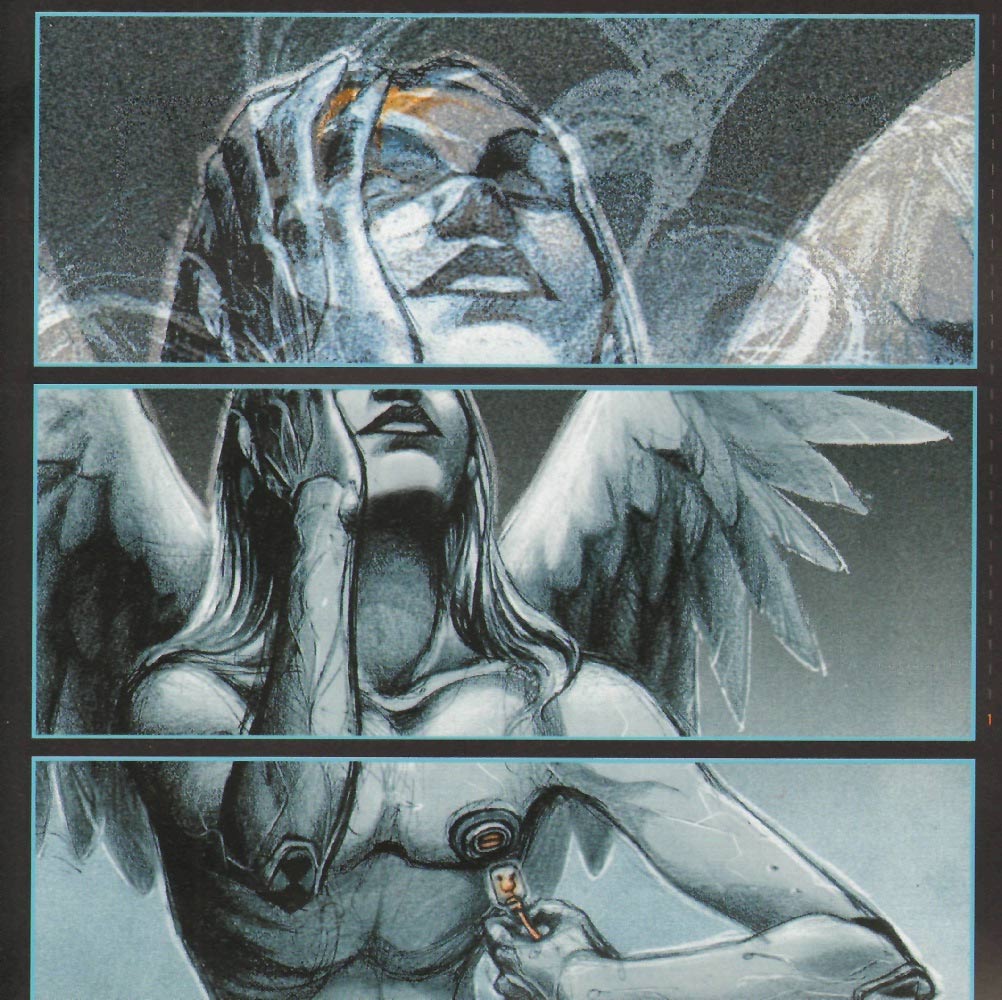
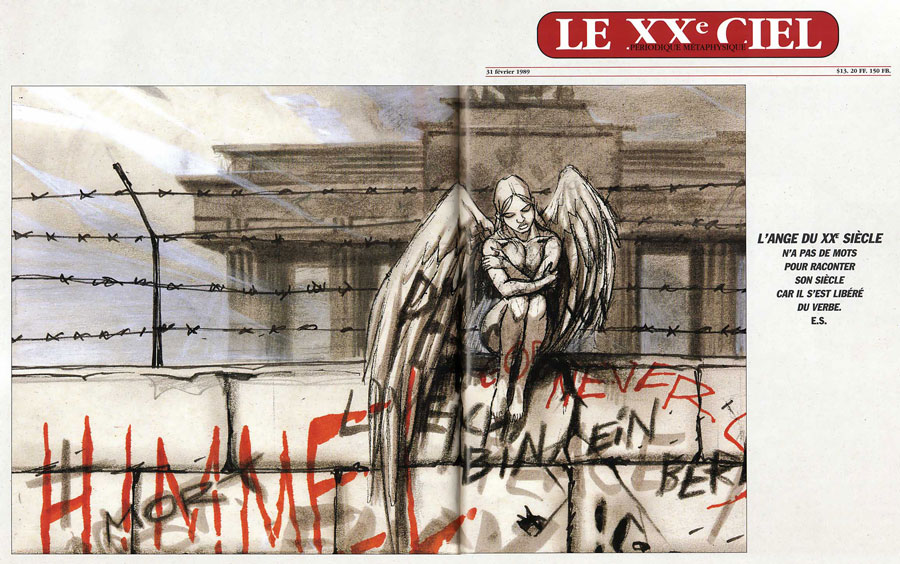
By 1997, Yslaire bought his first computer and immediately began toying with web design. From an experimental website he launched, came the series 'Mémoire du XXe Ciel', a collaboration with psycho-analyst Laurence Erlich. In 1997, Delcourt released the preliminary album 'Introduction au XXe Ciel', directly based on this website, xxeciel.com. In the following year, the series was actually launched with the first volume 'Mémoire du XXe ciel: 98'. By 2000, it transferred to Les Humanoïdes Associés, where it appeared under the title 'XXeciel.com' (2001-2004). After the 1998 first volume appeared in a reworked version, three more volumes were released. The graphic novel takes a dark look back at the war and violence of the 20th century through mysterious e-mails sent to an elderly psycho-analyst.
Interviewed by Daniel Couvreur (Le Soir, 22 May 2014), Yslaire said he tried to integrate photography into his work by contrasting it with artwork to play with the notion of reality. He also used Photoshop to reveal the imperfections of the pencil art beneath the drawing. Interviewed by Planète BD (2014), he said he felt a computer has something in common with the human brain and its unexplored parts: "(...) The human brain doesn't work in a linear fashion… but we're closer to psycho-analysis and analogies, especially in the field of emotions, that isn't rational and far less structured. The computer seems to be the instrument that expands the psycho-analysis."
'XXe Ciel'.
Le Ciel Au-Dessus de Bruxelles
Yslaire showed a more political side of himself with the anti-war protest 'Le Ciel Au-Dessus de Bruxelles' ("The Sky Above Brussels", 2006-2007). A Khazar Jew called Jules, who was killed in a Nazi camp during World War II, finds himself reincarnated in 2003 at a Brussels train station. The world is polarized by the administration of US President George Bush Jr's planned invasion of Iraq to depose Saddam Hussein. Meanwhile, the Israeli-Palestinian conflict also leads to a lot of bloodshed. Jules notices Fadya, a Muslim woman whom he manages to save from being investigated by two police officers by pretending to be family. However, Jules knows that Fadya is actually a suicide bomber and wants to convince her to not go through with her plan, inviting her over to his room in the local Hilton hotel.
'Le Ciel Au-Dessus de Bruxelles' stirred some controversy over its political-religious content. To evoke Hebrew and Arabic without having to subtitle dialogue, Yslaire used handwriting that mimics the look of these languages to non-speakers, but is actually regular French (and written from left to right) if one looks closely. Yslaire added realism by using actual photographic stills from news reports on TV screens that the drawn characters are watching. The comic was additionally controversial for featuring Jules and Fadya falling in love with each other, leading to very sensual, sometimes explicit sex scenes. Yslaire was directly inspired by John Lennon and Yoko Ono's peace campaigning in the 1960s and 1970s, who are also referenced throughout his story. Since the Beatle and his wife campaigned in the Amsterdam Hilton Hotel, the Brussels Hilton was a logical choice for Yslaire's story. Back in the 1960s, John and Yoko's message of "Make love not war" was also mocked, while Lennon and Yoko's interracial romance was criticized by narrow-minded citizens. Yslaire found it remarkable that a comic book in which a Jew and Arab make love was deemed more controversial than reports about war in the Middle East.

'Le Ciel Au-Dessus de Bruxelles' (2006).
In 2006 and 2007, 'Le Ciel Au-Dessus de Bruxelles' was published in two books by Futuropolis. By commission of the Louvre museum in Paris, Yslaire subsequently made the album 'Le Ciel Au-Dessus du Louvre' (2009) with co-scriptwriter Jean-Claude Carrière. This book is not a sequel to 'Le Ciel Au-Dessus de Bruxelles', but revolves around a painting by Jacques-Louis David in the Louvre, set against the background of the French Revolution when David was hired to paint it by Maximilien Robespierre. Yslaire was fascinated by David and Robespierre's personal contradictions. Robespierre wanted to establish a democracy based on rationalism instead of religion, but found himself head of a dictatorship led by paranoia and a short-lived replacement religion called "the Cult of the Supreme Being". David was a magnificent talent, but eventually became a pure propaganda artist for Robespierre and Napoleon, making portraits of people who would be guillotined a few months or years later. Carrière, who co-wrote the script of Yslaire's comic, had previously also written the screenplay of Andrzej Wajda's film 'Danton' (1983), also set during the French Revolution and investigating Robespierre's contradictory policies.
UROPA
By the 2010s, traditional printed media faced a crisis, since many articles, books and comics could be read for free online, reaching a wider audience but not bringing income to the authors. Yslaire noticed that his children also read books through social media or online platforms and considered comics "old-fashioned", which he couldn't deny. On the other hand, he did regard the stories told in traditional and digital media timeless and still worth making.
In 2012, Yslaire embarked upon a new adventure with the commercialization of his iPad and iPhone application 'UROPA', which he developed under the name of iSlaire. Blending fiction and reality, Yslaire developed this digital magazine in collaboration with his wife, Laurence Erlich-Hislaire, as well as with journalists like Jean Quatremer of Libération and Daniel Couvreur of Le Soir. Interviewed by Planète BD (2014), Yslaire explained that the characters in UROPA are real in the sense that he used photos and films depicting real-life people, like a journalist from Libération and Le Soir and comic artist Philippe Geluck. Others are actors and actresses. Certain parts of their lives, though, cannot be filmed or photographed and have to be presented by illustrations.
Since UROPA combines photography, film and sound with text and drawings, some critics wondered whether it could still be considered a comic strip. Interviewed by Daniel Couvreur (Le Soir, 22 May 2014), Yslaire denied this definition and called it "a form of total art" instead.
'Mademoiselle Baudelaire' (2021).
Literary adaptations
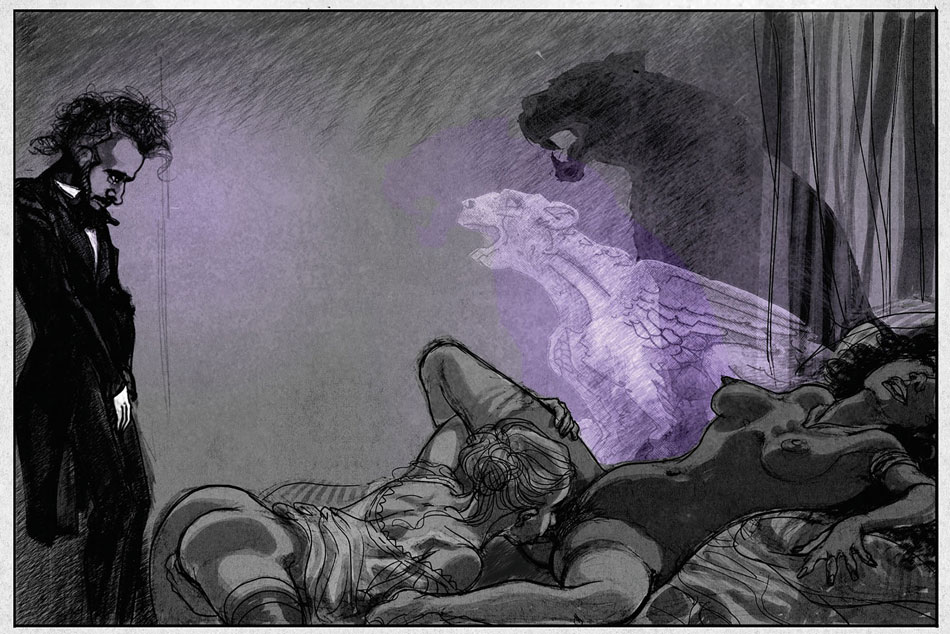
In 2021, Yslaire released 'Mademoiselle Baudelaire' a fictionalized biography about 19th-century French poet Charles Baudelaire, published in the Aire Libre collection of Dupuis. Baudelaire was a troubled soul, who had a very dominant mother that he felt emotionally neglected by at the same time. He was a whoremonger, alcoholic and opium addict and considered one Haitian prostitute, a certain Jeanne Duval, his muse. Nevertheless, his mother considered her a "black venus" and refused to give her son more money if he didn't break all his ties with her. Despite mentioning her in his poems and drawing a sketch of her, Jeanne's life is for the most part a mystery. Many people in Baudelaire's vicinity considered her a "bad influence" on him, though much of their comments were also tainted by prejudices about prostitutes and Creole people. Yslaire portrays Baudelaire's life of scandal, temptation, guilt, motherly pressure and debauchery in a captivating story. In 2022, Yslaire also illustrated Baudelaire's magnum opus, the erotic poetry collection 'Les Fleurs du Mal'.
In 2024, Yslaire created a graphic novel based on the 1948 crime novel 'La Neige Était Sale' ("The Snow Was Dirty") by best-selling Belgian detective novelist Georges Simenon (of 'Inspecteur Maigret' fame). The plot, inspired by World War II, is set during a military occupation of a foreign country. Frank Friedmaier is mostly concerned with chasing anything in a skirt, until the young adult is tempted by the criminal Fred Kromer to murder one of the military officers and rob watches from a store, just for kicks. While Yslaire provided the artwork for his adaptation, it was rewritten as a comic script by Jean-Luc Fromental. The comic was released by Dargaud, as part of their collection 'Simenon, Les Romans Durs'.
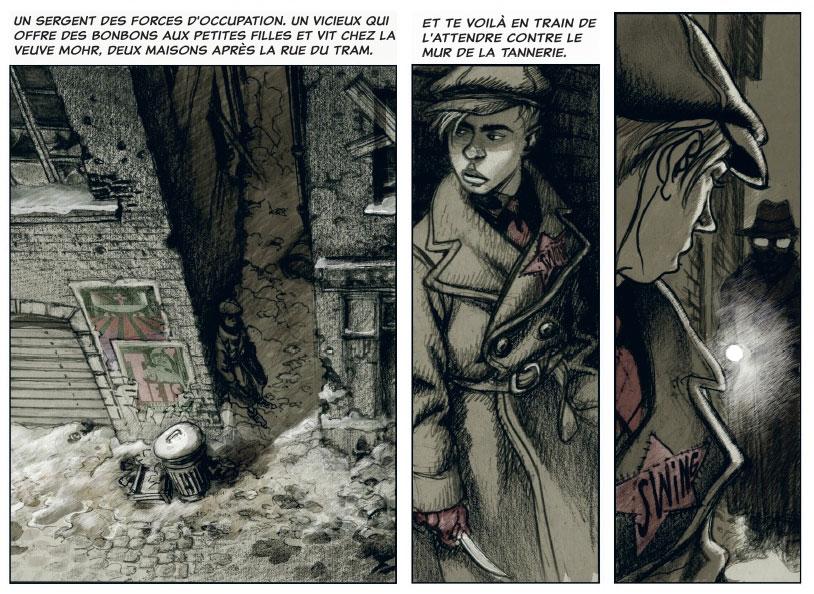
'La Neige Était Sale' (2024).
Graphic contributions
In 1983, Yslaire was one of several artists to make a graphic contribution to 'Baston Labaffe no. 5: La Ballade des Baffes' (Goupil, 1983), an official collective parody comic of André Franquin's 'Gaston Lagaffe'. He contributed to 'Les Belles Histories d'Onc' Renaud' (Delcourt, 1986), a collective comic book paying tribute to the singer Renaud. He did the same for singer-songwriter Alain Souchon in the collective tribute 'De Souchon Dans L'Air' (Delcourt, 1988). For the Fondation Daniel Balavoine, Yslaire helped out with the collective comic book 'Magiciens d'Eau' (Bandes Originales, 1987). Together with 20 other comic artists, he illustrated a record single for the project '20 Vraies Fausses Pochettes De Disque Par 20 Vrais Dessinateurs de BD' (1995). Yslaire chose a song by Stephan Eisher.
In addition, Yslaire designed the poster of the film 'Mister Nobody', directed by his friend Jaco Van Dormael. In September 1997, Hislaire and architect Francis Metzger collaborated on the scenography for the Heritage Days in the municipality of Schaerbeek/Schaarbeek. He also designed the railway platforms for the Central Station in Brussels.
Recognition
Yslaire received many honors during his long career. 'Bidouille et Violette' was crowned with the 1980 Prix Saint-Michel for "Best Humorous Script". The first volume of 'Sambre' received the Grand Prix Saint-Michel (1986), and the series itself was crowned with the Haxtur Award (1998) for "Best Comic Art". 'Le Ciel Au-Dessus de Bruxelles' received the Prix Saint-Michel (2006) for "Best Script", and 'La Mer Vue du Purgatoire' was bestowed with the Prix Saint-Michel for "Best Album" (2011). In Italy, 'Le Ciel Au-Dessus du Louvre' won the 2011 Premio Attilio Micheluzzi for "Best Foreign Comic Book". Yslaire received additional honors for his entire body of work through the Prix Bédéis Causa (1999) and the Grand Prix Diagonale by newspaper Le Soir (2014). In 2009, he was knighted as a Chevalier dans L'Ordre des Arts et des Lettres.
In May 1998, the angel from the 'XXciel.com' comic received its own comic book wall in the Rue des Chartreux/Kartuizerstraat 19 in Brussels, as part of the city's Comic Book Route.
Legacy and influence
One of the most original and experimental artists of his generation, Bernard Hislaire created a deeply personal body of work, firmly rooted in his own sentiments, interests and personality. Graphically, he underwent several evolutions, although, from personal experience, he noticed that his series flow smoothly into each other. The face of Baladin from his first comic inspired the looks of Violette, who in turn evolved into Sarah Samber and then Fabienne Rouge-Dyeu from 'XXe Siècle.com'. Narratively, Hislaire considered Bernard Sambre a more adult version of the teenager Bidouille, with the same character traits.
Bernard Hislaire, AKA Yslaire, has been named an influence by Maaike Hartjes, Bart Schoofs and Zep.
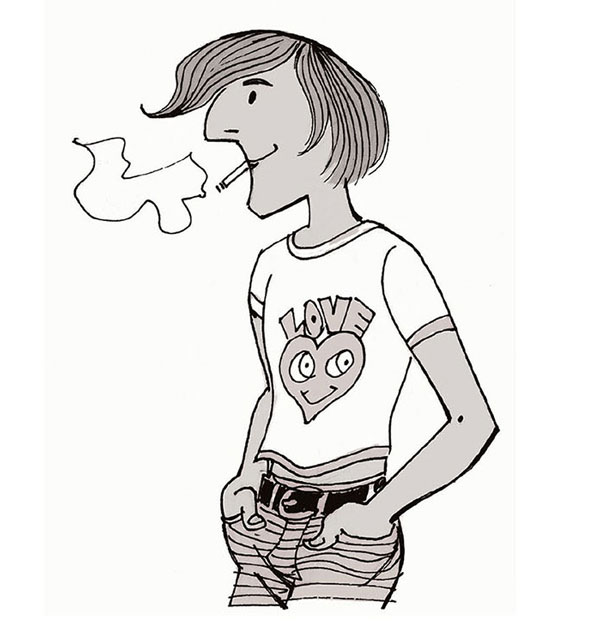
Early self-portrait.