


'Willard the Witch'.
Pino Rinaldi was an Italian comic artist. He began his career in his home country working for magazines like Skorpio, LancioStory, 1984 and Boy Music, as well as the Bonelli comic books 'Martin Mystère' (1989) and 'Nathan Never' (1993). In the 1990s, he worked for the UK, Italy and US divisions of Marvel Comics, while in the 2000s he returned to the Italian market. Rinaldi often worked on series with supernatural elements, such as 'Dagon' (Fenix, 1990), 'ClanDestine' (Marvel, 1994-1995), 'Agenzia-X' (Eura, 2000) and 'Willard The Witch' (Eura, 2001-2008).
Early life and career
Giuseppe Rinaldi was born in 1957 in Gravina in Puglia, a town in the Apulia region in southern Italy. Growing up reading American superhero comic books, his later comic book work underwent influences from the dynamic artwork of artists like Neal Adams and John Buscema. Rinaldi began his career in the mid-1970s as a graphic designer for advertisements. Together with his brother Rino, he ventured into comics in the early 1980s. Between 1980 and 1983, the brothers collaborated on the magazines published by Eura Editoriale, providing 23 stories to Skorpio and three to LancioStory. Pino Rinaldi also drew stories for the magazines 1984, published by Il Momento, and Boy Music, published by Rizzoli. His full-color story 'Omega' remained unpublished due to the cancellation of 1984, and didn't appear until the Genoese publisher Lo Vecchio released it in 2010.

'Una Storia di Natale' (Martin Mystère #93).
Italian comic books
After taking a break from comics in the mid-1980s, Pino Rinaldi began an association with Sergio Bonelli Editore in 1989. He illustrated stories for volumes #92 and #93 of the comic book series about supernatural adventurer 'Martin Mystère' (1989), and volume #22 of the sci-fi series 'Nathan Never' (1993). Because his style deflected a bit from the Bonelli housestyle, some of the artwork was adjusted by Bonelli staff artists. Under the pen name Paolo Renzi, he provided the cover illustrations for the 1992 reprints of Max Bunker and Frank Verola's 'Daniel' comic at Bunker Press. For publisher Fenix, he provided the cover illustrations for Dino Caterini and Giuliano Campo's five-issue comic book series 'Dagon' (1994), which also dealt with the supernatural. In addition, Rinaldi had provided the interior story artwork for the series' limited trial issue. The later issues were illustrated by Dino Caterini, S. Cafagna & A. Zaccheo, Vladimiro Missaglia and Giuseppe Manunta.
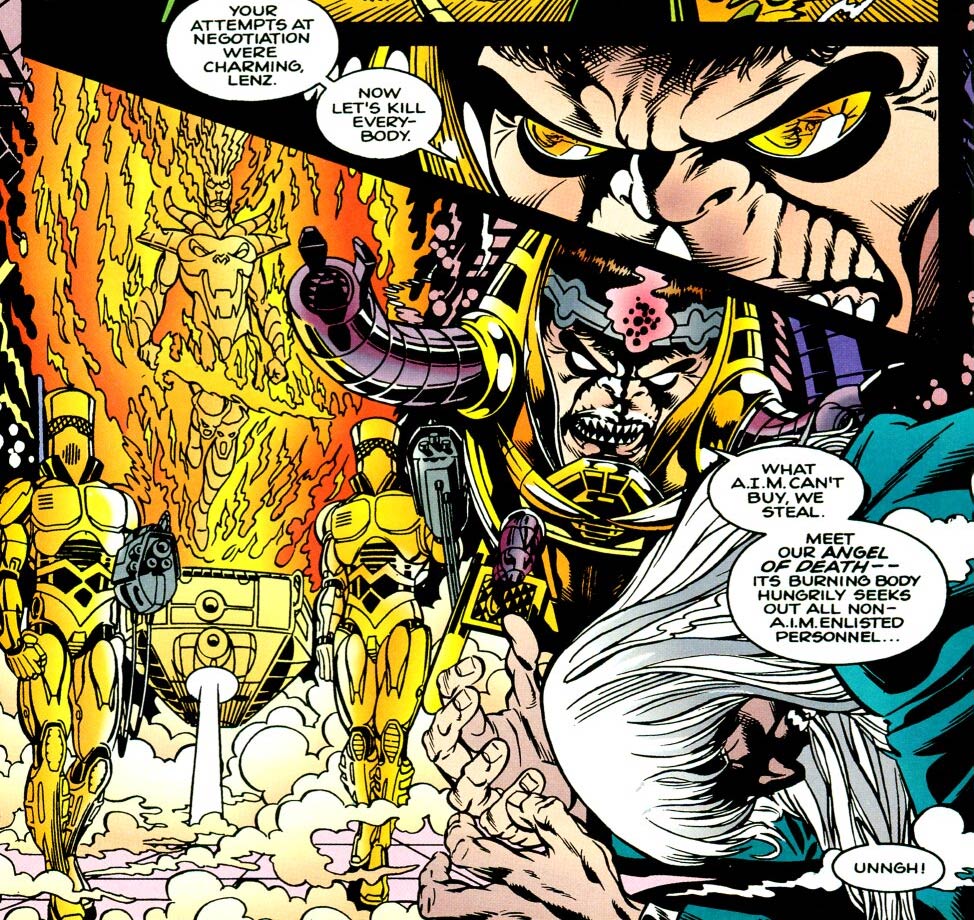
'ClanDestine' #9.
Marvel
By the early 1990s, Rinaldi had settled upon a more personal drawing style. In 1993, he began a collaboration with Marvel's UK division, creating the four-issue mini-series 'Wild Angel' (1993) with writer Nick Vince. However, the Marvel UK line folded before the series could be published, and the work was only released in a single black-and-white volume by Marvel Italia in 1995. In 1994, Rinaldo also appeared in the company's US titles, starting with a 'Valkyrie' story in 'Marvel Comics Presents' #168 (1994). He succeeded writer/artist Alan Davis on three later issues of 'ClanDestine' (1994-1995). Working with writer Glenn Dakin, Rinaldi illustrated issues #9, #10 and #12 of this series about a secret family of superhuman beings, with issue #11 drawn by Bryan Hitch.

'Conan Il Conquistadora' #1.
Rinaldi continued to do fill-ins on several Marvel series in the second half of the 1990s. He replaced Dante Bastianoni for the fourth issue of 'Fantastic Force' (1995), and penciled issues of 'Ultrafoce' (#4, 1995), 'Thor' (#498, 1996), 'Captain America' (#453, 1996) and 'Ka-Zar' (#6, 1997). He was one of the pencil artists of the Marvel graphic novel 'The Phoenix Resurrection: Aftermath' (1996), along with Jeff Lafferty, John Cleary and John Royle. A project with Jean Marc DeMatteis about a relaunch of Marvel's 'Doctor Strange' remained unpublished. In 1997, he was involved in a local production of 'Conan the Barbarian' comics for Marvel Italia, called 'Conan il Conquistadore' (two issues). The other artist on this series was Andrea Bianchi Carnevale, with stories written by Ade Capone and Xavier Marturet. Rinaldi was also a cover artist for the Marvel Italia editions of US comic books.
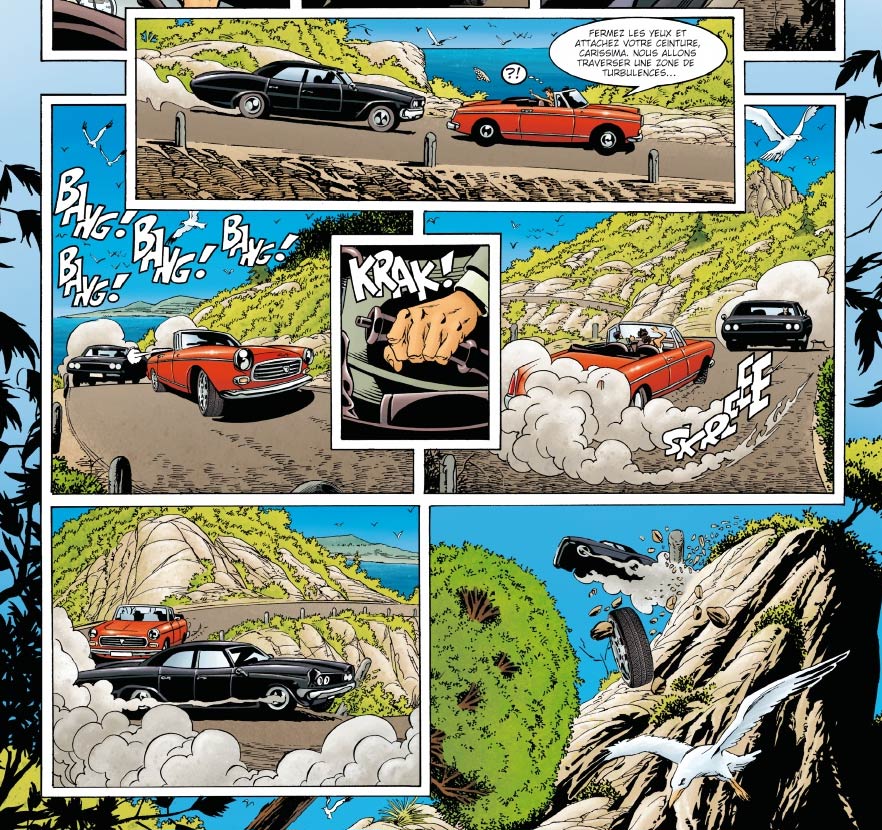
'OSS 117'.
Eura Editoriale
In the 21st century, Pino Rinaldo then resumed his collaboration with Eura Editoriale in Italy. As an allround author, he wrote and drew 'Agenzia-X' (2000), a series about a group of futuristic espionage agents. In 2017, 'Agenzia-X' was re-released in graphic novel format by publisher Allagalla. In Eura's LancioStory magazine, he then launched the comic series 'Wizzie the Witch', which was later renamed to 'Willard the Witch' (2001-2008). A young comic book artist with little success or financial resources, the main hero Willard is separated from his career-minded wife, but trying to fulfill the childhood dreams of his little daughter. Through a misunderstanding, he receives the magical abilities of Wanda Darkness, the last of a line of white witches. Completely unaware of the extent of his powers, Willard ends up in all sorts of adventures, while his inadequacy is supported by a host of conflicting "voices" that guide him in his actions. In 2009, the 'Willard the Witch' story was collected in a volume in Eura's 'Giganti dell’Avventura' series. Of the announced five-issue reprint mini-series by Colors & Gold Entertainment, only two issues were released in 2013.
Another Rinaldi series published in LancioStory was 'La Saga di Twee-Wan-Poor' (2002), about a group of strangers who are transported to a place where dreams and nightmares come true, an enchanted land called Twee-Wan-Poor. In 2013, the story was collected in book format by Shockdom.
Final years and death
In 2014, Pino Rinaldi illustrated covers for special editions of the series 'Kriminal' and 'Satanik' on the occasion of the characters' 50th anniversaries for 1000VolteMeglio Publishing. Subsequently, he appeared in the French market with two volumes of the espionage series 'OSS 117' (2015-2016) with writer Gihef for Soleil Productions. Pino Rinaldi was diagnosed with pancreatic cancer in February 2018. He died in Rome in April of the same year at the age of 60.

Illustration for a blog post in which Pino Rinaldi responds to accusations of plagiarism of his 'Agenzia-X' series.