


'Kronblom' (1939).
Elov Persson was an early Swedish comic artist, and the creator of the country's longest-running series, 'Kronblom' (1927- ) and 'Agust och Lotta' (1928- ). Both have become cultural icons in Sweden, and are still in production today by the Persson family. First by the artist's children Ingvar Persson and Gunnar Persson, who were in turn succeeded by their own children Jonas Persson, Bia Melin and Lasse Persson.
Early life and career
Elov Verner Persson was born in 1894 in the station house of Hästbo, Torsåker parish, a settlement in rural Gästrikland. He grew up in the poor household of station hand Erik Wilhelm Persson and Johanna Katarina Norlén, along with his four siblings. His mother died when the boy was four years old. He found some joy in drawing after discovering the work of Albert Engström and other cartoonists. Elov left school after the seventh grade, and then earned money for his family, first in the local sawmill and then as a bricklayer. Later on, he was employed by a food factory in Gävle. In the evenings, Persson picked up the drawing pen again, with the desire of becoming an advertising artist. He managed to sell funny drawings and comic strips to the local worker's newspaper Arbetarbladet and the humor magazine Kasper from Stockholm. Realizing he had more success selling jokes, Persson decided this was the path he would follow.
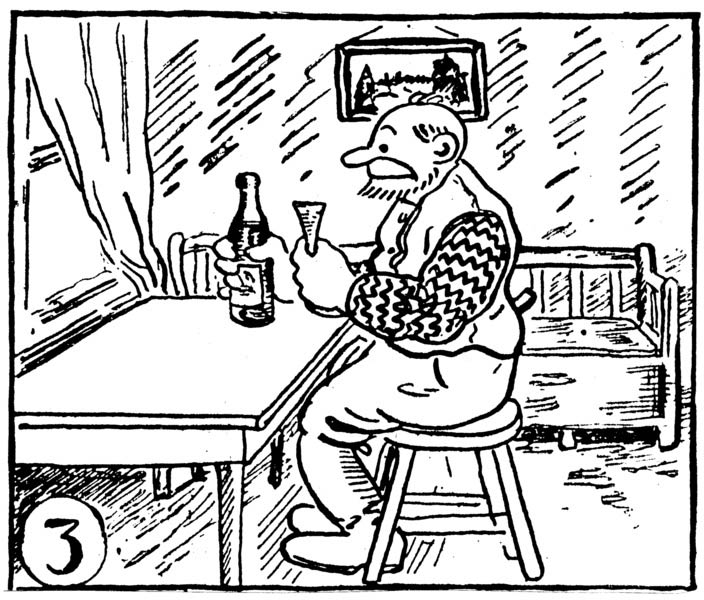
'Lars Petter'.
Lars Petter / Kaspersson
On 17 December 1924, Arbetarbladet ran Elov Persson's comic story 'När Lars Petter skulle slakta julgrisen' ("When Lars Petter was going to slaughter the Christmas pig"). The main character, an elderly working class figure called Lars Petter, can be considered a predecessor to the author's future creations. In the following year, Persson introduced his first recurring character in the newspaper Smålänningen. The elderly character 'Kaspersson' (1925-1929) was inspired by Oscar Jacobsson's 'Adamson', and appeared on a weekly basis. The artist left the series after four years, as his new employer was the publishing house Åhlén & Åkerlunds, which demanded exclusivity. 'Kaspersson' was continued in later years by Einar Lindberg, either in solo strips or as a guest character in Lindberg's 'Sympatiska Filip' series.
Kronblom
In 1929, Elov Persson and his wife Signe settled in the town of Storvik, where they remained until 1945. They then spent the rest of their lives in the small village of Torsåker in the Hofors municipality. The rural countryside of Gästrikland was also the setting for both of Persson's signature series. At age 22, Persson managed to sell the publishing house Åhlén & Åkerlunds his idea for the comic strip 'Kronblom'. Receiving a much higher rate than for his 'Kaspersson' strip, the young artist could now leave his day job and fully focus on cartooning. On 17 July 1927, 'Kronbloms äventyr' made his debut as full page in color in the weekly Allt för Alla. Eventually known as simply 'Kronblom', the feature was transferred to the weekly magazine Vårt Hem in 1932. An annual 'Kronblom' Christmas book with reprints has appeared since 1930. In 1956, Persson's creation got an additional spot in Åhlén & Åkerlunds' comic magazine 91:an. Persson was a modern cartoonist for his time, as he was one of the few to use word balloons instead of text captions.

'Kronblom'.
The lanky Kronblom and his wife Malin form a likeable elderly couple, who live peacefully in the fictional country village of Vinkelboda. Much like his spiritual father, Kronblom enjoys fishing and hunting, but is most of all lazy. He spends hours on end hanging around on the sofa. Malin's attempts to have him find a job, or to do a chore, are generally without success. The biggest nuisance in Kronblom's quiet life is however his mother-in-law, "Svärmor", who has the tendency to stay at their home for weeks, criticizing and bossing the poor lazybones around. At moments like these, Kronblom suddenly has more energy than usual, but mostly to play pranks on her to drive her away.
As Persson was a talented portrayer of people, he gave his characters an authentic flavor. He also tackled sensitive subjects like religion, racism and death, which sometimes led to censorship from his editors. Kronblom was the subject of two live action films starring Ludde Gentzel in the title role: 'Kronblom' (1947) and 'Kronblom kommer till stan' (1949). In the 1950s, Gits Olsson wrote a radio play based on the character.
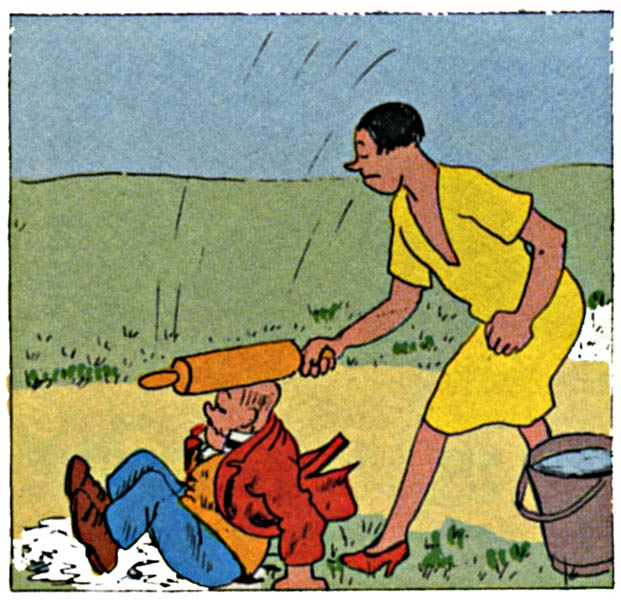
'Agust och Lotta'.
Agust och Lotta
Far less likeable than Kronblom and his wife were the protagonists in Elov Persson's other series, 'Agust och Lotta'. Following the success of 'Kronblom', his publisher asked him to create another series for its magazine Hela Världen in 1928. At the start, Agust Vråk was a pampered bachelor sent to the city by his father to earn his own money. He has a quick win however, and continues his laidback life full of partying, dancing and playing cards. After he married Lotta Svensson, the title of the feature changed from 'Agust' to 'Agust och Lotta'. This series painted a far less idyllic picture of marriage than 'Kronblom'. The stubborn pair constantly nag at each other, and the dominant Lotta regularly attacks her husband with breadcrumbs and frying pans. She is also openly courted by a third party, called Russinkvist. In 1934, Agust's son Jöns was introduced, a relic from a youth romance. In 1964, 'Agust och Lotta' moved to Hela Världen's successor magazine Min Värld, while the comic also appeared in the comic magazines 91:an, Åsa-Nisse and its own annual Christmas books. In the 1980s, the feature was transferred to the rurally oriented magazine Land.
Recognition
In 1966, Elov Persson won the Adamson Award in the category "Best Swedish comic-strip (or comic book) cartoonist" for his entire body of work.
Final years and death
In 1967, Elov Persson handed over his signature series 'Kronblom' to his son Gunnar Persson, but continued to draw 'Agust och Lotta' for three more years. He died in 1970, one day before his 76th birthday, when he suffered a heart attack during a fishing trip with his son Ingvar. After his father's death, Ingvar Persson took over 'Agust och Lotta'. By the 21st century, both series have been continued by a next generation of Perssons". Since 2006, Gunnar's son Jonas Persson has been responsible for 'Kronblom', while Ingvar's daughter Bia Melin has been drawing 'Agust och Lotta'. In addition, Ingvar's son Lasse Persson took over his father's solo creation 'Frid och Fröjd' from 2014 to 2020. Since 2014, Bia Melin's son Johannes Melin has been working with his mother on the 'Agust och Lotta' annuals. So by now, four generations of the Persson family have contributed to these iconic creations.
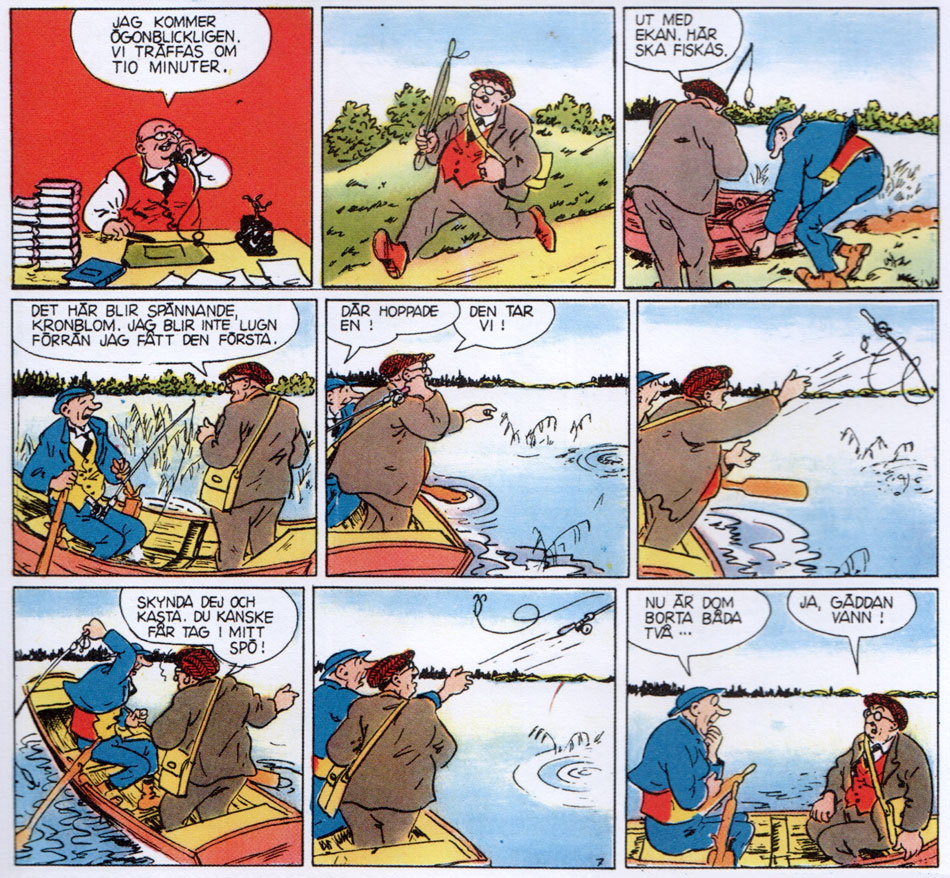
'Kronblom'.
Legacy
Along with Rudolf Petersson's '91:an' (1932- ), Elov Persson's 'Kronblom' (1927- ) and 'Agust och Lotta' (1928- ) have been the longest-running comic series in Sweden. All three have earned their rightful spot in the country's cultural heritage; Kronblom's name has even become synonymous with laziness and distrust of authority. The lasting power of these series has also been ground for anachronisms. Both Kronblom and Agust & Lotta still dress and live like it's the 1930s - they for instance still heat their houses with wood - while modern cars and equipment were also gradually introduced in the stories.
The cultural importance of Persson's creations has been illustrated by the statues of Kronblom and Agust in Elov Persson's hometown of Torsåker, and another one of Kronblom in Gunnar Persson's hometown of Örebro. Since 1987, Kronblom has been the mascot of the Swedish association football team Örebro SK. The site outside Persson's former house in Bäckebro (outside of Gävle), the spot where he created his character in 1927, was named Kronblomsplan and received a specially designed park bench on 19 June 2004. Persson's house in Torsåker is nowadays known as the "Kronblomsvillan" (Kronblom's villa). The Wadköping museum in Örebro has a replica of the interior of Kronblom's house, complete with puppets of Kronblom, Malin and Svärmor.

Elov Persson in the 1960s.