


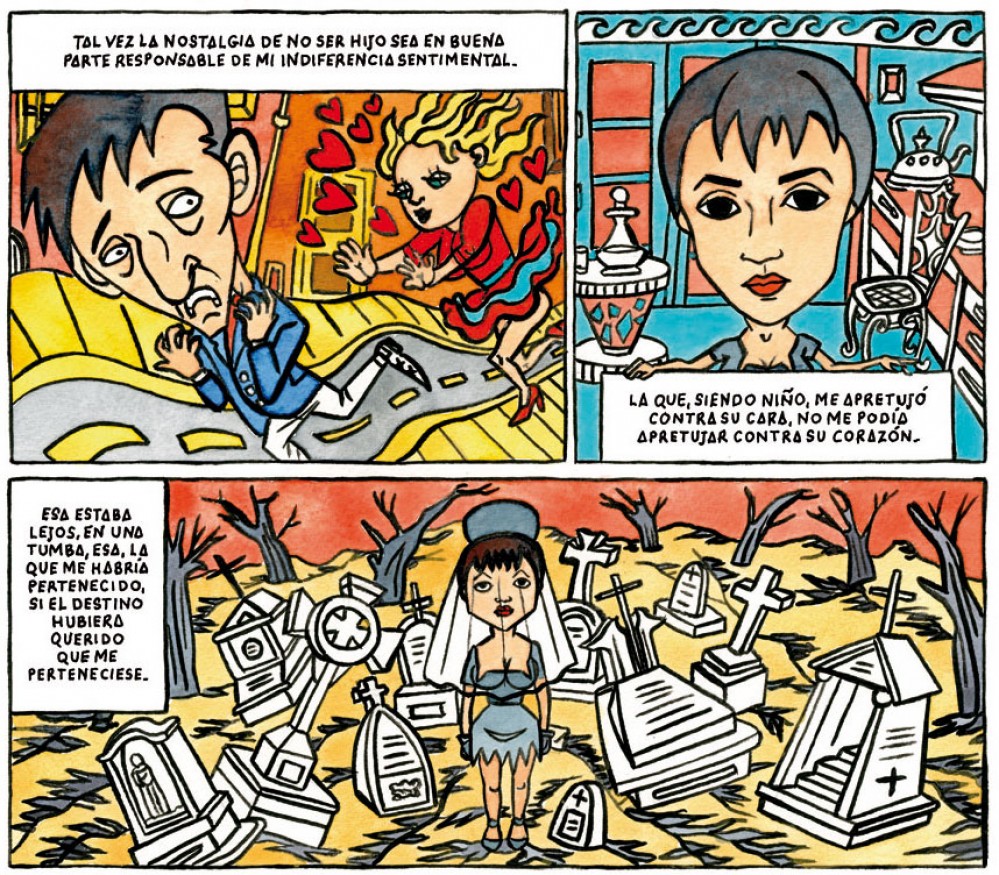

'Pessoa & Cia'.
Laura Pérez Vernetti has been part of Spain's alternative comic scene since the 1980s. An early contributor to the comics monthly El Víbora, Pérez Vernetti's comics deal regularly with eroticism, experimentation and social themes. Later works were often related to classic works of great literary masters and poets. Her comics have been published in Spain, France, Italy, Sweden, Portugal and Argentina. Up until 2008, she signed her work with simply "Laura".
El Víbora and other early work
Laura Pérez Vernetti-Blina was born in 1958 in Barcelona. After graduating in Fine Arts, she began her fruitful collaboration with the alternative comics monthly El Víbora, which lasted from 1981 to 1991. The magazine was one of the prime examples of a new wave in adult-oriented Spanish comics, freed from the censorship of the Franco era. Initially simply signing her work with "Laura", she too delved in graphical experiments, in collaboration with writers like Antonio Altarriba, Joseph-Marie Lo Duca and, most notably, Felipe Hernández Cava. Publisher La Cúpula released her first book collections, which were mostly of an erotic nature. 'El Toro Blanco' (1989), made in collaboration with Lo Duca, was based on Greek mythology and referred graphically to ancient Minoan art. It told the story of the mad passion of a woman called Parsifae for a white bull. 'La Trampa' (1990) collected several of her black-and-white stories. Between 1993 and 2000, Laura's art also appeared in five issues of Max and Pere Joan's irregularly appearing comix review Nosotros Somos Los Muertos.

'Emma Zunz' (El Víbora).
Graphic novels
Since 1999, many of her Spanish books have been published by Ediciones De Ponent, such as the erotic and lustful works 'Las Habitaciones Desmanteladas' (1999), 'Las Mil y una Noches' (2002, with Lo Duca), 'Amores Locos' (2005, with Antonio Altarriba) and 'El Brillo del Gato Negro' (2008, with Antonio Altarriba). For Amaníaco Ediciones, she experimented with a manga art style for 'Susana' (2004), a story about a female journalist researching the secret world of sex in her city. A notable collaboration between Laura and Felipe Hernández Cava was 'Macandé' (Ikusager, 2000), a graphic novel based on the life of the extraordinary gypsy singer and street candy vendor Gabriel Díaz Fernández (1897-1947). The duo later collaborated on 'Sarà Servito' (2010), a story about the moral decay of Venice, told through the painter Marina, who becomes a courtesan at night.
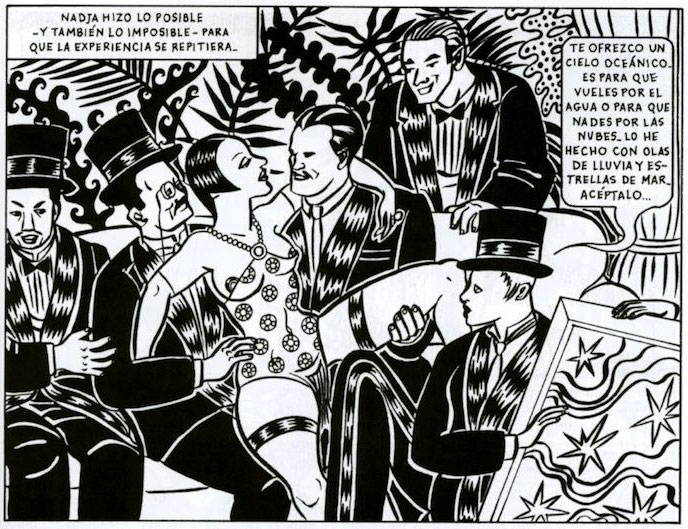
'Amores Locos'.
Graphic contributions
With Hernández Cava, Pérez Vernetti also contributed to collective books dealing with more socially engaged and humanitarian subject matter. The French anthology 'Nous Sommes les Maures' (Amok, 1998) dealt with the relationship between Europe and the Mahgreb region throughout the ages. '11 M, Once Miradas' (De Ponent, 2005) contained stories dedicated to the victims of terrorism. 'De Ellas' (2006) reinvented and celebrated the role of women in comic books. 'Nuestra Guerra Civil' (Ariadna Editorial, 2006) commemorated the 60th anniversary of the Spanish Civil War, and 'Guadalajara sera la Tumba del Fascismo' (De Ponent, 2007) featured art inspired by war propaganda posters to illustrate the text of Leonardo Sciascia's 1960 book 'El Antimonio'.
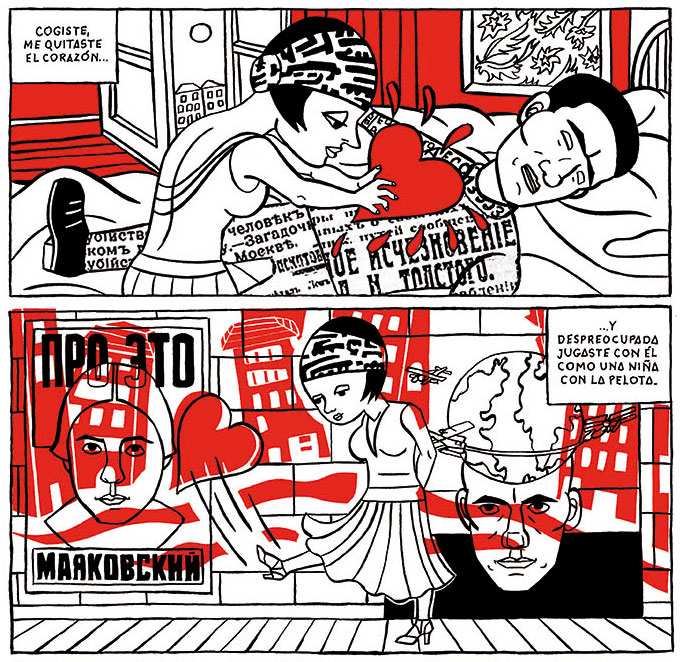
'El Caso Maiakovski'.
Literary works and poetry
In addition, Laura Pérez Vernetti has made graphical adaptations of works by literary masters such as Guy De Maupassant, Franz Kafka, Dylan Thomas, Jack London and Colette. While many of her early works dealt with eroticism, she has been mostly steering away from the subject since 2011. From then on, she has been pioneering the genre of "graphic poetry" in her country. With the publisher Luces de Gálibo and Reino de Cordelia S.L., she has released books about the lives and works of different poets, including 'Pessoa & CIA' (about the Portuguese poet Fernando Pessoa, 2011), 'El Caso Maiakovski,' (about the Russian poet Vladimir Maiakovski, 2014), 'Poémic' (about the contemporary poetry of Ferran Fernandez, 2015), 'Yo, Rilke' (about the Czech poet Rainer Maria Rilke, 2016) and 'Viñetas de Plata' (2017, about the Spanish poet Luis Alberto de Cuenca). For the Provincial Council of Malaga, she adapted poems by eight Spanish contemporary poets in 'Ocho Poemas. Novela Gráfica' (2016).
During the 1980s, with El Víbora's editor Onliyú, she had made comic versions of three short biographical stories from the 1896 book 'Imaginary Lives' of the French symbolist writer Marcel Schwob. For her book collection 'Las Vidas Imaginarias de Schwob' (Luces de Gálibo, 2019), she reworked these three biographies into longer narratives with another graphic style, and adapted to more of Schwob's stories. Her 2020 book 'La Cólera de Baudelaire' was a graphic novel about the complex and controversial life of the 19th-century French poet Charles Baudelaire, and also contained adaptations of the most notable poems from Baudelaire's 'The Flowers of Evil'.
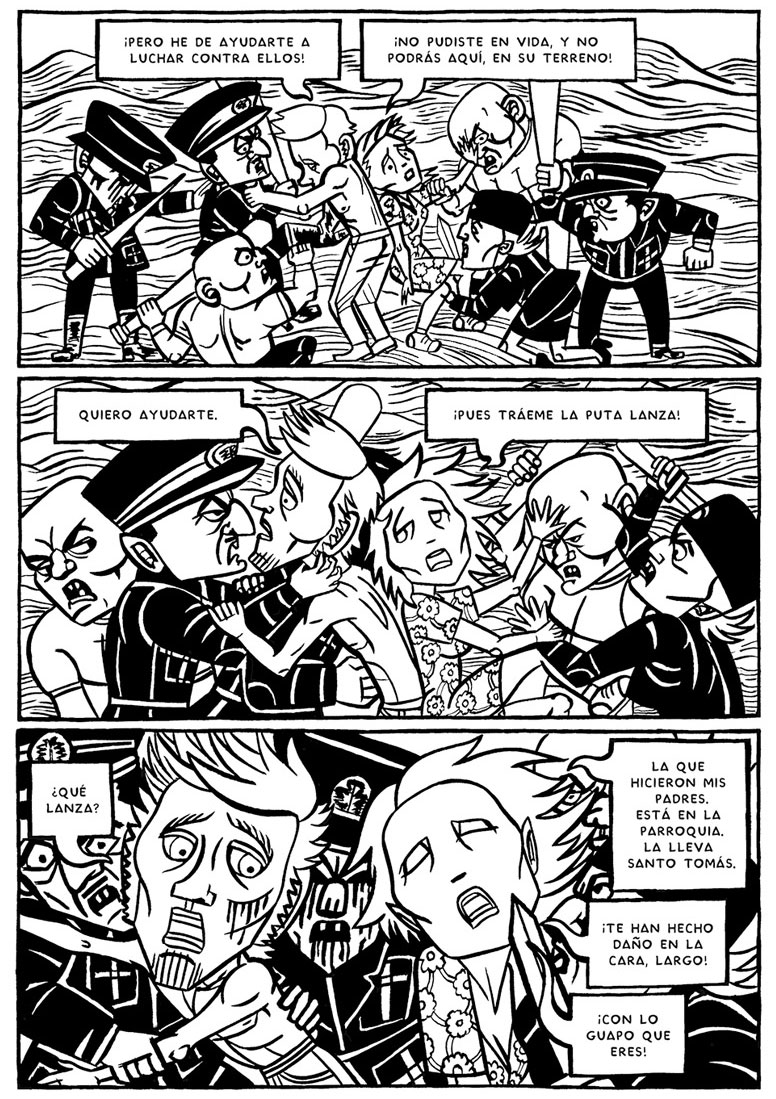
'El Designio' (2024).
El Designio
During the 2020s, Laura Pérez Vernetti teamed up with the Spanish novelist/essayist Javier Pérez Andújar for the graphic novel 'El Designio' (Autsaider Cómic, 2024), which combines gritty realism with dreamlike imagery. Set in a post-pandemic Barcelona, the story deals with three characters - El Largo, the exorcist priest Elías, and the one-armed Patricia - who follow the trail of Maravillas, an enigmatic and fascinating woman whose dramatic death is shrouded in mystery and unanswered questions.
Recognition
In 2018, Laura Pérez Vernetti won the Grand Prix for her career achievements at the 36th Salón Internacional del Cómic in Barcelona.
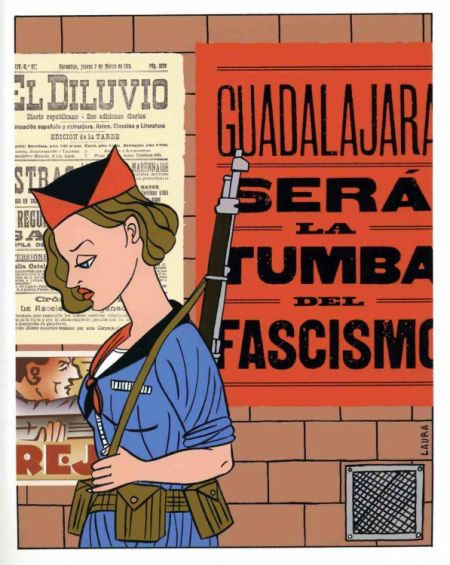
'Guadalajara Sera la Tumbo del Fascismo'.