


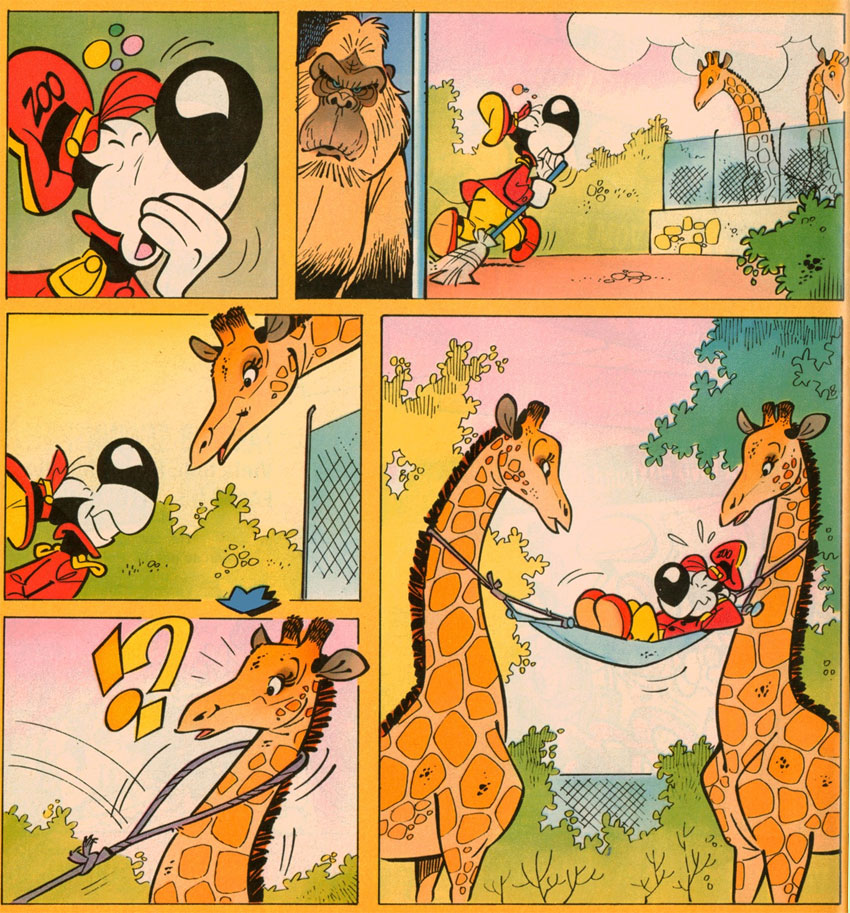
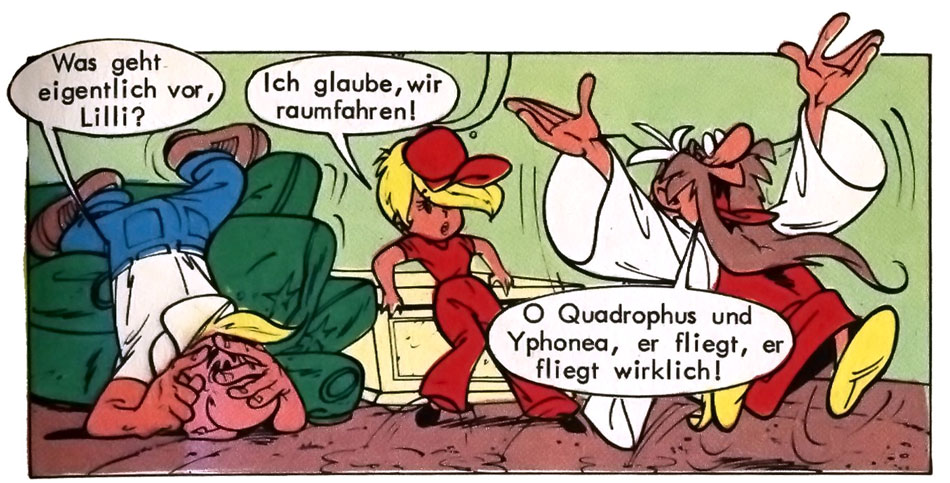
'Lupo' backcover gag from 1991.
Massimo Fecchi is an Italian comic artist, best-known for his work for international publishers. After starting out in the 1960s working for Italian magazines like Miao and Telezecchino, he began doing agency work through Studio Giolitti. Between 1973 and 1995, he was one of the lead artists on Rolf Kauka's 'Fix und Foxi', notable for redesigning the characters. Since the 1990s, he has been a prominent artist of Disney comics, working for publishers in Denmark and The Netherlands.
Early life and career
Massimo Fecchi was born in 1946 in Città di Castello in the Umbria region of Italy, but spent most of his childhood in Rome. He has remained in the city ever since. As a child, he filled his school notebooks with drawings and doodles and was fascinated by the characters from Disney cartoons, especially liking the Seven Dwarfs from the 'Snow White' film. An avid comic book collector, Fecchi read everything he could get his hands on, but preferred Franco-Belgian comics.
Studying to become a drawing teacher at the Art Institute of Rome, he had his first comic feature 'Picchio & Pacchio' (1964) published in Le Pioniere dell'Unita, the Thursday comic supplement of the newspaper L'Unità. After taking courses in animation, he became, at age nineteen, the youngest animator at Jet Film, where in 1965 he worked on TV commercials. Shortly afterwards, he shifted towards comics, citing Benito Jacovitti, Albert Uderzo, Peyo and Jean Roba as important early influences. Fecchi has also credited his later studio chief Sergio Rosi as an important tutor. In terms of Disney comics, he has expressed his admiration for Giorgio Cavazzano and Massimo De Vita.
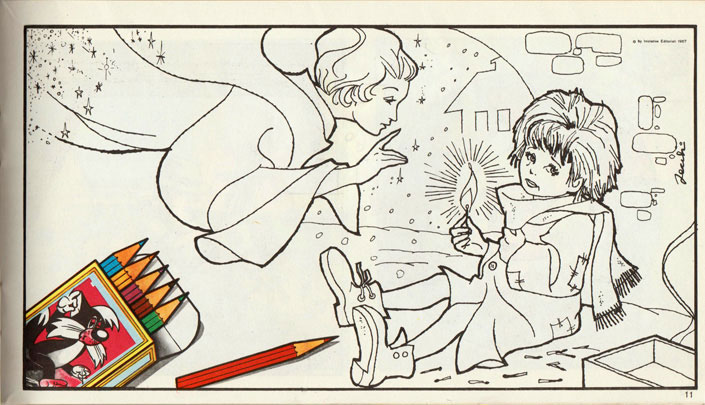
Artwork for Miao.
Italian comics
Between 1965 and 1970, Fecchi appeared in Miao, a landscape-format preschool activity magazine founded by Jet animators through Iniziative Editoriali. While Luigi Roveri drew the comic stories with the title character, Massimo Fecchi provided the artwork for the ones with 'Paperella' ("Duck") and 'Gnomo' ("Gnome"). Other illustrators for the title were N. Jacoponi, Isidori, Giorgio Michelini and Elena Poirer.
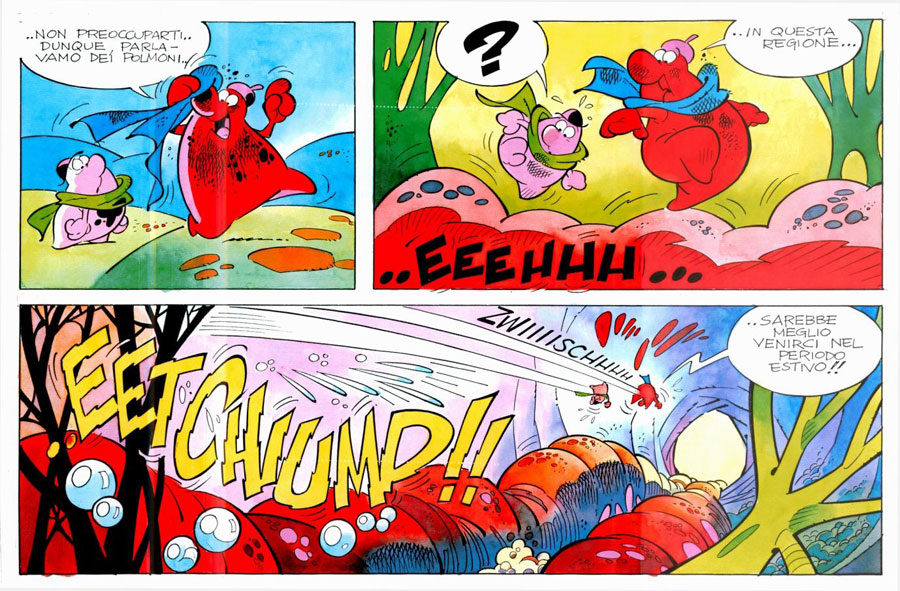
'Globulo Rosso'.
In 1966, Fecchi came to further notice in the Italian comic scene, when he participated in a contest held by a daily newspaper at the Lucca Comic Convention. His submission was 'Globulo Rosso', a comic about an anthropomorphic red blood cell, whose adventures in the human body usually dealt with the rivalry between the red and the white blood cells. Winning the contest's First Prize, his strip began serialization in a Roman newspaper, which was quickly aborted because of a financial disagreement between the artist and the publisher.
Later in the 1960s, Fecchi was associated with the Studio Rosi, where, along with fellow pencilers Giorgio Cambiotti and Francesco Valeriani, and inker Massimo Belardinelli, he worked on the 'Kriminal' comic books (Editoriale Corno) and the erotic series 'Messalina' and 'Jacula' (ErreGI/Ediperiodici). While these were realistically drawn comics, Fecchi later specialized in humor comics.
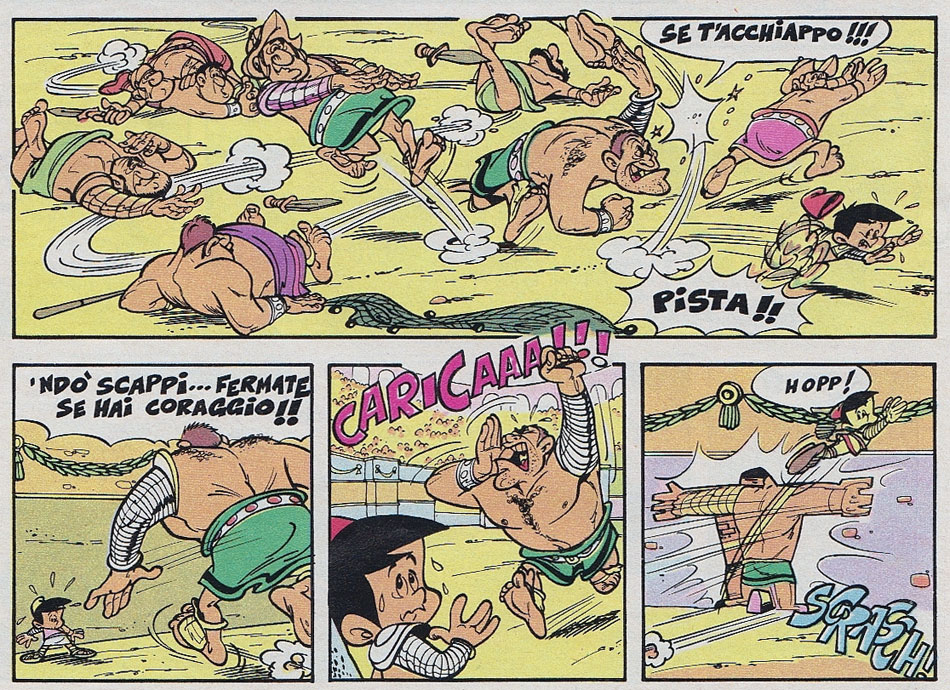
Le Avventure di Marcellino - 'Il Flauto Magico' (Il Giornalino #1, 4 January 1970).
Telezecchino
In 1968, he began working for Campi Editore on Telezecchino, a monthly magazine related to the annual Italian children's music competition Zecchino d'Oro. For this title, Fecchi and writer Luigi Roveri created mini-stories based on some of the contest's songs, as well as adaptations of fairy tales such as 'Thumbelina' ('Pollicina') and 'The Town Mouse and the Country Mouse' ('Il Topo di Città e il Topo di Campagna'). Between 1969 and 1972, Massimo Fecchi also contributed the comic feature about the reporter 'Giuseppe', which he drew in collaboration with Francesco Valeriani under the shared pseudonym "Framas" ("FRAncesco" and "MASsimo").
'Jonathan der rasende Reporter', German edition of 'Giuseppe' from Bastei Verlag's Das Froehliche Feuerwerk #5.
The 'Giuseppe' character was created for a comic adaptation of the 1968 hit song 'Giuseppe in Pennsylvania' by the Italian singer Gigliola Cinquetti. Since the publisher liked the character, it was decided to make a series about him. Written by Isa Mogherini, the stories were also translated into German, appearing under the title 'Jonathan der rasende Reporter' in a couple of Bastei Verlag pocket books.
In 1970, the Framas team-up of Fecchi and Valeriani also appeared in Il Giornalino magazine with a magical adventure starring the character 'Marcellino'. Set in Ancient Rome, the feature showed strong influences from Albert Uderzo and René Goscinny's 'Astérix' comics. Another Framas creation for Il Giornalino was 'Serafino'.

Tom & Jerry - 'Million Dollar Cat' (Tom & Jerry #270, April 1973).
Studio Giolitti
Around 1970, Massimo Fecchi began an association with Studio Giolitti in Rome, which marked the beginning of his international career. Through the studio, he spent the first half of the 1970s drawing licensed comic book stories with Warner Bros. and MGM cartoon characters for the Gold Key comic book line of Western Publishing in the USA. Characters he drew regularly were Tex Avery's 'Bugs Bunny', Friz Freleng's 'Tweety and Sylvester' and Hanna-Barbera's 'Tom and Jerry'. While working on these stories, Fecchi discovered he enjoyed drawing underdogs like the cats Tom and Sylvester the most, something he later also encountered when drawing Rolf Kauka's Lupo and Walt Disney's Donald Duck and Big Bad Wolf.
Through Giolitti, Fecchi also created the character 'Dee-Jay' for the British publisher Fleetway. Developed around 1971, Fecchi then spent two or three years drawing the adventures of this little yellow bird girl, who conducts a small orchestra of birds in the forest.
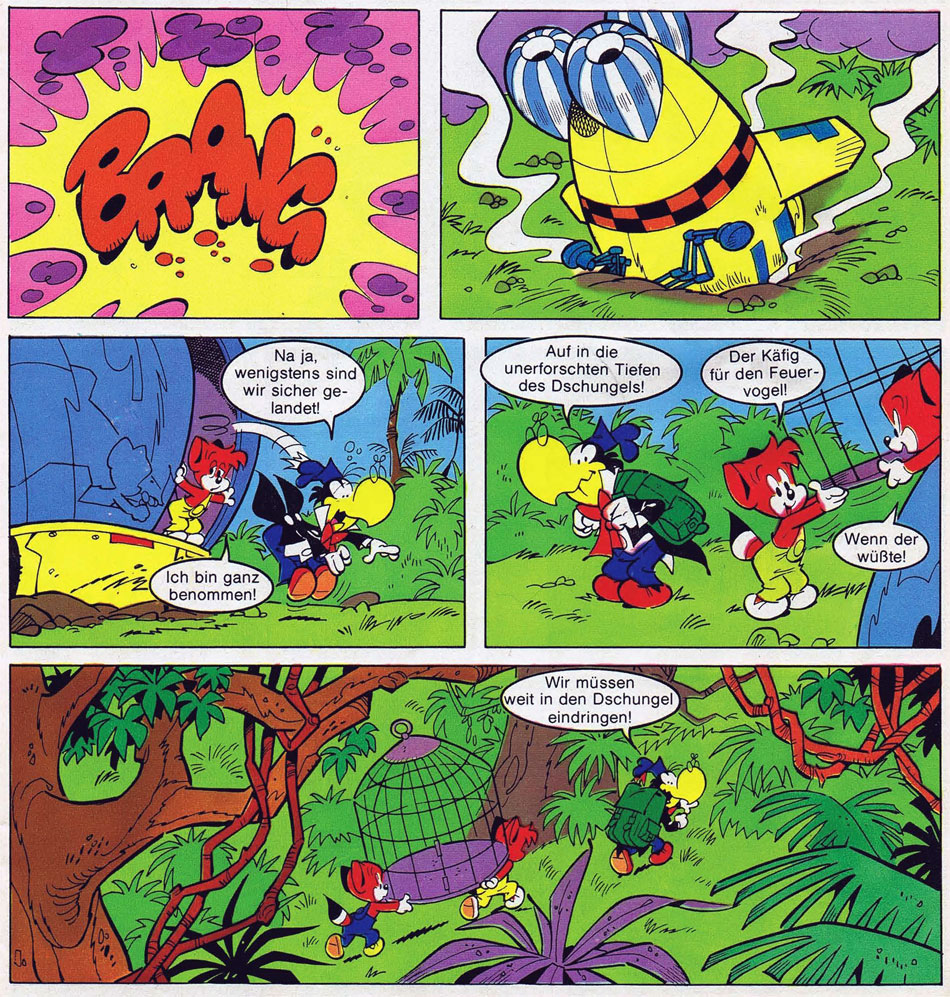
Fix und Foxi - 'Der Feuervogel' (Fix und Foxi #3, 1984).
Kauka comics
Through Giolitti, Massimo Fecchi also began his enduring association with the comic book creations of the German publisher Rolf Kauka, starting with a first 'Fix und Foxi' story in 1972. His first regular job for Kauka was drawing about a dozen stories with 'Die 7 Schnuckel' (1973-1974) for Pepito magazine, a comic feature about seven gnomes living in the attic of the Fröhlich guesthouse. Prior to Fecchi, other Giolitti artists like Rodolfo Valcarenghi and Francesco Valeriani had already drawn the characters. When Pepito folded in 1974, Fecchi switched to the Kauka flagship title, Fix und Foxi. In addition to longer stories with the two eponymous little foxes, in 1978 Fecchi also began drawing and plotting the mostly pantomime backcover gags with the goofy wolf 'Lupo', which he did for about fifteen years. A regular inker of his pencil artist during those days was Rodolfo Valcarenghi.
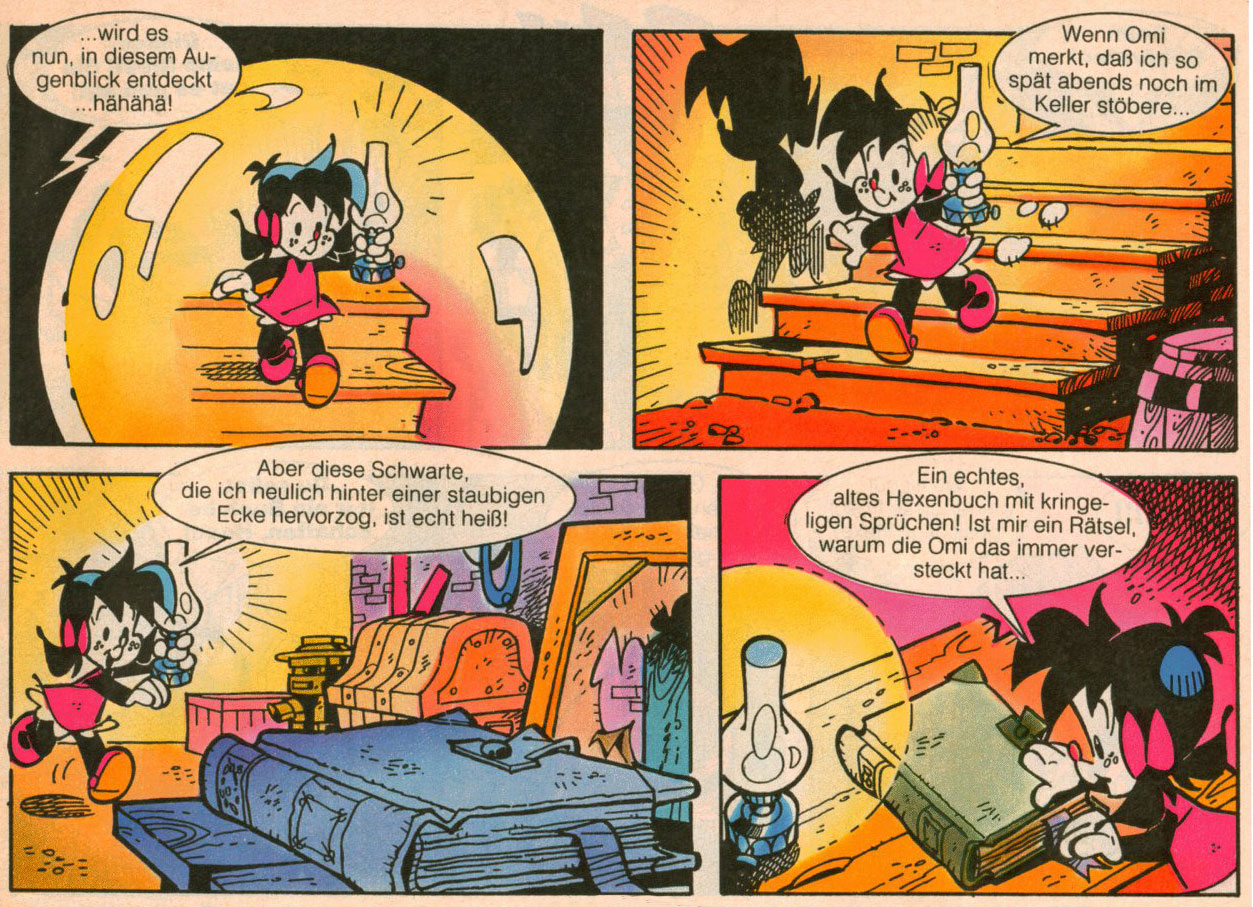
Fix und Foxi - 'Das geheimnisvolle Hexenbuch' (Fix und Foxi #13, 1992).
Initially, Fecchi drew the adventures of 'Fix und Foxi' in the original house style developed by Walter Neugebauer, and then switched to the more angular approach of Helmut Murek. Later, he began working for the Munich-based publisher more directly, and was encouraged by art director Vjekoslav Kostanjšek to give the characters his own spin. Starting in 1975, this resulted in the more dynamic designs that quickly became the company standard. It is generally assumed that Massimo Fecchi was officially assigned to give the characters a new look. In interviews, the artist remarked that the publisher basically had the other Spanish artists simply copy the Fecchi style. Even though he protested, there were even modelsheets made based on his designs. It wasn't until 1984 before Fecchi was officially appointed the chief illustrator of the magazine, by then published by Pabel Verlag. His tenure on 'Fix und Foxi' lasted for over twenty years, only coming to an end when the title was cancelled in 1994.
When in the 21st century Fix und Foxi was relaunched by Tigerpress Verlag in Hamburg (2006-2009), Massimo Fecchi was again approached to draw the characters. However, the publisher had a limited budget, resulting in Fecchi only doing layouts for two stories, scripted by Jürgen Seitz. The finished art was provided by Giuseppe De Facendis.

'Turnier der Tricks' (Knax #4, 1986).
Other German comics
In addition to his work for the Kauka magazines, Massimo Fecchi has worked on several other projects for the German market, often in collaboration with editor/scriptwriter Manfred Klinke. For instance, they developed the retro-futuristic space aliens 'Die Sniks' for the German figurine manufacturer Bullyland (1975). In 1978-1979, these characters also appeared in comic stories, made by the German illustrator Jürgen Alexander Heß for the children's page of Hörzu magazine. In 1982, Fecchi and Klinke also developed the characters 'Die Miesel'.
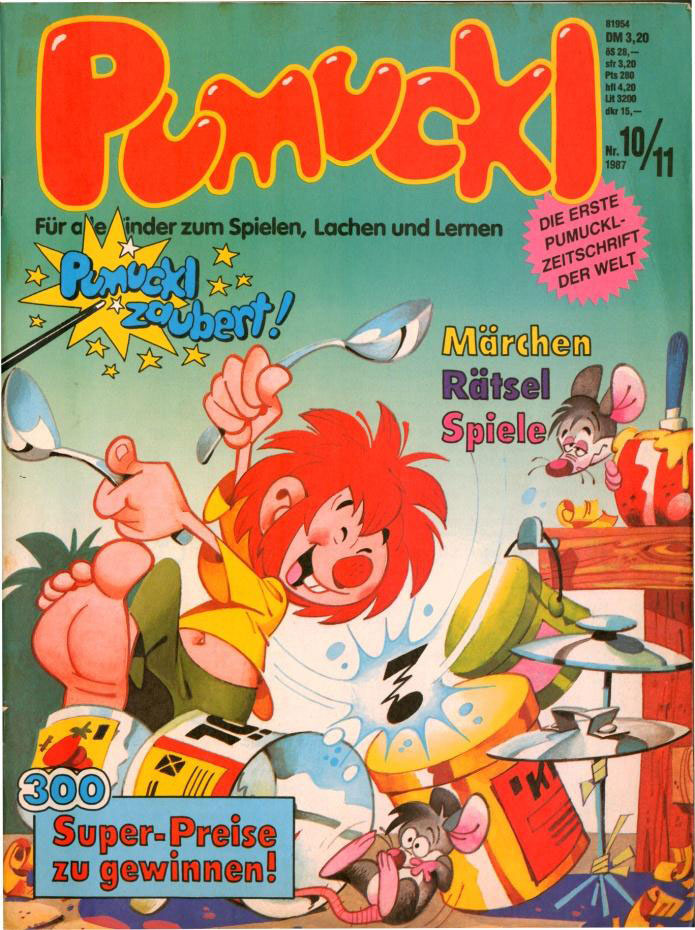
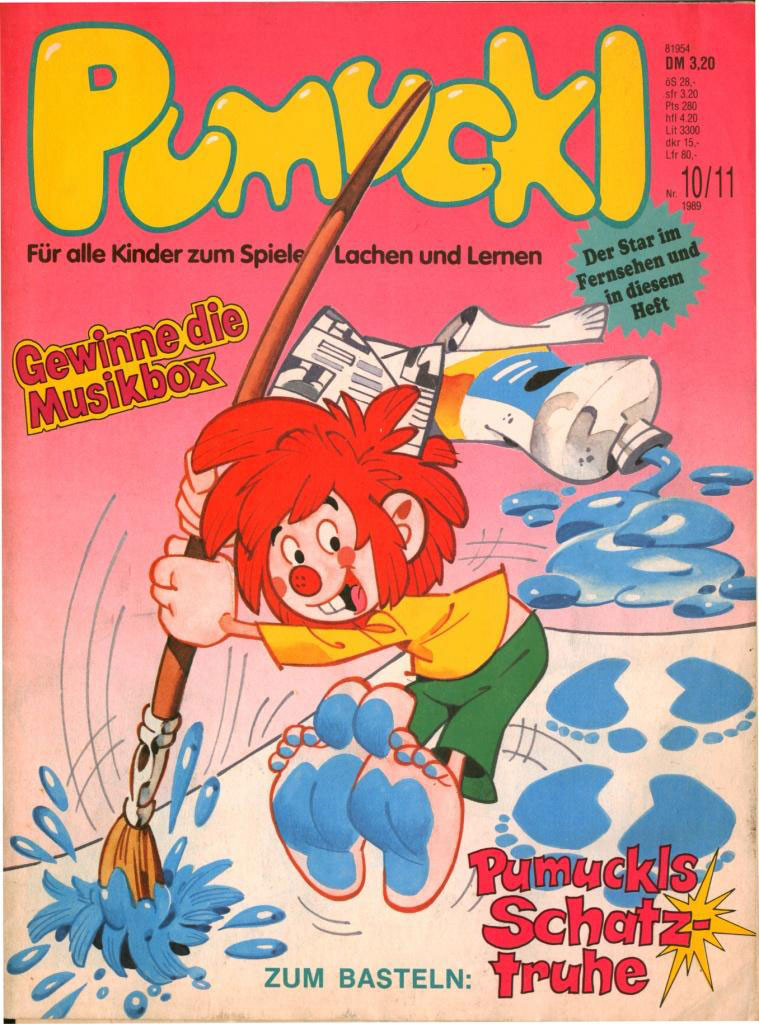
'Pumuckl'.
Between 1985 and 1989, Massimo Fecchi was an artist for Knax, the bimonthly magazine of the German savings banks. In the period 1984-1991, Fecchi was additionally an illustrator for Pumuckl magazine, starring the mischievous kobold from the children's books by Ellis Kaut and the TV series 'Meister Eder und sein Pumuckl'. Published by Merlin Verlag Glarus, the magazine was edited by the daughter of Rolf Kauka, Mascha Pohl-Kauka. Another contributor to the magazine was fellow Kauka artist Florian Julino. For the same German savings bank, the Sparkasse, Fecchi and Klinke additionally created a story of 40-50 pages for a dummy issue of another comic, 'Die Miesel' (1986), although it is unknown if the title ever saw the light.
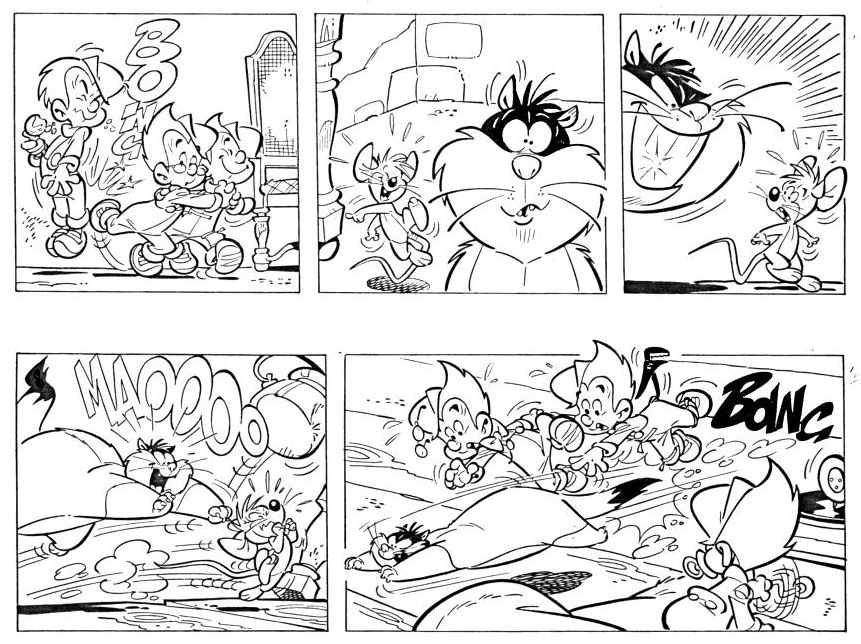
Line work for 'Die Miesel'.
After the disappearance of Fix und Foxi in 1994, Fecchi started working on his own comic book parody of 'Odysseus' for the German publisher Pabel-Moewig (1996-1997). Written and penciled by Fecchi, the artist was aided for the inking by Luca Magi and Rodolfo Valcarenghi. Even though four full-length adventures were created, only three were published, as the series failed to find an audience. During the early 1990s, for the German TV guide Fernsehwoche, Fecchi drew the comic features 'Mein Lieber Mann' and 'Der Inspector Kurz'.

'Odysseus'
Character design and illustration
During the 1990s, Fecchi expanded his German collaborations in the animation industry, doing character designs for Gerhard Hahn's Hahn-Film in Berlin ('Renada', 'Bibi Blocksberg') und Jürgen Egenolf's Cologne Cartoon in Köln ('Albert sagt...'). In addition, Massimo Fecchi has also worked on comics based on the 1997-1999 animated children's TV series 'Renaade'.
In his home country, he additionally worked as an illustrator for the evangelistic publishing house Edizioni Paoline and its division Editrice San Paolo (1997-2000), contributing to their educational books and the magazine Il Millimetro.

Donald Duck - 'The Talisman' (story D2001-113, Greek publication). © Disney
Disney comics
During the early post-Kauka period, Massimo Fecchi also applied for work with Disney Italia, but to no avail. In 1997, however, he was welcomed by the Danish Disney licensee Egmont to draw 'Donald Duck' comic stories for their 'Anders And Jumbobog' series. While these pocket books are compiled from mostly Italian Disney stories, Egmont has added self-produced opening stories, created by their own writers and artists. To match them with the Italian material, these pocket stories had to be created in the more expressive Italian style, instead of the traditional Carl Barks style of the magazine stories. So instead of working for the Italian publisher directly, Fecchi began drawing stories the Italian way for the Danish publisher! Other artists working in this style for Egmont were Pasquale Venanzio, Flemming Andersen and Antoni Bancells Pujadas.
Since the late 1990s, Fecchi has drawn a great many lengthy adventure stories with Donald Duck and his family, scripted by Egmont stalwarts like Pat & Carol McGreal, Gorm Transgaard and Mark & Laura Shaw. He was often assigned to sports-related stories, especially the ones related to important soccer championships. In 2004, he notably drew the story 'Powerplay On Killmotor Hill', a story scripted by Geoffrey Blum based on an unused plot by Carl Barks. Coincidentally, this was also the first Fecchi Disney story to be printed in translation in his home country Italy.
During the 2010s, Massimo Fecchi's production for the Danish pocket books gradually slowed down, but instead he began working more regularly for the Danish production of magazine-format stories. However, these haven't starred Donald or his family, but were adventure stories with Mickey Mouse and Goofy. It wasn't until the period 2018-2023 before he was actually drawing 'Donald Duck' directly for the Italian Topolino magazine, published by Panini Comics.
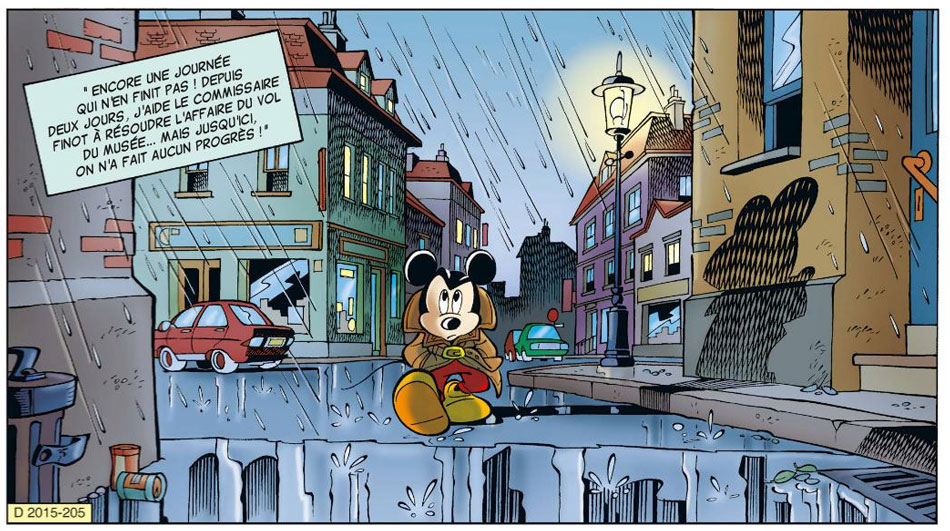
Mickey Mouse - 'The Girl at Café Noir' (story D2015-205, French publication). © Disney
Starting in 2018, Massimo Fecchi has also worked on stories for the Dutch Disney magazines, published by Sanoma and later DPG Media. There, he has been assigned to draw back-up stories with 'Goofy', but also to one of his favorite characters, 'The Big Bad Wolf'. In 2002, he had drawn the Disney wolf for the first time for Egmont, in a one-time jubilee story written by David Gerstein. In the Netherlands, however, the adventures of the Big Bad Wolf, his goody-two-shoes son Li'l Wolf and the Three Little Pigs are a weekly presence, allowing for a steady story production. In addition to regular stories with the characters, Fecchi has been assigned to spin-off series, for which he graphically designed most of the secondary characters. Since 2021, he has been the regular artist of the 'Forest school' sub series, starring Li'l Wolf and his naughty cousin Izzy at school, mostly written by Gerard Leever and Mathys van der Harst. In that same year, he also drew the debut story of the 'Little Zeke' feature, about the Bad Wolf's younger years. Written by Alex van Koten, the regular artist for this series became Daniel Pérez of Studio Comicup.
Between 2016 and 2020, Fecchi additionally created covers for the Disney comic books published by IDW in the USA. In 2018, he was among fifty other participating artists in the collective book 'Mickey All Stars', published in France by Glènat and in Italy by Panini.
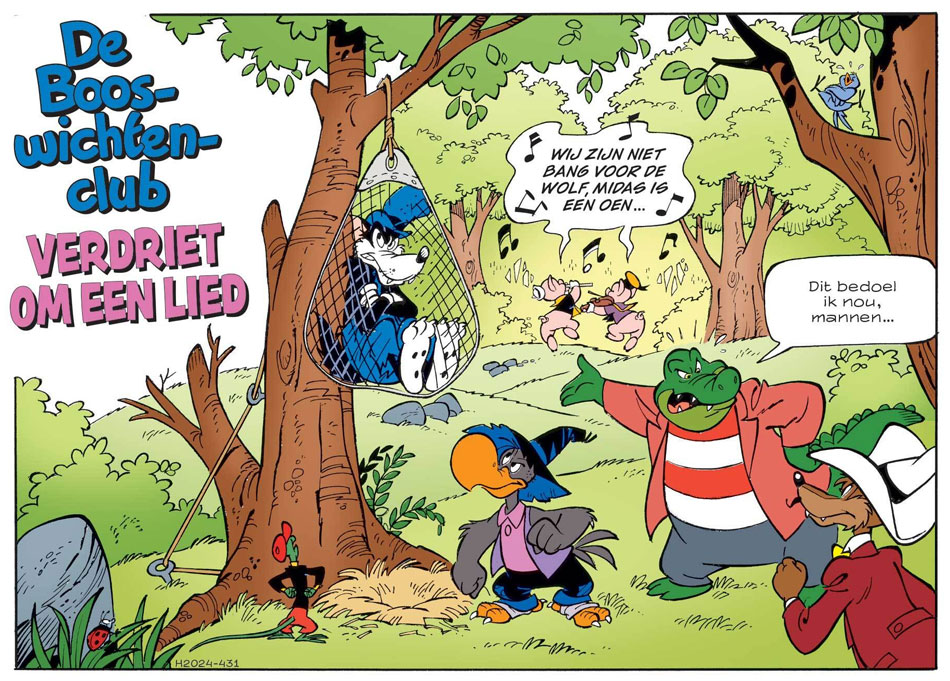
Big Bad Wolf/Foul Fellows' Club (story H2024-431). © Disney
Fecchi Studio
Especially during the 1980s and 1990s, Massimo Fecchi had an impressive production. As the main artist of Kauka's 'Fix und Foxi', and later as one of Egmont's popular Disney artists, he produced about a page a day. While he has been doing all the pencil artwork himself, for both characters and backgrounds, he has recruited help for the inking duties. Since 1980, several inkers have worked for the Rome-based "Studio Fecchi", including Rodolfo Valcarenghi and his son Marco Valcarenghi, joined in the 1990s by Luca Magi.
Following a modest start in his native comic scene in Italy, Massimo Fecchi became one of the most recognizable and sought-after artists for studio-based commercial comic productions in Europe. Especially on the German market, he has left his mark for his defining work on 'Fix und Foxi', along with several other children's titles. Just like Marco Rota and Carlo Gentina, he is one of the few Italian artists who have done most of their Disney work for publishers outside of their home country.
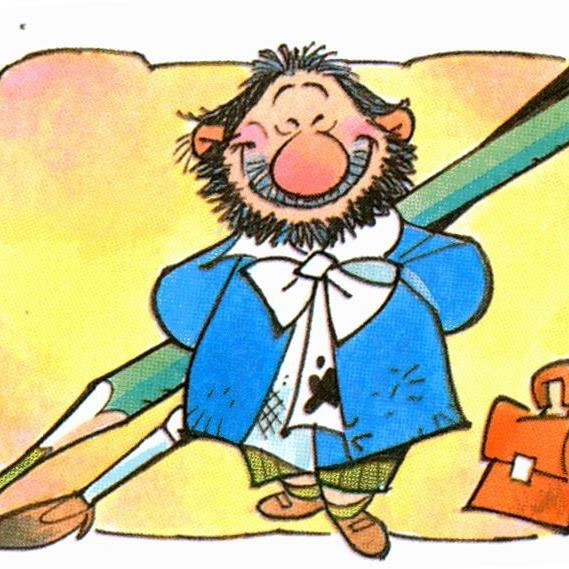
Self-portrait.